
How To Choose An Oscilloscope: Complete Buying Guide for Accurate Signal Testing & Professional Electronics Analysis
An oscilloscope is one of the most important tools in electronics testing, circuit analysis, and signal troubleshooting. Whether you are an engineering student, electronics hobbyist, repair technician, or professional design engineer, selecting the right oscilloscope can improve accuracy, speed, and overall testing performance. Many buyers get confused because modern oscilloscopes come with different specifications, bandwidth options, sample rates, channels, and advanced features.
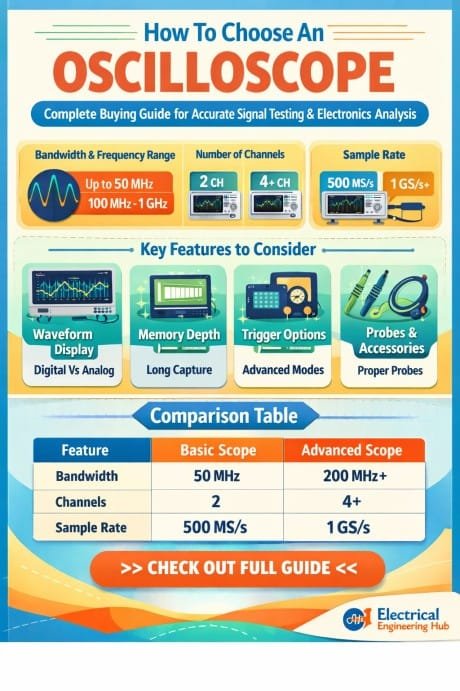
Table of Contents
Understanding how to choose an oscilloscope helps you avoid overspending while ensuring reliable signal measurements for your projects. From debugging embedded systems to analyzing power electronics and communication signals, the right device can make diagnostics easier and more precise.
Know more about cathode ray oscilloscope
Why an Oscilloscope Is Important
An oscilloscope displays electrical signals as waveforms, allowing users to observe voltage changes over time. Unlike a multimeter, which only shows numerical readings, an oscilloscope helps you visualize signal behavior in real time.
It is commonly used for:
- Electronic circuit testing
- Signal troubleshooting
- PCB debugging
- Frequency analysis
- Automotive diagnostics
- Communication system testing
- Power supply inspection
- Embedded system development
Modern digital oscilloscopes also provide waveform storage, automated measurements, FFT analysis, and protocol decoding for advanced applications.
Understanding Oscilloscope Types
Before deciding how to choose an oscilloscope, it is important to understand the main types available in the market.
| Oscilloscope Type | Best For | Key Advantage |
|---|---|---|
| Digital Storage Oscilloscope (DSO) | General electronics testing | Stores and analyzes signals |
| Mixed Signal Oscilloscope (MSO) | Embedded systems | Combines analog and digital channels |
| Digital Phosphor Oscilloscope (DPO) | Advanced signal analysis | Better waveform visualization |
| Handheld Oscilloscope | Fieldwork and maintenance | Portable and battery powered |
| PC-Based Oscilloscope | Budget users | Uses computer interface |
For most users, a digital storage oscilloscope offers the best balance of features, affordability, and performance.
Know more about AC Hipot Test Acceptable Leakage Current
Bandwidth: The Most Important Specification
Bandwidth is one of the first things to check when learning how to choose an oscilloscope. It determines the highest frequency signal the oscilloscope can accurately measure.
A common recommendation is to select an oscilloscope with at least five times the bandwidth of the highest signal frequency you plan to test.
Example
| Signal Frequency | Recommended Oscilloscope Bandwidth |
|---|---|
| 20 MHz | 100 MHz |
| 50 MHz | 250 MHz |
| 100 MHz | 500 MHz |
Choosing insufficient bandwidth can distort waveforms and reduce measurement accuracy.
For basic electronics projects, a 50 MHz to 100 MHz oscilloscope is usually enough. Professional electronics design and RF applications may require 500 MHz or higher.
Sample Rate and Why It Matters
Sample rate refers to how many times per second the oscilloscope captures signal data. It is measured in samples per second (Sa/s).
A higher sample rate ensures better waveform accuracy and detail. If the sample rate is too low, signals may appear distorted or incomplete.
Know more about Top 20 Electrical Testing Tools Which You Must Have
For reliable measurements:
- Sample rate should be at least 5 times the signal frequency
- Higher rates improve transient signal capture
- Real-time sampling is better for fast digital signals
Most modern digital oscilloscopes provide sample rates ranging from 1 GSa/s to 10 GSa/s.
Number of Channels
Channels determine how many signals you can analyze simultaneously.
| Channels | Suitable Applications |
|---|---|
| 2 Channels | Basic electronics and hobby work |
| 4 Channels | Professional debugging and circuit analysis |
| 8+ Channels | Complex industrial systems |
A two-channel oscilloscope is sufficient for beginners. Engineers working on embedded systems or multi-signal circuits should consider four-channel models.
Know more about Best Megger Testers for Industrial Use
Memory Depth and Signal Capture
Memory depth defines how much waveform data an oscilloscope can store during acquisition.
Deeper memory helps capture long-duration signals while maintaining high resolution. This becomes important when analyzing glitches, intermittent faults, or communication protocols.
If you work with serial buses, automotive electronics, or industrial automation systems, choosing deeper memory can significantly improve troubleshooting efficiency.
Display Quality and User Interface
A clear display improves waveform interpretation and testing accuracy. Modern oscilloscopes include high-resolution color screens with touch functionality.
When comparing models, consider:
- Screen size
- Display resolution
- Brightness
- Touchscreen support
- Waveform refresh rate
A faster waveform refresh rate helps detect random signal abnormalities more effectively.
Explore all about How to Test a 3 Phase Motor With a Megger
Triggering Features
Triggering stabilizes repetitive waveforms and captures specific signal events.
Basic trigger modes include:
- Edge trigger
- Pulse trigger
- Video trigger
- Logic trigger
Advanced triggering becomes important in digital electronics, communication systems, and embedded debugging.
Choosing strong triggering functionality is essential when deciding how to choose an oscilloscope for professional applications.
Built-In Measurement and Analysis Tools
Modern oscilloscopes include automated analysis tools that save time and improve productivity.
Useful features include:
- FFT spectrum analysis
- Protocol decoding
- Automatic voltage measurements
- Rise time analysis
- Duty cycle calculation
- Cursor measurements
- Data logging
These functions reduce manual calculations and improve testing precision.
Know more about Difference Between VLF and Megger
Probe Quality and Compatibility
Oscilloscope probes directly affect signal accuracy. Even a high-end oscilloscope can provide poor results with low-quality probes.
Common probe types include:
| Probe Type | Application |
|---|---|
| Passive Probe | General signal testing |
| Active Probe | High-speed circuits |
| Current Probe | Current measurements |
| Differential Probe | Floating signal analysis |
Always ensure the probe bandwidth matches or exceeds the oscilloscope bandwidth.
Portable vs Benchtop Oscilloscope
Portable handheld oscilloscopes are useful for on-site maintenance, automotive testing, and industrial inspections. Benchtop models provide larger displays, better accuracy, and more advanced features.
| Feature | Portable Oscilloscope | Benchtop Oscilloscope |
|---|---|---|
| Mobility | High | Low |
| Display Size | Smaller | Larger |
| Battery Operation | Yes | Usually No |
| Advanced Features | Limited | Extensive |
Professional laboratories and repair centers usually prefer benchtop oscilloscopes.
Find more about Best Megger Insulation Tester for Industrial Motors
Connectivity and Data Transfer
Modern oscilloscopes support multiple connectivity options for data storage and remote analysis.
Important connectivity features include:
- USB ports
- LAN connectivity
- HDMI output
- Wi-Fi support
- PC software integration
These features simplify waveform sharing, documentation, and remote diagnostics.
Budget Considerations
Oscilloscope pricing varies widely depending on specifications and brand reputation.
| User Level | Recommended Budget |
|---|---|
| Beginner | $150 – $400 |
| Intermediate | $400 – $1000 |
| Professional Engineer | $1000 – $5000+ |
Popular oscilloscope brands include Keysight, Tektronix, Rigol, Siglent, and Rohde & Schwarz.
For beginners, Rigol and Siglent provide excellent value with modern features at competitive prices.
Common Mistakes to Avoid
Many buyers focus only on price and ignore technical requirements. Avoid these common mistakes:
- Choosing insufficient bandwidth
- Ignoring sample rate
- Buying too few channels
- Overlooking memory depth
- Using poor-quality probes
- Ignoring future upgrade needs
Know more about Insulation Resistance Testing: Step-by-Step Process
Selecting the right oscilloscope requires balancing performance, features, and long-term usability.
Final Thoughts
Understanding how to choose an oscilloscope is essential for accurate signal testing and reliable electronics analysis. The ideal oscilloscope depends on your application, frequency range, testing environment, and future project requirements.
For basic electronics work, a 100 MHz digital storage oscilloscope with two channels is usually enough. Engineers handling advanced embedded systems, RF circuits, or industrial automation should invest in higher bandwidth, deeper memory, and advanced triggering capabilities.
A carefully selected oscilloscope improves troubleshooting accuracy, saves development time, and enhances overall testing efficiency. By evaluating bandwidth, sample rate, channels, memory depth, and analysis features, you can confidently choose an oscilloscope that meets both current and future technical needs.
Know more about Power Quality Analyzer Buying Guide
Get new guides in your feed. Follow Electrical Insights on LinkedIn for new electrical standards guides, calculators and design tips from Azad Circuit Hub.
#HowToChooseAnOscilloscope,#OscilloscopeGuide,#DigitalOscilloscope,#ElectronicsTesting,#SignalAnalysis,#EngineeringTools,#OscilloscopeBuyingGuide,#PortableOscilloscope,#LabEquipment,#ElectronicDiagnostics
