Top 25 Questions Regarding Usage Of Oscilloscope: Complete Professional Guide for Accurate Signal Analysis, Troubleshooting & Electronic Testing Mastery
Oscilloscopes are one of the most important tools in electronics testing, used for visualizing electrical signals, diagnosing circuit faults, and ensuring signal integrity in both analog and digital systems. Engineers, technicians, and students rely on them to measure waveform behavior, frequency response, and voltage variations in real time. In professional electronics work, understanding the Questions Regarding Usage Of Oscilloscope is essential because it directly impacts troubleshooting accuracy and measurement reliability.
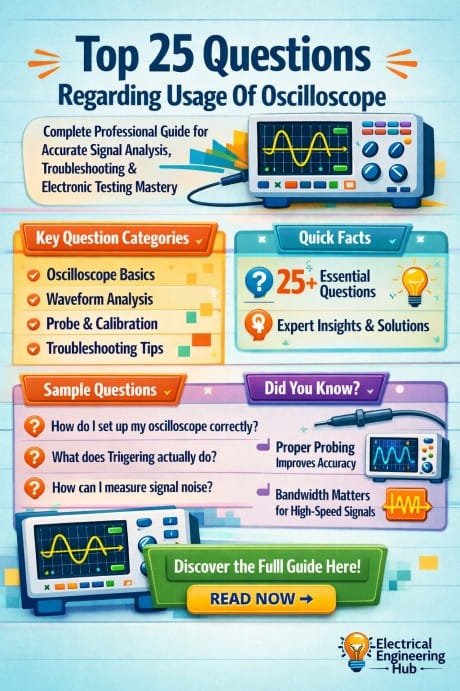
Table of Contents
From selecting probe types to interpreting waveforms, every detail matters when working with sensitive circuits. This guide explores common doubts, practical insights, and technical clarity to help improve confidence in real-world applications.
Understanding Oscilloscope Basics
The Questions Regarding Usage Of Oscilloscope often begin with fundamental concepts such as bandwidth, sampling rate, and probe calibration. An oscilloscope displays voltage signals over time, allowing users to observe waveform shape, amplitude, and frequency behavior. Modern digital storage oscilloscopes (DSOs) also enable signal capture and analysis for deeper diagnostics.
Know more about How To Choose An Oscilloscope
Key components include vertical scaling, horizontal time base, trigger settings, and input channels. Proper understanding of these elements ensures accurate waveform interpretation and prevents measurement errors during electronic testing and circuit debugging.
Top 25 Oscilloscope Usage Questions and Answers
The Questions Regarding Usage Of Oscilloscope can be organized into practical queries that technicians frequently encounter during lab work, repair tasks, and field diagnostics.
Table: 25 Common Questions and Quick Answers
| No. | Question | Short Answer |
|---|---|---|
| 1 | What is an oscilloscope used for? | Signal visualization |
| 2 | How to measure frequency? | Using time period |
| 3 | What is bandwidth? | Signal frequency limit |
| 4 | How to connect probes? | Ground + signal tip |
| 5 | What is triggering? | Stable waveform capture |
| 6 | Why waveform is unstable? | Improper trigger |
| 7 | What is probe attenuation? | Signal scaling ratio |
| 8 | Difference between analog and digital scope? | Display method |
| 9 | How to measure voltage? | Vertical scaling |
| 10 | What is sampling rate? | Data capture speed |
| 11 | Why calibration is needed? | Accuracy assurance |
| 12 | What is DC coupling? | Full signal view |
| 13 | What is AC coupling? | Removes DC offset |
| 14 | How to avoid noise? | Proper grounding |
| 15 | What is rise time? | Signal transition speed |
| 16 | What is time base? | Horizontal scale |
| 17 | What is persistence mode? | Signal history view |
| 18 | Why use 10x probe? | Reduced loading |
| 19 | What is aliasing? | Sampling distortion |
| 20 | How to store waveforms? | Save function |
| 21 | What is FFT mode? | Frequency analysis |
| 22 | How to measure delay? | Cursor tools |
| 23 | What is overshoot? | Signal spike |
| 24 | Why signal clipping occurs? | Input overload |
| 25 | How to improve accuracy? | Proper setup |
The Questions Regarding Usage Of Oscilloscope are not only theoretical but directly linked to practical troubleshooting in electronics labs. Each of these questions reflects a real challenge faced during circuit analysis, PCB debugging, and power electronics testing.
Know more about cathode ray oscilloscope
Signal Measurement and Interpretation Techniques
Accurate measurement depends on correct probe handling, grounding techniques, and proper scaling settings. Many beginners struggle with waveform distortion due to incorrect attenuation or poor grounding practices. Engineers often emphasize using short ground leads to minimize inductive noise and ensure clean signal capture.
Another important factor is understanding waveform shape interpretation. Square waves, sine waves, and pulse signals each indicate different circuit behaviors. For instance, distorted square waves may indicate bandwidth limitations or transmission line issues.
Troubleshooting Common Oscilloscope Issues
The Questions Regarding Usage Of Oscilloscope frequently highlight troubleshooting concerns such as unstable signals, incorrect amplitude readings, and noise interference. These issues often arise due to improper calibration or incorrect probe selection.
Findt all about AC Hipot Test Procedure for Cables
Common troubleshooting methods include adjusting trigger levels, switching coupling modes, and verifying probe compensation. In power electronics testing, improper grounding can also introduce unwanted ripple effects that distort readings. Ensuring correct setup significantly improves diagnostic accuracy.
Measurement Accuracy and Best Practices
Accuracy is one of the most critical aspects when working with oscilloscopes. Even small errors in probe placement or scaling can lead to misleading results. Technicians are advised to regularly calibrate probes and verify reference signals before performing measurements.
Another key practice is selecting the right bandwidth for the application. Using a low-bandwidth oscilloscope for high-frequency signals can result in incomplete waveform representation. Similarly, incorrect sampling rates may introduce aliasing errors, leading to false interpretations.
Know more about Top 20 Electrical Testing Tools Which You Must Have
Advanced Oscilloscope Features for Professionals
Modern oscilloscopes offer advanced functions such as FFT analysis, protocol decoding, and deep memory storage. These features help engineers analyze complex signals in communication systems, embedded electronics, and industrial control systems.
Understanding these advanced tools is part of mastering the Questions Regarding Usage Of Oscilloscope because they extend beyond basic waveform viewing. They allow deeper insight into frequency components, noise patterns, and signal timing relationships, which are essential for high-level diagnostics.
Find all about Top 15 Partial Discharge Tester Suppliers in United States
Practical Usage Tips for Better Results
Efficient oscilloscope usage depends on consistent practice and attention to setup details. Always verify probe compensation before measurement, and ensure the oscilloscope is properly grounded. Use appropriate time base settings to avoid compressed or stretched waveforms.
In addition, avoid long probe leads in high-frequency circuits as they introduce parasitic inductance. Keeping signal paths short and clean improves measurement stability and reduces errors during analysis.
Conclusion
Mastering oscilloscope operation requires more than just understanding controls; it demands practical experience with real-world signals and troubleshooting scenarios. The Questions Regarding Usage Of Oscilloscope provide a structured way to explore common challenges and refine measurement skills.
Know more about VLF Testing vs Hipot
Whether working in electronics repair, R&D, or academic labs, accurate signal interpretation plays a key role in ensuring system reliability and performance. With proper techniques, correct setup, and consistent practice, users can achieve professional-level precision in electronic testing and diagnostics.
Get new guides in your feed. Follow Electrical Insights on LinkedIn for new electrical standards guides, calculators and design tips from Azad Circuit Hub.
#Oscilloscope #Electronics #SignalAnalysis #Waveform #ElectronicTesting #EngineeringTools #ElectricalEngineering #LabEquipment #DigitalOscilloscope #CircuitTesting
