ChargePoint Home Flex vs Wallbox Pulsar Plus: Best Guide
Choosing a smart Level 2 EV charger is not only about maximum amperage. The charger has to match your EV, electrical panel, installation method, charging habits, and smart-home requirements. In this chargepoint home flex vs wallbox pulsar plus comparison, I will look at the two chargers from a practical electrical engineering perspective.
I have an electrical engineering background with more than 15 years of field experience in electrical panels, industrial automation, PLCs, SCADA systems, and power equipment. When I assess an EV charger, I pay close attention to continuous load, circuit sizing, charging current, connector compatibility, and how the charger will work in a real home.
ChargePoint Home Flex vs Wallbox Pulsar Plus at a Glance
| Feature | ChargePoint Home Flex | Wallbox Pulsar Plus |
|---|---|---|
| Charger type | Level 2 AC | Level 2 AC |
| Maximum output | Up to 50A | Up to 48A |
| Maximum power | Up to 12 kW | Up to 11.5 kW |
| Connector | J1772 | J1772 |
| Installation | Plug-in or hardwired, depending on configuration | Hardwired / plug-in configurations vary |
| Wi-Fi | Yes | Yes |
| Mobile app | ChargePoint app | Wallbox app |
| Outdoor use | Yes, with appropriate installation | Yes |
| Smart charging | Yes | Yes |
| Best suited for | Connected home charging | Compact smart charging |
The actual charging rate also depends on your vehicle's onboard AC charger. A charger capable of more current will not make an EV charge faster than the vehicle allows.
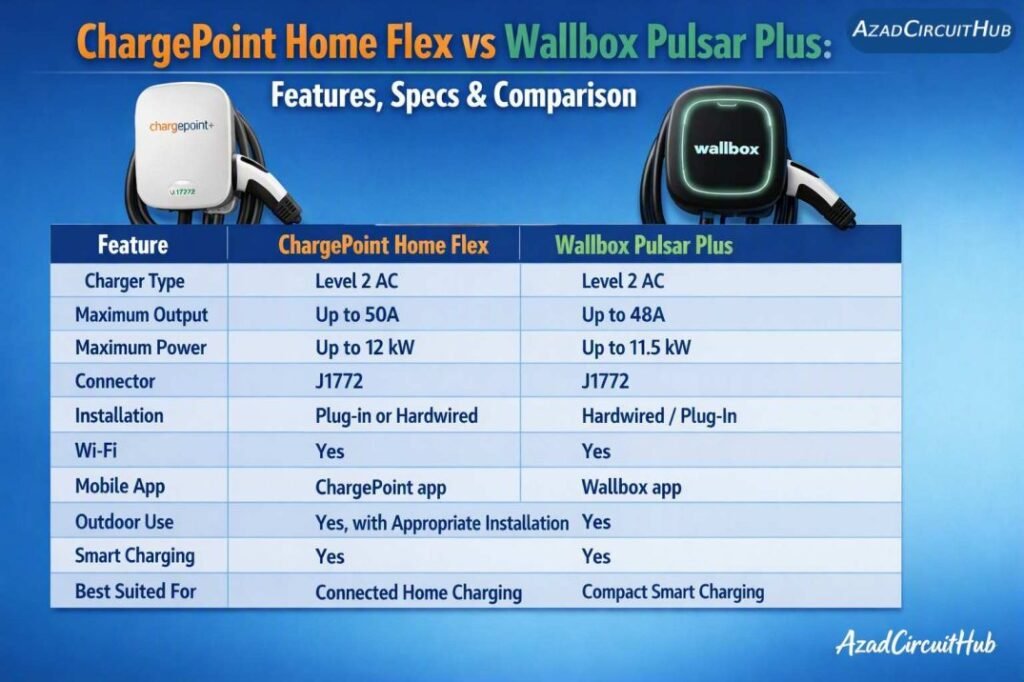
Table of Contents
Table of Contents
ChargePoint Home Flex Overview
The ChargePoint Home Flex is one of the better-known smart residential EV charging stations. Its main attraction is flexibility. The charger can be configured for different current levels, allowing the installation to be matched to the home's electrical capacity.
At higher current settings, Home Flex can deliver substantially more power than a typical 32A Level 2 charger. However, the circuit must be designed for the selected charging current because EV charging is a continuous electrical load.
The ChargePoint mobile app also provides useful charging controls, scheduling, charging status, and energy information.
If you want the complete product breakdown before comparing it with Wallbox, see my ChargePoint Home Flex Review for installation, specifications, and practical charging considerations.
Wallbox Pulsar Plus Overview
The Wallbox Pulsar Plus takes a different approach. It has a compact enclosure and focuses heavily on smart charging and connected-home features.
The Pulsar Plus is available with output levels suitable for residential Level 2 charging, with some configurations reaching approximately 48A and 11.5 kW at 240V.
One of its biggest physical advantages is its relatively compact design. That can matter when the charger is installed beside a garage door, near a parking space, or on a narrow wall.
The Wallbox app provides charging management, scheduling, monitoring, and other connected functions.
For readers comparing additional Wallbox models, my Wallbox Pulsar Plus EV Charger Reviews hub covers the Pulsar Plus range and related buying considerations.
Charging Speed Comparison
Charging speed is one of the most important differences to examine, but maximum charger output should not be confused with actual vehicle charging speed.
| Charging Current | Approx. Power at 240V | Typical Application |
|---|---|---|
| 32A | 7.7 kW | Standard Level 2 home charging |
| 40A | 9.6 kW | Faster overnight charging |
| 48A | 11.5 kW | Higher-output home charging |
| 50A | 12.0 kW | High-current Level 2 charging |
For example, a 48A charger produces about 11.5 kW at 240V. If the vehicle's onboard charger accepts only 7.7 kW, the car will remain the limiting factor.
From an electrical installation standpoint, this is why I recommend checking the EV manufacturer's AC charging specification before buying the highest-current charger.
Installation and Electrical Requirements
Installation is where I would pay particular attention when comparing these chargers.
A high-current Level 2 EV charger can operate for several hours continuously. The branch circuit therefore needs appropriate overcurrent protection, conductors, connections, and equipment grounding.
For example, a charger operating at 48A is generally treated as a continuous 48A load. Under the common 125% continuous-load calculation used by NEC installations, that results in a 60A branch-circuit requirement, subject to the specific equipment instructions and applicable code.
The actual installation should always follow the manufacturer's instructions and local electrical requirements.
Plug-in installations also require a properly installed receptacle. A generic 14-50 outlet that was never intended for sustained high-current EV charging should not be treated as equivalent to a correctly designed EV charging circuit.
Smart Charging Features
Both chargers provide connected charging functions, but their software ecosystems are different.
ChargePoint has a large EV charging network and a mature charging application. Home Flex users can monitor charging, schedule sessions, and manage charging settings through the ChargePoint ecosystem.
Wallbox uses its own app and connected platform. Depending on the model and setup, users can monitor energy consumption, schedule charging, and control charging sessions.
For homeowners who already use one ecosystem, app familiarity can be a practical factor.
Size and Physical Design
The Wallbox Pulsar Plus is known for its compact form factor. This can make a difference in smaller garages where wall space is limited.
ChargePoint Home Flex has a more substantial design but remains suitable for typical residential garages and exterior installations when installed according to the manufacturer's requirements.
Cable management should also be considered. Look at where the vehicle's charging inlet is located and whether the cable can comfortably reach the parking position without creating a trip hazard.
ChargePoint Home Flex vs Wallbox Pulsar Plus: Which Has More Value?
Value depends on the installation rather than just the purchase price.
ChargePoint Home Flex can be attractive to drivers who want flexible current settings and access to the established ChargePoint software ecosystem. Wallbox Pulsar Plus can appeal to buyers who prioritize a compact smart charger and Wallbox's energy-management platform.
Before purchasing, compare:
- Maximum charging current
- Vehicle AC charging capacity
- Plug-in versus hardwired installation
- Electrical panel capacity
- Wi-Fi requirements
- App features
- Cable length
- Warranty
- Outdoor installation rating
- Current Amazon pricing
If you are comparing these two against other residential charging stations, my guide to the best level 2 ev charger provides a broader starting point.
Which Charger Should You Buy?
The choice in this chargepoint home flex vs wallbox pulsar plus comparison depends heavily on your vehicle and installation.
Home Flex makes sense for someone who wants adjustable charging current and a charger closely connected to the ChargePoint ecosystem. It can also be useful when electrical capacity needs to be managed carefully.
Pulsar Plus is particularly interesting if physical size and Wallbox's smart charging features are important to you.
I would not select either charger purely because one has a higher maximum amperage. If your EV accepts only 40A, moving to a 50A-capable charger does not automatically provide faster charging.
Check Current Amazon Pricing
For buyers ready to compare current availability, installation options, and customer feedback:
Check ChargePoint Home Flex on Amazon
Check Wallbox Pulsar Plus on Amazon
Prices and available configurations can change, so verify the exact amperage and connector configuration on the product page before ordering.
ChargePoint Home Flex vs Wallbox Pulsar Plus: Pros and Cons
| Charger | Main Advantages | Points to Check |
|---|---|---|
| ChargePoint Home Flex | Adjustable current, strong app ecosystem, high output | Larger physical design, installation requirements |
| Wallbox Pulsar Plus | Compact design, smart controls, high output | Confirm exact model and installation configuration |
Frequently Asked Questions
Is ChargePoint Home Flex better than Wallbox Pulsar Plus?
Both are smart Level 2 home chargers with different design and software features. The appropriate choice depends on your EV's charging capacity, electrical installation, desired smart features, and physical installation location.
Can ChargePoint Home Flex charge faster than Wallbox Pulsar Plus?
Maximum charging output depends on the specific configuration. Home Flex can support high-current charging, while Pulsar Plus configurations can reach up to approximately 48A. Actual charging speed is limited by the EV's onboard AC charger.
Does Wallbox Pulsar Plus work with Tesla?
The Pulsar Plus configuration with a J1772 connector can work with Tesla vehicles that support J1772 charging when the appropriate Tesla charging adapter is used. Confirm compatibility with your specific Tesla model and charging setup before purchasing.
What breaker do I need for a 48A EV charger?
A 48A continuous charging load commonly leads to a 60A branch-circuit calculation under NEC continuous-load rules. However, the final breaker, conductors, disconnecting means, and installation must follow the charger manufacturer's instructions and applicable local electrical code.
Is a smart EV charger worth buying?
Smart charging can be useful if you want scheduled charging, remote monitoring, energy tracking, or control through a mobile application. The value depends on how often you use those functions and whether your electricity rate or home energy system benefits from scheduled charging.
Final Buying Checklist
Before ordering either charger, check these five items:
- Confirm your EV's maximum AC charging rate.
- Check your electrical panel's available capacity.
- Select the correct breaker and wiring through a qualified installation.
- Confirm connector and cable requirements.
- Compare current Amazon pricing and warranty coverage.
For a homeowner who wants a connected Level 2 charging station, both the ChargePoint Home Flex and Wallbox Pulsar Plus offer useful features. The important part is matching the charger to the vehicle and electrical system rather than choosing solely from the maximum advertised amperage.
Get new guides in your feed. Follow Electrical Insights on LinkedIn for new electrical standards guides, calculators and design tips from Azad Circuit Hub.
#ChargePointHomeFlex, #WallboxPulsarPlus, #EVChargerComparison, #Level2EVCharger, #EVCharging, #HomeEVCharger, #SmartEVCharger, #ElectricVehicle, #EVChargingStation, #EVCharger