NEC Article for Demand Factors: Article 220 Tables Explained (2026)
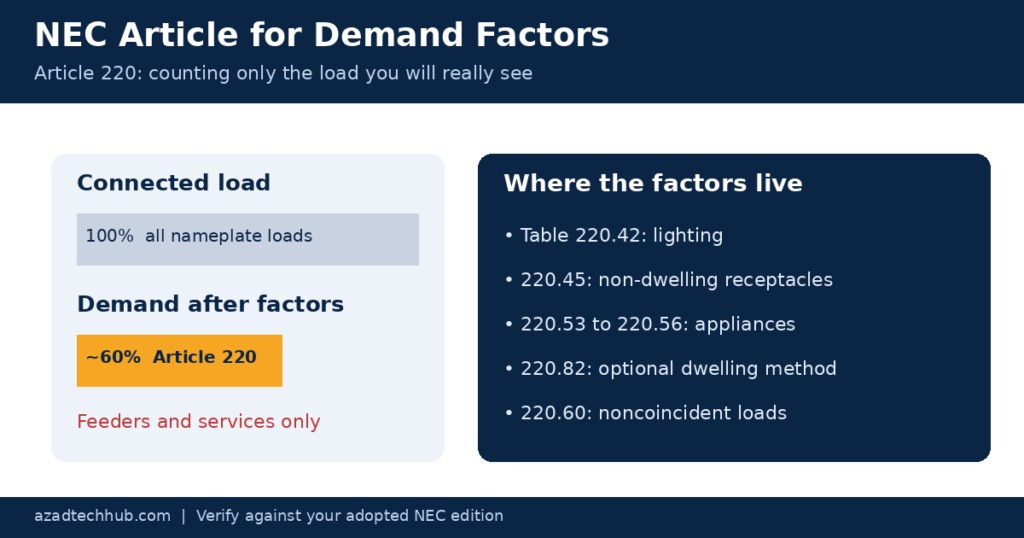
The NEC article for demand factors is Article 220, Branch-Circuit, Feeder, and Service Calculations. It is where the code tells you how much of the connected load you may count when sizing a feeder or service, using tables for lighting, receptacles, dryers, ranges and kitchen equipment.
This guide shows where each NEC demand factor lives, the numbers in the main tables, a worked dwelling example, and a free one-page PDF cheat sheet. If you want the engineering concept first, start with our demand factor and diversity factor guide.
Quick answer: NEC demand factors are in Article 220, Part III (standard method, 220.40 to 220.61) and Part IV (optional methods, such as 220.82 for dwellings). Table 220.42 covers lighting, a receptacle table covers non-dwelling outlets (220.45 in 2023, 220.44 earlier), and Tables 220.54, 220.55 and 220.56 cover dryers, ranges and commercial kitchens.
What Are the NEC Demand Factors?
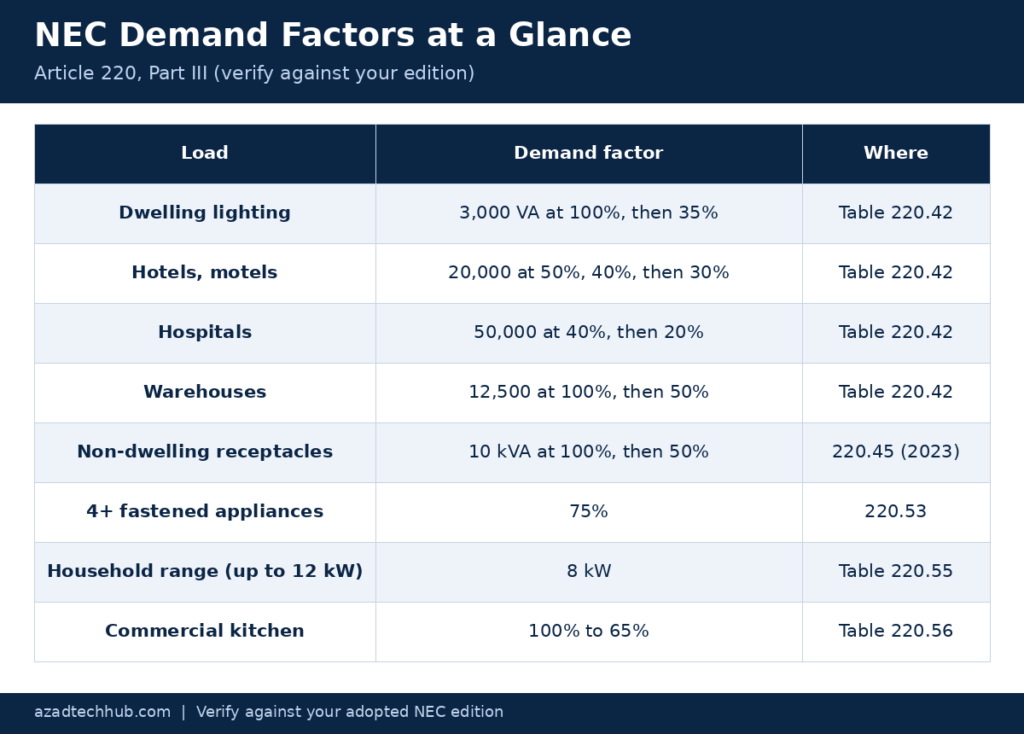
A demand factor is the percentage of a connected load you count when calculating a feeder or service. The NEC does not give one universal value. It gives specific factors for specific loads, and the NEC article for demand factors applies them only to feeders and services, never to individual branch circuits. These are the main ones:
| Load | Demand factor | Where |
|---|---|---|
| Dwelling general lighting | First 3,000 VA at 100%, 3,001 to 120,000 VA at 35%, over 120,000 VA at 25% | Table 220.42 |
| Hotels and motels | First 20,000 VA at 50%, next 80,000 VA at 40%, remainder at 30% | Table 220.42 |
| Hospitals | First 50,000 VA at 40%, remainder at 20% | Table 220.42 |
| Warehouses | First 12,500 VA at 100%, remainder at 50% | Table 220.42 |
| Non-dwelling receptacles | First 10 kVA at 100%, remainder at 50% | 220.45 (220.44 before 2023) |
| Four or more fastened appliances (dwelling) | 75% | 220.53 |
| Electric dryers (dwelling) | 100% for 1 to 4, then falling | 220.54 |
| Household ranges | One range up to 12 kW counts as 8 kW | Table 220.55 |
| Commercial kitchen equipment | 100% for 1 to 2 units, down to 65% for 6 or more | Table 220.56 |
The NEC Article for Demand Factors: Article 220 NEC 2023 and Its Parts
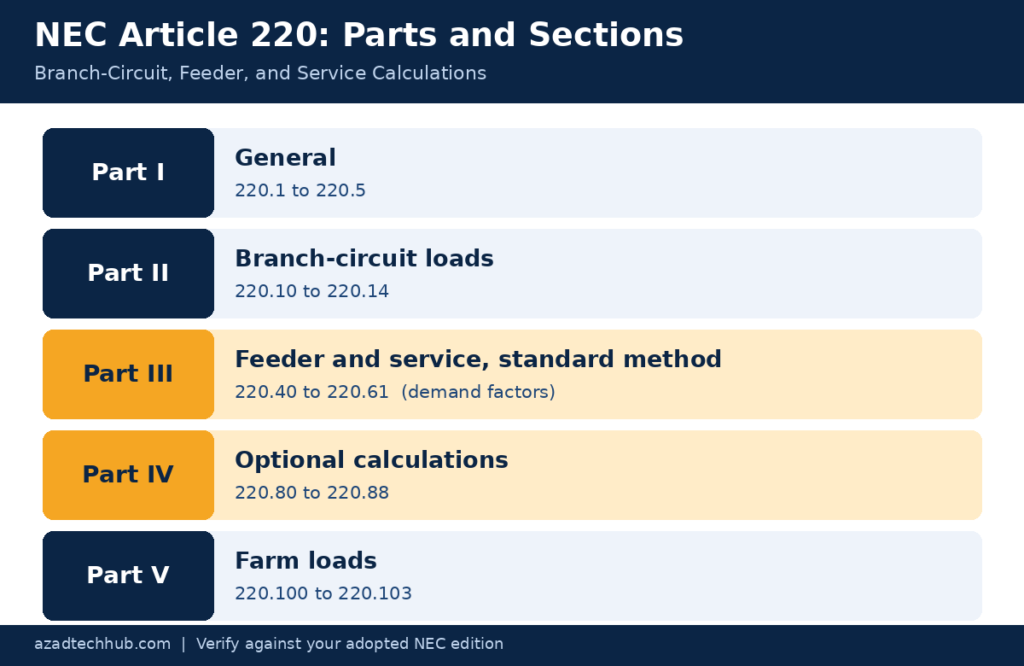
What is Article 220 in the NEC? It is the load calculation article, split into parts:
- Part I, General (220.1 to 220.5): scope and general rules.
- Part II, Branch-circuit load calculations (220.10 to 220.14): unit loads such as 3 VA per square foot for dwelling lighting.
- Part III, Feeder and service load calculations (220.40 to 220.61): the standard method with the demand factors above.
- Part IV, Optional calculations (220.80 to 220.88): dwelling, multifamily, school and restaurant methods.
- Part V, Farm load calculations: farm buildings and dwellings.
The 2023 edition keeps this structure, but section numbers moved in some places, so confirm against the edition your jurisdiction uses. Read the code free on NFPA’s free access page.
NEC Table 220.42: Lighting Demand Factors
Table 220.42 is the one people ask for as a PDF, and it is the first table in the NEC article for demand factors that most calculations use. It reduces general lighting load by occupancy. For a dwelling the first 3,000 VA counts fully and the rest counts at 35%, which is why large houses do not need a service sized to the full lighting load. For “all others”, such as offices and stores, the lighting counts at 100%. Verify the exact table in your edition, because it is labeled differently in some 2023 summaries.
What Does NEC Section 220.45 Cover?
Within the NEC article for demand factors, 220.45 in the 2023 edition covers receptacle loads for non-dwelling units. Outlets are counted at 180 VA each, and the demand rule counts the first 10 kVA at 100% and the remainder at 50%. In the 2020 and earlier editions the same rule was in 220.44, so check the edition. Dwelling receptacles are not handled here: they come from the general lighting and small-appliance rules.
Dryers, Ranges and Kitchen Equipment
Appliances have their own tables, which is why the NEC article for demand factors has so many sections:
| Section | Load | Rule in brief |
|---|---|---|
| 220.53 | Fastened-in-place appliances, dwelling | 75% when there are four or more (not ranges, dryers, heating or AC) |
| 220.54 | Electric dryers | 5,000 W or nameplate, whichever is larger. 100% for 1 to 4 dryers, then 85%, 75%, 65%, 60%, 55%, 50%, 47% for 5 to 11 |
| 220.55 | Household cooking | Table 220.55: one range up to 12 kW counts as 8 kW |
| 220.56 | Commercial kitchen equipment | 100% for 1 to 2 units, 90% for 3, 80% for 4, 70% for 5, 65% for 6 or more |
| 220.60 | Noncoincident loads | Count only the larger of heating or cooling |
Optional Method: 220.82 for Dwellings
The NEC article for demand factors also allows a simpler optional method. Part IV lets you calculate a dwelling more quickly. Add the general lighting, small-appliance, laundry and nameplate loads. Count the first 10 kVA at 100% and the remainder at 40%. Then add the larger of the cooling load or heating load at its own factor. This optional method usually gives a smaller service than the standard method, and you can use either.
NEC Article 220 Load Calculation Example
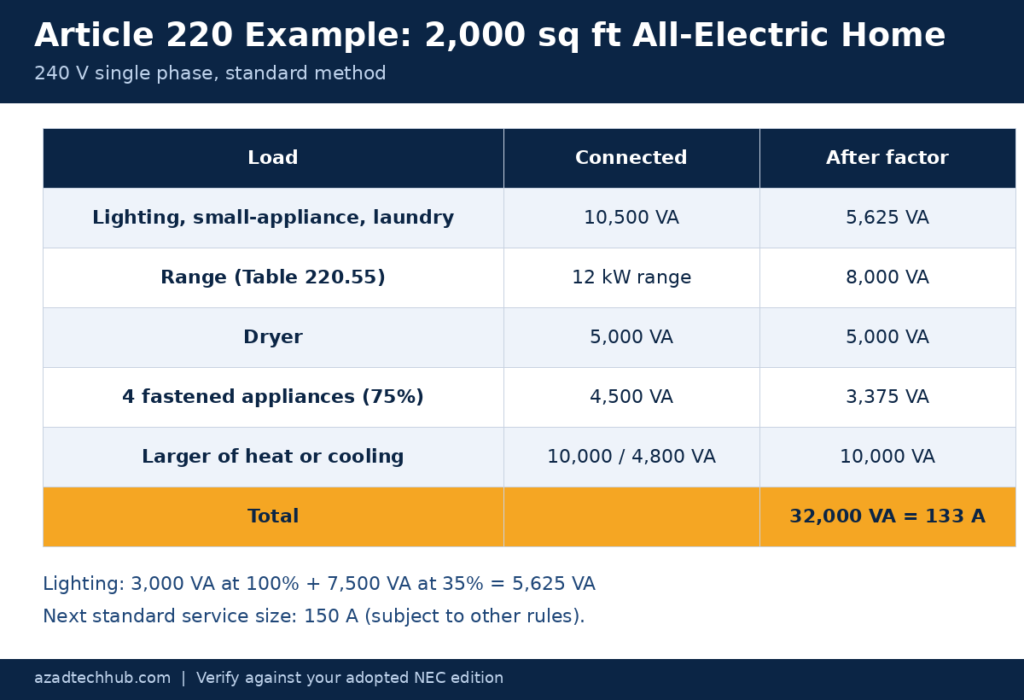
Take a 2,000 sq ft all-electric home, 240 volts single phase, using the standard method of the NEC article for demand factors:
- General lighting, small-appliance and laundry: 2,000 × 3 VA = 6,000 VA, plus 3,000 VA for two small-appliance circuits and 1,500 VA for laundry = 10,500 VA. Demand: 3,000 at 100% + 7,500 at 35% = 5,625 VA.
- Range: 8,000 VA from Table 220.55.
- Dryer: 5,000 VA.
- Four fastened appliances totaling 4,500 VA at 75%: 3,375 VA.
- Heating or cooling: 10,000 VA of heat versus 4,800 VA of cooling. Use the larger: 10,000 VA.
Total = 32,000 VA ÷ 240 V = 133 A. A 150 A service is the next standard size, subject to the other service rules. The optional method would give a different answer, so compare both.
Related Demand Factor Guides and Tools
Our demand factor and diversity factor guide links all the spokes:
- Homes: demand factor for residential loads.
- Motors: demand factor for motor loads and NEC 430.32 motor overload protection.
- Transformers: demand factor for transformer sizing and diversity factor for transformer sizing.
- HVAC: air conditioning demand factor.
- Comparisons: coincidence factor vs demand factor and demand factor vs power factor.
- Tools: the maximum demand calculator, electrical diversity calculator, electrical load calculator and EV charger load calculation tool.
For the service itself, see calculating electrical service size. Our older guide, NEC Article 220, is a shorter overview.
Free PDF: NEC Article for Demand Factors Cheat Sheet
The NEC is copyrighted, so we do not host its text. Download our one-page NEC article for demand factors cheat sheet in our own words, with the factors in this guide and the worked example:
What Does NEC Article 90 and Article 200 Contain?
Article 90 is the introduction: the purpose and scope of the code, enforcement, and how to read mandatory and permissive rules. It has no demand factors. Article 200 covers the use and identification of grounded conductors, such as the white or gray neutral. See our NEC article for grounding and bonding for the grounding side.
Tools for Load Work
Once the NEC article for demand factors gives you a number, measure the real load when the building is running. As an Amazon Associate I earn from qualifying purchases, at no extra cost to you. See our affiliate disclosure.
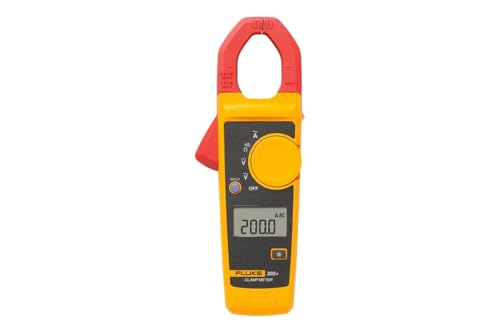
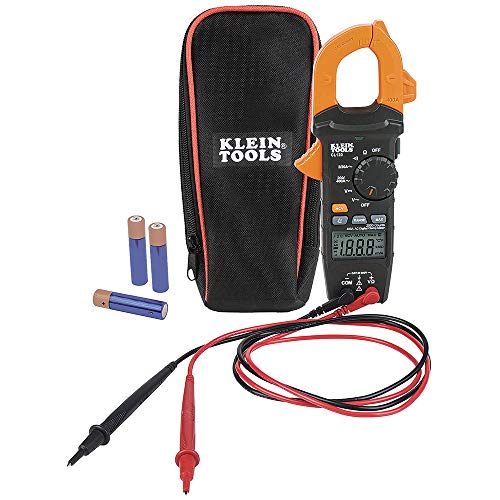
- Clamp meter: read actual amps on the feeder. See our best clamp meter for electricians.
- Energy monitor: logs real demand over days.
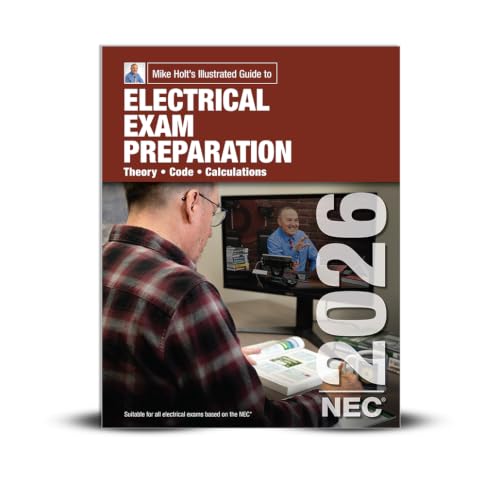
- NEC reference book: a printed code book makes Article 220 easier to navigate.

Frequently Asked Questions
What is the NEC article for demand factors?
Article 220, in particular Parts III and IV.
What are the NEC demand factors?
Specific percentages in tables such as 220.42, 220.45, 220.54, 220.55 and 220.56, plus rules like 75% for four or more fastened appliances.
What does NEC section 220.45 cover?
Non-dwelling receptacle loads in the 2023 edition (220.44 earlier).
Conclusion
The NEC article for demand factors is Article 220. Learn the tables, apply them only to feeders and services, and compare the standard and optional methods. Use the cheat sheet, and run the numbers in our maximum demand calculator.
Sources: NFPA 70, National Electrical Code (Article 220, Tables 220.42, 220.54, 220.55, 220.56, 220.82).
Get new guides in your feed. Follow Electrical Insights on LinkedIn for new electrical standards guides, calculators and design tips from Azad Circuit Hub.