
Demand Factor vs Power Factor: Key Differences, Formulas, Examples and Applications
When working with electrical loads, demand factor and power factor are often confused because both affect how an electrical system is planned and operated. However, they measure very different things. Demand factor relates to how much of the connected load is actually used, while power factor describes the relationship between real power and apparent power.
Understanding Demand Factor vs Power Factor is important for transformer sizing, generator selection, feeder design, energy management, and electricity cost analysis. A good design considers both factors rather than treating them as interchangeable.
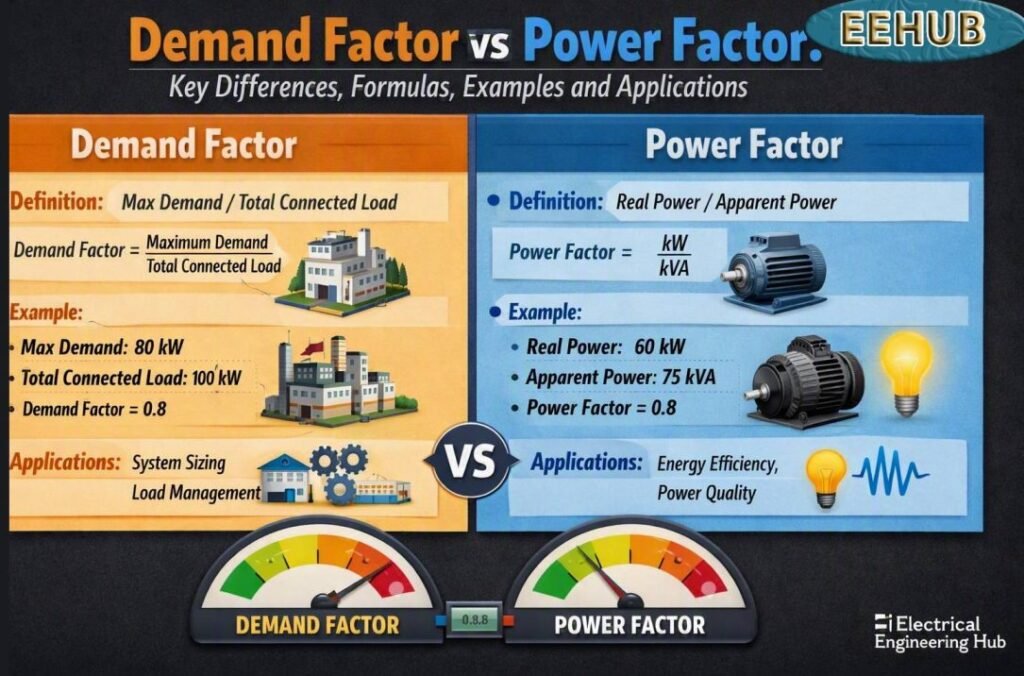
Table of Contents
Table of Contents
| Feature | Demand Factor | Power Factor |
|---|---|---|
| Main purpose | Measures actual demand compared with connected load | Measures efficiency of electrical power utilization |
| Formula | Maximum Demand ÷ Connected Load | kW ÷ kVA |
| Typical value | 0 to 1 | 0 to 1 |
| Main unit | No unit | No unit |
| Affected by | Load usage pattern | Inductive/capacitive loads |
| Important for | Transformer, feeder and generator sizing | Power quality and electricity demand |
| Example | 70 kW demand from 100 kW connected load = 0.70 | 80 kW at 100 kVA = 0.80 PF |
What Is Demand Factor?
Demand factor is the ratio between the maximum demand of an electrical installation and its total connected load. It indicates how much of the installed load is likely to operate at the same time.
The formula is:
Demand Factor = Maximum Demand ÷ Connected Load
For example, suppose a commercial building has 200 kW of connected electrical equipment, but its highest measured demand is 140 kW.
Demand Factor = 140 ÷ 200 = 0.70
This means the building has a 70% demand factor. The remaining connected capacity does not operate at full load at the same time.
Demand factor is especially useful when estimating the practical electrical demand of residential buildings, offices, factories, hospitals, and other facilities.
For a deeper explanation of demand factor, diversity factor, calculations, and practical applications, see our guide to Demand Factor and Diversity Factor.
What Is Power Factor?
Power factor represents the relationship between real electrical power and apparent power in an AC system.
The basic formula is:
Power Factor = Real Power (kW) ÷ Apparent Power (kVA)
For example, if a motor consumes 80 kW while drawing 100 kVA:
Power Factor = 80 ÷ 100 = 0.80
A power factor of 0.80 means that 80% of the apparent power is being converted into useful real power, while the remaining portion is associated with reactive power.
Induction motors, transformers, compressors, pumps, fluorescent lighting, and other inductive equipment can reduce power factor. Capacitor banks and automatic power factor correction systems are commonly used to improve it.
Demand Factor vs Power Factor: The Main Difference
The simplest way to understand Demand Factor vs Power Factor is to remember that demand factor deals with load utilization, while power factor deals with the relationship between real and apparent power.
Consider a factory with 500 kW of connected equipment. If the maximum recorded demand is 350 kW, its demand factor is:
350 ÷ 500 = 0.70
Now suppose the factory operates at 350 kW with a power factor of 0.80. Its apparent power is approximately:
350 ÷ 0.80 = 437.5 kVA
The two calculations describe different characteristics of the same electrical installation.
Demand factor helps determine how much of the installed load needs to be supplied at peak demand. Power factor helps determine how much apparent power the electrical system must carry to deliver that real power.
Demand Factor vs Power Factor Formula
The formulas are simple, but they are used for different engineering decisions.
| Parameter | Formula | Example | Result |
|---|---|---|---|
| Demand Factor | Maximum Demand ÷ Connected Load | 350 ÷ 500 kW | 0.70 |
| Power Factor | kW ÷ kVA | 350 ÷ 437.5 | 0.80 |
| Apparent Power | kW ÷ PF | 350 ÷ 0.80 | 437.5 kVA |
| Real Power | kVA × PF | 437.5 × 0.80 | 350 kW |
The distinction becomes important during equipment selection. A transformer is normally rated in kVA, not kW. Therefore, the expected demand and operating power factor both need to be considered.
How Demand Factor Affects Electrical System Design
Demand factor can prevent engineers from unnecessarily sizing equipment for the full connected load.
For example, a building with 1,000 kW of connected load and a demand factor of 0.60 may have an estimated maximum demand of:
1,000 × 0.60 = 600 kW
If the expected operating power factor is 0.90, the approximate apparent power becomes:
600 ÷ 0.90 = 667 kVA
A designer may then select a transformer with an appropriate standard rating while allowing a suitable margin for future expansion and operating conditions.
This approach can reduce unnecessary capital costs while maintaining adequate capacity.
How Power Factor Affects Electricity Costs
Power factor can also affect electricity costs, particularly for larger commercial and industrial customers. The exact tariff structure varies by utility, customer class, location, and billing period.
For example, a utility tariff may charge separately for energy consumption in kWh and demand in kW or kVA. Some commercial tariffs may also apply power factor adjustments or minimum power factor requirements.
As an illustration, assume a facility consumes 50,000 kWh in a billing period at an energy rate of $0.12/kWh.
Energy charge:
50,000 × $0.12 = $6,000
If the applicable tariff also includes a $15/kW demand charge and the billed demand is 300 kW:
300 × $15 = $4,500
The combined energy and demand charges would be $10,500 before taxes, riders, fixed charges, or other applicable fees.
These are example rates, not a universal electricity tariff. Actual electricity prices can vary significantly by utility and customer category.
Why Power Factor Correction Matters
A low power factor increases the current required to deliver the same amount of real power.
For a three-phase system:
I = P ÷ (√3 × V × PF)
Suppose a 100 kW load operates at 480 V and 0.75 power factor:
I ≈ 160.4 A
If the same load operates at 0.95 power factor:
I ≈ 126.7 A
Improving the power factor therefore reduces current. Lower current can reduce cable losses, voltage drop, and loading on transformers and switchgear.
However, power factor correction does not reduce the connected load. This is another important distinction when comparing Demand Factor vs Power Factor.
Demand Factor and Power Factor in Transformer Sizing
Both parameters can influence transformer selection, but they enter the calculation at different stages.
Assume:
- Connected load = 800 kW
- Demand factor = 0.75
- Operating power factor = 0.90
Maximum demand:
800 × 0.75 = 600 kW
Required apparent power:
600 ÷ 0.90 = 667 kVA
The transformer should not simply be selected as an 800 kVA unit without considering operating conditions, future expansion, temperature, harmonics, load growth, and the applicable design standard.
For detailed calculations involving demand and diversity, refer to Demand Factor and Diversity Factor and compare the calculated demand with the expected operating profile.
Demand Factor vs Diversity Factor
Demand factor is also different from diversity factor. Demand factor compares maximum demand with connected load. Diversity factor compares the sum of individual maximum demands with the maximum demand of the entire installation.
For example, three sections may have individual peak demands of 50 kW, 40 kW, and 30 kW. Their combined individual peaks total 120 kW. If the entire facility has a maximum demand of only 90 kW, the diversity factor is:
120 ÷ 90 = 1.33
This occurs because the individual loads do not necessarily reach their maximum demand at the same time.
Understanding Demand Factor and Diversity Factor together gives engineers a better picture of realistic system loading.
Practical Example
Consider a small manufacturing facility with:
- Connected load: 600 kW
- Demand factor: 0.70
- Maximum demand: 420 kW
- Power factor: 0.85
Maximum demand:
600 × 0.70 = 420 kW
Apparent power:
420 ÷ 0.85 = 494.1 kVA
The electrical distribution system therefore needs to accommodate approximately 494 kVA at the calculated peak condition.
If power factor improves to 0.95 while real demand remains 420 kW:
420 ÷ 0.95 = 442.1 kVA
This demonstrates why demand factor and power factor should not be combined into one concept. One determines the likely peak real load from connected equipment, while the other determines the apparent power required to supply that real load.
Key Takeaways
Key Takeaways
The most important points are:
- Demand factor measures actual maximum demand against connected load.
- Power factor measures real power against apparent power.
- Demand factor is useful for estimating realistic electrical demand.
- Power factor is important for current, transformer loading, voltage drop, and power quality.
- A low power factor increases current for a given kW load.
- Power factor correction can reduce current and apparent power.
- Demand factor does not directly indicate motor or system efficiency.
- Both parameters should be considered during transformer, generator, cable, and feeder design.
- Electricity charges depend on the utility tariff, customer class, location, and billing structure.
Frequently Asked Questions
Is demand factor the same as power factor?
No. Demand factor compares maximum demand with connected load, while power factor compares real power with apparent power. They describe different electrical characteristics.
Can demand factor be greater than 1?
Normally, demand factor should not exceed 1 because maximum demand should not be greater than the connected load. An apparent value above 1 usually indicates an incorrect load inventory, measurement issue, or a difference in how the loads were defined.
What is a good power factor for an industrial facility?
A power factor of 0.90 or higher is commonly considered reasonable for many industrial systems, while values around 0.95 to 0.99 are often desirable. The appropriate target depends on the equipment and utility tariff.
Does improving power factor reduce kWh consumption?
Power factor correction does not normally reduce the real energy required by the equipment. It primarily reduces reactive current and apparent power. However, lower current can reduce distribution losses in some systems.
Why are both factors important in transformer sizing?
Demand factor helps estimate the maximum real load that the transformer needs to supply. Power factor converts that real power requirement into apparent power in kVA, which is the basis of transformer ratings.
Final Thoughts
Demand Factor vs Power Factor is not a choice between two methods. They are separate electrical engineering concepts that answer different questions. Demand factor tells you how much of the installed load is likely to be required at peak demand, while power factor tells you how efficiently apparent power is being converted into useful real power.
Using both correctly leads to better transformer sizing, feeder design, generator selection, voltage-drop calculations, and electrical cost management. For a complete understanding of how load characteristics interact, continue with our detailed guide on Demand Factor and Diversity Factor.
Get new guides in your feed. Follow Electrical Insights on LinkedIn for new electrical standards guides, calculators and design tips from Azad Circuit Hub.
#DemandFactor, #PowerFactor, #DemandFactorVsPowerFactor, #ElectricalEngineering, #PowerSystems, #ElectricalLoad, #PowerFactorCorrection, #ElectricalCalculations, #ElectricalDesign, #EngineeringGuide
