
Demand factor for Residential loads
Understanding how much electrical equipment actually operates at the same time is important when sizing a residential electrical system. A house may have a refrigerator, air conditioner, water heater, oven, washing machine, lighting, and several plug loads, but these appliances rarely run at full load together.
This is where demand factor becomes useful. It helps engineers and electricians estimate the maximum expected demand instead of simply adding every connected load. The result can support better sizing of the service entrance, distribution board, transformer, feeder, and other electrical equipment.
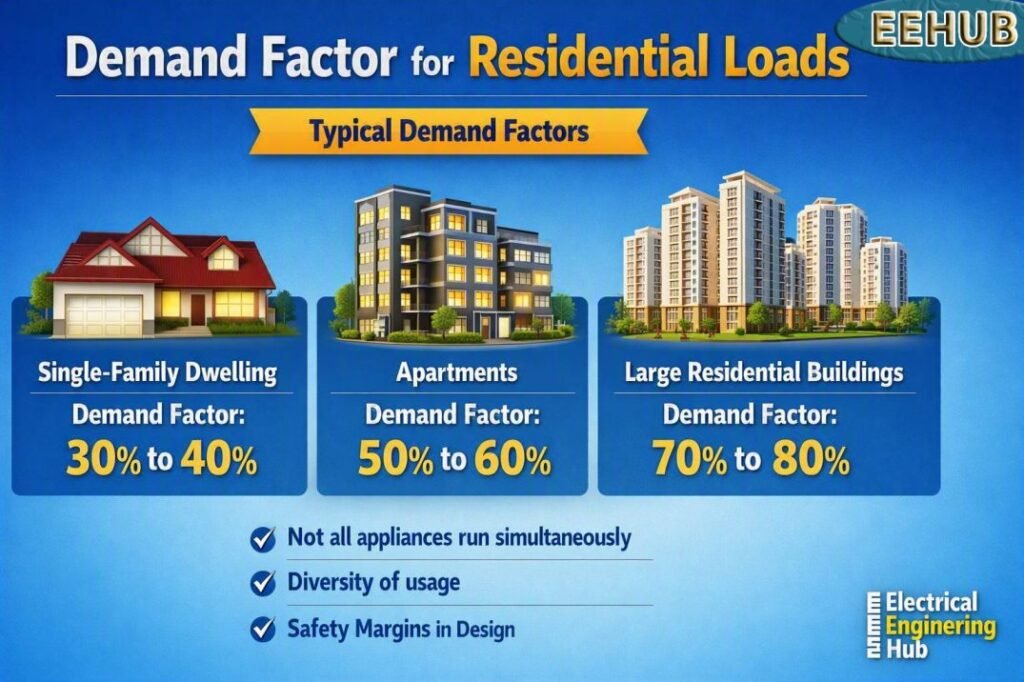
Table of Contents
Table of Contents
For a broader explanation of how demand and diversity affect electrical system design, see our Demand Factor and Diversity Factor guide.
Quick comparison: Residential load and demand factor
| Item | Meaning | Typical residential example |
|---|---|---|
| Connected load | Total rated load of all equipment | 25 kW |
| Maximum demand | Highest expected simultaneous load | 12–16 kW |
| Demand factor | Maximum demand ÷ connected load | 0.48–0.64 |
| Diversity | Difference between individual maximum demands and system maximum demand | Reduces overall design demand |
| Load factor | Average load ÷ maximum demand | Usually lower than demand factor |
| Main purpose | Estimate actual system demand | Service and feeder sizing |
What is demand factor for Residential loads?
Demand factor for Residential loads is the ratio between the maximum demand of a home and the total connected electrical load. It is normally expressed as a decimal or percentage.
The basic formula is:
Demand Factor = Maximum Demand ÷ Total Connected Load
For example, suppose a house has a total connected load of 20 kW, but the highest measured or expected simultaneous demand is 12 kW.
Demand factor = 12 ÷ 20 = 0.60
Therefore, the demand factor is 0.60 or 60%.
A value below 1 is common because residential appliances do not normally operate at their rated power at the same time. A 2 kW washing machine may operate for only part of the day, while an electric oven may be switched off when the air conditioner is operating.
Why demand factor matters in a house
Simply adding every appliance rating can produce an unnecessarily high calculated load. This may result in oversized cables, breakers, transformers, and service equipment.
On the other hand, using an unrealistically low value can create an undersized electrical installation. The system may experience voltage drop, nuisance breaker trips, overheating, or poor equipment performance.
Residential load calculations therefore consider the expected operating pattern of appliances. Large loads such as HVAC systems, electric water heaters, electric ranges, dryers, EV chargers, and heat pumps deserve particular attention.
For new construction, the calculation should also follow the applicable electrical code and local utility requirements. In the United States, residential service calculations commonly refer to NEC Article 220 and applicable demand allowances.
How to calculate Demand factor for Residential loads
The calculation is straightforward when the connected load and maximum demand are known.
Step 1: List connected loads
Prepare a load schedule containing lighting, receptacles, HVAC equipment, kitchen appliances, water heaters, pumps, dryers, EV chargers, and other significant loads.
Step 2: Determine rated power
Use the nameplate rating where available. For example:
| Residential load | Quantity | Rating | Connected load |
|---|---|---|---|
| LED lighting | 20 | 12 W | 0.24 kW |
| Refrigerator | 1 | 0.25 kW | 0.25 kW |
| Air conditioner | 2 | 1.8 kW | 3.60 kW |
| Water heater | 1 | 4.5 kW | 4.50 kW |
| Electric oven | 1 | 3.5 kW | 3.50 kW |
| Washing machine | 1 | 0.8 kW | 0.80 kW |
| Dryer | 1 | 4.5 kW | 4.50 kW |
| Miscellaneous loads | — | — | 1.50 kW |
| Total | 18.89 kW |
The connected load in this example is 18.89 kW.
Step 3: Estimate maximum demand
Assume the expected maximum simultaneous residential demand is 11.5 kW.
Demand factor = 11.5 ÷ 18.89
Demand factor ≈ 0.61
The calculated demand factor is therefore approximately 61%.
This does not mean the house will always consume 61% of its connected load. It represents the relationship between the selected maximum demand and the total installed load.
Typical demand factor for residential loads
There is no single demand factor that applies to every house. It depends heavily on the number of occupants, climate, heating system, cooking method, air conditioning, water heating, and EV charging.
A small apartment with gas cooking may have a relatively modest connected load. A large all-electric home with multiple HVAC systems and two EV chargers can have a much higher peak demand.
| Home type | Typical connected load | Possible maximum demand | Illustrative demand factor |
|---|---|---|---|
| Small apartment | 6–10 kW | 3–6 kW | 0.40–0.60 |
| Medium home | 12–20 kW | 6–12 kW | 0.40–0.65 |
| Large home | 20–35 kW | 10–22 kW | 0.45–0.65 |
| All-electric home | 25–45 kW | 15–30 kW | 0.50–0.75 |
| Home with EV charging | 25–50+ kW | 15–35+ kW | 0.50–0.80 |
These figures are planning examples, not code-mandated values. The actual calculation should use the requirements applicable to the project.
Demand factor vs diversity factor
Demand factor and diversity factor are related but they are not the same thing.
Demand factor compares the maximum demand of a particular installation with its total connected load. Diversity factor compares the sum of individual maximum demands with the maximum demand of the complete system.
For example, several houses may each have a calculated maximum demand of 10 kW. If 100 houses are supplied from one transformer, it would not necessarily be correct to assume that all 100 homes reach 10 kW at exactly the same time.
This diversity can significantly reduce the expected transformer or feeder peak compared with simply adding individual maximum demands.
For the full relationship between these calculations, read our Demand Factor and Diversity Factor resource before finalizing a residential load calculation.
Residential demand factor and electricity cost
Demand factor is mainly a load-sizing concept, but maximum demand can also influence electricity costs where a utility applies demand charges.
For example, assume a home consumes 900 kWh in one month and the energy rate is $0.18/kWh.
Energy charge:
900 × $0.18 = $162
If the tariff also includes a demand charge of $12 per kW and the recorded monthly demand is 10 kW:
Demand charge:
10 × $12 = $120
The combined energy and demand charges would be $282 before taxes, fixed fees, and other adjustments.
Many residential customers, however, are billed primarily on energy consumption rather than a commercial-style demand charge. Actual electricity rates vary by utility, state, tariff, season, and customer class. Always check the current utility tariff when calculating a real bill.
Example of residential service sizing
Consider a home with an 18.89 kW connected load and an estimated maximum demand of 11.5 kW.
If the supply is single-phase at 240 V, the approximate current is:
I = P ÷ V
I = 11,500 ÷ 240
I ≈ 47.9 A
The actual service calculation cannot be based on this simple equation alone in every case. Continuous loads, power factor, conductor temperature ratings, voltage drop, equipment ratings, code requirements, and utility rules may affect the final selection.
For a 120/240 V residential system, the load should also be properly distributed between the two ungrounded conductors to maintain reasonable phase balance.
Factors that affect residential demand
Several factors can change the expected peak demand of a home:
- Number of occupants
- Floor area and building type
- Climate and outdoor temperature
- Air-conditioning capacity
- Electric heating
- Electric water heating
- Cooking appliances
- Clothes dryer usage
- Swimming pool pumps
- Well pumps
- EV chargers
- Battery storage systems
- Solar PV systems
- Home automation and energy management
EV charging deserves special attention because a Level 2 charger can add a substantial continuous load. A home with a 48-amp EV charger can draw about 11.5 kW at 240 V, making it a major part of the service-load calculation.
Common mistakes when using demand factor
One common mistake is applying a single percentage to every appliance. Residential load calculations are more accurate when major loads are considered according to their operating characteristics and applicable code provisions.
Another mistake is confusing connected load with maximum demand. Connected load represents installed equipment capacity, while maximum demand represents the highest expected simultaneous requirement.
It is also important not to use generic online demand factors as a replacement for an electrical code calculation. Published values are useful for preliminary engineering, but final service sizing should follow the governing standard and utility requirements.
Frequently asked questions
What is a normal demand factor for a house?
A residential demand factor can commonly fall somewhere around 0.4 to 0.7 for planning purposes, but there is no universal value. Homes with electric heating, multiple air conditioners, EV chargers, or other large loads may have higher demand.
Can demand factor be greater than 1?
Normally, demand factor should not exceed 1 because maximum demand cannot exceed the total connected load under the same measurement basis. A value above 1 usually indicates an error in the load data, units, measurement period, or calculation.
Is demand factor the same as load factor?
No. Demand factor compares maximum demand with connected load. Load factor compares average load with maximum demand. They describe different characteristics of an electrical system.
Does demand factor determine breaker size?
It can contribute to determining the calculated load used for service and feeder sizing, but breaker selection also depends on conductor ampacity, continuous loads, equipment ratings, short-circuit requirements, code rules, and other design factors.
What demand factor should I use for residential load calculation?
Do not select a demand factor simply because it is a common percentage. Use the applicable electrical code, utility requirements, appliance ratings, and expected operating conditions. For U.S. residential installations, NEC load-calculation provisions are particularly important.
Final thoughts
Demand factor for Residential loads helps bridge the gap between the total installed capacity of a home and the amount of power it is likely to require at peak operation. It is especially useful when evaluating residential feeders, service entrances, distribution boards, transformers, and electrical infrastructure.
A good calculation starts with an accurate appliance schedule and then considers how those loads actually operate. Large loads such as HVAC systems, electric heating, water heaters, dryers, and EV chargers should never be overlooked.
Before selecting a service size or transformer, combine demand calculations with applicable code requirements, conductor ampacity, voltage drop, power factor, and utility rules. Understanding the difference between connected load, maximum demand, demand factor, and diversity can lead to a safer and more economical residential electrical system.
For a deeper understanding of the calculations used together in electrical load planning, explore our Demand Factor and Diversity Factor guide.
Get new guides in your feed. Follow Electrical Insights on LinkedIn for new electrical standards guides, calculators and design tips from Azad Circuit Hub.
DemandFactor, #ResidentialLoads, #ElectricalEngineering, #ElectricalLoadCalculation, #NEC, #ResidentialElectrical, #LoadDemand, #ElectricalDesign, #PowerSystems, #ElectricalSafety
