NEC Code for Commercial Buildings: Key Rules, GFCI, Romex and Free PDF (2026)
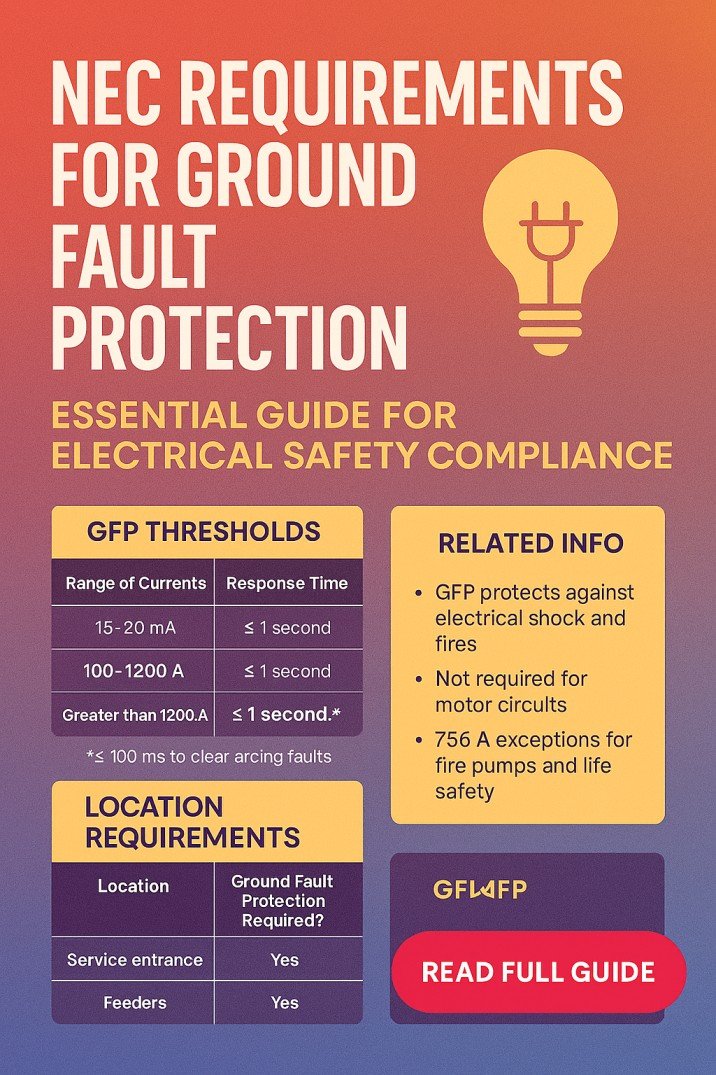
The NEC code for commercial buildings is NFPA 70, the National Electrical Code, and it covers everything from the service entrance to the last receptacle. If you want the short version: commercial services follow Article 230, receptacle GFCI protection follows 210.8(B), and Romex is allowed only in limited building types. This guide explains each rule, clears up the 2020, 2021 and 2026 edition confusion, and shows how to read the code for free.
By Abdul Wassay, Electrical Engineer with 15+ years in power systems and protection. Some links are affiliate links, disclosed in our affiliate disclosure.
Quick Answer: NEC Code for Commercial Buildings at a Glance
- The NEC is adopted by your state or city, so the enforced edition (2020, 2023 or 2026) decides which rules apply.
- Commercial services follow Article 230, feeders follow Article 215, and panels follow Article 408.
- GFCI protection for non-dwelling receptacles is in 210.8(B).
- Type NM cable (Romex) is permitted only in structures allowed to be Type III, IV or V construction, behind a 15-minute thermal barrier.
Download our free NEC code for commercial buildings PDF cheat sheet
What Is NEC in Building Code?
What is NEC in building code? NEC stands for National Electrical Code, published by NFPA as NFPA 70. It sets the minimum safe installation rules for wiring and equipment. The International Building Code points to it for electrical work, but the NEC is not federal law. Your state or local authority adopts it, often with amendments, and your inspector enforces that version.
That is why the NEC code for commercial buildings can differ between Texas, California and New York. Always confirm the adopted edition before you design or bid.
How the NEC Code for Commercial Buildings Differs From Residential Rules
Commercial work is not just “bigger residential.” The main differences are:
- Voltage and phases: 208Y/120 V and 480Y/277 V three-phase systems are common, so conductor and breaker choices change.
- Wiring methods: EMT, MC cable, cable tray and busway replace most residential cable.
- Protection: AFCI rules focus on dwellings and dormitories, while GFCI follows the separate non-dwelling list in 210.8(B).
- Labeling: 110.16 requires arc flash warning labels on service and feeder equipment in other than dwelling units.
- Load calculations: occupancy-based lighting and receptacle loads replace dwelling-unit formulas.
NEC Code for Commercial Buildings: 2020, 2021, 2023 and 2026
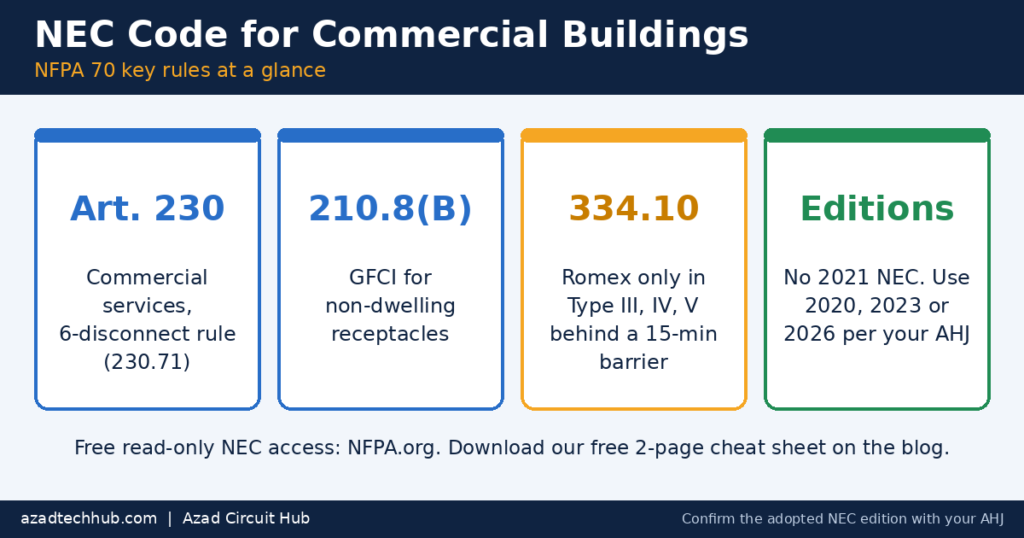
Searchers often type “nec code for commercial buildings 2020” or “2021”. Here is the cycle: the NEC is revised every three years, so the editions are 2017, 2020, 2023 and 2026. There is no 2021 NEC. The 2021 model building codes generally reference the 2020 NEC, which is why that year shows up in searches.
- 2020 NEC: still enforced in many jurisdictions.
- 2023 NEC: widely adopted, with expanded GFCI rules for non-dwelling kitchens and other areas.
- 2026 NEC: released in 2025 and being adopted state by state. The load calculation rules were reorganized, so check article numbers against your edition.
NEC Code for Commercial Buildings PDF: How to Read It Free
Many people search for a “free NEC code book” or “NFPA 70 NEC 2026 PDF”. NFPA offers free, read-only online access to NFPA 70 after you create a free account. It cannot be downloaded or printed. Be cautious with sites offering a full PDF download, because they are usually unauthorized copies or outdated editions.
What you can legally do:
- Read the current NEC online for free on the NFPA website.
- Download our two-page cheat sheet of commercial rules from this post.
- Buy a printed copy if you work in the field daily. Check the current price of the NEC 2026 code book and the color-coded tabs that make jobsite lookups faster.
What Are the NEC Requirements for Commercial Services?
The service is where utility power enters the building, so the NEC code for commercial buildings is strictest here. Plan the main equipment, the feeder routes and the working space together, because a late change to any of them usually forces a redesign. Key points:
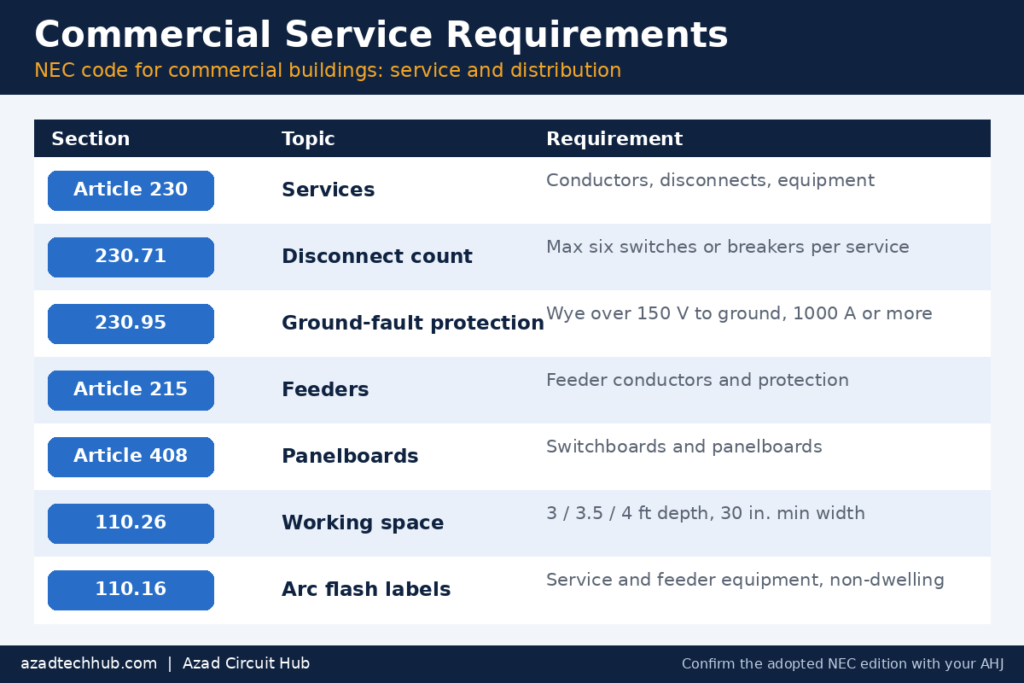
- Article 230 covers service conductors and equipment.
- 230.71 limits a service to six switches or circuit breakers grouped in one location.
- 230.95 requires ground-fault protection of equipment on solidly grounded wye services over 150 volts to ground, up to 1000 volts phase to phase, rated 1000 amperes or more.
- Article 215 sizes feeders, and NEC Article 210.20 A explains the 125% continuous load rule that drives breaker sizes.
- Article 408 covers switchboards and panelboards.
- 110.26 sets working space. Commercial gear often lands in condition 2 or 3, which means 3.5 ft or 4 ft of depth. See NEC Article 110.26 A and our guide to the NEC code for clearance in front of panels.
- Overcurrent protection rules are in NEC Article 240, and grounding and bonding is in Article 250.
Special systems such as emergency (Article 700) and legally required standby (Article 701) apply to many commercial occupancies. Hospitals add Article 517.
GFCI Requirements in Commercial Buildings
GFCI requirements in commercial buildings are in 210.8(B), “Other Than Dwelling Units.” It applies to 125 to 250 volt receptacles on single-phase circuits of 50 amps or less, and on three-phase circuits of 100 amps or less (150 volts to ground or less). The locations include:
- Bathrooms and commercial kitchens
- Rooftops and outdoors
- Within 6 ft of a sink
- Indoor damp and wet locations
- Locker rooms with showering facilities
- Garages, service bays and similar areas
The 2023 edition expanded non-dwelling kitchen coverage and added buffet serving areas, so a 2020 design may need updating. The dwelling-unit list is different, and is covered in our NEC Article 210.8 A guide. Arc-fault rules for dwellings and dormitories are in our NEC code for arc fault breakers post.
How Many Outlets Do You Need in a Commercial Building?
There is no fixed outlet count in the NEC code for commercial buildings. The dwelling-unit spacing rules in 210.52 do not apply to offices or stores. Instead, the NEC sets specific cases and load calculations:
- 210.62: one receptacle per 12 linear feet of show window.
- 210.63: a service receptacle within 25 ft of HVAC equipment on rooftops, attics and crawl spaces.
- Load calculations: in the 2020 and 2023 editions, receptacles are counted at 180 VA per yoke (220.14(I)), and offices and banks use the larger of that or 1 VA per square foot.
- Branch circuits: run NEC Article 210 branch circuit rules to split the load.
In practice the number of outlets comes from the tenant layout, the occupancy and your local amendments. Add spares. Box capacity matters too, so check the NEC article for box fill.
Can You Use Romex in a Commercial Building?
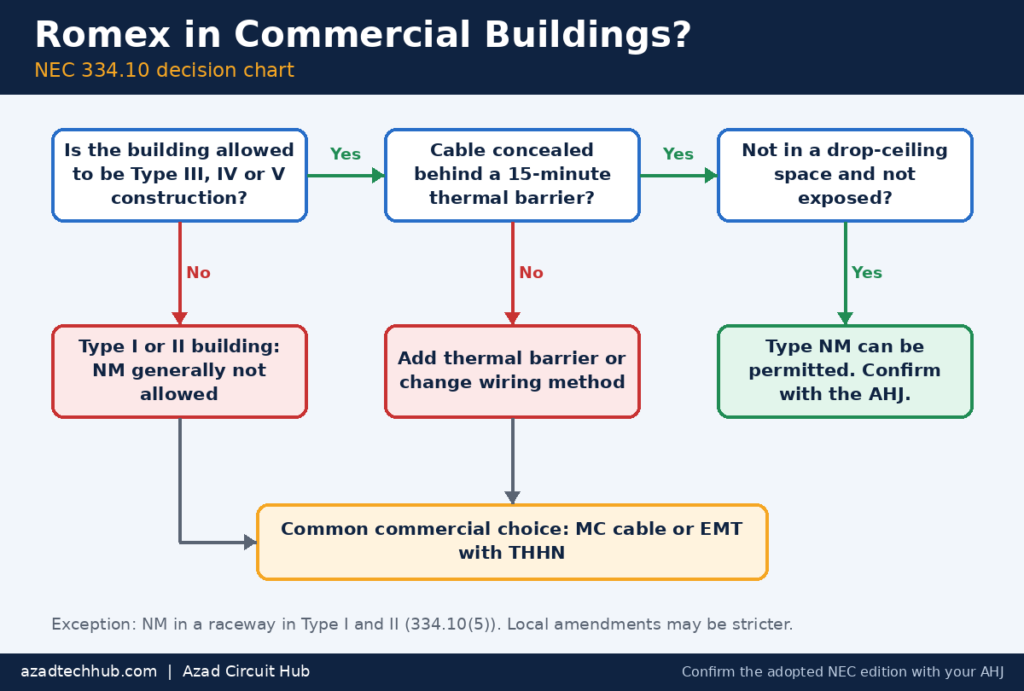
Sometimes. Can you use Romex wiring in a commercial building? Under 334.10(3), Type NM cable is permitted in structures that are allowed to be Type III, IV or V construction, with the cable concealed behind a thermal barrier with at least a 15-minute finish rating. That means NM cannot run exposed. Inspectors also commonly reject it above suspended ceilings, since ceiling tiles are not that thermal barrier.
Type I and Type II buildings are generally off limits unless the building could legally have been Type III, IV or V, or the cable is in a raceway where 334.10(5) permits it. Many commercial contractors skip the question and use MC cable or EMT. For conduit sizing, use our conduit fill calculator, and for larger runs the cable tray fill calculator.
Tools for Commercial NEC Inspections
Verify before you touch anything, and keep these in the bag:
- A best non-contact voltage tester for quick checks
- A multimeter for electricians to confirm zero energy
- A clamp meter for load verification
- A thermal imaging camera to find hot connections in panels
As an Amazon Associate I earn from qualifying purchases, at no extra cost to you.
FAQs About the NEC Code for Commercial Buildings
Is there a free NEC code for commercial buildings PDF download?
The full NEC is free to read online at NFPA, but not to download. Our cheat sheet PDF is free.
Does the NEC require GFCI in commercial buildings?
Yes, for the locations listed in 210.8(B).
Which NEC edition applies to my building?
The one your local authority has adopted. Ask the inspector.
Conclusion
The NEC code for commercial buildings comes down to three habits: confirm the adopted edition, follow the service and working space rules, and match the wiring method to the building type. For more guides, browse our electrical standards library, electrical calculators and product reviews.
Get new guides in your feed. Follow Electrical Insights on LinkedIn for new electrical standards guides, calculators and design tips from Azad Circuit Hub.