NEC Article for Branch Circuits: Article 210 Guide (2026)
The NEC article for branch circuits is Article 210. It governs the wiring between your final breaker and the outlets it feeds, including circuit ratings, conductor sizes, GFCI and AFCI protection, and receptacle placement. This guide explains the NEC article for branch circuits in plain English, shows how it connects to Articles 215, 310, 376 and 725, and includes a free PDF cheat sheet. It belongs to our NEC and electrical standards library, written from 15+ years of field experience in power systems and protection.
Quick answer: Use Article 210 for branch circuit ratings, required circuits, GFCI/AFCI and receptacle rules. Use Article 215 for feeders, Article 310 for conductor ampacity, Article 376 for metal wireways and Article 725 for Class 1, 2 and 3 signaling circuits.
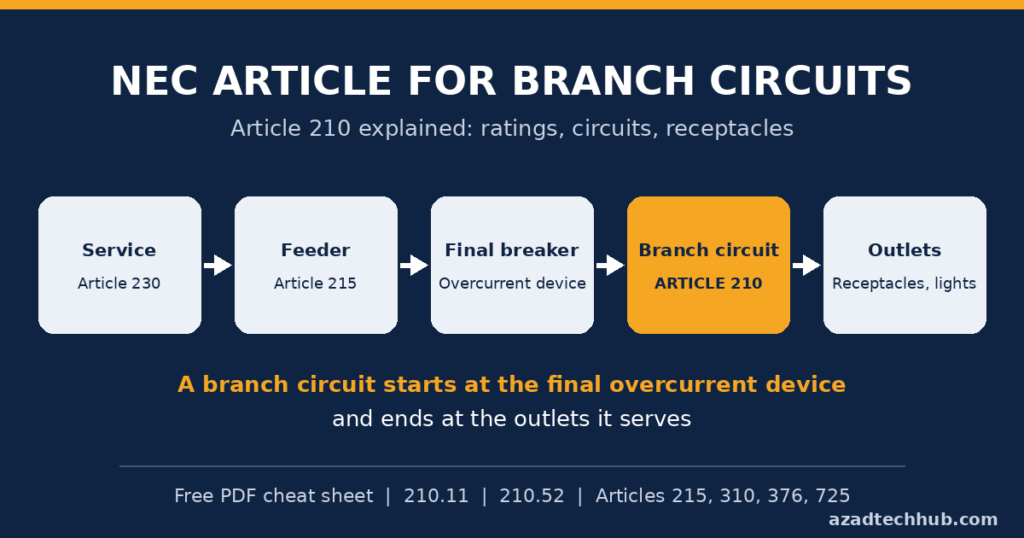
Table of Contents
Table of Contents
What Is the NEC Article for Branch Circuits?
Article 210, titled Branch Circuits, is the NEC article for branch circuits. Article 100 defines a branch circuit as the conductors between the final overcurrent protective device and the outlets it serves. Everything upstream of that breaker is a feeder or service, covered by other articles. Understanding this branch circuit definition is the first step, because inspectors, exam questions and plan reviewers all start from the same dividing line: the last overcurrent device before the load.
Article 210 sorts branch circuits by what they supply:
- General-purpose: lighting and receptacles.
- Appliance: outlets for plug-in appliances.
- Individual: one circuit for one load, such as a range or EV charger.
- Multiwire: several ungrounded conductors sharing one neutral (210.4).
Two protection rules draw the most inspector attention: our NEC 210.8 A GFCI guide and arc fault breaker guide cover them.
Branch Circuit Ratings and Conductor Sizing
Section 210.3 lists the standard ratings: 15, 20, 30, 40 and 50 amperes. Section 210.24 summarizes the minimum copper conductor for each.
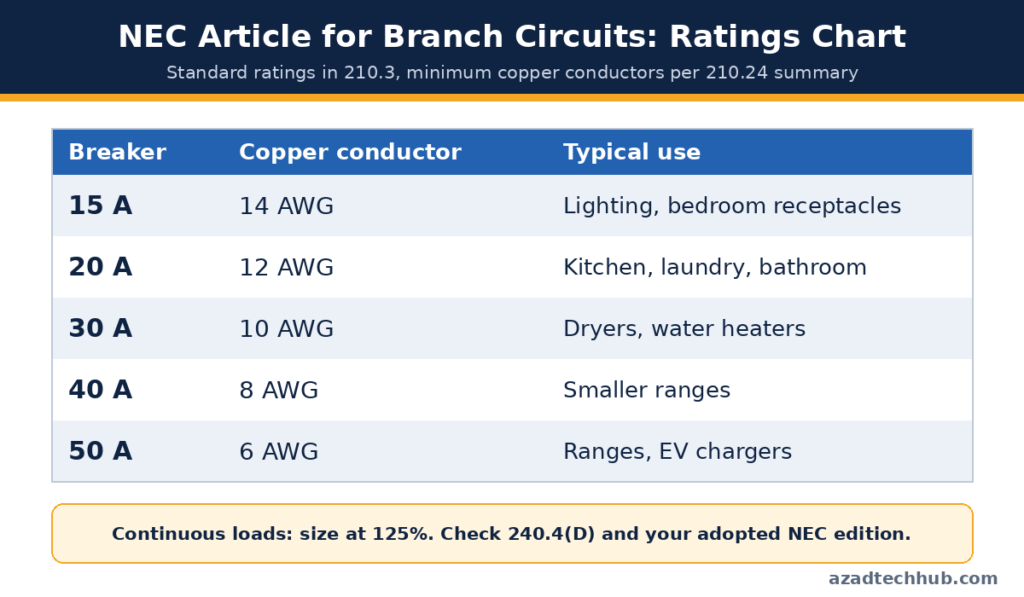
Two rules drive these numbers. Conductors and breakers must handle 125% of continuous loads plus 100% of noncontinuous loads (210.19 and 210.20), and our NEC 210.20 A guide has worked examples. Section 240.4(D) also caps 14, 12 and 10 AWG copper at 15, 20 and 30 amps, explained in our NEC article for overcurrent protection. Choosing the next size up from the table is not a violation, but undersizing a conductor for its breaker is. Applying the NEC article for branch circuits correctly means matching the breaker, the conductor and the receptacle rating together. Working in metric? Use the AWG to mm² conversion chart.
How Is the Required Number of Branch Circuits Determined?
Under the NEC article for branch circuits, section 210.11(A) requires enough circuits to serve the calculated load. Calculate the load first (Article 220 in the 2023 NEC, renumbered Article 120 in the 2026 NEC), then divide by the rating of the circuits you plan to use. A 20 A, 120 V circuit carries 2,400 VA, or 1,920 VA continuous. Section 210.11(B) requires the load to be evenly proportioned among circuits. Our demand factor guide and kW vs kVA cable sizing article help with the math.
Dwelling units also need minimum circuits under 210.11(C), whatever the calculation says:
- Two or more 20 A small-appliance circuits
- One 20 A laundry circuit
- One 20 A bathroom circuit
- One 20 A garage circuit
Once the count is set, label every circuit. A circuit breaker finder such as the one in our Klein ET310 review makes panel directories accurate in minutes.
NEC 210.52: Dwelling Unit Receptacle Rules
Searches for “nec 210.52 pdf” are common because this section drives most receptacle layouts:
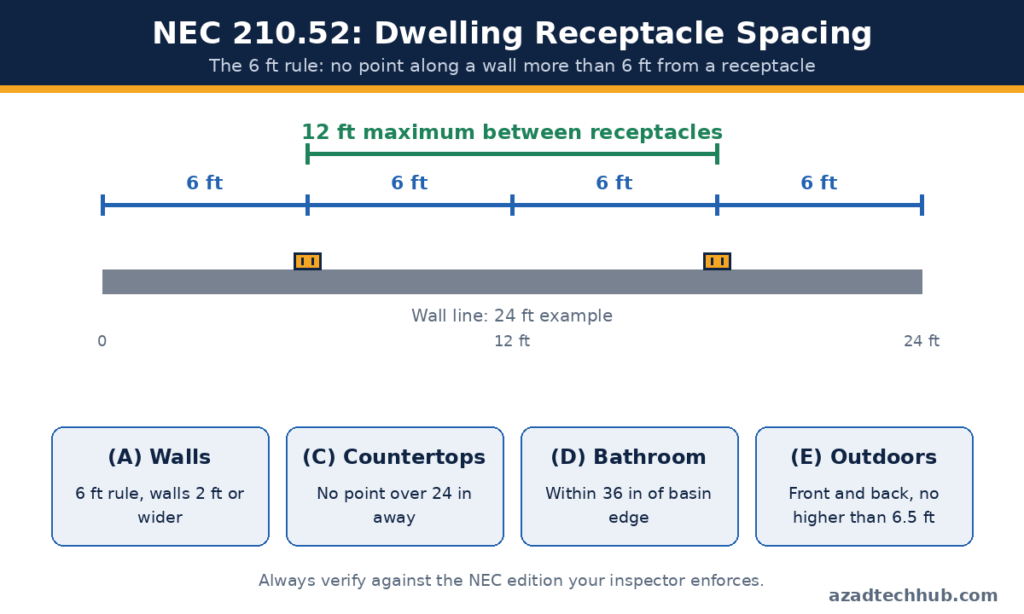
- 210.52(A): no point along a wall line more than 6 ft from a receptacle, so 12 ft maximum spacing.
- 210.52(B): kitchen receptacles go on the small-appliance circuits.
- 210.52(C): countertops need receptacles so no point along the wall is more than 24 in away.
- 210.52(D): a bathroom receptacle within 36 in of each basin.
- 210.52(E): front and back outdoor receptacles, no higher than 6.5 ft above grade.
Remember that GFCI protection under 210.8 applies to many of these locations, including kitchens, bathrooms, garages and outdoors, so receptacle layout and protection planning go together. After wiring, verify every outlet. A plug-in GFCI receptacle tester catches open grounds and reversed polarity before the inspector does.
Download our free PDF: NEC Article 210 Branch Circuits Cheat Sheet.
Permissible Loads on Branch Circuits
Sections 210.22 and 210.23 limit what each circuit can supply. A 15 A or 20 A multioutlet circuit may serve lighting and portable cord-and-plug loads. If it also feeds fixed appliances, each fixed appliance should not exceed 50% of the circuit rating. Individual circuits, such as for a dryer, range or EV charger, serve only that one load. Following the NEC article for branch circuits here prevents nuisance tripping and overheated conductors.
Article 215 vs Article 210
Article 215 covers feeders: the conductors between service equipment and the final branch-circuit breaker. A conductor becomes a branch circuit only after that last overcurrent device. Section 215.2 applies the same 125% continuous load rule, sized for the combined load, and 215.3 handles feeder overcurrent protection. When feeder and branch conductors share a raceway, check the conduit fill calculator, and see junction box vs pull box for splice locations.
Articles 310, 376 and 725 Alongside the NEC Article for Branch Circuits
These three articles support the NEC article for branch circuits on nearly every job:
- Article 310 covers conductors for general wiring. Table 310.16 gives allowable ampacities at 30°C ambient with up to three current-carrying conductors, and adjustment factors apply beyond that.
- Article 376 covers metal wireways. Conductors fill no more than 20% of the cross-section, and derating applies above 30 current-carrying conductors. For a similar fill check, try our cable tray fill calculator.
- Article 725 covers Class 1, 2 and 3 remote-control, signaling and power-limited circuits, such as thermostat and doorbell wiring. The 2026 NEC adds Article 206 for non-power-limited circuits.
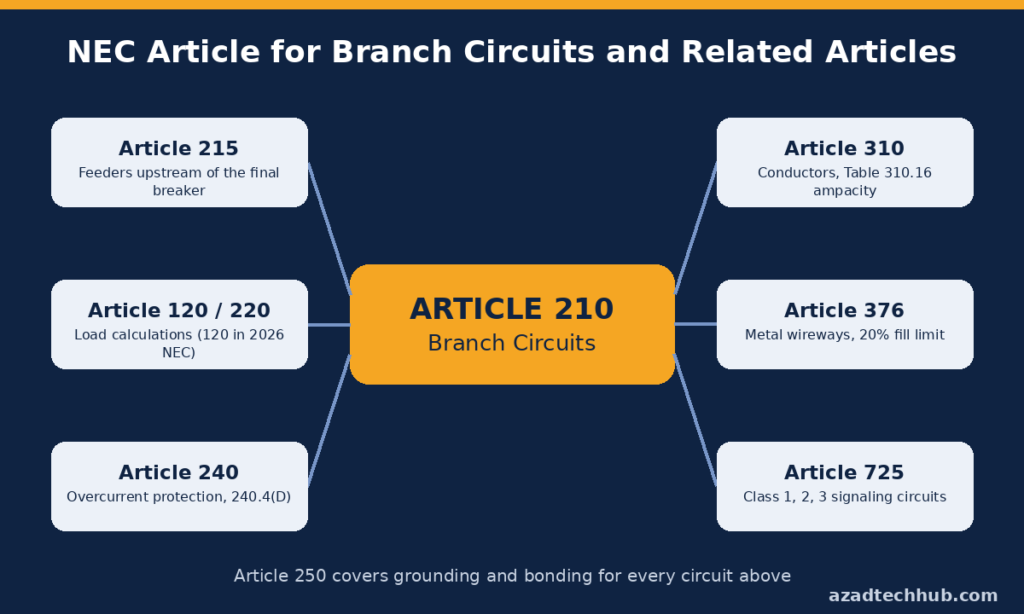
Grounding rules sit in our NEC article for grounding and bonding guide.
What Changed for Branch Circuits in the 2026 NEC?
For the NEC article for branch circuits, the 2026 NEC moved load calculations to Article 120, gave garages their own GFCI item in 210.8(A)(2), and now lets an outlet branch-circuit AFCI sit at the first outlet or switch when you extend an existing circuit (210.12(E)). It also revised 210.52 and added 210.52(C)(4) on countertop receptacle locations. States adopt editions at different times, so confirm with your inspector. You can read the code free on NFPA’s online access page.
Tools for Branch Circuit Work
Good tools make work under the NEC article for branch circuits faster and safer. Start with a multimeter for electricians and a non-contact voltage tester to prove circuits dead. Clean terminations matter, so see our best wire strippers. Adding an EV charger? It is a continuous load needing its own circuit. Use the EV charger load calculation tool, then compare Level 2 EV chargers.
As an Amazon Associate I earn from qualifying purchases, at no extra cost to you. See the affiliate disclosure.
NEC Article for Branch Circuits Self-Check Questions
- What is the maximum standard branch-circuit rating? 50 A.
- How many small-appliance circuits must a dwelling have? Two or more, 20 A.
- What fill limit applies in a metal wireway? 20%.
- Which article covers feeders? Article 215.
- Which article holds the ampacity table? Article 310, Table 310.16.
FAQs About the NEC Article for Branch Circuits
What NEC article covers branch circuits?
Article 210. Load calculations sit in Article 220, or Article 120 in the 2026 edition.
What is Article 725 of the NEC?
It covers Class 1, 2 and 3 remote-control, signaling and power-limited circuits.
What does NEC Article 376 contain requirements for?
Metal wireways, including fill, support and conductor limits.
What is Article 310 in the NEC?
Conductors for general wiring, including ampacity Table 310.16.
Conclusion
The NEC article for branch circuits, Article 210, ties together ratings, conductor sizing, protection and receptacle layout. Pair it with Articles 215, 310, 376 and 725, confirm your local edition, and keep the cheat sheet handy on site. Browse more guides in our electrical standards library.
Get new guides in your feed. Follow Electrical Insights on LinkedIn for new electrical standards guides, calculators and design tips from Azad Circuit Hub.