How to Use a Circuit Breaker Finder: Step-by-Step Guide
Finding the correct circuit breaker for an outlet, light, appliance, or other electrical device can be frustrating when your electrical panel is not clearly labeled. A circuit breaker finder makes this job much easier by helping you identify which breaker controls a specific circuit.
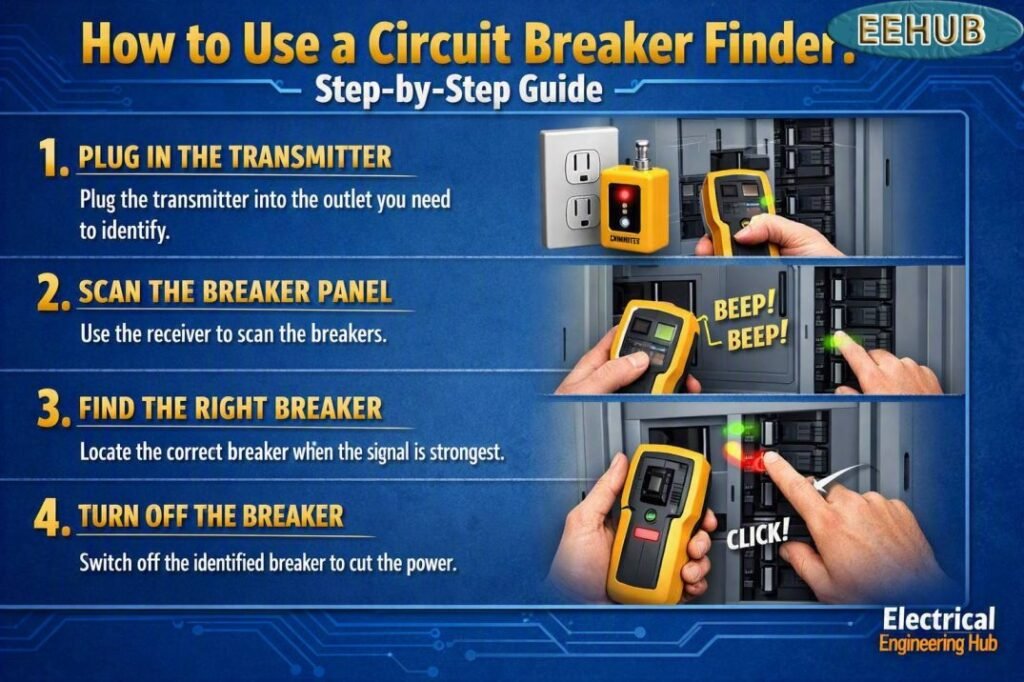
If you are learning how to use a circuit breaker finder, the basic process is simple. Plug the transmitter into the outlet, scan the electrical panel with the receiver, and identify the breaker that produces the strongest signal. However, getting reliable results requires proper setup and a few safety precautions.
This guide explains how to use a circuit breaker finder, how the tool works, common mistakes to avoid, and how to get better results when working with residential electrical circuits.
Quick Comparison: Circuit Breaker Finder Options
The table below gives you a quick look at common options before going through the complete process. It can help you decide whether a dedicated circuit tracer is suitable for your electrical troubleshooting needs.
| Circuit Breaker Finder | Best For | Main Feature | Typical Use |
|---|---|---|---|
| Klein ET310 | Homeowners and electricians | Digital transmitter and receiver | Finding breakers for outlets |
| Basic outlet tester | Simple outlet checks | Wiring indication | Testing receptacles |
| Advanced circuit tracer | Professional troubleshooting | Circuit tracing functions | Complex electrical systems |
| Non-contact voltage tester | Quick voltage detection | Contactless sensing | Checking energized conductors |
For a broader look at electrical testing equipment, see our best electric circuit analyzer guide before choosing a tool for your electrical troubleshooting kit.
What Is a Circuit Breaker Finder?
A circuit breaker finder is a two-piece electrical testing tool designed to identify the circuit breaker connected to a particular electrical outlet or receptacle.
Most basic models have a transmitter and a receiver. The transmitter plugs into an outlet and sends a signal through the circuit. You then move the receiver across the breakers in the electrical panel. When the receiver detects the transmitter’s signal, it indicates the matching breaker.
This is much faster than switching breakers off one at a time and checking whether an outlet has lost power.
The tool is especially useful when:
- Circuit breaker labels are missing or incorrect
- You need to identify an unknown receptacle circuit
- You are preparing an outlet for maintenance
- You want to label an electrical panel
- You are troubleshooting a residential branch circuit
- You need to find the breaker controlling a specific room
How Does a Circuit Breaker Finder Work?
Before learning how to use a circuit breaker finder, it helps to understand the basic operating principle.
The transmitter sends a recognizable electrical signal through the circuit connected to the receptacle. That signal travels back to the electrical panel through the branch-circuit wiring.
The receiver detects the signal when it is moved near the corresponding circuit breaker. Depending on the model, the receiver may provide a visual indication, audible tone, or both.
The important point is that the tool does not simply detect voltage. It is looking for the transmitter’s signal.
This is why a circuit breaker finder can identify one breaker among several energized breakers in the panel.
How to Use a Circuit Breaker Finder Step by Step
Learning how to use a circuit breaker finder is straightforward when you follow the correct sequence.
1. Turn on the circuit breaker finder
Install the required batteries in the receiver and transmitter if your model uses them. Turn the receiver on and make sure it responds normally.
For the Klein ET310, check that the transmitter and receiver are functioning before starting the breaker identification process.
2. Plug the transmitter into the outlet
Insert the transmitter into the electrical receptacle you want to trace.
The transmitter should fit firmly into the outlet. If it does not power up or provide an indication, check whether the receptacle is energized.
Do not force a loose or damaged plug into an outlet.
3. Go to the electrical panel
Locate the electrical panel supplying the outlet. Keep the panel area clear so you can safely scan the breakers.
If you are working around an unfamiliar panel, avoid touching exposed electrical conductors or internal components.
4. Scan the circuit breakers
Hold the receiver according to the manufacturer’s instructions and move it across the breakers.
Start with a slow pass across the entire panel. The receiver may respond differently as it moves close to the correct breaker.
Do not rush this step. Moving too quickly can make the signal harder to identify.
5. Identify the strongest signal
The correct breaker usually produces the strongest or clearest receiver indication.
Depending on the tool, you may hear a tone or see a visual indicator change.
If several breakers appear to respond, move the receiver slowly around the suspected breakers and compare their signal strength.
6. Switch off the suspected breaker
Once you have identified the likely breaker, switch it off.
Return to the outlet and verify that power has been removed. This is an important step because the purpose of breaker identification is to confirm which overcurrent device controls the circuit.
Never rely on the circuit finder alone when electrical safety depends on confirming that power is off.
7. Confirm the result
Check the outlet with an appropriate electrical tester after switching off the breaker.
For electrical work, use a properly rated voltage tester or multimeter to verify the absence of voltage. A circuit breaker finder identifies a circuit, but it should not replace a proper electrical safety check.
8. Label the electrical panel
If the breaker was previously unlabeled, mark it clearly.
Good panel labeling can save considerable time during future maintenance. Write a useful description such as “Living Room Outlets” instead of simply writing “Room 1.”
Klein ET310: A Practical Choice for Breaker Identification
The Klein ET310 is designed for identifying the circuit breaker connected to an electrical receptacle. It uses a transmitter that plugs into the outlet and a receiver used at the electrical panel.
Its simple operating method makes it suitable for homeowners, maintenance workers, technicians, and electricians who need a convenient way to trace receptacle circuits.
One of its biggest advantages is that you do not need to turn breakers off repeatedly just to determine which one controls an outlet.
For readers who want a dedicated tool rather than relying on trial and error, Check the Klein ET310 on Amazon for current pricing and availability.
Klein ET310 Key Features
| Feature | Klein ET310 |
|---|---|
| Tool type | Circuit breaker finder |
| Transmitter | Plug-in receptacle transmitter |
| Receiver | Handheld breaker receiver |
| Primary function | Identify matching breaker |
| Suitable for | Residential branch circuits |
| Operation | Plug, scan, identify, verify |
| Best advantage | Faster breaker identification |
The ET310 is best viewed as a focused circuit identification tool. If you also perform voltage, current, continuity, or power-quality measurements, you may want to add a more versatile electrical tester to your toolbox.
You can compare broader testing options in our best electric circuit analyzer guide if you need more than basic breaker identification.
How to Get More Accurate Results
Knowing how to use a circuit breaker finder is only part of the process. The testing environment can affect the receiver’s response.
Use these practices for better results:
Scan slowly
Move the receiver gradually across the breakers. A slow scan makes it easier to recognize the strongest signal.
Keep the receiver in the correct position
Hold the receiver consistently while scanning. Changing its angle or distance can affect the signal strength.
Check both sides of the panel
Some electrical panels have breakers arranged in different configurations. Scan the complete panel instead of assuming the circuit will be in a particular position.
Verify the suspected breaker
After identifying the breaker, switch it off and confirm that the target receptacle is no longer energized.
Check unusual circuits separately
GFCI-protected, AFCI-protected, multi-wire branch circuits, and other specialized wiring arrangements may require additional attention. If the circuit behaves unexpectedly, stop and investigate rather than assuming the finder is wrong.
Common Mistakes When Using a Circuit Breaker Finder
Even a simple electrical tester can produce confusing results when used incorrectly.
Scanning too quickly
A fast movement across the panel can cause you to miss the strongest signal.
Assuming the first response is correct
The receiver may respond to nearby circuits. Compare signals before deciding which breaker is the match.
Skipping voltage verification
A circuit finder is not a substitute for verifying electrical isolation. Always use an appropriate tester before touching conductors.
Ignoring mislabeled panels
Existing breaker labels should not automatically be trusted. One reason to use a circuit finder is to correct inaccurate panel documentation.
Using the tool on unsuitable circuits
Follow the manufacturer’s instructions and electrical ratings. If the wiring arrangement is unusual or the tool does not provide a clear result, use an appropriate circuit tracing method or consult a qualified electrician.
Circuit Breaker Finder vs Multimeter
A circuit breaker finder and a multimeter serve different purposes.
| Tool | Primary Purpose | Best Use |
|---|---|---|
| Circuit breaker finder | Identify a breaker | Tracing receptacle circuits |
| Digital multimeter | Measure electrical values | Voltage, resistance, continuity |
| Clamp meter | Measure current | Load and current testing |
| Non-contact tester | Detect voltage | Quick preliminary checks |
| Outlet tester | Check receptacle wiring | Basic outlet diagnostics |
A breaker finder is therefore not a replacement for a multimeter. It is a specialized tool that makes circuit identification faster.
If you regularly troubleshoot electrical systems, keeping several complementary electrical testing tools available is more practical than expecting one device to perform every job.
Safety Tips Before Working at an Electrical Panel
Electrical panels can contain lethal voltages. Even when the breaker you are identifying is switched off, other parts of the panel can remain energized.
Follow these precautions:
- Do not touch exposed conductors.
- Keep hands dry when working around electrical equipment.
- Use properly rated test equipment.
- Follow the manufacturer’s instructions.
- Do not remove the panel cover unless you are qualified to do so.
- Verify de-energization before performing electrical work.
- Stop if the panel, wiring, or receptacle appears damaged.
- Hire a qualified electrician when the installation is unfamiliar or unsafe.
The purpose of a breaker finder is to make circuit identification easier, not to eliminate the need for electrical safety procedures.
When Should You Buy a Circuit Breaker Finder?
A circuit breaker finder is worth considering if you frequently work with residential receptacles or need to organize an electrical panel.
It can be particularly useful when moving into an older home, remodeling a property, installing new receptacles, performing maintenance, or correcting incomplete breaker labels.
For occasional use, a simple model may be enough. For regular electrical troubleshooting, look for a tool that is easy to operate, durable, and supported by clear manufacturer instructions.
If you want a dedicated breaker identification tool, Buy the Klein ET310 on Amazon and check the latest price before ordering.
Frequently Asked Questions
Can a circuit breaker finder identify the correct breaker?
Yes. A circuit breaker finder is designed to identify the breaker associated with the receptacle where its transmitter is connected. However, you should confirm the result by switching off the suspected breaker and testing the outlet.
Do I need to turn off the breaker before using a circuit finder?
No. The transmitter normally needs an energized receptacle to send its identifying signal. Follow the specific operating instructions for your model and do not work on the circuit until power has been properly verified as off.
Can I use the Klein ET310 on every electrical circuit?
The Klein ET310 is primarily intended for identifying breakers connected to receptacles. Always check the manufacturer’s specifications and instructions before using it on unusual wiring arrangements or specialized circuits.
Why does my circuit breaker finder detect multiple breakers?
Nearby circuits can sometimes produce responses because of wiring layout, signal coupling, or panel configuration. Scan slowly and compare the strength of the responses. Then switch off the suspected breaker and verify the target outlet.
Is a circuit breaker finder the same as a multimeter?
No. A circuit breaker finder identifies a circuit breaker, while a multimeter measures electrical quantities such as voltage, resistance, and continuity. They perform different jobs and are often useful together.
Final Thoughts
Learning how to use a circuit breaker finder can save a lot of time when working with an unlabeled or poorly labeled electrical panel. The process is simple: connect the transmitter to the receptacle, scan the breakers, identify the strongest response, switch off the suspected breaker, and verify the result with an appropriate tester.
The Klein ET310 is a practical option for homeowners and professionals who want a dedicated tool for identifying receptacle circuits. It does not replace proper electrical testing, but it can make breaker identification much faster and more convenient.
For anyone building a complete electrical troubleshooting kit, explore our best electric circuit analyzer recommendations to compare tools for voltage, current, circuit tracing, and other electrical measurements.
Get new guides in your feed. Follow Electrical Insights on LinkedIn for new electrical standards guides, calculators and design tips from Azad Circuit Hub.
#CircuitBreakerFinder, #BreakerFinder, #ElectricalTesting, #ElectricalTools, #CircuitBreaker, #ElectricalSafety, #ElectricianTools, #HomeElectrical, #ElectricalTroubleshooting, #DIYElectrical