
kW vs kVA Cable Sizing: Which Should You Use?
When selecting a cable for an electrical load, one of the first questions is whether sizing should be based on kW or kVA. The answer depends on the type of load, power factor, system voltage, and the way the equipment rating is provided. Understanding kW vs kVA Cable Sizing helps prevent undersized conductors, excessive voltage drop, nuisance tripping, and unnecessary cable costs.
For most AC distribution systems, cable current is the key value used for conductor selection. Since kVA represents apparent power and includes the effect of power factor, it is often the more direct starting point for AC cable sizing.
kW vs kVA Cable Sizing
| Parameter | kW | kVA |
|---|---|---|
| Represents | Real power | Apparent power |
| Unit | Kilowatt | Kilovolt-ampere |
| Includes power factor? | Yes, indirectly | No |
| Common use | Energy consumption and useful output | Transformers, generators and AC distribution |
| Directly related to AC current | Depends on PF | Yes |
| Typical cable-sizing starting point | Requires PF | Usually preferred |
| Example at 400 V, 100 A, 3-phase | 69.3 kW at PF 1.0 | 69.3 kVA |
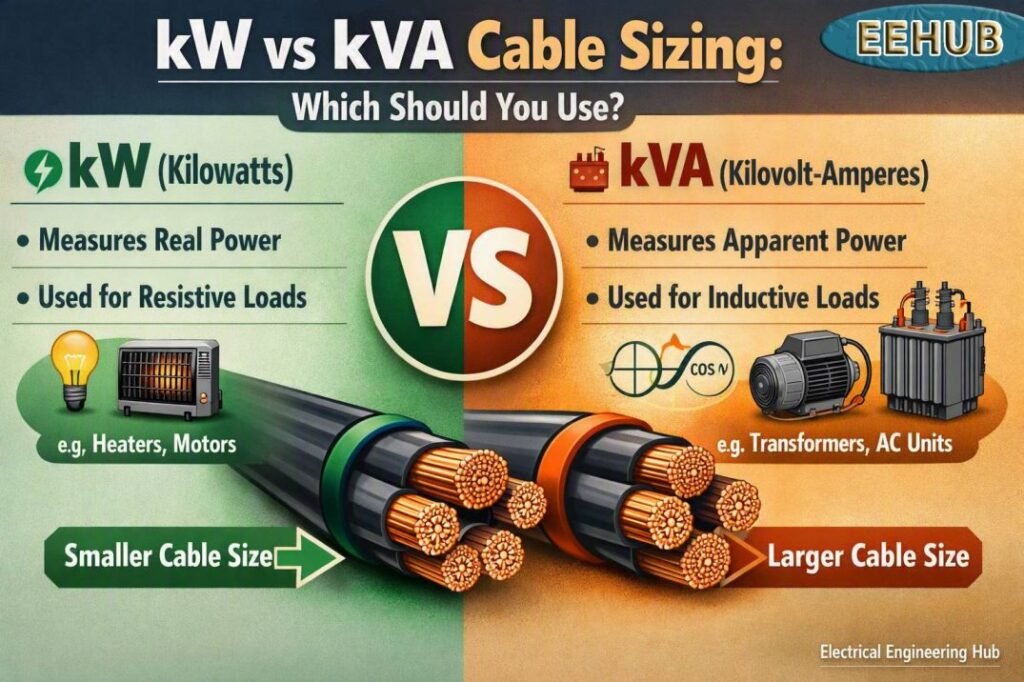
Table of Contents
Table of Contents
Understanding kW and kVA
Kilowatt (kW) measures real electrical power. It is the portion of electrical power that performs useful work, such as turning a motor, producing heat, or powering electronic equipment.
Kilovolt-ampere (kVA) measures apparent power. It combines real power and reactive power and is commonly used for equipment such as transformers, alternators, UPS systems, and generators.
The relationship between them is:
kW = kVA × Power Factor
Therefore:
kVA = kW ÷ Power Factor
For example, a 75 kW motor operating at a power factor of 0.85 has an apparent power of:
75 ÷ 0.85 = 88.24 kVA
That difference matters because the cable carries current associated with apparent power rather than simply the useful kW output.
Why kVA Is Usually Better for AC Cable Sizing
Cable conductors are selected according to the current they must safely carry. For a three-phase system, apparent power can be converted directly into current using:
I = kVA × 1000 ÷ (√3 × V)
For a single-phase system:
I = kVA × 1000 ÷ V
This makes kVA particularly useful when sizing feeders supplied from transformers, generators, or UPS systems.
For example, consider a 100 kVA, 400 V three-phase transformer:
I = 100,000 ÷ (1.732 × 400)
I ≈ 144.3 A
The cable therefore needs an ampacity suitable for approximately 144 A before applying the relevant installation factors, voltage-drop requirements, and protective-device considerations.
For this reason, kW vs kVA Cable Sizing should normally start with the apparent-power rating when the load is supplied by an AC source with a known kVA capacity.
When kW Is Used for Cable Sizing
kW can still be used, but the power factor must be known or reasonably estimated.
Suppose a three-phase load consumes 50 kW at 400 V and has a power factor of 0.90.
First calculate apparent power:
kVA = 50 ÷ 0.90 = 55.56 kVA
Then calculate current:
I = 55,560 ÷ (1.732 × 400)
I ≈ 80.1 A
If someone incorrectly treats the 50 kW as 50 kVA, the calculated current would be only about 72.2 A. That difference can lead to an unsuitable conductor selection.
This is one of the main reasons kW alone should not be used for AC cable calculations unless the power factor is included.
kW vs kVA Cable Sizing Example
Consider a 30 kW three-phase motor connected to a 400 V supply with a power factor of 0.85.
The apparent power is:
kVA = 30 ÷ 0.85 = 35.29 kVA
Current becomes:
I = 35,290 ÷ (1.732 × 400)
I ≈ 50.9 A
The cable should not simply be selected from the 30 kW figure. The calculated operating current is approximately 51 A, and the final conductor size must then be checked against ampacity, installation method, ambient temperature, grouping, voltage drop, and applicable electrical codes.
For motor circuits, starting current and the requirements for motor branch circuits and overload protection also need consideration.
Typical Cable Current Ratings
Cable ampacity varies significantly with conductor material, insulation temperature rating, installation method, ambient temperature, number of loaded conductors, and local code requirements.
The following values are examples rather than universal ratings.
| Copper conductor | Example ampacity range* | Typical application |
|---|---|---|
| 6 mm² | 32–46 A | Small feeders and equipment |
| 10 mm² | 44–63 A | Medium loads |
| 16 mm² | 59–85 A | Larger feeders |
| 25 mm² | 75–105 A | Distribution circuits |
| 35 mm² | 92–130 A | Higher-current feeders |
| 50 mm² | 110–160 A | Large feeders |
| 70 mm² | 140–200 A | Heavy distribution |
*Actual allowable ampacity must be taken from the applicable cable standard and installation conditions. These ranges should not replace a code-compliant cable selection.
A cable’s current rating is more important than its nominal kW or kVA label. The calculated design current must remain within the permitted conductor ampacity after all applicable correction factors.
How Power Factor Changes Cable Current
Power factor has a direct effect on current when the real power remains constant.
| Load | Power Factor | kW | Approx. kVA |
|---|---|---|---|
| Load A | 1.00 | 50 | 50.0 |
| Load B | 0.95 | 50 | 52.6 |
| Load C | 0.90 | 50 | 55.6 |
| Load D | 0.85 | 50 | 58.8 |
| Load E | 0.80 | 50 | 62.5 |
At lower power factors, the same useful power requires greater current. Higher current can increase conductor losses and voltage drop.
This is particularly important in industrial facilities with induction motors, transformers, welding equipment, and other inductive loads.
Cable Sizing Also Requires Voltage Drop
Ampacity is only one part of cable selection. A conductor can have enough current-carrying capacity but still produce excessive voltage drop over a long run.
Voltage drop depends on factors such as:
- Cable length
- Load current
- Conductor resistance
- Reactance
- Power factor
- Cable arrangement
- Operating temperature
For a long feeder, the designer should calculate both ampacity and voltage drop and use the larger required conductor size.
For example, a 63 A-rated cable may safely carry the design current, but a long 150 m run could require a larger cable to maintain an acceptable voltage at the load.
If you are working through the complete conductor selection process, use a cable size calculator to check current capacity, voltage drop, conductor size, and other key parameters together.
kW vs kVA Cable Sizing for Motors
Motor nameplates commonly provide power in kW or horsepower, while the electrical input current depends on efficiency and power factor.
For a motor:
Input kW = Output kW ÷ Efficiency
Then:
kVA = Input kW ÷ Power Factor
For example, assume a 30 kW motor has 92% efficiency and 0.85 power factor.
Input power:
30 ÷ 0.92 = 32.61 kW
Apparent power:
32.61 ÷ 0.85 = 38.36 kVA
At 400 V three-phase:
I = 38,360 ÷ (1.732 × 400)
I ≈ 55.4 A
This illustrates why motor cable sizing should not be based only on the mechanical output rating.
Transformer and Generator Cable Sizing
kVA is especially convenient for transformers and generators because these devices are commonly rated in kVA.
For a 250 kVA, 400 V three-phase transformer:
I = 250,000 ÷ (1.732 × 400)
I ≈ 360.8 A
The feeder must then be selected based on the actual design requirements, including transformer loading, cable installation method, allowable voltage drop, short-circuit withstand, protective-device coordination, and applicable code.
For generator-fed systems, the generator’s kVA rating also provides a useful starting point for estimating maximum available current.
For larger distribution systems, a cable size calculator can simplify the first-stage calculation before the final engineering checks are completed.
Which One Should You Use?
The practical rule is simple:
- Use kVA when you know the apparent-power rating or when sizing cables for AC equipment such as transformers, generators, and UPS systems.
- Use kW when the load is specified only in real power, but convert it to kVA using the actual power factor before calculating current.
The final cable size should never be selected from kW or kVA alone. The design current, installation conditions, voltage drop, ambient temperature, grouping, conductor material, insulation rating, and applicable electrical standard all matter.
| Situation | Preferred starting value |
|---|---|
| Transformer | kVA |
| Generator | kVA |
| UPS | kVA |
| Motor with kW rating | kW + efficiency + PF |
| Resistive heater | kW, with PF close to 1 |
| Industrial mixed load | kVA or calculated demand current |
| Long cable run | Design current + voltage-drop calculation |
Common Cable Sizing Mistakes
Several mistakes appear frequently when selecting conductors for AC systems:
- Treating kW as kVA without considering power factor.
- Ignoring motor efficiency when starting with motor output power.
- Selecting cable solely from ampacity without checking voltage drop.
- Using a generic cable ampacity without considering installation conditions.
- Ignoring ambient-temperature and grouping correction factors.
- Selecting the cable before determining the correct protective-device rating.
- Assuming the same cable size works for every installation method.
Avoiding these errors makes cable selection safer and more economical.
Final Verdict
kW vs kVA Cable Sizing comes down to understanding how electrical power becomes current in an AC circuit. kW represents useful real power, while kVA represents apparent power and provides a direct relationship with AC current.
For transformers, generators, and UPS equipment, kVA is usually the most convenient starting point. For motors and other loads specified in kW, include efficiency and power factor before calculating the design current.
After calculating current, always verify cable ampacity, voltage drop, installation conditions, short-circuit requirements, and local electrical standards.
If you want a faster preliminary calculation, use a cable size calculator to estimate the required conductor size before carrying out the final engineering checks.
FAQs
Is cable sizing based on kW or kVA?
For AC systems, cable sizing is fundamentally based on current. kVA is often more useful because it can be converted directly into current. If the load is given in kW, power factor must be considered before calculating current.
Can I use kW directly to select a cable?
You can use kW as the starting point only when the power factor and other required load information are known. For motors, efficiency should also be considered because the nameplate kW may represent mechanical output rather than electrical input.
Why is kVA used for transformers?
Transformers are commonly rated in kVA because their thermal limits depend on voltage and current rather than the load’s power factor. The kVA rating therefore provides a convenient measure of the maximum apparent load the transformer can supply.
Does a low power factor require a larger cable?
Yes, for the same kW load, a lower power factor results in higher current. Higher current can require a larger conductor and may also increase voltage drop and resistive losses.
What should I check after calculating cable current?
Check the conductor’s allowable ampacity, installation method, temperature and grouping correction factors, voltage drop, short-circuit withstand, protective-device coordination, and the requirements of the applicable electrical standard. The final cable selection should be based on the complete design rather than kW or kVA alone.
Get new guides in your feed. Follow Electrical Insights on LinkedIn for new electrical standards guides, calculators and design tips from Azad Circuit Hub.
kWvskVA, #CableSizing, #ElectricalEngineering, #CableSizeCalculator, #PowerFactor, #ElectricalDesign, #CableCalculation, #ElectricalInstallation, #KWtoKVA, #EngineeringGuide
