
Best Thermal Camera for Home Inspections: 3 Top Picks for 2026
A thermal camera can reveal problems that are invisible to the naked eye. Heat loss around windows, overloaded electrical connections, wet insulation, HVAC problems, and hot pipes can all create temperature patterns that help you find issues before they become expensive repairs.
The best thermal camera for home inspections should offer a clear thermal image, useful temperature measurement, practical portability, and enough resolution to identify small hot or cold spots. It should also be simple enough for homeowners while providing features that professionals can use during routine inspections.
For this guide, I compared three popular options: the FLIR C5, Klein Tools TI250, and FLIR Edge Pro. Each takes a different approach, so the right choice depends on whether you want a dedicated inspection camera, a straightforward tool for electrical work, or a smartphone-connected thermal imaging solution.
Best Thermal Camera for Home Inspections: Features Comparison
| Thermal Camera | Thermal Resolution | Temperature Range | Key Feature | Best For | Buy on Amazon |
|---|---|---|---|---|---|
| FLIR C5 | 160 × 120 | -20°C to 400°C (-4°F to 752°F) | MSX image enhancement, Wi-Fi, compact design | Professional home inspections | Buy Now |
| Klein Tools TI250 | 160 × 120 | -20°C to 400°C (-4°F to 752°F) | IR and visual imaging, adjustable emissivity | Electrical and HVAC troubleshooting | Buy Now |
| FLIR Edge Pro | Up to 640 × 480* | Approx. -20°C to 400°C* | Wireless smartphone connection | Detailed mobile inspections | Buy Now |
*Specifications can vary by Edge Pro configuration and software mode. Check the current Amazon listing before purchasing.
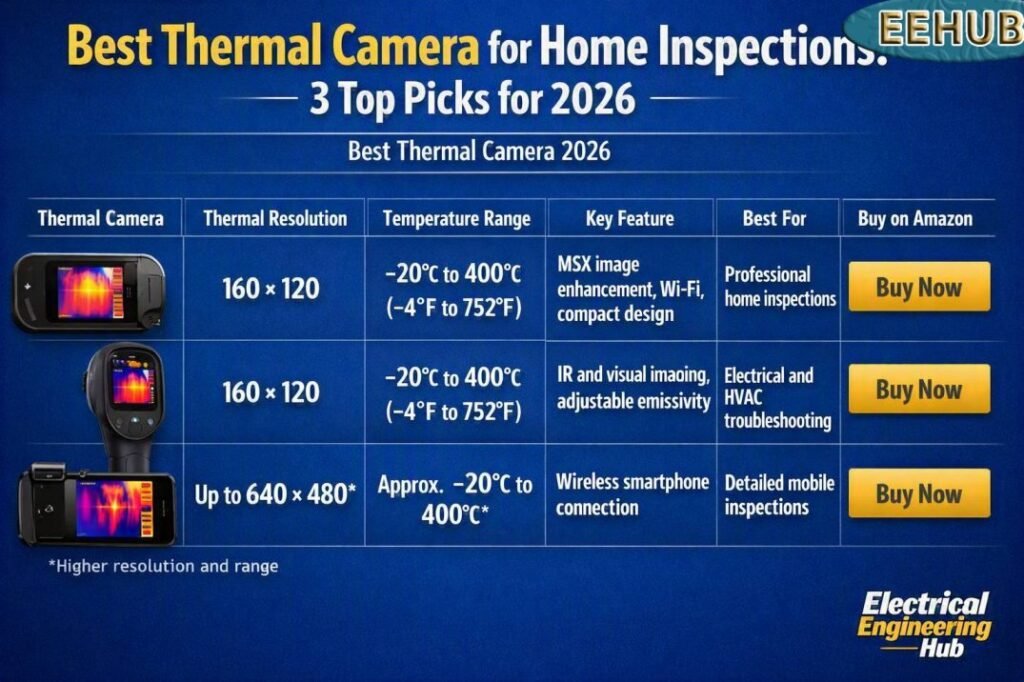
Table of Contents
Table of Contents
1. FLIR C5
The FLIR C5 is one of the most complete choices for people who want a compact inspection camera without carrying a large professional thermal imaging system. Its 160 × 120 thermal resolution provides enough detail for many residential applications, while FLIR's MSX technology adds visual details to the thermal image.
That combination is particularly useful when inspecting walls, ceilings, electrical panels, windows, and mechanical equipment. Instead of seeing only a block of different temperatures, you can often identify the physical feature associated with the temperature change.
The C5 also includes a built-in visual camera, Wi-Fi connectivity, and a compact touchscreen design. Its temperature measurement range is suitable for most residential inspection tasks.
Why the FLIR C5 stands out
- 160 × 120 thermal resolution
- MSX thermal image enhancement
- Built-in visible-light camera
- Compact and rugged design
- Wi-Fi connectivity
- On-camera temperature measurement
- Suitable for electrical, HVAC, plumbing, and building inspections
The FLIR C5 is particularly appealing if you regularly document inspection findings. Images can be stored and transferred without relying entirely on a separate device.
If you want a professional-grade compact option, check the FLIR C5 price and availability on Amazon before buying.
2. Klein Tools TI250
Klein Tools designed the TI250 with tradespeople in mind, and that makes it an interesting alternative for electrical contractors, HVAC technicians, maintenance professionals, and homeowners who want a practical thermal imaging tool.
The camera combines thermal and visual imaging, making it easier to understand what you are looking at. Its 160 × 120 thermal resolution is useful for finding overheated circuit breakers, loose electrical connections, hot motors, HVAC temperature differences, and plumbing issues.
One advantage of the TI250 is its relatively straightforward operation. You do not need to spend hours learning complicated thermal analysis software before using it for basic troubleshooting.
Klein Tools TI250 highlights
- 160 × 120 thermal resolution
- -20°C to 400°C temperature range
- Thermal and visual image modes
- Adjustable emissivity
- Center-point temperature measurement
- Rechargeable battery
- Designed for professional trades
- Compact handheld format
For electrical inspections, emissivity adjustment is useful because different materials emit infrared radiation differently. A shiny metal surface, for example, can produce misleading readings if the camera settings and inspection technique are not appropriate.
The TI250 is a strong choice if your inspections involve a lot of electrical equipment and mechanical systems. See the Klein Tools TI250 on Amazon to check the current price and seller options.
3. FLIR Edge Pro
The FLIR Edge Pro takes a different approach. Rather than being a traditional standalone thermal camera, it is designed to work with a smartphone or compatible mobile device. This can be convenient if you already use your phone for inspection photographs, reports, and client communication.
Its wireless design makes it easy to move around a property while keeping the thermal image on the phone screen. Depending on the configuration and software mode, the Edge Pro can provide considerably more image detail than basic entry-level thermal cameras.
That makes it useful for inspecting building envelopes, HVAC systems, electrical equipment, insulation, moisture-related temperature differences, and other areas where greater image detail can help.
If electrical troubleshooting is your primary application, explore our detailed guide to the best thermal imaging camera for electricians for more specialized recommendations.
FLIR Edge Pro advantages
- Smartphone-based thermal imaging
- Wireless operation
- High-resolution imaging options
- Convenient image sharing
- Compact and portable
- Useful FLIR thermal analysis features
- Suitable for professional documentation
The main consideration is that your phone becomes part of the inspection system. You should therefore check device compatibility and the current FLIR app requirements before purchasing.
Check the FLIR Edge Pro on Amazon if you prefer smartphone-based thermal inspections.
What Should You Look for in a Thermal Camera?
Choosing the best thermal camera for home inspections is not simply about buying the model with the highest resolution. Several specifications affect the usefulness of a thermal image.
Thermal resolution
Higher thermal resolution provides more pixels and generally makes it easier to identify smaller temperature differences and objects at greater distances.
For routine residential work, 160 × 120 can be quite capable. Higher-resolution systems become more attractive for detailed building diagnostics and professional reporting.
Temperature range
A wide measurement range is useful when inspecting electrical equipment, heating systems, appliances, and mechanical components. However, the maximum range should not be the only deciding factor.
Image enhancement
Features such as FLIR MSX can make thermal images easier to interpret. Combining thermal information with visible edges can help you identify exactly where a hot or cold area is located.
Emissivity adjustment
Adjustable emissivity is important when measuring different materials. Correct settings can improve temperature measurement accuracy, particularly on surfaces that reflect infrared energy.
Field of view
A wider field of view is helpful when scanning walls, ceilings, electrical panels, and larger areas. A narrower field of view can be useful for examining smaller components from a suitable distance.
Which Thermal Camera Is Best for Home Inspections?
The best thermal camera for home inspections depends on the type of work you perform.
The FLIR C5 is the strongest all-around option for users who want a compact standalone inspection camera with useful documentation features. Its combination of resolution, MSX enhancement, Wi-Fi, and rugged construction makes it a well-rounded choice.
The Klein Tools TI250 is especially attractive for electricians and HVAC technicians who want a straightforward handheld tool for troubleshooting electrical and mechanical systems.
The FLIR Edge Pro makes more sense for users who prefer smartphone-based thermal imaging and want the convenience of viewing, saving, and sharing images through a mobile device.
If your work involves electrical troubleshooting more than general building inspection, you may also want to compare our guide to the best thermal imaging camera for electricians before choosing a model.
Thermal Camera Uses Around the Home
A thermal camera can be useful for many inspection tasks, including:
- Finding overheated circuit breakers
- Detecting loose electrical connections
- Checking HVAC supply and return temperatures
- Identifying missing insulation
- Finding unusual heat loss around windows
- Locating potential moisture-related cold spots
- Checking radiant floor heating
- Inspecting motors and pumps
- Finding hot water pipe routes
- Checking appliances and electrical equipment
Remember that a thermal camera does not directly see through walls. It detects infrared radiation from the surface. A temperature pattern can indicate a problem, but additional testing may be required to determine the exact cause.
How to Get Better Thermal Images
Even a high-quality camera can produce poor results if it is used incorrectly.
Allow equipment to operate long enough to reach its normal condition before scanning. Keep the camera at an appropriate distance and avoid relying on a single temperature reading. Look for patterns and compare similar components whenever possible.
Reflections can also create misleading readings, especially on shiny metal surfaces. When accurate temperature measurement matters, use appropriate emissivity settings and follow the manufacturer's recommendations.
For electrical inspections, never open energized equipment or place yourself in an unsafe position simply to obtain a better thermal image. Follow appropriate electrical safety procedures.
Final Verdict
For most residential inspectors, the FLIR C5 offers the best balance of portability, image quality, measurement capability, and inspection-focused features. The Klein Tools TI250 is a practical alternative for electrical and HVAC troubleshooting, while the FLIR Edge Pro is an excellent option for users who prefer smartphone-based thermal imaging.
The right choice ultimately comes down to how you plan to use the camera. Consider thermal resolution, temperature range, emissivity controls, image enhancement, portability, and reporting features rather than choosing solely by price.
Frequently Asked Questions
Is a thermal camera worth it for home inspections?
Yes. Thermal imaging can help identify unusual temperature patterns associated with insulation gaps, electrical overheating, HVAC problems, and possible moisture issues. It is most valuable when the thermal image is combined with visual inspection and other diagnostic methods.
What thermal resolution is good for home inspections?
A 160 × 120 thermal sensor is suitable for many residential inspection tasks. Higher resolutions can provide more detail, especially when inspecting smaller components or working farther away from the target.
Can thermal cameras detect water leaks?
They can sometimes help locate temperature patterns associated with water leaks, but they do not directly detect water. A leak may change the surface temperature, creating a visible thermal anomaly. Moisture meters and other testing methods may be needed to confirm the problem.
Can a thermal camera see through walls?
No. Thermal cameras generally measure infrared radiation from the surface of an object. They cannot see through walls like an X-ray system. However, temperature differences on a wall surface can sometimes reveal insulation problems, air leakage, pipes, or other hidden conditions.
Is the FLIR C5 better than the Klein TI250?
The FLIR C5 is generally better suited to users who prioritize compact professional inspections, image enhancement, and connectivity. The Klein TI250 is a strong choice for tradespeople who want a simple thermal imaging tool for electrical, HVAC, and maintenance troubleshooting.
Related Guides
- How to Use a Thermal Camera for Electrical Faults
- FLIR ONE Pro vs Seek Thermal
- Best Thermal Imaging Camera Under $500
Get new guides in your feed. Follow Electrical Insights on LinkedIn for new electrical standards guides, calculators and design tips from Azad Circuit Hub.
ThermalCamera, #HomeInspections, #BestThermalCamera, #ThermalImaging, #HomeInspectionTools, #InfraredCamera, #ThermalImagingCamera, #DIYHomeInspection, #ElectricalInspection, #ThermalCamera2026
