NEC Article for Box Fill: Rules, Table and Formula (2026)
The NEC article for box fill is Article 314, and the rule that does the work is section 314.16. It decides how many conductors, devices and fittings can go in an outlet, device or junction box before the box is overcrowded and the wires run hot or get damaged. This guide shows where box fill sits in the code book, what counts toward it, the formula, and a worked example, with a free one-page PDF cheat sheet and a chart you can save.
Quick answer: Under the NEC article for box fill, the calculation is done in section 314.16. Add up the volume allowances for every conductor, clamp, fitting, device and ground in the box (Table 314.16(B)), then confirm the box volume (Table 314.16(A), or the marked volume) is equal or larger.
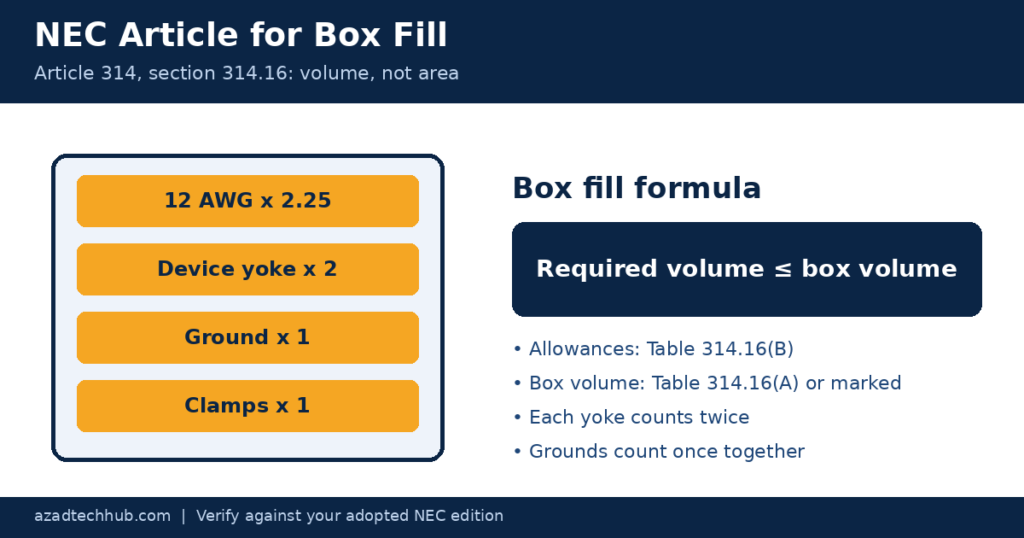
Table of Contents
Table of Contents
What NEC Article Covers Box Fill Calculations?
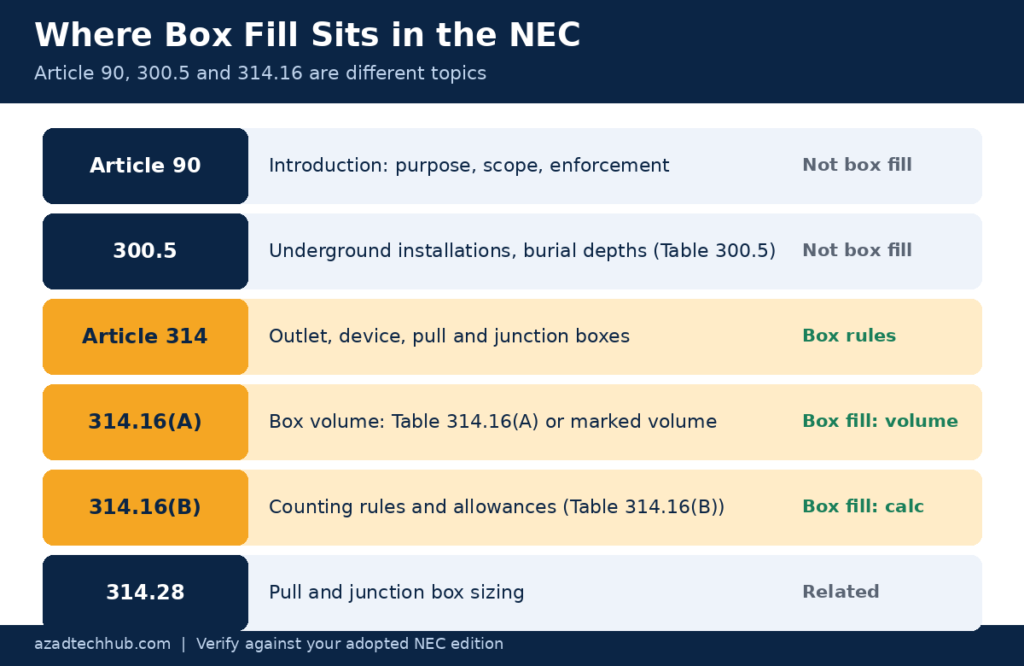
The NEC article for box fill is Article 314, titled Outlet, Device, Pull, and Junction Boxes; Conduit Bodies; Fittings; and Handhole Enclosures. Inside it, section 314.16 covers the number of conductors in outlet, device and junction boxes and conduit bodies. Part (A) gives the box volume, and part (B) gives the fill calculation. So when someone asks where to find box fill in the NEC, the answer is Chapter 3, Article 314, section 314.16.
Two other numbers confuse searchers. Article 90 is the NEC’s introduction: it states the purpose of the code, its scope, how it is enforced, and the difference between mandatory and permissive rules. It does not contain box fill. Section 300.5 covers underground installations and gives the minimum burial depths in Table 300.5. It is a different topic, but it matters when a box or raceway is buried. Use the map below to keep them straight.
What Counts Toward Box Fill Under the NEC Article for Box Fill?
Section 314.16(B) assigns a volume allowance to each item. The sizes come from Table 314.16(B):
| Conductor | Volume allowance |
|---|---|
| 18 AWG | 1.50 cu in. |
| 16 AWG | 1.75 cu in. |
| 14 AWG | 2.00 cu in. |
| 12 AWG | 2.25 cu in. |
| 10 AWG | 2.50 cu in. |
| 8 AWG | 3.00 cu in. |
| 6 AWG | 5.00 cu in. |
Here is what counts, in plain terms:
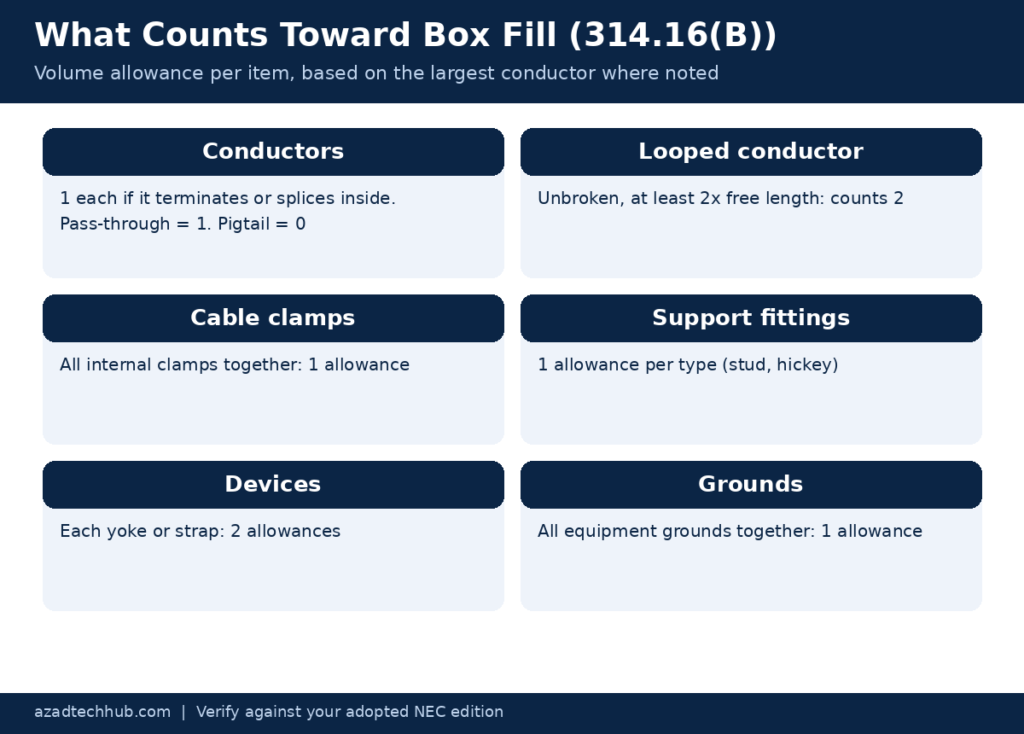
- Conductors: each conductor that comes from outside the box and ends or is spliced inside counts once. An unbroken conductor that passes through counts once. A pigtail that starts and ends inside the box counts zero.
- Looped conductors: an unbroken conductor looped through the box that is at least twice the minimum free length counts twice.
- Cable clamps: one or more internal clamps count as one allowance, based on the largest conductor.
- Support fittings: each type of fixture stud or hickey counts as one allowance.
- Devices: each yoke or strap counts as two allowances, based on the largest conductor connected to it.
- Equipment grounding conductors: all grounds together count as one allowance, based on the largest one.
Box Fill Calculation Formula
The box fill calculation formula in the NEC article for box fill is simple:
Required volume = sum of all volume allowances (count × cu in per item)
The box passes when its volume is equal to or greater than that number. Box volume comes from Table 314.16(A) for standard metal boxes, or from the volume marked on the box, which is how nonmetallic boxes are rated. A few standard sizes are below.
| Box | Volume | Max 14 AWG | Max 12 AWG |
|---|---|---|---|
| 3 × 2 × 2-1/2 in. device | 12.5 cu in. | 6 | 5 |
| 3 × 2 × 3-1/2 in. device | 18.0 cu in. | 9 | 8 |
| 4 × 1-1/2 in. round or octagonal | 15.5 cu in. | 7 | 6 |
| 4 × 1-1/2 in. square | 21.0 cu in. | 10 | 9 |
| 4-11/16 × 1-1/2 in. square | 29.5 cu in. | 14 | 13 |
Those maximums only apply when every conductor is the same size and nothing else is in the box, so a real calculation gives a smaller number. For this reason a NEC box fill chart is a starting point, not the answer.
Electrical Box Fill Examples
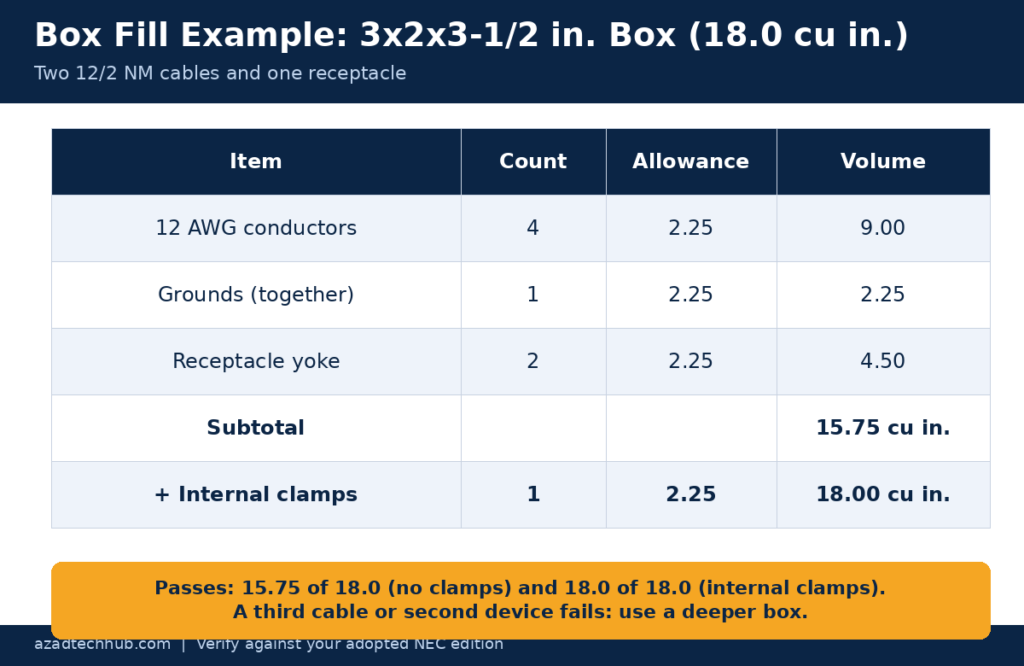
To see the NEC article for box fill in action, take a single-gang 3 × 2 × 3-1/2 in. box (18.0 cu in.) holding two 12/2 NM cables and one receptacle:
| Item | Count | Allowance | Volume |
|---|---|---|---|
| 12 AWG insulated conductors | 4 | 2.25 | 9.00 |
| Equipment grounding conductors (together) | 1 | 2.25 | 2.25 |
| Receptacle yoke | 2 | 2.25 | 4.50 |
| Total (no internal clamps) | 15.75 | ||
| Add internal cable clamps | 1 | 2.25 | 18.00 |
Without internal clamps the box is at 15.75 of 18.0 cu in. and passes. With internal clamps it reaches exactly 18.0, so it passes with no room to spare. Adding a third cable or a second device would fail it, and the fix is a deeper or larger box.
Box Fill Calculation Worksheet and PDF
For field use, download our one-page NEC article for box fill cheat sheet. It holds the allowance table, the counting rules, standard box volumes and a blank worksheet in our own words:
The NEC itself is copyrighted, so we do not host it. You can read it free on NFPA’s free access page.
If you are asking about the NEC article for box fill 2022, note that there is no 2022 NEC. The editions are 2017, 2020, 2023 and 2026, and the box fill method in 314.16 is largely the same across them. Section letters can move, so check the edition your inspector uses.
Box Fill vs Conduit Fill
The NEC article for box fill and the conduit fill rules answer different questions, so a box fill calculator and a conduit fill calculator are not interchangeable. Box fill is about volume in cubic inches inside a box. Conduit fill is about cross-sectional area as a percentage of a raceway. A circuit can need both: the box must hold the splices and devices, and the conduit feeding it must hold the wires. Check conduit with our conduit fill calculator and our guide to the NEC article for conduit fill. Larger runs may need a pull box, covered in our NEC 314.28 pull box sizing guide.
Related NEC Rules for Boxes and Outlets
The NEC article for box fill is one piece of a box installation. Related guides on this site:
- GFCI locations that decide which device goes in the box: NEC article 210.8 A.
- Which way to mount the receptacle: NEC code for outlet orientation.
- Grounding conductors that count toward fill: NEC article for grounding and bonding.
- Room-by-room wiring rules: home electrical wiring NEC code guide.
- Circuit sizing: the AC cable size calculator and full load amperage calculator, plus more on our electrical calculators page.
Tools for Box Work
Once the NEC article for box fill check passes, the right gear helps. As an Amazon Associate I earn from qualifying purchases, at no extra cost to you. See our affiliate disclosure.
- Deep and extension boxes: extra volume is the cheapest fix for an overfull box.
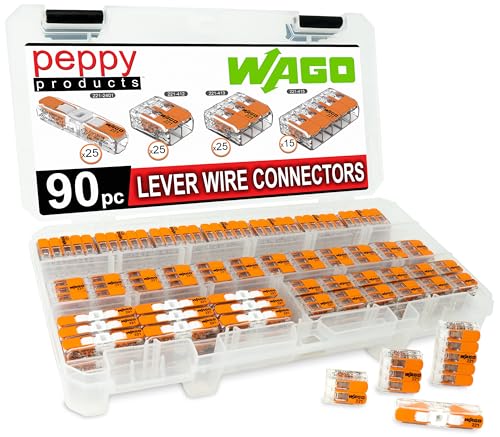
- Wire connectors: compact lever connectors make crowded boxes easier to wire. See our WAGO lever nut guide.
- Wire strippers: see our best wire strippers.
- Testers: confirm the box is dead before you work. See our voltage tester reviews.
- Reference: a pocket code book keeps Table 314.16 in your tool bag.



Frequently Asked Questions
What NEC article covers box fill calculations?
Article 314, section 314.16.
Where can I find box fill in the NEC?
The NEC article for box fill is Article 314 in Chapter 3, and section 314.16 holds the rules.
What is article 300.5 of the NEC code?
It covers underground installations and minimum cover depths (Table 300.5). It is unrelated to box fill.
What does NEC article 90 contain?
The introduction: purpose, scope, enforcement, and how to read mandatory and permissive rules.
How do I do box fill calculations in the NEC?
Add the allowances in Table 314.16(B) for conductors, clamps, fittings, devices and grounds, then compare with the box volume.
Conclusion
The NEC article for box fill comes down to Article 314 and section 314.16: add the volume allowances, then check them against the box volume. Download the cheat sheet, keep a spare deep box in the truck, and check your adopted edition. For the conduit side of the circuit, use the conduit fill calculator.
About This Guide
Written by Abdul Wassay, an electrical engineer who publishes standards-based calculators and guides on Azad Circuit Hub. This guide is educational, not a substitute for the NEC or a licensed electrician. Verify against the edition and local amendments your AHJ enforces. Spotted an error? Use our contact page.
Sources: NFPA 70, National Electrical Code (Article 90, 300.5, Article 314 including 314.16, 314.28).
Get new guides in your feed. Follow Electrical Insights on LinkedIn for new electrical standards guides, calculators and design tips from Azad Circuit Hub.