
Renogy vs Victron Solar Charge Controller: Which MPPT Controller Is Better?
Choosing the right solar charge controller can have a major effect on charging efficiency, battery life, and the overall performance of an off-grid solar system. Two popular names in this market are Renogy and Victron Energy. Both offer MPPT and PWM controllers, but they target somewhat different users and system requirements.
This Renogy vs Victron Solar Charge Controller comparison looks at efficiency, features, monitoring, installation, compatibility, reliability, and value to help you choose the better option for your solar setup.
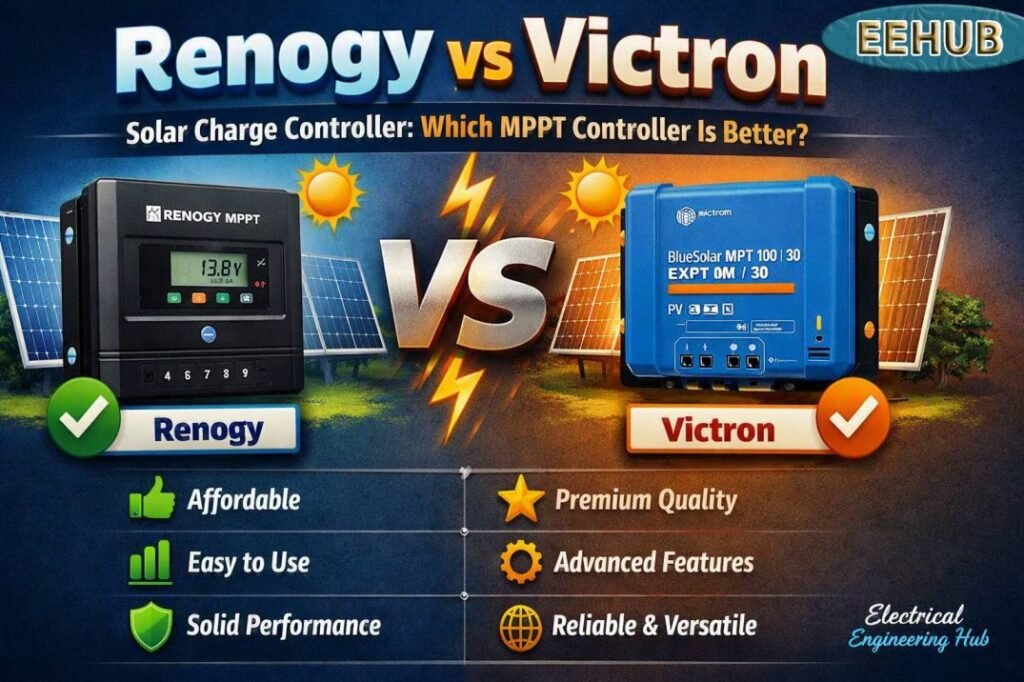
Table of Contents
Table of Contents
| Feature | Renogy MPPT | Victron MPPT |
|---|---|---|
| Controller type | MPPT | MPPT |
| Typical efficiency | Up to around 98% depending on model | Up to around 98% depending on model |
| Battery compatibility | Lead-acid and lithium on compatible models | Lead-acid, lithium and other configurable chemistries |
| Bluetooth monitoring | Available on selected models | Available through compatible SmartSolar models |
| Mobile monitoring | Renogy app on supported models | VictronConnect app |
| Programming | Simple to advanced depending on model | Highly configurable |
| Best for | Home, RV and small off-grid systems | Advanced solar and off-grid systems |
| Installation | User-friendly | Better suited to users wanting detailed configuration |
| Price | Generally more affordable | Generally higher priced |
| Product ecosystem | Renogy ecosystem | Large Victron ecosystem |
Use this quick comparison as a starting point, then review the detailed sections below before choosing a controller for your system.
Where to Buy Renogy MPPT Solar Charge Controller
Where to Buy Victron MPPT Solar Charge Controller
For a broader look at controller types and suitable applications, see our guide to the best mppt solar charge controller options before making your final purchase.
Renogy vs Victron Solar Charge Controller: Main Differences
The biggest difference is not simply charging efficiency. Both brands make efficient MPPT controllers, but their approach to system management is different.
Renogy focuses heavily on ease of use. Its charge controllers are popular with RV owners, campers, DIY solar users, and smaller residential systems. Many Renogy products combine straightforward setup with useful features such as Bluetooth monitoring and preset battery profiles.
Victron Energy takes a more advanced approach. Its SmartSolar MPPT controllers offer extensive configuration options and integrate with other Victron equipment. This makes them particularly attractive for larger off-grid systems, boats, telecom applications, and professional installations.
If you want a controller that is easy to install and configure, Renogy can be an excellent choice. If you need detailed control and plan to expand your system, Victron often has the advantage.
MPPT Charging Performance
Maximum Power Point Tracking, or MPPT, allows the controller to operate the solar array at an efficient voltage and convert that available energy into suitable battery charging power.
For example, a solar panel may produce power at a voltage that is significantly higher than the battery voltage. An MPPT controller adjusts the operating point and converts the excess voltage into additional charging current.
Both Renogy and Victron offer high-efficiency MPPT technology.
| Charging Factor | Renogy | Victron |
|---|---|---|
| MPPT tracking | Yes | Yes |
| High conversion efficiency | Yes | Yes |
| Suitable for 12V systems | Yes | Yes |
| Suitable for 24V systems | Yes | Yes |
| Larger system options | Available | Extensive range |
| Advanced configuration | Moderate to high | High |
Actual performance depends on the exact model, solar array voltage, battery voltage, temperature, wiring losses, and operating conditions.
Renogy MPPT Solar Charge Controller
Renogy MPPT controllers are designed with simplicity in mind. They are particularly popular among users building RV solar systems, camper electrical systems, cabins, and smaller off-grid installations.
A Renogy MPPT controller can be a good choice when you want reliable solar charging without spending a large amount of time configuring advanced parameters.
Many models support lithium batteries, AGM batteries, gel batteries, and other common battery types. However, battery compatibility should always be checked against the specific model before purchase.
Why Choose Renogy?
Renogy has several advantages for DIY users:
- Straightforward installation
- User-friendly displays on selected models
- Bluetooth monitoring on compatible controllers
- Support for common battery chemistries
- Competitive pricing
- Wide range of solar components
- Good compatibility with Renogy’s wider ecosystem
If you are building a small solar system and want an affordable MPPT controller, check the current Amazon listing for the Renogy MPPT Solar Charge Controller and compare the available models, ratings, and specifications before purchasing.
Victron MPPT Solar Charge Controller
Victron SmartSolar MPPT controllers are known for advanced monitoring and configuration. They are widely used in off-grid solar systems where precise control and system integration are important.
One of the strongest features is the VictronConnect mobile application. Compatible controllers can communicate with a smartphone through Bluetooth, allowing users to view charging information and configure supported settings.
Victron also offers a broad ecosystem that includes inverters, battery monitors, DC-DC chargers, communication devices, and system management equipment.
Why Choose Victron?
Victron is especially attractive when you need:
- Advanced configuration
- Detailed charging information
- Bluetooth monitoring
- Flexible battery settings
- System expansion
- Integration with other Victron equipment
- Professional-grade off-grid solutions
For users who expect their solar installation to grow over time, this ecosystem can be a major advantage.
Check the latest price and available configurations of the Victron MPPT Solar Charge Controller on Amazon before buying, because model ratings and features vary considerably across the range.
Renogy vs Victron Solar Charge Controller for Lithium Batteries
Lithium batteries have different charging requirements from traditional lead-acid batteries. A suitable controller should provide an appropriate charging profile and allow the required voltage settings.
Both brands offer controllers that can work with lithium battery systems. However, compatibility is model-specific.
| Battery Type | Renogy | Victron |
|---|---|---|
| Flooded lead-acid | Supported on compatible models | Supported |
| AGM | Supported | Supported |
| Gel | Supported | Supported |
| LiFePO4 | Supported on compatible models | Supported on compatible models |
| Custom charging settings | Model dependent | Strong configuration options |
Victron has an advantage for users who want more control over charging parameters. Renogy remains attractive for users who prefer preset profiles and a simpler setup.
Monitoring and Mobile Apps
Monitoring is increasingly important in modern solar installations. Instead of checking the controller manually, users can monitor solar voltage, battery voltage, charging current, and energy production through a compatible application.
Renogy offers Bluetooth-enabled monitoring on selected controllers and uses its own app ecosystem.
Victron’s SmartSolar controllers use VictronConnect, which provides detailed information and configuration options. The interface is particularly useful for users who want to understand exactly how their system is operating.
For a basic RV or cabin installation, Renogy’s monitoring may be sufficient. For advanced system management, Victron generally provides more depth.
Ease of Installation
Installation depends on the controller’s current rating, solar array voltage, battery voltage, cable size, fuse or breaker requirements, and mounting location.
Renogy tends to be easier for beginners because its products are designed around straightforward DIY installations.
Victron controllers are also well documented, but the number of configurable settings can make them feel more technical to a first-time solar user.
Regardless of brand, always follow the manufacturer’s wiring sequence and installation instructions. Correct cable sizing and overcurrent protection are essential for safe operation.
Price and Overall Value
Price is one of the most noticeable differences between these brands.
Renogy usually provides a lower entry price, making it attractive for budget-conscious users. Victron controllers can cost more, but the additional monitoring, configuration, and ecosystem integration may justify the premium.
| Buying Priority | Better Choice |
|---|---|
| Lower upfront cost | Renogy |
| Simple DIY installation | Renogy |
| RV solar system | Renogy |
| Advanced monitoring | Victron |
| Extensive configuration | Victron |
| Larger expandable system | Victron |
| Integrated Victron system | Victron |
| Beginner-friendly setup | Renogy |
The best option depends on your system rather than the brand alone.
If your main priority is finding a suitable controller at a reasonable price, compare the latest Renogy MPPT charge controller options on Amazon before selecting a model.
Renogy vs Victron Solar Charge Controller: Which One Is Better?
For many beginners, Renogy provides an excellent balance between price, features, and ease of installation. It makes sense for RVs, cabins, small backup systems, and DIY solar projects.
Victron is the stronger choice when advanced configuration, detailed monitoring, and future expansion matter more than the initial purchase price.
In other words, Renogy is often the practical value choice, while Victron is the more advanced ecosystem choice.
If you are still deciding between controller technologies, our guide to the best pwm solar charge controller can also help you determine whether PWM is suitable for your system before spending more on MPPT technology.
What Size Solar Charge Controller Do You Need?
Controller sizing should be based on the solar array’s maximum current and voltage, along with the battery bank voltage.
A simple starting point is:
Controller current ≈ Solar array power ÷ Battery charging voltage
For example, a 600W solar array charging a 12V battery bank could theoretically produce around:
600W ÷ 14.4V = 41.7A
A controller with sufficient current capacity should therefore be selected, while also considering manufacturer limits, temperature, array configuration, and design margin.
Never select a controller based only on the nominal wattage of your solar panels. Check both the maximum PV voltage and maximum charging current of the specific controller.
Renogy vs Victron Solar Charge Controller: Pros and Cons
| Brand | Pros | Cons |
|---|---|---|
| Renogy | Affordable, easy to use, good for DIY systems, broad product range | Advanced configuration varies by model |
| Victron | Excellent monitoring, highly configurable, strong ecosystem, scalable | Higher cost and more technical setup |
This makes the decision fairly simple for many buyers. Choose Renogy when affordability and simplicity are your priorities. Choose Victron when system control, monitoring, and expandability are more important.
Final Verdict
The better option in a Renogy vs Victron Solar Charge Controller comparison depends on what you expect from your solar system.
Renogy is a strong choice for homeowners, RV users, campers, and DIY installers who want dependable MPPT charging without unnecessary complexity. Its competitive pricing also makes it attractive when building a system on a budget.
Victron is better suited to users who want advanced control, detailed monitoring, and integration with a wider off-grid power system. Its SmartSolar range is particularly appealing for serious solar installations where configuration and future expansion are important.
Before ordering, compare the exact controller’s PV voltage limit, charging current, battery compatibility, communication features, and recommended solar array size.
For a complete controller buying guide, explore our best mppt solar charge controller recommendations and compare suitable models for your battery voltage and solar array.
FAQs
Is Victron better than Renogy for solar charging?
Victron generally offers more advanced configuration and monitoring, while Renogy focuses more on affordability and ease of use. The better choice depends on the size and complexity of your solar system.
Are Renogy MPPT controllers reliable?
Renogy MPPT controllers are widely used in RV, camping, backup, and off-grid applications. Reliability depends on the specific model, installation quality, operating conditions, and correct sizing.
Are Victron MPPT controllers worth the extra money?
They can be worth the additional cost if you need detailed monitoring, flexible settings, or integration with other Victron equipment. For a simple small solar system, Renogy may provide better value.
Can Renogy and Victron charge controllers work with LiFePO4 batteries?
Yes, compatible models from both brands can support LiFePO4 batteries. Always check the exact controller’s battery settings and charging specifications before connecting a lithium battery.
Should I buy MPPT or PWM?
MPPT is generally more efficient and is often the better choice when solar panel voltage is significantly higher than battery voltage, or when maximizing energy production is important. PWM can still be useful for smaller, simple solar systems where cost is the main concern.
For more options before buying, compare our best pwm solar charge controller recommendations as well as MPPT models to match the controller with your solar array and battery bank.
Get new guides in your feed. Follow Electrical Insights on LinkedIn for new electrical standards guides, calculators and design tips from Azad Circuit Hub.
RenogyVsVictron, #SolarChargeController, #MPPTController, #Renogy, #VictronEnergy, #SolarPower, #OffGridSolar, #SolarBattery, #MPPTSolar, #SolarSystem
