
MPPT vs PWM Solar Charge Controller: Full Guide
Choosing the right solar charge controller has a direct impact on your solar system’s efficiency, battery life, and long-term savings. If you are comparing MPPT vs PWM Solar Charge Controller, understanding how each technology works will help you make the right investment.
While both controllers regulate charging from solar panels to batteries, they differ significantly in efficiency, compatibility, and price. This guide explains every important difference, compares real-world performance, and recommends the best Amazon models for different users.
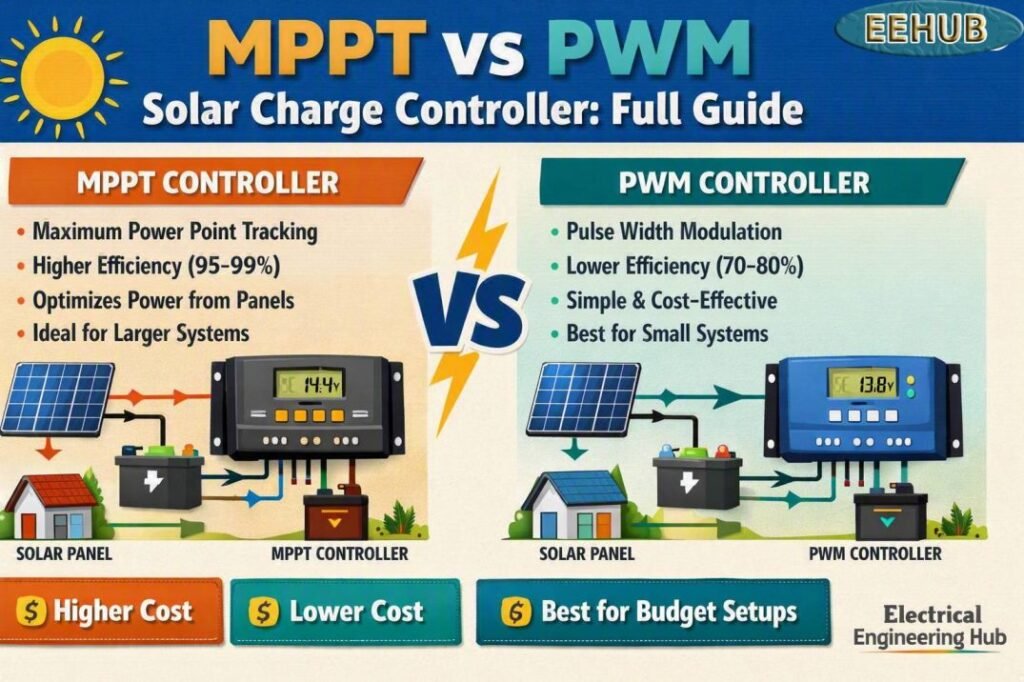
Table of Contents
Table of Contents
MPPT vs PWM Solar Charge Controller Quick Comparison
| Feature | MPPT Controller | PWM Controller |
|---|---|---|
| Efficiency | 95-99% | 70-85% |
| Cost | Higher | Budget-friendly |
| Best For | Medium to large solar systems | Small solar systems |
| Battery Charging | Faster | Standard |
| Panel Voltage | Accepts higher voltage | Panel voltage should match battery |
| Cold Weather Performance | Excellent | Average |
| Energy Harvest | Maximum | Limited |
| ROI | Better long-term | Better upfront savings |
If your priority is maximum energy production, MPPT is the clear winner. For small off-grid applications, PWM remains a practical and economical option.
What is a Solar Charge Controller?
A solar charge controller regulates electricity flowing from solar panels to batteries. It prevents overcharging, deep discharge, overheating, and battery damage.
Without a controller, batteries can lose capacity quickly and have a much shorter lifespan.
The two most common types are:
- MPPT (Maximum Power Point Tracking)
- PWM (Pulse Width Modulation)
Both serve the same purpose but use completely different charging methods.
MPPT vs PWM Solar Charge Controller Explained
The biggest difference is how efficiently they convert solar panel power into battery charging current.
MPPT Controller
An MPPT controller continuously tracks the maximum power point of the solar panel. It converts excess voltage into additional charging current.
For example:
| Solar Panel Output | Battery Voltage | Charging Current |
|---|---|---|
| 36V, 10A (360W) | 12V | Nearly 30A |
Very little power is wasted.
PWM Controller
A PWM controller simply connects the solar panel directly to the battery during charging.
If a 36V panel charges a 12V battery, much of the available voltage is unused.
Example:
| Solar Panel Output | Battery Voltage | Effective Charging |
|---|---|---|
| 36V, 10A | 12V | Around 120W usable |
This explains why MPPT controllers often generate 20-35% more usable energy.
Working Principle Comparison
| Feature | MPPT | PWM |
|---|---|---|
| Tracks Maximum Power Point | Yes | No |
| Voltage Conversion | Yes | No |
| Current Boost | Yes | No |
| Energy Optimization | Excellent | Limited |
| Intelligent Charging | Advanced | Basic |
Efficiency Comparison
One of the biggest reasons homeowners upgrade to MPPT is higher efficiency.
MPPT Efficiency
- 95-99% conversion efficiency
- Better in cloudy weather
- Excellent during winter
- More daily energy production
PWM Efficiency
- 70-85% efficiency
- Lower output in cold weather
- Less effective with large solar arrays
- Suitable for basic charging needs
For systems above 300W, MPPT generally pays for itself through higher energy harvest.
When Should You Choose MPPT?
An MPPT controller is ideal when:
- Solar array exceeds 300W
- Panels are far from batteries
- Higher panel voltage is available
- Winter performance matters
- Maximum efficiency is important
- Lithium batteries are used
Amazon Recommendation
Renogy Rover 40A MPPT Solar Charge Controller
If you want reliable charging with high efficiency, the Renogy Rover 40A is one of the highest-rated MPPT controllers available on Amazon.
Key Features
- Up to 99% tracking efficiency
- Supports AGM, Gel, Flooded, and Lithium batteries
- Bluetooth monitoring support
- LCD display
- Temperature compensation
- Multiple protection features
Pros
- Excellent charging efficiency
- Easy installation
- Reliable performance
- Great build quality
Cons
- Higher price than PWM
- Bluetooth module sold separately
Check today’s Amazon price on the Renogy Rover 40A MPPT Solar Charge Controller and see available discounts before purchasing.
When Should You Choose PWM?
A PWM controller is still a good choice when:
- Solar system is under 200W
- Budget is limited
- Battery voltage matches panel voltage
- RV systems
- Small cabins
- Garden lighting
- Portable solar kits
Amazon Recommendation
Renogy Wanderer 30A PWM Controller
The Renogy Wanderer 30A offers dependable charging for smaller solar systems at an affordable price.
Key Features
- 30A charging capacity
- LCD display
- Multiple battery support
- Temperature sensor
- Easy wiring
- Battery protection functions
Pros
- Affordable
- User-friendly
- Reliable performance
- Compact design
Cons
- Lower efficiency
- Not suitable for large solar arrays
View the Renogy Wanderer 30A PWM Controller on Amazon to compare pricing and customer reviews before ordering.
Performance Comparison
| Parameter | MPPT | PWM |
|---|---|---|
| Battery Charging Speed | Fast | Moderate |
| Power Utilization | Excellent | Lower |
| Panel Flexibility | High | Limited |
| Installation Distance | Long cable runs | Short cable runs |
| Large Systems | Excellent | Not recommended |
| Small Systems | Good | Excellent |
| Cost | Higher | Lower |
Cost Comparison
Many buyers focus only on the initial purchase price.
However, the long-term savings tell a different story.
| Controller | Typical Cost | Long-Term Savings |
|---|---|---|
| MPPT | Higher | High |
| PWM | Lower | Moderate |
Although MPPT costs more initially, it generates additional energy every day, reducing the payback period.
Battery Compatibility
Both controller types support multiple battery technologies.
| Battery Type | MPPT | PWM |
|---|---|---|
| AGM | Yes | Yes |
| Flooded Lead Acid | Yes | Yes |
| Gel | Yes | Yes |
| Lithium (LiFePO4) | Excellent | Limited depending on model |
Always verify battery compatibility before purchasing.

Which Controller Produces More Power?
In most installations, MPPT produces significantly more usable energy.
Example:
| Solar Array | MPPT Daily Output | PWM Daily Output |
|---|---|---|
| 400W | 1.8-2.1 kWh | 1.4-1.6 kWh |
| 800W | 3.8-4.2 kWh | 3.0-3.3 kWh |
The difference becomes larger during colder months because MPPT converts higher panel voltage into additional charging current.
Installation Tips
For the best performance:
- Install the controller close to the battery.
- Use properly sized cables.
- Add DC breakers or fuses.
- Ensure good ventilation.
- Program the correct battery type.
- Follow manufacturer torque specifications.
Correct installation improves efficiency and battery life regardless of controller type.
Common Buying Mistakes
Avoid these mistakes when selecting a controller.
- Buying based only on price
- Ignoring battery chemistry
- Undersizing the controller
- Using high-voltage panels with PWM
- Ignoring future solar expansion
- Purchasing without temperature protection
Selecting the correct controller today prevents expensive upgrades later.
Should You Upgrade from PWM to MPPT?
If you already own a PWM controller, upgrading makes sense when:
- Expanding your solar system
- Installing lithium batteries
- Using high-voltage solar panels
- Experiencing low charging efficiency
- Living in colder climates
Many users recover the additional investment through increased energy production over time.
Explore More Buying Options
If you are still comparing different brands and capacities, don’t miss our comprehensive guide on the Best Solar Charge Controller. It compares top-rated MPPT and PWM models for every budget and solar system size.
Final Verdict
The winner of the MPPT vs PWM Solar Charge Controller comparison depends on your solar setup.
Choose an MPPT controller if efficiency, future expansion, and maximum energy production are your priorities. It is the best option for residential solar systems, larger off-grid installations, and lithium battery banks.
Choose a PWM controller if you have a small solar system, matching panel and battery voltages, and want the lowest upfront cost.
For most homeowners installing new solar systems today, the Renogy Rover 40A MPPT Solar Charge Controller offers the best balance of efficiency, reliability, and long-term value. Smaller RV and camping systems can save money with the dependable Renogy Wanderer 30A PWM Controller.
Before making your final decision, check our in-depth guide on the Best Solar Charge Controller to compare more top-rated models, expert reviews, and buying recommendations.
Frequently Asked Questions
Is MPPT better than PWM?
Yes. MPPT controllers are more efficient because they track the maximum power point of the solar panel and convert excess voltage into additional charging current.
Is an MPPT controller worth the extra cost?
For solar systems above 300W, MPPT usually delivers higher daily energy production and better long-term savings, making it a worthwhile investment.
Can I replace a PWM controller with an MPPT controller?
Yes. Most systems can be upgraded, provided the new controller matches your battery voltage, solar array size, and current requirements.
Which controller is better for lithium batteries?
An MPPT controller is generally the better choice because it provides advanced charging profiles and higher efficiency with lithium battery banks.
What size solar charge controller do I need?
The controller should be sized according to the solar array’s maximum current and system voltage, with additional capacity for future expansion.
Get new guides in your feed. Follow Electrical Insights on LinkedIn for new electrical standards guides, calculators and design tips from Azad Circuit Hub.
MPPTvsPWMSolarChargeController, #SolarChargeController, #MPPTController, #PWMController, #SolarEnergy, #SolarPower, #OffGridSolar, #RenewableEnergy, #SolarInstallation, #SolarGuide
