
Renogy Rover 40A vs 60A: Which MPPT Solar Charge Controller Is Better?
Choosing between Renogy Rover 40A vs 60A depends on your solar array size, battery bank, and future expansion plans. Both controllers use maximum power point tracking (MPPT) to harvest solar energy efficiently, but their charging capacity makes them suitable for different installations.
As an electrical engineer with hands-on experience in solar power systems, electrical protection, and troubleshooting, I recommend checking more than the rated amperage. Maximum PV voltage, battery charging limits, cable sizing, and system voltage all affect the right choice.


Renogy Rover 40A vs 60A: Quick Comparison
| Feature | Renogy Rover 40A | Renogy Rover 60A |
|---|---|---|
| Maximum rated charging current | 40A | 60A |
| Battery system | 12V/24V models | 12V/24V models |
| Controller technology | MPPT | MPPT |
| Best for | Small to medium solar systems | Larger solar systems |
| Solar input capacity | Check exact model manual | Check exact model manual |
| Battery compatibility | Model-dependent | Model-dependent |
| Display | Model-dependent LCD | Model-dependent LCD |
| Expansion potential | Moderate | Higher |
Specifications can vary by Rover version and product generation. Confirm the exact model’s manual before purchasing or connecting your solar panels.
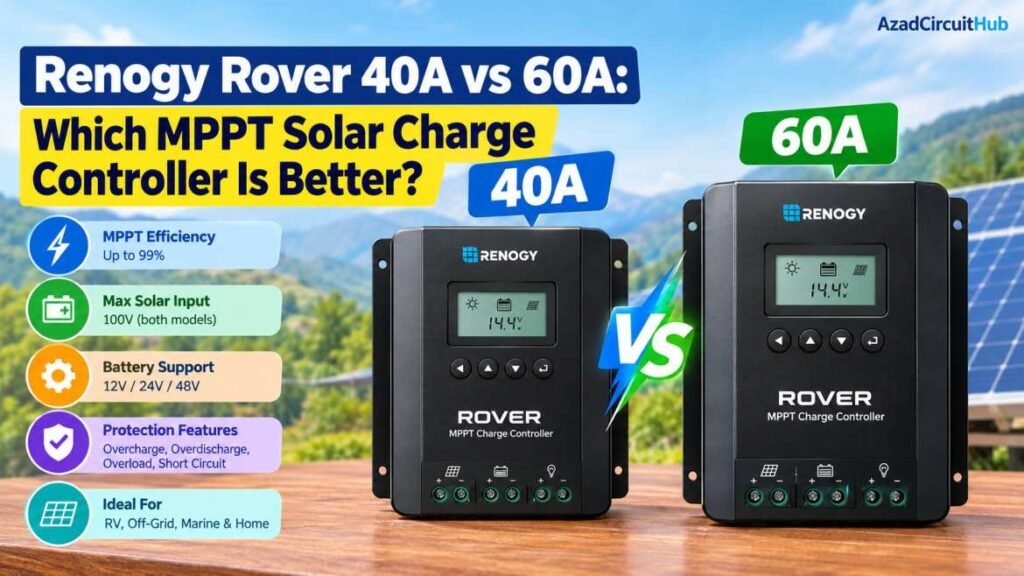
Table of Contents
Table of Contents
Charging Capacity: 40A vs 60A
The main difference is the maximum rated charging current. A 40A controller can supply up to 40A of battery charging current under suitable conditions, while a 60A model can supply up to 60A.
For a 12V battery system, this difference can matter when you install a larger solar array. A 60A controller can support more charging current, provided the PV input limits, battery requirements, and manufacturer specifications allow it.
For example, a 200Ah battery bank may work well with a 40A controller if its recommended charging current and solar array size match. A larger battery bank or a system with more solar panels may benefit from the additional capacity of a 60A model.
However, a higher-rated controller does not automatically produce more energy. Actual output depends on sunlight, panel temperature, battery state of charge, and system losses.
Renogy Rover 40A Review: Who Should Buy It?
The Renogy Rover 40A MPPT Solar Charge Controller is a practical option for many small off-grid systems, RV installations, cabins, and backup power setups.
Its 40A rating can suit a moderate solar array without requiring the additional capacity of a 60A controller. If your current panels and battery bank fit within its operating limits, paying extra for a larger model may offer little benefit.
Before buying, check the supported battery chemistry, maximum PV open-circuit voltage, rated solar input power, and charging settings.
Buy the Renogy Rover 40A MPPT Solar Charge Controller on Amazon: Renogy Rover 40A MPPT Solar Charge Controller
For more details on its features and practical applications, read my rover 40a mppt charge controller review.
When Is the Renogy Rover 60A Worth It?
The Rover 60A is worth considering when your solar installation needs more charging current or you plan to expand your panel capacity.
A larger controller can reduce the chance of outgrowing your equipment as your off-grid system develops. It may suit larger battery banks, workshops, remote cabins, and systems with higher daily energy demand.
Still, check the battery manufacturer’s maximum charging current. A 60A controller may be oversized for a battery that cannot safely accept that much current unless the charging current can be limited appropriately.
Also check conductor size, overcurrent protection, cooling requirements, and the controller’s permitted PV input. These details are important for safe and reliable DC operation.
Which Controller Offers Better Value?
The best value depends on how much charging capacity you actually need.
| Your Solar Setup | Better Starting Point |
|---|---|
| Small off-grid system | Rover 40A |
| Moderate 12V battery bank | Rover 40A, subject to specifications |
| Larger solar array | Compare Rover 60A limits |
| Planned system expansion | Rover 60A may offer more flexibility |
| Battery with a low charging-current limit | Size according to battery specifications |
Do not buy the 60A model simply because it has a higher rating. Compare the price difference with the additional capacity you will use.
If brand choice is still open, my renogy vs victron comparison can help you evaluate other MPPT solar charge controller options.
Installation Tips Before Buying
Before installing either controller:
- Confirm your battery bank voltage.
- Check the total solar array’s open-circuit voltage, including cold-weather increases.
- Verify the controller’s maximum PV power for your system voltage.
- Match charging settings to your battery chemistry.
- Size cables and protective devices according to the manual and applicable electrical requirements.
- Follow the manufacturer’s connection and disconnection sequence.
As an electrical engineer, I pay particular attention to DC wiring and overcurrent protection. Undersized cables and loose terminals can cause overheating, voltage drop, and equipment damage.
Frequently Asked Questions
1. Is the Renogy Rover 60A better than the 40A?
Not for every installation. The 60A model offers more charging-current capacity, but the 40A model may provide better value for a smaller solar array.
2. Can I use a Renogy Rover 40A with a 200Ah battery?
Yes, if the controller’s specifications, solar input, and battery charging requirements are compatible. Check the battery manufacturer’s recommended charging current.
3. How many solar panels can a Rover 40A handle?
The number depends on panel wattage, system voltage, maximum PV input voltage, and the controller’s rated solar input power. Check the exact model manual before connecting panels.
4. Can a Rover 60A charge a 12V battery?
Some Rover 60A versions support 12V and 24V systems. Verify the exact model’s supported voltage and charging limits before purchasing.
5. Is MPPT better than PWM?
MPPT controllers generally harvest solar power more effectively in many installations, especially when the panel operating voltage is higher than the battery charging voltage. Actual gains depend on system design and operating conditions.
Final Verdict
In the Renogy Rover 40A vs 60A comparison, the 40A model is a sensible choice for many moderate solar installations, while the 60A model is worth considering when you need greater charging capacity or expect to expand your solar array.
Match the controller to the panels, battery, and electrical system rather than choosing by amperage alone. Confirm the exact product specifications, compare current Amazon prices, and select the model that meets your present needs without sacrificing essential safety requirements.
Follow Us on Social:
Subscribe our Newsletter on Electrical Insights for latest updates from Azad Circuit Hub
#RenogyRover, #RenogyRover40A, #RenogyRover60A, #MPPTChargeController, #SolarChargeController, #SolarPowerSystem, #OffGridSolar, #SolarBatteryCharging, #SolarControllerComparison, #RenogySolar
