
Motor Control Center Troubleshooting Guide | Expert MCC Fault Diagnosis & Repair Solutions
Motor control centers are critical components in industrial and commercial electrical systems. They distribute power, protect electrical equipment, and control motors that operate pumps, compressors, conveyors, fans, and production machinery. When faults occur, operations can slow down or completely stop, leading to downtime, production losses, and safety risks. This is why understanding Motor Control Center Troubleshooting is essential for maintenance engineers, plant operators, and electrical technicians.
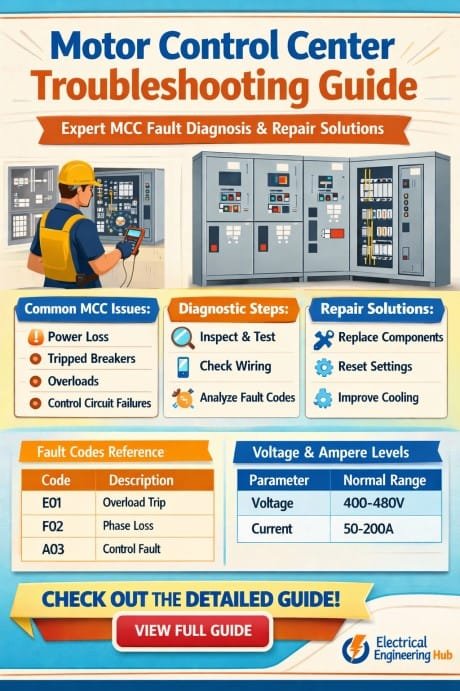
Table of Contents
Table of Contents
A proper troubleshooting process helps identify faults quickly and prevents repeated failures. Whether the issue involves circuit breakers, contactors, overload relays, busbars, variable frequency drives, or power distribution components, systematic diagnosis ensures reliable system performance and longer equipment life.
Know more about mcc panel design software
Understanding the Basics of MCC Systems
A motor control center, commonly called an MCC, is a centralized assembly that houses motor starters, protective devices, control units, and power distribution systems. MCC panels are widely used in manufacturing plants, water treatment facilities, HVAC systems, solar pumping stations, and industrial automation projects.
Modern MCC systems may include:
| MCC Component | Function |
|---|---|
| Circuit Breakers | Protect circuits from short circuits and overloads |
| Contactors | Control motor switching operations |
| Overload Relays | Protect motors from overheating |
| Busbars | Distribute electrical power within the panel |
| VFDs | Control motor speed and efficiency |
| Control Transformers | Supply low voltage control power |
| PLC Interfaces | Enable automation and remote monitoring |
Understanding the function of each component makes Motor Control Center Troubleshooting more effective and accurate.
Common Causes of MCC Failures
Electrical faults inside MCC panels usually develop gradually. Early signs often appear before a major breakdown occurs. Ignoring warning signs can result in expensive repairs and operational downtime.
Below are some of the most common MCC problems:
| Fault Type | Possible Cause |
|---|---|
| Motor not starting | Contactor failure, control circuit issue, overload trip |
| Breaker tripping | Short circuit, overload, ground fault |
| Excessive heating | Loose connections, overloaded circuits |
| Burning smell | Insulation failure, overheating components |
| Voltage imbalance | Supply issues or damaged wiring |
| Frequent overload trips | Mechanical motor load or incorrect settings |
| VFD fault alarms | Parameter mismatch or cooling failure |
A structured Motor Control Center Troubleshooting process can isolate these faults before they affect the entire electrical system.
Explore everything about electrical control panel design training
Safety Precautions Before Troubleshooting
Safety should always be the first priority when working on electrical systems. MCC panels contain high voltage equipment that can cause severe injury or equipment damage if handled improperly.
Before starting inspection or testing:
- Disconnect and isolate power supply
- Use lockout and tagout procedures
- Wear proper PPE including insulated gloves and safety glasses
- Verify absence of voltage using a calibrated meter
- Follow electrical safety standards and site procedures
Never attempt MCC maintenance without proper training and authorization.
Step-by-Step Motor Control Center Troubleshooting Process
A systematic approach reduces troubleshooting time and improves fault diagnosis accuracy.
Visual Inspection
Start with a detailed visual inspection of the MCC panel.
Look for:
- Burn marks or discoloration
- Loose terminals
- Dust accumulation
- Damaged insulation
- Corrosion
- Broken wiring
- Overheated busbars
Many MCC faults can be identified visually before using testing instruments.
Download the mcc panel design guide pdf
Check Incoming Power Supply
Verify that the incoming voltage is correct and balanced across all phases.
Use a multimeter to measure:
| Electrical Test | Standard Condition |
|---|---|
| Phase-to-phase voltage | Balanced within acceptable tolerance |
| Phase-to-neutral voltage | Stable and consistent |
| Frequency | According to system rating |
| Ground continuity | Proper grounding available |
Voltage imbalance can damage motors and cause repeated equipment trips.
Inspect Circuit Breakers and Protection Devices
Circuit breakers protect the system from faults and overload conditions. If a breaker trips repeatedly, investigate the root cause instead of simply resetting it.
Check for:
- Mechanical wear
- Incorrect breaker ratings
- Overheating
- Faulty trip mechanisms
- Short circuit signs
Proper breaker coordination is important during Motor Control Center Troubleshooting.
Know more about What is a Motor Control Center (MCC)
Test Contactors and Relays
Contactors are among the most frequently failing MCC components due to continuous switching operations.
Inspect contactors for:
- Worn contacts
- Coil damage
- Chattering operation
- Carbon buildup
- Loose control wiring
Also verify overload relay settings according to motor full load current.
Examine Control Circuits
Control wiring issues can prevent motors from starting even when power circuits are healthy. Download the excel sheet for MCC panel sizing calculation
Inspect:
- Push buttons
- Selector switches
- Auxiliary contacts
- Control transformers
- PLC signals
- Interlocks
Loose control terminals often create intermittent faults that are difficult to identify without careful inspection.
Find all about How Does a Motor Control Center Work
Troubleshooting MCC Motor Starting Problems
One of the most common maintenance complaints is a motor failing to start. The issue may originate from either the power circuit or the control circuit.
Use the following troubleshooting guide:
| Problem | Possible Cause | Recommended Solution |
|---|---|---|
| Motor does not start | No control voltage | Check control transformer |
| Contactor not energizing | Coil failure | Replace contactor coil |
| Overload relay tripped | Motor overload | Reset and inspect motor load |
| Breaker trips instantly | Short circuit | Check cable insulation |
| Motor humming only | Single phasing | Inspect incoming supply |
Motor-related faults require immediate attention because prolonged electrical stress can damage windings permanently.
Diagnosing Overheating in MCC Panels
Excessive heat is a serious issue in electrical distribution systems. It reduces component life and increases fire risk.
Common causes include:
- Loose cable terminations
- Overloaded feeders
- Poor ventilation
- Harmonic distortion
- Dust accumulation
- Corroded connections
Thermal imaging cameras are highly effective during Motor Control Center Troubleshooting because they identify hotspots before equipment failure occurs.
Know more about Motor Control Center Bucket Replacement Cost
Signs of MCC Overheating
| Warning Sign | Possible Impact |
|---|---|
| Hot panel surface | Internal overload |
| Discolored insulation | Excessive temperature |
| Burning odor | Component failure risk |
| Fan malfunction | Inadequate cooling |
| Melted terminals | Loose connection heating |
Regular preventive maintenance reduces overheating risks significantly.
VFD and Automation Fault Diagnosis
Modern MCC systems often include variable frequency drives and PLC automation systems. These devices improve motor efficiency but add complexity to troubleshooting.
Common VFD faults include:
- Overvoltage alarms
- Undervoltage conditions
- Overcurrent trips
- Communication errors
- Cooling fan failures
- Parameter mismatch
Know more about Electrical Panel Upgrade 200 Amp
When diagnosing VFD issues:
- Check incoming supply voltage
- Inspect grounding
- Verify motor cable integrity
- Review fault history logs
- Confirm programming settings
Automation-related faults may also involve sensors, relays, communication modules, or PLC input/output signals.
Preventive Maintenance Best Practices
Preventive maintenance is the most effective way to reduce emergency breakdowns and improve MCC reliability.
A maintenance plan should include:
| Maintenance Activity | Recommended Frequency |
|---|---|
| Thermal scanning | Every 6 months |
| Tightening connections | Annually |
| Cleaning MCC panels | Quarterly |
| Insulation resistance testing | Annually |
| Relay calibration | As required |
| Breaker inspection | Every 12 months |
Consistent maintenance improves safety, extends equipment lifespan, and lowers repair costs.
Importance of Proper Documentation
Accurate maintenance records simplify future troubleshooting and help technicians identify recurring faults.
Maintain records for:
- Fault history
- Breaker trips
- Replacement parts
- Motor current readings
- Thermal scan reports
- Maintenance schedules
Find all about Electrical Panel Upgrade Cost Los Angeles
Documentation improves the efficiency of Motor Control Center Troubleshooting and supports predictive maintenance programs.
Choosing the Right MCC Repair Strategy
Some faults require simple adjustments, while others may require component replacement or complete system upgrades.
Repair decisions should consider:
- Equipment age
- Spare part availability
- Downtime impact
- Safety compliance
- Energy efficiency improvements
In older MCC systems, upgrading protection relays and automation controls can improve operational reliability and reduce maintenance requirements.
Conclusion
Industrial operations depend heavily on reliable motor control systems. A single MCC fault can interrupt production, damage equipment, and increase operational costs. Effective Motor Control Center Troubleshooting requires a systematic approach, technical knowledge, and proper safety procedures.
Know more about Electrical Panel Upgrade Cost For EV Charger
By understanding MCC components, identifying common faults, inspecting electrical connections, and following preventive maintenance practices, technicians can reduce downtime and improve system performance. Whether dealing with breaker trips, overheating, contactor failures, or VFD alarms, accurate diagnosis is the key to reliable electrical operations.
Modern facilities that prioritize regular inspection, thermal analysis, and preventive maintenance experience fewer unexpected failures and achieve better long-term performance from their motor control center systems.
Get new guides in your feed. Follow Electrical Insights on LinkedIn for new electrical standards guides, calculators and design tips from Azad Circuit Hub.
#motorcontrolcentertroubleshootingguide,#MCCtroubleshooting,#motorcontrolcenter,#electricalmaintenance,#industrialautomation,#electricalengineering,#MCCpanel,#troubleshootingguide,#powerdistribution,#industrialelectrical
