
How Does a Motor Control Center Work: Complete Guide to MCC Operation, Components, and Industrial Applications
A motor control center (MCC) is a vital part of modern industrial electrical systems, designed to control, protect, and monitor electric motors from a centralized location. Industries rely on MCCs to ensure smooth operation of pumps, compressors, conveyors, and heavy machinery. To understand industrial automation clearly, it is important to first understand How Does a Motor Control Center Work in real-world applications.
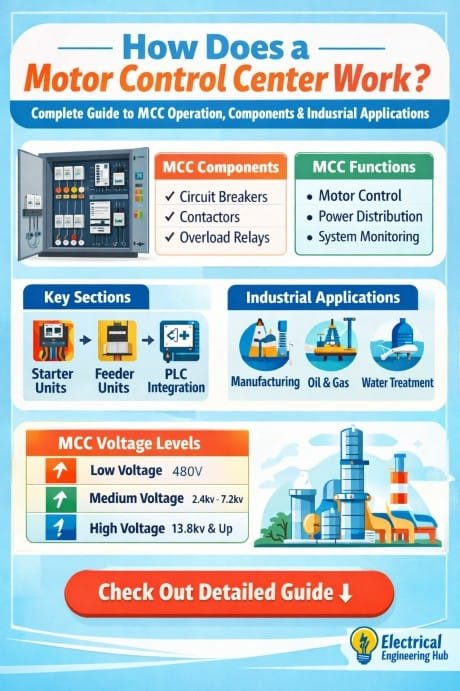
Table of Contents
Table of Contents
This system combines power distribution, motor starters, protection devices, and control circuits into a single structured panel arrangement. MCCs improve operational efficiency, reduce downtime, and enhance electrical safety across manufacturing plants, water treatment facilities, and processing industries.
What is a Motor Control Center (MCC)
A Motor Control Center is an assembly of multiple motor control units housed in a common enclosure. Each unit is responsible for controlling an individual motor through components such as circuit breakers, contactors, overload relays, and control wiring. The system is designed for centralized motor management, making maintenance and troubleshooting easier for engineers.
Use our online tool for free Electrical Panel Upgrade Cost Calculator
Understanding How Does a Motor Control Center Work begins with recognizing that it acts as a hub where incoming electrical power is distributed to different motor loads with controlled switching and protection. MCCs are widely used in industries where multiple motors operate simultaneously and require coordinated control.
Core Components of MCC
A motor control center is built using several electrical and mechanical components that ensure safe and efficient operation. These parts work together to manage motor performance and protect equipment from faults.
| Component | Function |
|---|---|
| Busbar System | Distributes incoming power to all MCC units |
| Circuit Breaker | Protects against short circuits and overloads |
| Contactor | Switches motor ON/OFF remotely |
| Overload Relay | Prevents motor damage due to overheating |
| Control Transformer | Provides low-voltage control supply |
| PLC Interface (optional) | Enables automation and remote monitoring |
When studying How Does a Motor Control Center Work, it becomes clear that busbars act as the backbone of power distribution, while contactors and relays ensure safe switching and motor protection. The combination of these components ensures that motors operate only within safe electrical limits, reducing the risk of failure and downtime.
Know more about What is a Motor Control Center (MCC)
Working Principle and Operation Sequence
The working principle of an MCC is based on controlled power distribution and automated switching. When a start command is given, the control circuit activates the contactor, allowing electrical power to flow from the busbar to the motor. At the same time, protective devices continuously monitor current levels to prevent abnormal conditions.
To understand How Does a Motor Control Center Work in operation, consider the following sequence: power enters the MCC from the main supply, it is distributed through busbars, then directed to individual motor starters. When a motor is started, the contactor closes the circuit, and the motor begins operation. If overload or fault conditions occur, the overload relay or breaker trips the circuit instantly.
In advanced systems, PLCs and smart controllers enhance automation by enabling remote start/stop functions and real-time monitoring. This improves process efficiency and reduces manual intervention in industrial environments.
Types of Motor Control Centers
Motor Control Centers are available in different configurations depending on application requirements and safety standards. Each type is designed for specific industrial conditions and operational flexibility.
| Type | Description |
|---|---|
| Fixed MCC | Motor starters are permanently fixed and not removable |
| Withdrawable MCC | Units can be withdrawn for maintenance without shutting down the system |
| Intelligent MCC | Equipped with digital monitoring and PLC-based automation |
| Low Voltage MCC | Used for standard industrial motors up to 1000V |
| Medium Voltage MCC | Designed for heavy-duty industrial applications |
When analyzing How Does a Motor Control Center Work, it is important to understand that each type follows the same fundamental principle but differs in maintenance convenience, control features, and automation level. Withdrawable and intelligent MCCs are increasingly used in modern industries due to their flexibility and smart diagnostics.
Download the mcc panel design guide pdf
Industrial Applications of MCC
Motor Control Centers are widely used across multiple industries where reliable motor operation is essential. They provide centralized control and improve operational efficiency in complex systems.
Common applications include water treatment plants, oil and gas refineries, cement factories, textile mills, and food processing units. In these environments, How Does a Motor Control Center Work becomes critical knowledge for engineers responsible for maintaining continuous production.
MCCs control pumps in water distribution systems, regulate conveyor belts in manufacturing plants, and manage compressors in refrigeration systems. Their ability to handle multiple motors from a single location makes them an essential part of industrial automation infrastructure.
Safety, Protection and Maintenance
Safety is one of the most important aspects of MCC operation. These systems are designed with multiple layers of protection to prevent electrical hazards and equipment damage. Circuit breakers protect against short circuits, while overload relays prevent thermal damage to motors.
Explore everything about electrical control panel design training
Understanding How Does a Motor Control Center Work also involves recognizing the importance of regular maintenance. Routine inspection of busbars, tightening of electrical connections, and testing of protective devices ensures long-term reliability. Dust accumulation and loose wiring are common issues that can affect performance if not addressed timely.
Modern MCCs often include diagnostic indicators and fault alarms that help maintenance teams identify problems quickly. This reduces downtime and improves overall system reliability in industrial operations.
Advantages and Efficiency Benefits
Motor Control Centers offer several advantages that make them indispensable in industrial environments. They simplify motor control, improve safety, and reduce installation complexity.
One major benefit is centralized control, which allows operators to manage multiple motors from a single location. Another advantage is scalability, as additional motor starters can be added without major redesign of the system. Energy efficiency is also improved through better load management and reduced power losses. Download the excel sheet for MCC panel sizing calculation
When evaluating How Does a Motor Control Center Work in terms of efficiency, it becomes clear that MCCs reduce operational costs by minimizing downtime and improving fault detection. Their structured design also enhances safety compliance with industrial electrical standards.
Conclusion
In modern industrial systems, understanding How Does a Motor Control Center Work is essential for engineers, technicians, and facility managers. MCCs serve as the backbone of motor control infrastructure, ensuring safe, efficient, and reliable operation of electrical motors across various applications.
From power distribution to fault protection and automation, every element within an MCC contributes to smooth industrial performance. As industries continue to move toward automation and smart monitoring, MCC technology is evolving to deliver even greater control, safety, and operational efficiency.
Know more about mcc panel design software
Get new guides in your feed. Follow Electrical Insights on LinkedIn for new electrical standards guides, calculators and design tips from Azad Circuit Hub.
#MotorControlCenter,#MCCPanel,#ElectricalEngineering,#IndustrialAutomation,#PowerDistribution,#ElectricalSystem,#ControlPanel,#MotorControl,#ElectricalMaintenance,#IndustrialPower
