
How to Size Cable for Street Lighting Circuits
Choosing the correct cable size for a street lighting circuit is one of the most important steps in electrical design. A wrong cable size can cause voltage drop, overheating, poor lamp performance, and unnecessary power losses. That is why engineers and electricians always need to size cable for street lighting circuits carefully.
Street lighting systems often run over long distances. This makes cable sizing more critical compared to indoor wiring. Whether you are installing LED street lights, solar-powered poles, or conventional lighting systems, understanding how to size cable for street lighting circuits ensures safety, efficiency, and compliance with electrical standards.
In this guide, you will learn the complete cable sizing process with practical examples, tables, and expert tips.
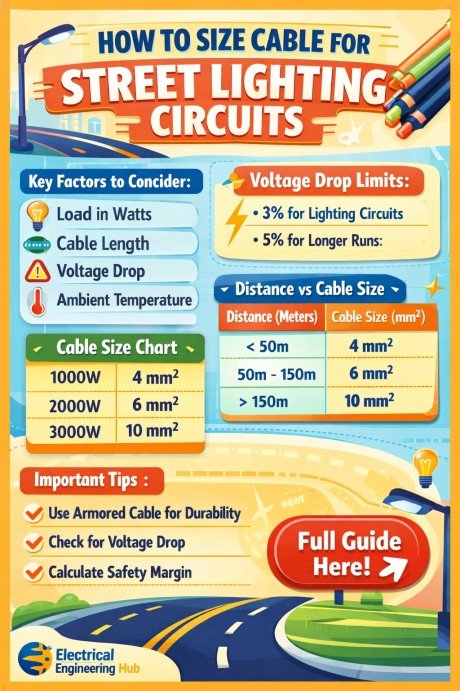
Table of Contents
Table of Contents
Why Proper Cable Sizing Matters in Street Lighting
Street light circuits are usually distributed across roads, highways, parking lots, and industrial areas. Since the load is spread over long cable lengths, voltage drop becomes a major concern.
Proper cable sizing helps in:
- Reducing energy losses
- Maintaining voltage at each luminaire
- Preventing cable overheating
- Improving system lifespan
- Meeting NEC and IEC standards
- Lowering maintenance costs
Find all about step by step Lux Level Testing Procedure
If you fail to size cable for street lighting circuits correctly, the last street light may receive low voltage, causing dim output or early failure.
Key Factors to Size Cable for Street Lighting Circuits
Before selecting the cable, consider these important factors:
1. Total Connected Load
Calculate the total wattage of all street lights.
Formula:
Total Load (W) = Number of Lights × Wattage per Light
Example:
20 lights × 120W = 2400W
Uncover insights on iec standard for lighting lux level, download a calculator in excel to calculate the required lux level according to IEC standards.
2. System Voltage
Common street lighting voltages include:
| System Type | Voltage |
|---|---|
| Single Phase | 230V |
| Three Phase | 400V |
| Solar DC System | 12V / 24V / 48V |
Higher voltage systems reduce current and allow smaller cable sizes.
3. Cable Length
Longer cable length increases resistance and voltage drop.
Example:
A 300-meter cable run needs larger cable than a 50-meter run for the same load.
4. Allowable Voltage Drop
IEC recommends:
- 3% for lighting circuits
- Maximum 5% in some cases
For street lights, lower voltage drop gives better light consistency.
Use our online tool Lighting Load Calculation per Square Foot: Download Excel Sheet
5. Installation Method
Cable ampacity changes depending on installation:
- Underground buried cable
- Cable tray
- PVC conduit
- Direct laying
Buried cables may require derating.
6. Ambient Temperature
High temperatures reduce cable current carrying capacity.
This is very important in hot climates.
Basic Formula to Calculate Cable Size
To size cable for street lighting circuits, use current and voltage drop formulas.
Current Formula for Single Phase
I = P ÷ (V × PF)
Where:
- I = Current (A)
- P = Power (W)
- V = Voltage
- PF = Power Factor
Know more about How to Wire a 480/277 Lighting System: Step-By-Step Guide for Safe Commercial Installation
Example:
Load = 2400W
Voltage = 230V
PF = 0.95
Current:
I = 2400 ÷ (230 × 0.95)
I = 10.98A
Required current is 11A.
Voltage Drop Formula
For single phase:
VD = (2 × L × I × mV/A/m) ÷ 1000
Where:
- VD = Voltage Drop
- L = Length
- I = Current
This formula helps verify if the cable size is acceptable.
Use our free street light cable size calculator
For easier calculations, you can use our street light cable size calculation tool.
Standard Street Light Cable Size Chart
Below is a general cable size reference:
| Load Current | Distance Up to 50m | Distance Up to 100m | Distance Up to 200m |
|---|---|---|---|
| 5A | 1.5 mm² | 2.5 mm² | 4 mm² |
| 10A | 2.5 mm² | 4 mm² | 6 mm² |
| 16A | 4 mm² | 6 mm² | 10 mm² |
| 25A | 6 mm² | 10 mm² | 16 mm² |
| 32A | 10 mm² | 16 mm² | 25 mm² |
This table is for copper cables under normal conditions.
Step-by-Step Example to Size Cable for Street Lighting Circuits
Let’s calculate a real-world example.
Given Data:
- Number of poles = 15
- Light per pole = 150W LED
- Voltage = 230V
- Cable length = 180m
- Power factor = 0.95
- Allowable voltage drop = 3%
Download Free Street Lighting Voltage Drop Calculator in Excel
Step 1: Total Load
Total Load:
15 × 150 = 2250W
Step 2: Current Calculation
I = 2250 ÷ (230 × 0.95)
I = 10.29A
Step 3: Select Initial Cable
From ampacity, 2.5 mm² looks suitable.
Step 4: Check Voltage Drop
For 2.5 mm² copper:
mV/A/m = 18
VD = (2 × 180 × 10.29 × 18) ÷ 1000
VD = 66.67V
Voltage drop percentage:
(66.67 ÷ 230) × 100 = 28.9%
This is too high.
Step 5: Increase Cable Size
Try 10 mm²:
mV/A/m = 4.4
VD = (2 × 180 × 10.29 × 4.4) ÷ 1000
VD = 16.3V
Percentage:
(16.3 ÷ 230) × 100 = 7.08%
Know more about Smart Solar Street Light System with IoT Integration
Still high.
Try 16 mm²:
mV/A/m = 2.8
VD = 10.37V
Percentage:
4.5%
Better and acceptable in many applications.
This shows why voltage drop matters more than current in long street light runs.
Key Takeaways
- Always calculate total load first
- Voltage drop is the main factor in long street lighting circuits
- Never select cable only based on current
- Copper cables offer lower resistance than aluminum
- Follow IEC or NEC regulations for compliance
- Future load expansion should be considered
- Use calculation tools for quick verification
To compare conductor ratings and dimensions, check our guide on street light wire size.
Find the exact street lights cable size with Street Light Cable Size Chart
Copper vs Aluminum Cable for Street Lighting
| Factor | Copper | Aluminum |
|---|---|---|
| Conductivity | Higher | Lower |
| Cost | Higher | Lower |
| Size Requirement | Smaller | Larger |
| Durability | Better | Moderate |
| Weight | Heavy | Light |
Copper is preferred for reliability, but aluminum can reduce project cost.
Common Mistakes in Street Light Cable Sizing
Avoid these mistakes:
- Ignoring voltage drop
- Using undersized neutral cable
- Not applying temperature correction factor
- Skipping diversity factor
- Not considering future extension
- Wrong power factor assumptions
These mistakes can lead to system failure.
Find more Electrical Engineering Tools for easy electrical calculations and estimations.
Best Practices for Safe Installation
To properly size cable for street lighting circuits, follow these best practices:
- Use armored cables for underground installation
- Maintain proper earthing
- Install weatherproof junction boxes
- Use voltage drop software for large projects
- Keep spare capacity for expansion
- Follow local electrical codes
A well-designed cable system improves safety and reduces long-term expenses.
Final Thoughts
When planning outdoor lighting systems, it is essential to size cable for street lighting circuits using both ampacity and voltage drop calculations. Many installers focus only on current, but long-distance street light circuits require deeper analysis.
By calculating load, checking voltage drop, and selecting the right conductor size, you can build a safe and efficient lighting system. Whether it is a small residential road or a large municipal lighting project, proper cable sizing ensures stable performance and lower maintenance.
Using professional tools and standard cable charts makes the process faster and more accurate.
Use this tool if you are trying to calculate cable size for underground cables. Try here Underground Cable Size Calculator – Find Correct Wire Size for Long Distance Runs
FAQs
What cable is used for street lighting?
XLPE armored copper or aluminum cable is commonly used for street lighting because of durability and outdoor protection.
How much voltage drop is acceptable for street lights?
Normally 3% is preferred, but up to 5% may be acceptable depending on the standard and project type.
Can I use 2.5 mm² cable for street lights?
Yes, but only for short distances and low loads. Voltage drop must always be checked.
Is copper better than aluminum for street lighting circuits?
Copper offers better conductivity and lower voltage drop, making it more efficient for long cable runs.
Get new guides in your feed. Follow Electrical Insights on LinkedIn for new electrical standards guides, calculators and design tips from Azad Circuit Hub.
#StreetLightingCableSizing, #CableSizingGuide, #StreetLightWiring, #ElectricalEngineering, #CableCalculation, #LightingCircuits, #VoltageDropCalculation, #ElectricalDesign, #PowerDistribution, #StreetLightInstallation
