
Lux Level Testing Procedure
Proper lighting is critical in homes, offices, factories, and commercial buildings. Poor lighting can reduce productivity, cause eye strain, and create safety hazards. That is why understanding the Lux Level Testing Procedure is important for engineers, facility managers, and safety officers.
A proper light measurement process helps ensure compliance with workplace standards and improves visual comfort. Whether you are testing an office, warehouse, hospital, or industrial site, following the correct procedure gives accurate results.
This guide explains everything you need to know about measuring lux levels, the tools required, and how to maintain lighting compliance.
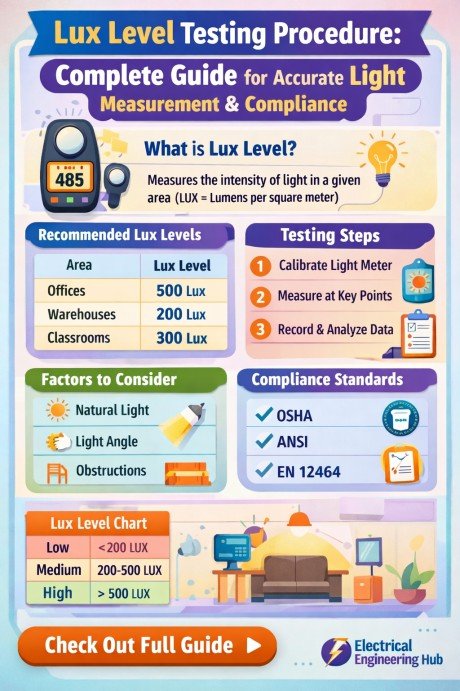
Table of Contents
Table of Contents
What is Lux in Lighting?
Lux is the unit of illuminance. It measures the amount of light falling on a surface per square meter.
In simple words:
| Unit | Meaning |
|---|---|
| Lux (lx) | Light intensity on a surface |
| Lumens (lm) | Total light emitted by a source |
| Candela (cd) | Light intensity in a direction |
For example, if one lumen spreads over one square meter, it equals one lux.
Understanding lux values helps determine if an area has enough light for its intended purpose.
Know more about Top 20 Electrical Testing Tools Which You Must Have
Why Lux Level Testing is Important
Lighting affects performance, safety, and energy efficiency. A proper Lux Level Testing Procedure ensures the environment meets required standards.
Main benefits include:
- Improves worker productivity
- Reduces eye fatigue
- Enhances workplace safety
- Ensures legal compliance
- Helps optimize energy consumption
- Identifies dark spots in working areas
Many industries follow strict regulations based on international lighting codes such as iec lighting standards.
Tools Required for Lux Testing
Before starting the test, make sure you have the right equipment.
Essential Tools
| Tool | Purpose |
|---|---|
| Lux Meter | Measures illumination levels |
| Floor Plan | Marks measurement points |
| Calibration Certificate | Confirms meter accuracy |
| Notebook or App | Records readings |
| Tripod (Optional) | Stabilizes sensor |
A calibrated lux meter is the most important tool for accurate testing.
Know more about Best Megger Testers for Industrial Use
Lux Level Testing Procedure Step by Step
Following the correct Lux Level Testing Procedure ensures reliable results.
Step 1: Understand the Testing Area
Identify the area you want to measure.
Examples include:
- Office workstations
- Corridors
- Factory floors
- Control rooms
- Parking areas
Each area has different lighting requirements.
Step 2: Review Required Standards
Before testing, check the applicable lighting standards.
For example:
| Area | Recommended Lux Level |
|---|---|
| Office Desk | 300–500 lux |
| Warehouse | 100–300 lux |
| Classroom | 300–500 lux |
| Hospital Room | 200–500 lux |
| Inspection Area | 750–1000 lux |
You can compare these values with your internal guidelines or refer to the detailed lux level standard for accurate requirements.
Explore all about How to Test a 3 Phase Motor With a Megger
Step 3: Prepare the Environment
For accurate results:
- Turn on all lighting fixtures
- Allow lights to stabilize for 15 minutes
- Close curtains if artificial light is being tested
- Remove temporary obstructions
- Ensure normal operating conditions
This prevents false readings.
Step 4: Divide the Area into Grid Points
Divide the room into equal sections.
Example grid setup:
| Room Size | Suggested Grid Points |
|---|---|
| Small Room | 9 points |
| Medium Room | 16 points |
| Large Hall | 25 points |
This method ensures uniform light measurement.
Step 5: Place the Lux Meter Sensor
Place the sensor at the working plane height.
Standard heights:
- Office desk: 0.8 meters
- Factory workbench: 0.85 meters
- Floor areas: Ground level
Keep the sensor flat and avoid shadows.
Know more about Top 12 Electrical Testing Equipment Suppliers in USA
Step 6: Take Readings
Record lux readings at every grid point.
Important tips:
- Hold the meter steadily
- Avoid blocking light
- Take multiple readings if needed
- Record peak and minimum values
Example:
| Point | Reading (Lux) |
|---|---|
| P1 | 420 |
| P2 | 395 |
| P3 | 410 |
| P4 | 435 |
Step 7: Calculate Average Lux
Use this formula:
Average Lux = Total of all readings ÷ Number of points
Example:
(420 + 395 + 410 + 435) ÷ 4 = 415 lux
This average determines compliance.
Step 8: Compare with Standards
Compare measured values against required lux levels.
If values are lower:
- Add more lighting fixtures
- Replace old lamps
- Clean luminaires
- Improve fixture layout
This step is important for lighting audits.
Know more about Insulation Resistance Testing: Step-by-Step Process
Key Takeaways
- Lux measures the amount of light on a surface
- Testing should follow a grid-based method
- A calibrated lux meter is necessary
- Compare readings with standard requirements
- Uniformity is as important as average lux
- Regular testing improves safety and efficiency
These points make the Lux Level Testing Procedure more effective and reliable.
Common Mistakes During Lux Level Testing
Avoid these mistakes for better accuracy:
Testing Too Early
Lights need warm-up time.
Wrong Sensor Height
Always test at working level.
Ignoring Natural Light
Daylight can affect readings.
Uncover insights on iec standard for lighting lux level, download a calculator in excel to calculate the required lux level according to IEC standards.
Using Uncalibrated Meter
Calibration ensures precision.
Taking Few Readings
More points give better results.
Lux Uniformity in Testing
Uniformity shows how evenly light is distributed.
Formula:
Uniformity Ratio = Minimum Lux ÷ Average Lux
Example:
| Parameter | Value |
|---|---|
| Minimum Lux | 320 |
| Average Lux | 400 |
| Uniformity Ratio | 0.8 |
Higher uniformity means better lighting quality.
Low uniformity creates bright and dark spots.
Use our online tool Lighting Load Calculation per Square Foot: Download Excel Sheet
Best Practices for Accurate Lux Measurement
Follow these tips:
- Test during normal operating hours
- Use certified lux meters
- Keep sensor clean
- Repeat readings for consistency
- Document all observations
- Check fixture condition before testing
These practices improve reliability.
When Should You Perform Lux Testing?
Lux testing should be done:
| Situation | Frequency |
|---|---|
| New Installation | Before handover |
| Routine Maintenance | Every 6 months |
| Safety Audit | Annually |
| Lighting Upgrade | After installation |
| Complaint Investigation | As needed |
Regular testing helps maintain compliance.
Conclusion
A proper Lux Level Testing Procedure is essential for maintaining safe and efficient lighting conditions. It ensures compliance with workplace regulations and improves visual comfort.
By using a lux meter correctly, dividing the space into grids, and comparing results with required standards, you can identify lighting problems quickly.
Whether you manage an office, industrial plant, or public building, regular lux testing helps create a better environment for everyone.
Know more about How to Wire a 480/277 Lighting System: Step-By-Step Guide for Safe Commercial Installation
Accurate light measurement is not just about numbers. It is about safety, productivity, and long-term efficiency.
Frequently Asked Questions
1. What is the standard lux level for office lighting?
Most offices require 300 to 500 lux for normal desk work.
2. How often should lux testing be performed?
It is recommended every 6 to 12 months or after any lighting changes.
3. What device is used for lux testing?
A digital lux meter is used to measure illumination levels.
4. Can natural light affect lux readings?
Yes, daylight can change readings, so testing conditions should be controlled.
5. What is a good lux uniformity ratio?
A ratio above 0.7 is generally considered acceptable for most workplaces.
Get new guides in your feed. Follow Electrical Insights on LinkedIn for new electrical standards guides, calculators and design tips from Azad Circuit Hub.
#LuxLevelTesting, #LightingInspection, #LuxMeter, #ElectricalTesting, #IlluminationTesting, #LightingStandards, #WorkplaceSafety, #ElectricalEngineering, #LightMeasurement, #EnergyEfficiency
