Enphase IQ 40 Review: 32A, Plug-in, J1772 & NACS Hardwired
The Enphase IQ 40 is a 32-amp Level 2 EV charger designed for homeowners who want faster home charging without moving into the higher electrical load of a 48A or 64A charging station. In this Enphase IQ 40 Review, I will look at its charging capacity, NEMA 14-50 plug-in design, J1772 connector, smart features, installation requirements, and practical use.
I approach EV chargers from an electrical engineering background, with more than 15 years of experience working with electrical panels, industrial automation, controls, and power systems. For a home EV charger, I pay close attention to continuous load, circuit capacity, connector design, and actual charging requirements rather than looking only at the advertised kW figure.
Enphase IQ 40 Specifications
| Feature | Enphase IQ 40 |
|---|---|
| Charging current | 32A |
| Voltage | 240V |
| Maximum power | 7.7 kW |
| Installation | Plug-in / hardwired configurations |
| Plug-in connection | NEMA 14-50 |
| Vehicle connector | J1772 / NACS configurations |
| Cable length | 25 ft |
| Connectivity | Wi-Fi connected |
| Warranty | 5 years |
| Charging level | Level 2 AC |
| Certification | Safety certified |
| Best suited for | Residential EV charging |
The 32A output is a useful middle ground for many homeowners. At 240V, the theoretical charging output is approximately 7.7 kW. Actual charging speed also depends on the vehicle's onboard AC charger, battery state, temperature, and charging limits.
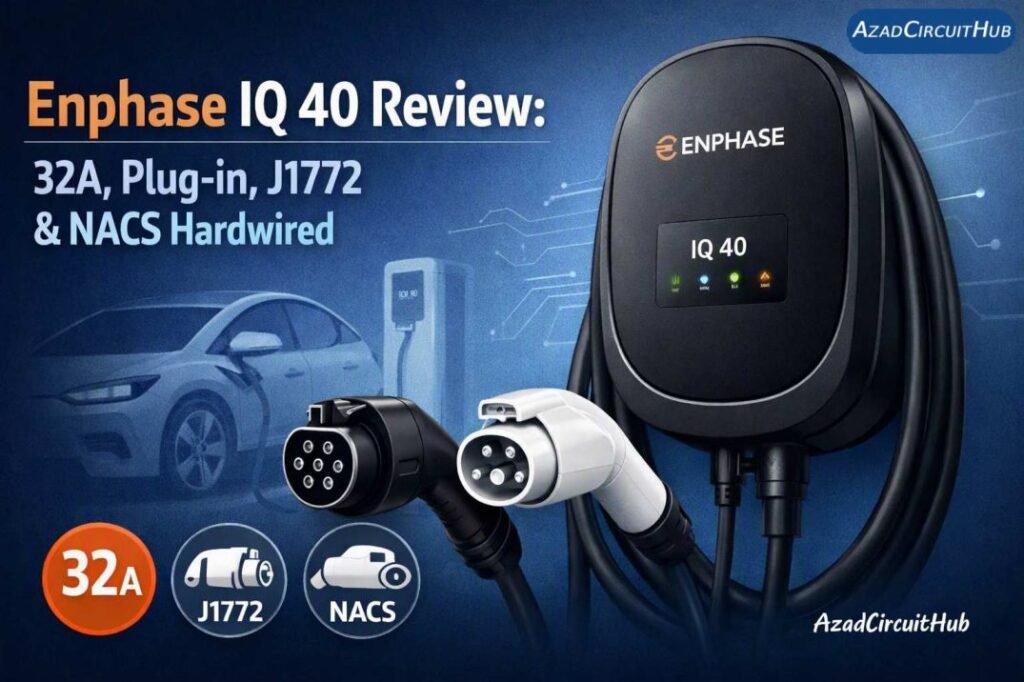
Table of Contents
Table of Contents
Enphase IQ 40 Charging Performance
The biggest attraction of the IQ 40 is its 32A Level 2 charging capability. Compared with a standard 120V Level 1 charger, 240V Level 2 charging can add substantially more range during an overnight charging session.
The 7.7 kW maximum output is suitable for many daily driving patterns. For example, someone who drives a moderate number of miles each day may be able to replenish the required energy overnight without needing a higher-current 40A or 48A charger.
However, buying a higher-output charger does not automatically mean faster charging. The EV's onboard AC charging system must also be capable of accepting the available power.
For a broader comparison of Enphase models, see my complete guide to Enphase ev charger reviews, where the IQ 40 is compared with higher-current IQ models.
32A Plug-In Design and NEMA 14-50 Connection
One of the practical features of the Enphase IQ 40 is its NEMA 14-50 plug-in configuration. This can be convenient for homeowners who prefer a removable charger rather than a permanently hardwired unit.
The important point is that the NEMA 14-50 outlet must be properly installed for EV charging. A receptacle that happens to fit the plug is not enough. The branch circuit, conductors, overcurrent protection, grounding, and installation method should all be suitable for the continuous EV load.
The plug-in design can also be useful if you move homes or want the ability to disconnect the charger.
J1772 Connector and Vehicle Compatibility
The listed IQ 40 model uses a J1772 connector, which is widely used for AC Level 2 charging. The connector provides a direct connection for compatible EVs and plug-in hybrid vehicles.
Enphase also offers IQ 40 configurations with NACS, so buyers should check the exact product listing before ordering. Connector selection should be based on the vehicle you intend to charge.
If you are unsure which connector and charging configuration fit your vehicle, my Enphase ev charger reviews guide covers the different IQ 40, IQ 50, IQ 60, and IQ 80 configurations.
Wi-Fi Connectivity and Smart Charging
The IQ 40 is more than a basic AC power supply. The listed model includes Wi-Fi connectivity, allowing it to function as a connected EV charging device.
Smart connectivity can be useful for monitoring charging activity and managing the charger through its supported software ecosystem. This is particularly useful for homeowners who want more visibility than they get from a basic plug-in EVSE.
For me, smart connectivity is most useful when it adds practical control and monitoring rather than simply adding another app to the phone. Buyers should therefore consider the software features they will actually use.
25-Foot Charging Cable
The included 25-foot cable is another practical advantage. Cable length matters more than many buyers realize because the location of the electrical outlet or hardwired charger may not line up perfectly with the vehicle's charge port.
A longer cable can make parking easier and reduce the need to reposition the vehicle. It can also provide additional flexibility when the charging equipment is mounted on a garage wall.
The cable should still be positioned carefully to prevent vehicle tires, doors, or other equipment from damaging it.
Enphase IQ 40 Installation Requirements
The 32A output should be treated as a continuous electrical load when designing the charging circuit. This means the installation should not be sized like an occasional household appliance.
Before installation, I would check:
- Available electrical service capacity
- Panel breaker space
- Branch-circuit conductor size
- Overcurrent protection
- NEMA 14-50 receptacle rating for plug-in installation
- Grounding and bonding
- Indoor or outdoor installation location
- Local electrical requirements
If your panel already supplies electric heating, HVAC, water heating, dryers, or other large loads, a load calculation may be appropriate before installing an EV charger.
For homeowners comparing residential charging equipment, I also recommend reviewing my guide to the best level 2 ev charger before deciding which current rating makes sense.
Enphase IQ 40 vs Higher-Current Chargers
The IQ 40's 32A output sits below the 40A IQ 50, 48A IQ 60, and 64A IQ 80. That does not make it unsuitable for home charging.
| Charger | Current | Approx. Power at 240V | Installation |
|---|---|---|---|
| IQ 40 | 32A | 7.7 kW | Plug-in / hardwired |
| IQ 50 | 40A | 9.6 kW | Plug-in / hardwired |
| IQ 60 | 48A | 11.5 kW | Hardwired |
| IQ 80 | 64A | 15.4 kW | Hardwired |
The IQ 40 can be a sensible choice when the vehicle does not require higher AC charging power or when the homeowner wants to keep electrical demand lower.
A higher-current charger becomes more relevant when the EV supports it and the home has enough electrical capacity.
Is the Enphase IQ 40 Worth Buying?
In this Enphase IQ 40 Review, the main strengths are its 32A Level 2 output, 7.7 kW charging capacity, Wi-Fi connectivity, 25-foot cable, five-year warranty, and convenient NEMA 14-50 plug-in configuration.
The charger is particularly interesting for homeowners who want a connected residential EV charger without immediately stepping up to a higher-current installation.
Check Enphase IQ 40 price and availability on Amazon
Before buying, confirm the connector configuration, vehicle compatibility, available circuit capacity, and installation requirements.
If you are comparing the IQ 40 with other residential charging stations, my best level 2 ev charger guide provides additional options across different charging-current categories.
Enphase IQ 40 Review: Pros and Cons
| Pros | Considerations |
|---|---|
| 32A Level 2 charging | Not as fast as 48A or 64A units |
| Approximately 7.7 kW | Vehicle charging limit still applies |
| NEMA 14-50 plug-in option | Requires a correctly installed circuit |
| Wi-Fi connectivity | Smart features depend on supported software |
| 25-foot cable | Cable management is important |
| Five-year warranty | Verify current terms before purchase |
| J1772 configuration available | Check connector before ordering |
| Enphase ecosystem | Higher-current options may suit some homes better |
Frequently Asked Questions
Is the Enphase IQ 40 a Level 2 charger?
Yes. The Enphase IQ 40 is a 240V Level 2 AC EV charger rated at 32A, providing approximately 7.7 kW of maximum theoretical charging power.
How fast does the Enphase IQ 40 charge?
The IQ 40 can deliver up to approximately 7.7 kW at 240V and 32A. Actual vehicle charging speed depends on the EV's onboard charger and other operating conditions.
Does the Enphase IQ 40 use a NEMA 14-50 plug?
The listed 32A plug-in version uses a NEMA 14-50 plug. The receptacle and branch circuit should be correctly installed and rated for continuous EV charging.
Is Enphase IQ 40 compatible with J1772 vehicles?
The specified model uses a J1772 connector and is suitable for compatible J1772 EVs. Enphase also offers NACS configurations, so buyers should verify the exact connector on the product they purchase.
Does the Enphase IQ 40 have Wi-Fi?
Yes. The listed IQ 40 model includes Wi-Fi connectivity, providing smart charging and connected-device capabilities through its supported Enphase ecosystem.
Final Verdict
The Enphase IQ 40 is a practical 32A Level 2 EV charger for homeowners who want approximately 7.7 kW of charging power, smart connectivity, a 25-foot cable, and the convenience of a NEMA 14-50 plug-in installation.
Its 32A output is enough for many daily charging routines, while the J1772 and NACS configurations give buyers options based on vehicle compatibility. The most important step is to match the charger to the EV's onboard charging capability and the home's electrical capacity.
Check the Enphase IQ 40 on Amazon before buying, and verify the exact connector, plug-in configuration, warranty, and current product specifications shown on the listing.
Get new guides in your feed. Follow Electrical Insights on LinkedIn for new electrical standards guides, calculators and design tips from Azad Circuit Hub.
#EnphaseIQ40, #EnphaseIQ40Review, #EVCharger, #Level2EVCharger, #J1772, #NACS, #HomeEVCharging, #EVCharging, #ElectricVehicle, #Enphase