
Best Level 2 EV Charger for Nissan Leaf (Top Picks + Charging Times)
If you own a Nissan Leaf, moving from a standard 120V outlet to Level 2 home charging can make a major difference in daily charging time. The right setup can add useful range during a normal evening at home without requiring an expensive DC fast-charging session.
As an electrical engineer with hands-on experience in electrical panels, load management, and equipment installation, I always look at more than the advertised charging speed. Circuit rating, plug type, cable length, protection features, installation method, and the vehicle’s onboard charger all matter.
For most Leaf owners with a suitable 240V circuit, the Best Level 2 EV Charger for Nissan Leaf is one that matches the car’s AC charging capability while providing safe and convenient home charging.
Best Level 2 EV Chargers for Nissan Leaf at a Glance
| Charger | Output | Plug | Cable | Best For | Nissan Leaf Use |
|---|---|---|---|---|---|
| EVIQO Level 2 EV Charger | Up to 48A* | NEMA 14-50 / hardwired options vary | Long cable options | Higher-power home charging | Excellent for home installation |
| WOLFBOX WE40 | Up to 40A | NEMA 14-50 | 25 ft class | Plug-in charging | Excellent match for most Leaf models |
| Nissan Leaf onboard charger | Model dependent | J1772 AC | — | Determines actual AC charging rate | Limits maximum charging speed |
*Always verify the specific model's electrical requirements before installation.
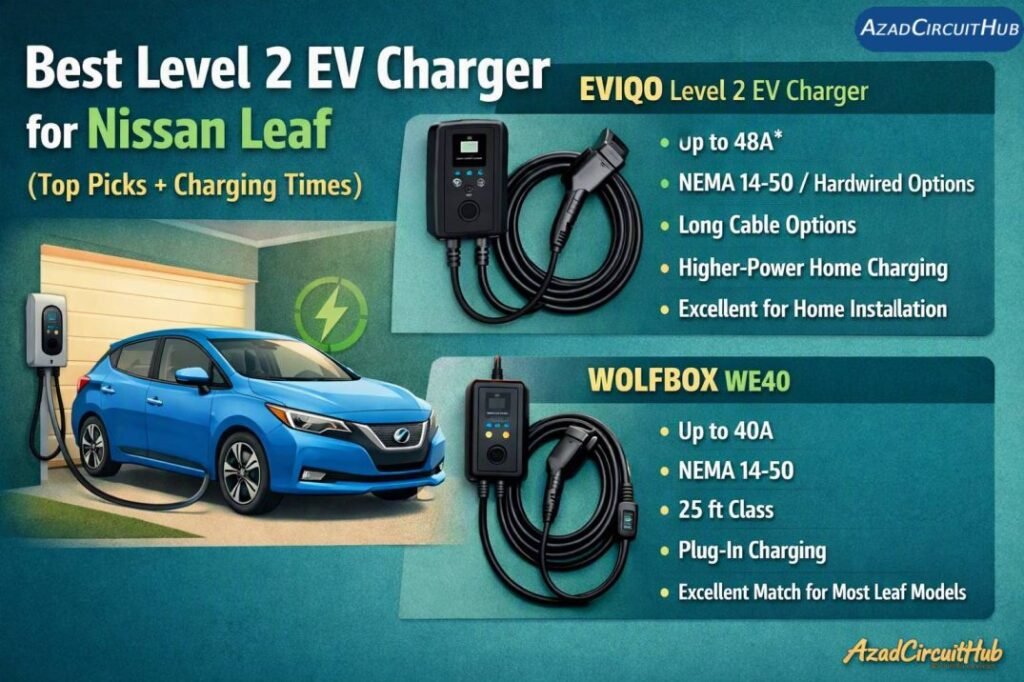
Table of Contents
Table of Contents
For many households, a 32A or 40A Level 2 EVSE is already more than enough for a Nissan Leaf because the car's onboard AC charger determines how much power it can actually accept.
If you are comparing several home charging options, see our guide to best level 2 chargers for home for a broader comparison of EVSE options, installation types, and charging features.
How Fast Does a Nissan Leaf Charge on Level 2?
The charging time depends on the Leaf's battery size, state of charge, onboard AC charger, battery temperature, and the EVSE's available power.
A common Nissan Leaf setup uses a 6.6 kW-class onboard charger. A Level 2 EVSE capable of delivering 40A can provide more than the vehicle may need, but that does not mean the Leaf will continuously draw 9.6 kW.
| Nissan Leaf Battery | Approx. Level 2 Power | Approx. 0–100% Time* |
|---|---|---|
| 24 kWh | 3.3–6.6 kW | About 4–8 hours |
| 30 kWh | 6.6 kW class | About 5–6 hours |
| 40 kWh | 6.6 kW class | About 6–8 hours |
| 62 kWh | 6.6 kW class | About 9–11 hours |
*Charging time varies by model year, battery condition, temperature, starting state of charge, charging losses, and onboard charger rating. These are practical estimates rather than guaranteed times.
This is an important point when choosing the Best Level 2 EV Charger for Nissan Leaf. Buying a higher-amperage EVSE does not automatically make the Leaf charge faster than its onboard AC system allows.
EVIQO Level 2 EV Charger
The EVIQO Level 2 EV Charger is worth considering if you want a feature-rich home charging setup with higher available current than many basic portable EV chargers.
Its appeal is mainly in the combination of charging capability, home installation flexibility, and smart charging features offered by the specific model.
For a Leaf owner, the extra output can provide useful headroom if the charger is later used with another EV that supports higher AC charging power. Your Leaf will still regulate its own charging current according to its onboard charger.
Why Leaf Owners May Consider EVIQO
- Level 2 240V home charging
- Higher-current capability on compatible configurations
- Suitable for dedicated home EV circuits
- Useful cable reach depending on model
- Smart charging features on supported versions
- Suitable for garages and residential parking areas
Before purchasing, check the exact EVIQO model, plug configuration, breaker requirement, and installation instructions.
Check the EVIQO Level 2 EV Charger on Amazon if you want a higher-capability home EVSE that can also provide flexibility for a future EV.
For our detailed product analysis, read the EVIQO Level 2 EV Charger Review before choosing the exact configuration.
WOLFBOX WE40 Level 2 EV Charger
The WOLFBOX WE40 is a practical option for Leaf owners who prefer a plug-in installation with a NEMA 14-50 connection. Its 40A class charging capability gives it plenty of capacity for a Nissan Leaf while keeping the installation relatively straightforward when a properly rated 240V receptacle is already available.
A 40A EV charger normally requires a circuit designed for continuous EV charging. Under the common 80% continuous-load rule used for EV charging circuits, a 40A continuous load requires a 50A circuit.
That does not mean every installation should simply use a 50A breaker. The receptacle, wiring, disconnecting means, panel capacity, and installation method must all be properly matched.
WOLFBOX WE40 Key Features
| Feature | WOLFBOX WE40 |
|---|---|
| Charging type | AC Level 2 |
| Maximum current class | 40A |
| Connection | NEMA 14-50 plug |
| Installation | Plug-in |
| Best use | Residential charging |
| Leaf compatibility | J1772-equipped North American models |
Check WOLFBOX WE40 on Amazon if you want a plug-in NEMA 14-50 charger that can deliver more than enough capacity for the typical AC charging needs of a Nissan Leaf.
You can also see our detailed WOLFBOX 40amp Level 2 EV Charger Review for installation considerations, features, and real-world buying factors.
What Amperage Does a Nissan Leaf Need?
The Nissan Leaf does not necessarily need a 40A EVSE to charge effectively. The car's onboard charger is the limiting component in many configurations.
For example, connecting a Leaf with a 6.6 kW onboard charger to a 40A EVSE does not force the vehicle to consume 40A. The EV communicates with the charging equipment and draws the current it is designed to accept.
This is why a 32A or 40A EVSE can be a sensible choice even when the vehicle cannot use the charger's full rated output.
For homeowners planning to keep the charger for many years, choosing a higher-capacity EVSE can also provide compatibility with a future EV.
Electrical Installation Considerations
A Level 2 charger should normally be treated as a significant continuous electrical load. The circuit must be sized according to the EVSE's actual maximum current and the applicable electrical code.
For example:
| EVSE Current | Typical Minimum Circuit Rating* |
|---|---|
| 16A | 20A |
| 24A | 30A |
| 32A | 40A |
| 40A | 50A |
| 48A | 60A |
*Illustrative sizing based on an 80% continuous-load rule. Local electrical codes and equipment instructions must be followed.
Check your electrical panel before selecting a charger. A home with an older panel, limited service capacity, or several large loads may need a load calculation before adding an EV charging circuit.
The receptacle also matters. A NEMA 14-50 outlet should be installed using equipment and wiring suitable for the intended continuous load. Avoid relying on an inexpensive extension cord or household receptacle adapter for permanent EV charging.
J1772 Compatibility With Nissan Leaf
Most North American Nissan Leaf models use the SAE J1772 connector for Level 1 and Level 2 AC charging. This makes the Leaf compatible with a large range of J1772 home EVSE products.
The charging connector should not be confused with the DC fast-charging connector. Depending on model year and market, Leaf vehicles may use CHAdeMO for DC fast charging.
For home charging, the J1772 connection is the important part when selecting a conventional Level 2 EV charger.
If you are comparing connector options across different electric vehicles, our guide to best level 2 chargers for home covers more J1772 and home-charging choices.
How to Choose the Right Charger for Your Leaf
I recommend checking these points before buying:
- Confirm the Leaf model year. Charging hardware varies between generations and battery versions.
- Check the onboard charger rating. This tells you the maximum AC charging power the vehicle can use.
- Check your panel capacity. Do not select an EVSE before confirming that the electrical service can support it.
- Choose the correct plug. A NEMA 14-50 charger requires a suitable 14-50 receptacle and circuit.
- Consider cable length. A longer cable can be useful when the parking position changes.
- Look for safety features. Ground-fault protection and appropriate thermal monitoring are important.
- Think about future EVs. A higher-rated EVSE may remain useful if you replace the Leaf later.
Is a 40A Charger Too Much for a Nissan Leaf?
Not necessarily. A 40A EVSE can be used with a Leaf when the vehicle and electrical installation are compatible with the charging equipment.
The key distinction is between the charger's maximum output and the vehicle's actual charging acceptance.
The EVSE advertises its available current, while the vehicle controls how much current it draws. Therefore, a 40A unit can be paired with a Leaf without the car automatically receiving 40A.
The important part is installing the EVSE on a properly sized circuit and following the manufacturer's instructions.
Charging Time: What Should Leaf Owners Expect?
If you arrive home with a partially depleted battery, overnight Level 2 charging can usually cover normal daily driving needs without requiring a full battery recharge every night.
For example, adding 30 kWh at roughly 6.6 kW theoretically takes about 4.5 hours before accounting for charging losses and changes in charging power. Real charging time can be longer.
Battery temperature, charging losses, battery management, and the vehicle's state of charge all influence the final result.
This is why I prefer looking at the amount of energy needed rather than relying only on a manufacturer's headline charging-time figure.
Frequently Asked Questions
Can I use a 40A Level 2 charger with a Nissan Leaf?
Yes, provided the EVSE is compatible with the Leaf's J1772 AC charging system and the electrical installation is correctly designed. The Leaf will only draw the power its onboard charging system accepts.
Does a 40A charger make a Nissan Leaf charge at 40A?
No. The vehicle controls its charging current. A 40A EVSE provides up to its rated available current, but the Leaf's onboard charger determines the actual AC charging rate.
How long does a Nissan Leaf take to charge on Level 2?
Depending on the battery size and model, a full charge can take several hours. Many 6.6 kW-class Leaf configurations can replenish a substantial portion of the battery overnight.
Is NEMA 14-50 good for Nissan Leaf charging?
Yes. A properly installed NEMA 14-50 receptacle can support many plug-in Level 2 EVSEs. The circuit must be correctly sized for continuous EV charging and installed according to applicable electrical requirements.
Should I buy a 32A or 40A EV charger for my Leaf?
Both can work well. The decision depends on the Leaf's onboard charger, existing electrical capacity, installation cost, and whether you may use the EVSE with another EV in the future.
Final Buying Advice
For most Nissan Leaf owners, the main goal should be dependable overnight Level 2 charging rather than simply choosing the EVSE with the highest amperage number.
The WOLFBOX WE40 is particularly relevant for buyers who want a plug-in NEMA 14-50 setup, while the EVIQO is worth considering for homeowners who want additional charging capability and features.
Before buying the Best Level 2 EV Charger for Nissan Leaf, confirm your exact Leaf model, onboard AC charging rate, electrical panel capacity, circuit requirements, and connector type.
If you are also shopping for another EV or want one charger that can serve multiple vehicles, compare our best level 2 chargers for home guide before making your final purchase.
Get new guides in your feed. Follow Electrical Insights on LinkedIn for new electrical standards guides, calculators and design tips from Azad Circuit Hub.
#NissanLeaf, #Level2EVCharger, #EVCharger, #NissanLeafCharging, #EVCharging, #HomeEVCharger, #J1772Charger, #ElectricVehicle, #EVChargingStation, #EVChargerGuide
