Circuit Breaker Finder Not Working or Wrong Breaker? Fixes That Work
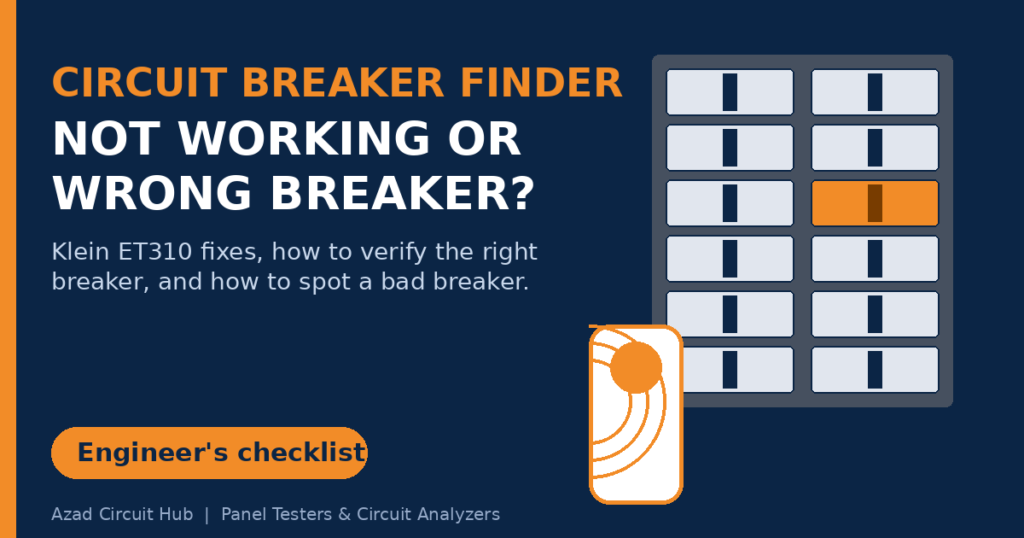
Circuit breaker finder not working or wrong breaker: if that is the problem in front of you, the finder is rarely the faulty part. As an electrical engineer, I trace circuits and verify panel labels as part of my regular work, and most failed searches come down to a weak 9V battery, a dead or miswired outlet, a 240V circuit, or the way the receiver is held against the panel. This guide is the checklist I run before I blame the tool, plus what to do when a Klein ET310 genuinely needs replacing.
Quick answer: Fit a fresh 9V battery in the receiver, plug the transmitter into a live, correctly wired 120V outlet, hold the receiver flat against each breaker, and scan slowly from top to bottom. Still wrong? Check for a 240V circuit, a shared neutral or a mislabeled panel, then confirm the circuit is dead with a voltage tester before you touch any wire.

- ACCURATE CIRCUIT BREAKER IDENTIFICATION: Quickly locate the correct breaker with precision using our circuit breaker fin…
- TWO-PART SYSTEM: Consists of a Transmitter connected to the outlet/fixture and a Receiver to scan the panel, allowing fo…
- CLEAR INDICATIONS: The Receiver provides visual and audible cues when the correct breaker is found, ensuring a hassle-fr…
Circuit Breaker Finder Not Working or Wrong Breaker: 7 Common Causes
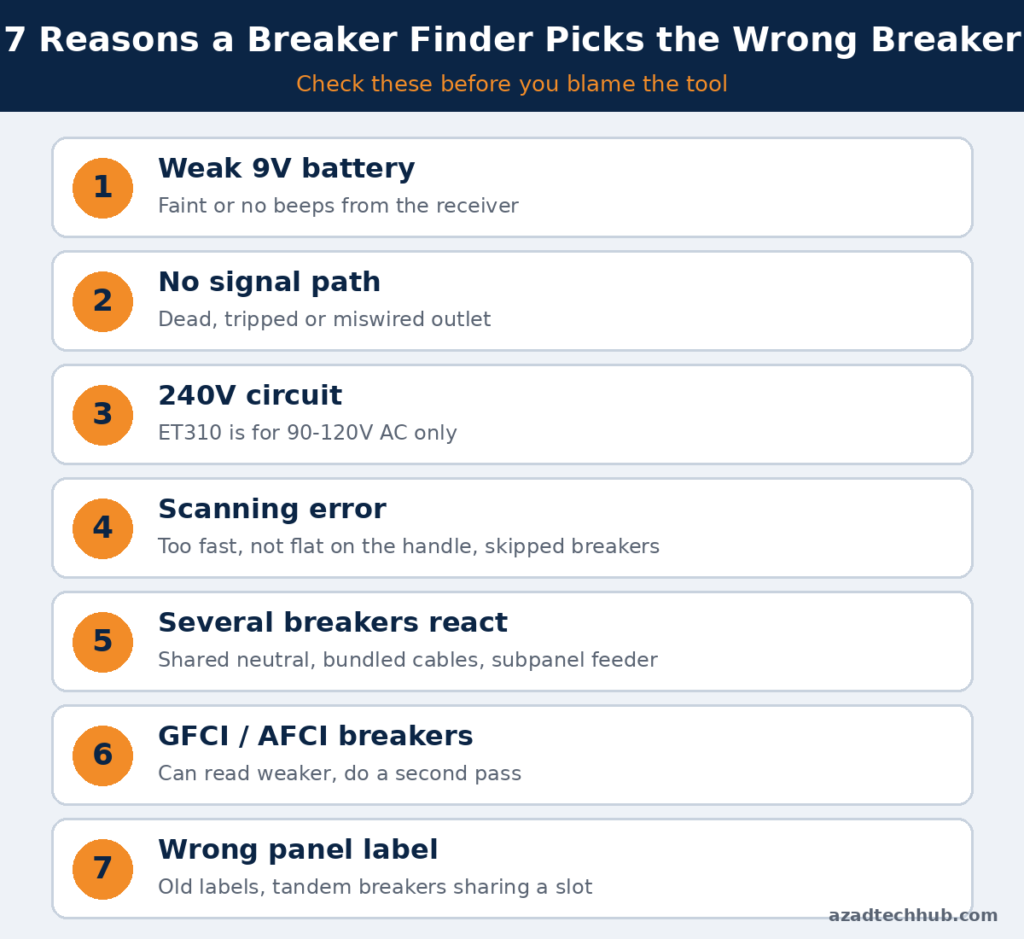
If you have read circuit breaker finder not working or wrong breaker reddit threads, the advice usually boils down to the same short list. Work through it in this order, because it goes from the cheapest fix to the most involved.
- Weak or dead 9V battery in the receiver. The ET310 only needs a battery in the receiver, and the receiver switches itself off after about three minutes of non-use. A tired battery gives faint or no beeps, which looks exactly like a finder that cannot find anything.
- The transmitter has no signal path. The transmitter is powered by the circuit it is plugged into, so a tripped breaker, a dead outlet or a switched receptacle means no signal at all. Read the built-in GFCI and wiring tester on the transmitter first. If it reports a wiring fault, fix that before you scan.
- It is a 240V circuit. The ET310 is rated for 90 to 120V AC circuits. Dryers, ranges, EV chargers and many HVAC loads are 240V, so a 120V finder is the wrong tool for them.
- Scanning technique. Hold the receiver tip flat against the face of each breaker handle, move at a steady pace, and scan every breaker, including the ones you think are irrelevant. Rushing past a breaker is the most common reason people pick the wrong one.
- Two or more breakers react. Bundled cables, a shared neutral (multiwire branch circuit), or a subpanel feeder can spread the signal. Pick the breaker with the strongest, most consistent response, not the first one that beeps.
- Special breakers read differently. In my experience, GFCI, AFCI and dual-function breakers can give weaker or less consistent readings than standard breakers. Do a second pass and confirm with a voltage tester.
- The panel label is wrong, or two circuits share one slot. The finder may point to the right breaker while the old label sends you to the wrong one. Tandem (double-stacked) breakers add to the confusion.
Klein ET310 Not Working or Not Finding the Breaker? Fix It in 5 Steps
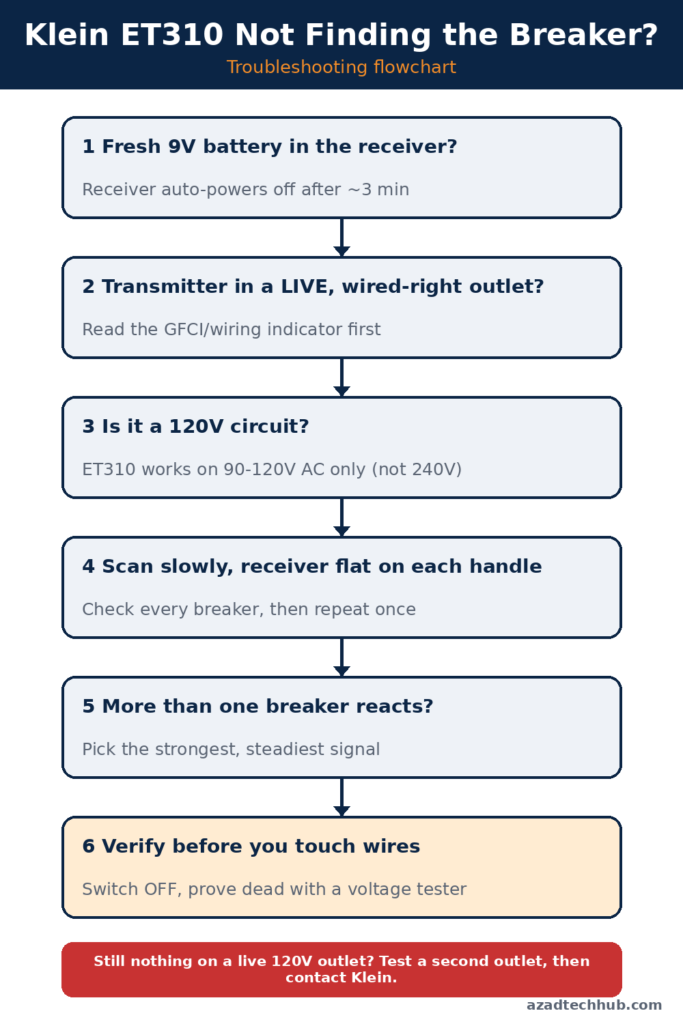
Searches for “klein et310 not working” and “klein et310 not finding breaker” are very common, and the fix is almost always one of these five steps. If your Klein circuit breaker finder is not working, do them in order:
- Replace the 9V battery with a fresh alkaline cell and check the low-battery indicator.
- Test the unit on a known live, correctly wired outlet before using it on the problem circuit. Klein recommends verifying the tester this way before every use.
- Make sure the transmitter is fully seated and the outlet grips the prongs firmly. A loose or worn receptacle weakens the signal.
- Re-scan every breaker slowly with the receiver flat against the handle, then repeat the scan once.
- If you still get nothing on a confirmed live 120V circuit, test the unit on a second outlet. If it fails there too, contact Klein or the seller about warranty.
My rule on the job is simple: a finder that works on one outlet and not on another is telling you something about the circuit, not the tool.
If you want a finder with a built-in GFCI tester, the Klein Tools ET310 is the one I would start with
How Does a Klein Circuit Breaker Finder Work?
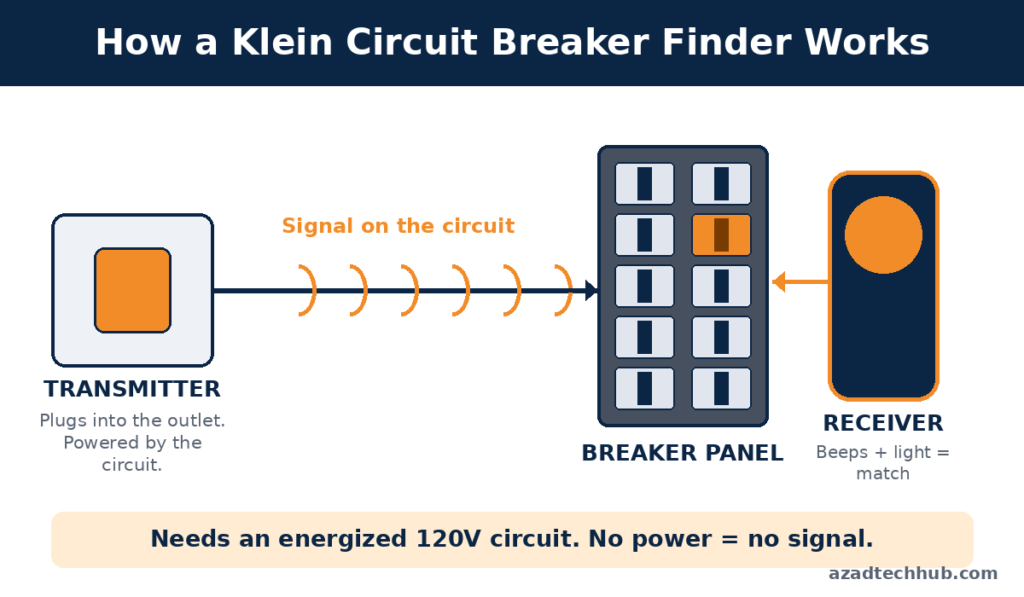
A Klein circuit breaker finder has two parts. The transmitter plugs into the outlet (or connects to a fixture with Klein’s optional accessories) and puts a signal on that circuit. The receiver then scans the breakers in the panel and gives visual and audible indications when it reaches the breaker feeding that circuit. On the ET310 the transmitter docks into the receiver for storage and carries the GFCI outlet tester, which is why it is handy for both jobs.
If you are new to the tool, our step-by-step guide on how to use a circuit breaker finder walks through the full scan, and the Klein ET310 review covers its features in detail. Here is what matters for troubleshooting:
- Pros: built-in GFCI outlet tester, transmitter docks in the receiver, battery only in the receiver, 6.6 ft drop rating, CAT II 120V safety rating.
- Limits: 120V circuits only, the circuit must be energized, and like any finder it can show more than one candidate breaker.

- REPLACEMENT TRANSMITTER for the ET310 Circuit Breaker Finder with Integrated GFCI Outlet Tester
- THE ET310 HAS TWO PARTS a Transmitter connected to the electrical outlet or fixture, and a Receiver used to scan the pan…
- TEST GFCI DEVICES for tripping with GFCI tester incorporated into the Transmitter
Will a Circuit Breaker Finder Work Without Power?
No. The transmitter takes its power from the circuit, so a de-energized circuit sends no signal and the receiver has nothing to detect. If the circuit is dead, turn the breakers off one at a time with a helper, or use a lamp or radio plugged into the outlet to see when it goes off. For live-circuit methods, read our guide on how to find a breaker without turning off power.
Circuit Breaker Finder Not Working or Wrong Breaker? Always Verify Before You Touch Anything
Even when the finder beeps clearly, it only identifies a likely breaker. Before you open a box or splice a wire, switch the breaker off and prove the circuit is dead at the point of work with a voltage tester or multimeter. This one habit protects you from mislabeled panels, shared neutrals and the occasional bad reading.
To build your verification kit, start with our voltage tester reviews and multimeter reviews, and learn the outlet check in our GFCI outlet tester guide. Browse every tool we cover in the Panel Testers & Circuit Analyzers category, or compare options in our best electrical panel testers and circuit analyzers roundup.
How to Identify a Bad Breaker Switch with a Multimeter
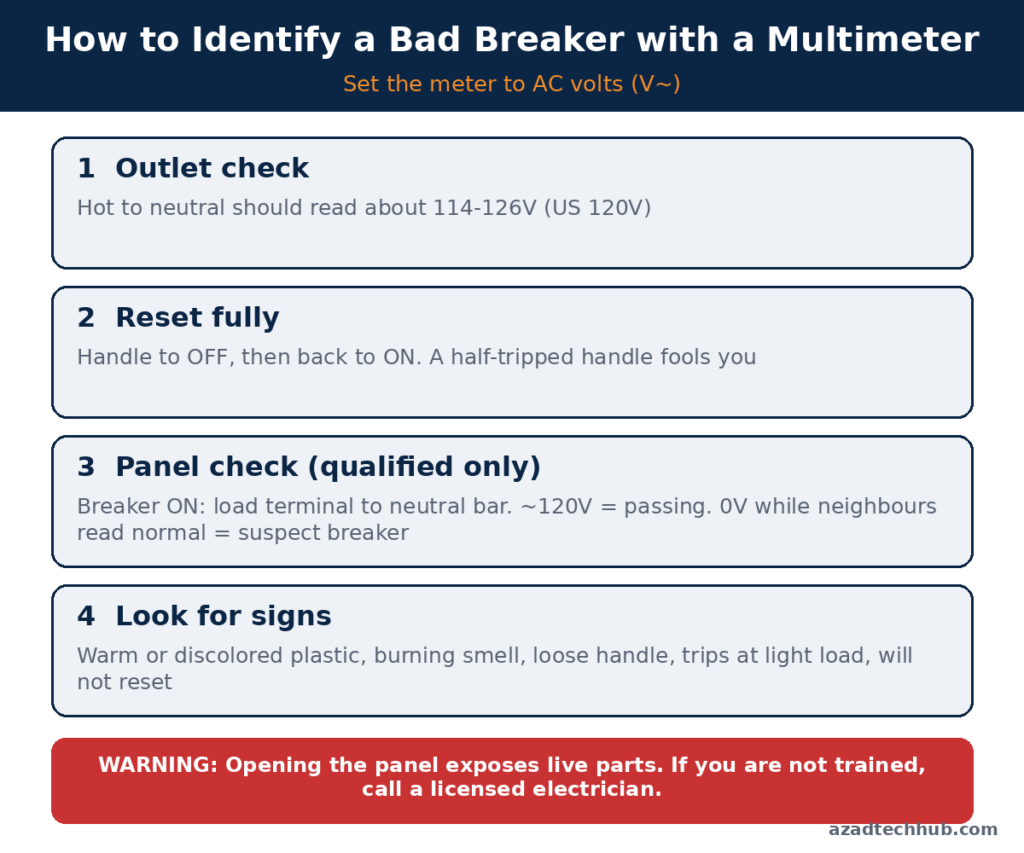
If the finder lands on the right breaker but the circuit is still dead, the breaker itself may be failing. Here is the sequence I follow:
- Check the outlet first. Set the multimeter to AC volts and measure hot to neutral. A healthy US 120V outlet reads roughly 114 to 126V.
- Reset properly. Push the breaker fully to OFF, then back to ON. A half-tripped handle looks “on” but is not making contact.
- Check at the panel, only if you are qualified. Removing the panel cover exposes live parts. With the breaker ON, measure from the breaker’s load terminal to the neutral bar. About 120V means the breaker is passing power. Zero volts, while the adjacent breakers read normal, points to a failed breaker or a fault downstream.
- Look for physical signs. Warm or discolored plastic, a burning smell, a loose handle, repeated trips under light load, or a breaker that will not reset are all replacement signals.
Replace a bad breaker only with the exact type listed for your panel. If you are not trained to work inside a panel, call a licensed electrician. A thermal camera such as the one in our FLIR C5 review can also show a hot breaker from the front without touching anything.
How to Tell if an Arc Fault Breaker Is Bad
Press the push-to-test button on the AFCI breaker with the panel energized. If it trips, the arc-detection circuit passed its self-test; reset it and move on. If it does not trip, or it trips repeatedly with nothing plugged in, replace the breaker. Be careful with plug-in AFCI testers: they imitate an arc waveform, and they do not always trip every manufacturer’s breaker, so a failed result from a third-party tester is not proof of a bad breaker. Repeated nuisance trips are more often caused by a loose connection or a specific appliance than by the breaker itself.
What Is the 80% Rule on Breakers?
The 80% rule means a continuous load (running three hours or more) should not exceed 80% of the breaker rating. It comes from sizing the circuit at 125% of the continuous load, and 80% is simply the inverse. The NEC does not print it as a standalone “80% rule”, but the effect is the same.
| Breaker size | Maximum continuous load |
|---|---|
| 15A | 12A |
| 20A | 16A |
| 30A | 24A |
| 40A | 32A |
| 50A | 40A |
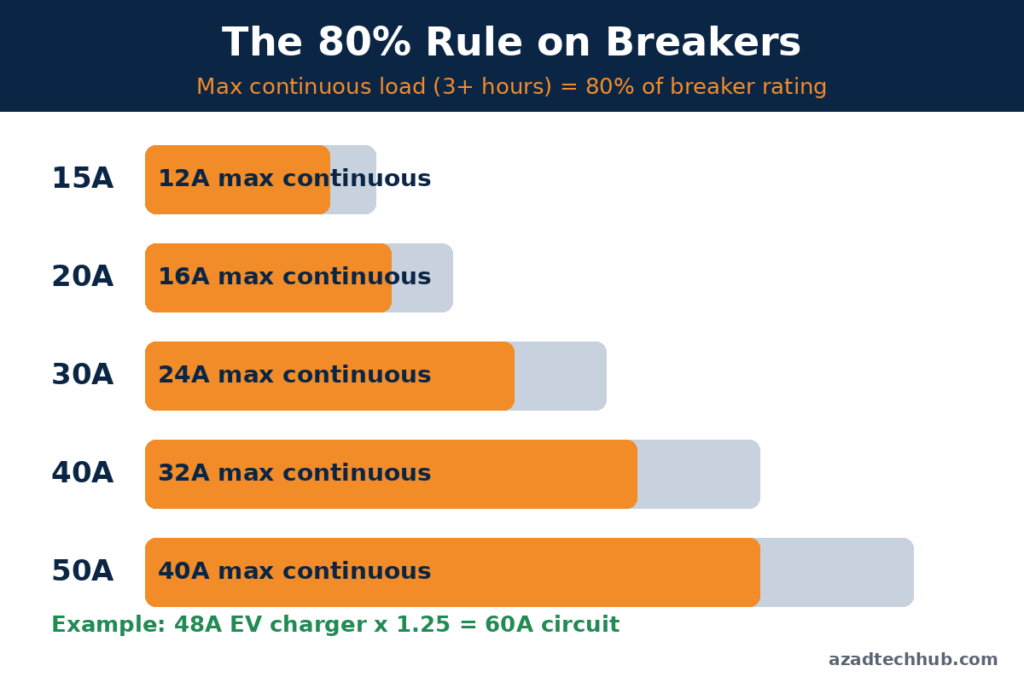
This is why a 48A EV charger needs a 60A circuit, as explained in our EVIQO NACS 48A charger review and the Eviqo hardwired vs plug-in comparison. It also explains why a breaker that trips under a long, steady load is often doing exactly its job.
Which Finder Should You Buy If Yours Keeps Failing?
If your finder is old, cheap or unreliable, upgrading is often faster than troubleshooting it. Digital finders with a transmitter and receiver all follow the same principle, so compare features and build quality rather than assuming brand names are interchangeable. That includes people searching for a Milwaukee circuit breaker finder or an Ideal circuit breaker finder.
- Klein or Ideal? Read our Klein vs Ideal circuit breaker finder comparison.
- Need GFCI testing in the same tool? See the best circuit breaker finder for GFCI outlets.
- Want to see every option? Use our best circuit breaker finder top picks guide for the full shortlist of digital circuit breaker finders.
My pick for most homeowners and electricians: Klein Tools ET310
FAQ
My Klein breaker finder isn’t working. What should I do?
Replace the 9V battery, test the unit on a known live and correctly wired 120V outlet, seat the transmitter firmly, and rescan every breaker slowly with the receiver flat against the handle. If it still fails on a second outlet, contact Klein or the seller about the warranty.
Klein circuit breaker finder how to use: what are the basic steps?
Plug the transmitter into the outlet, turn on the receiver, and scan each breaker one at a time. The breaker with the strongest, steadiest indication is the match. Then switch it off and verify the outlet is dead. The full walkthrough is in our how-to-use guide.
How does a Klein circuit breaker finder work?
The transmitter puts a signal on the circuit through the outlet. The receiver picks up that signal at the breaker feeding the circuit and responds with visual and audible indications.
Will a circuit breaker finder work without power?
No. The transmitter is powered by the circuit, so a dead circuit sends no signal.
How to identify a bad breaker switch with a multimeter?
Measure hot to neutral at the outlet, reset the breaker fully OFF then ON, and if you are qualified, measure the load terminal to the neutral bar with the breaker ON. No voltage while neighboring breakers read normal suggests a failed breaker or downstream fault.
What is the 80%rule on breakers?
Continuous loads should stay at or below 80% of the breaker rating, for example 16A on a 20A breaker.
How to tell if an arc breaker is bad?
Use the built-in test button. If it will not trip, or it trips repeatedly with nothing connected, replace it.
Final Verdict
When your circuit breaker finder is not working or finds the wrong breaker, the cause is usually the battery, the outlet, a 240V circuit, or the scanning method, not a faulty tool. Run the checklist, verify with a voltage tester, and replace the finder only when it fails on a confirmed live 120V circuit. If you need a reliable all-round option with a built-in GFCI tester, the Klein Tools ET310 is the one I recommend.
Related Guides and Tools
- Klein ET310 Circuit Breaker Finder Review
- How to Use a Circuit Breaker Finder: Step-by-Step Guide
- Klein vs Ideal Circuit Breaker Finder
- Best Circuit Breaker Finder: Top Picks
- How to Find a Breaker Without Turning Off Power
- Best Electrical Panel Testers & Circuit Analyzers
- Panel Testers & Circuit Analyzers Reviews (category)
Get new guides in your feed. Follow Electrical Insights on LinkedIn for new electrical standards guides, calculators and design tips from Azad Circuit Hub.