Grizzl-E vs ChargePoint: Which EV Charger Wins?
Choosing the right home EV charger can make charging faster, easier, and more reliable. Two popular options are Grizzl-E and ChargePoint, both known for offering Level 2 charging for electric vehicles. But they take different approaches to design, smart features, installation, and everyday use.
This Grizzl-E vs ChargePoint comparison looks at charging speed, amperage, connectivity, durability, installation, pricing, and overall value. If you are trying to decide which charger fits your garage or driveway, the quick comparison below gives you a useful starting point.


Grizzl-E vs ChargePoint Quick Comparison
| Feature | Grizzl-E | ChargePoint |
|---|---|---|
| Charger type | Level 2 | Level 2 |
| Typical maximum output | Up to 40A on many models | Up to 50A on Home Flex |
| Maximum charging power | Up to 9.6 kW | Up to 12 kW |
| Connector | J1772 | J1772 |
| Smart connectivity | Depends on model | Yes |
| Wi-Fi/app control | Select models | Yes |
| Hardwired installation | Available | Available |
| Plug-in installation | Available | Available |
| Outdoor use | Yes, model dependent | Yes |
| Best for | Simple, rugged charging | Smart charging and connected features |
| Main advantage | Durability and simplicity | Smart controls and higher output |
| Amazon availability | Yes, Check Price | Yes, Check Price |
This table gives you the basic differences, but the details matter when comparing charging performance, installation requirements, and long-term ownership.
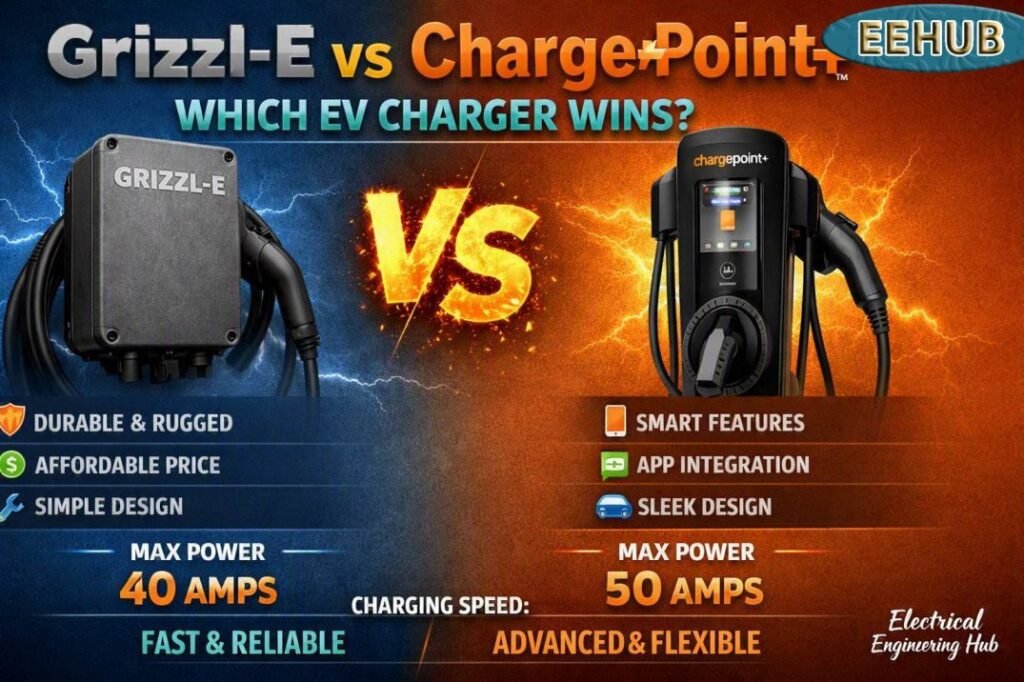
Table of Contents
Table of Contents
Grizzl-E vs ChargePoint: Charging Performance
Charging speed is one of the first things EV owners should consider. A Level 2 EV charger uses a 240-volt circuit and can add much more driving range per hour than a standard 120-volt outlet.
Grizzl-E has built a strong reputation around straightforward Level 2 charging. Many Grizzl-E models deliver up to 40 amps, which provides approximately 9.6 kW of charging power on a 240-volt supply.
ChargePoint Home Flex takes charging output a step further. It can provide up to 50 amps when installed on a suitable circuit, producing up to 12 kW of charging power. However, the actual charging rate is limited by the vehicle’s onboard charger.
For example, an EV capable of accepting only 7.2 kW will not charge at 12 kW simply because a higher-rated EVSE is installed.
Grizzl-E vs ChargePoint: Smart Features
The biggest difference between these chargers is connectivity.
Grizzl-E is attractive to drivers who want a dependable charger without relying heavily on an app. Depending on the model, you can get basic charging functionality or smart features. This simpler approach can be useful for homeowners who prefer to plug in and charge without managing another connected device.
ChargePoint has a stronger focus on connected charging. Its Home Flex charger can connect to the ChargePoint app, allowing users to monitor charging, manage settings, view charging information, and control the charging experience remotely.
Smart charging can also be useful if your utility offers time-of-use electricity rates. You may be able to schedule charging during cheaper periods and reduce the cost of charging at home.
If app-based control and charging data are important to you, ChargePoint has the advantage.
Build Quality and Outdoor Installation
A home EV charger may be installed inside a garage, on an exterior wall, or in another exposed location. That makes weather resistance and enclosure quality important.
Grizzl-E is particularly well known for its rugged metal enclosure and weather-resistant construction. This makes it appealing for homeowners who need a durable EVSE for outdoor charging.
ChargePoint Home Flex also supports indoor and outdoor installation when installed according to the manufacturer’s requirements. Its enclosure is designed for residential use and provides a more polished appearance.
If your priority is rugged construction and a straightforward charging unit, Grizzl-E is a strong option. If you want a more connected charger with a refined smart-home experience, ChargePoint may be the better match.
Installation and Electrical Requirements
Both chargers require a suitable 240-volt circuit. The exact breaker and wire size depend on the charger’s selected current, installation method, local electrical code, and the manufacturer’s instructions.
For continuous EV charging loads, the circuit is generally sized at 125% of the continuous load under NEC requirements. For example, a 40-amp continuous charging load typically requires a 50-amp circuit.
A 50-amp charging setting can require a larger circuit, depending on the installation configuration.
| Charging Current | Approx. Charging Power at 240V | Typical Minimum Circuit Rating |
|---|---|---|
| 24A | 5.76 kW | 30A |
| 32A | 7.68 kW | 40A |
| 40A | 9.60 kW | 50A |
| 48A | 11.52 kW | 60A |
| 50A | 12.00 kW | 60A+ |
Always have the installation checked by a qualified electrician. Panel capacity, conductor size, breaker type, conduit, voltage drop, and local requirements can affect the final installation.
Grizzl-E vs ChargePoint: Which Is Easier to Use?
Ease of use depends on what you expect from your charger.
Grizzl-E keeps things relatively simple. You connect the J1772 plug to the vehicle and charging begins according to the vehicle’s settings. This is ideal for someone who does not need detailed charging statistics or extensive remote controls.
ChargePoint provides a more feature-rich experience. The app can make it easier to check charging activity and manage your charger. For EV owners who enjoy smart-home technology, this added functionality can be a major benefit.
However, more features also mean more software and connectivity considerations. A simple charger can be preferable if your main goal is reliable charging rather than advanced monitoring.
Price and Overall Value
Price can change based on the model, retailer, promotions, and included features. Grizzl-E models are often positioned as a strong value choice for buyers who prioritize durable hardware.
ChargePoint generally commands a premium when you consider its smart features and higher available charging output.
Before buying, compare the total installation cost rather than looking only at the charger price. A higher-amperage installation may require electrical upgrades, which can significantly increase the project cost.
If you want a durable charger with a practical feature set, Grizzl-E offers excellent value.
For drivers who want smart charging, app connectivity, and flexible output settings, ChargePoint Home Flex is worth considering.
Which Charger Is Better for Your EV?
The right choice depends on your vehicle and charging habits.
Choose Grizzl-E if you:
- Prefer a rugged and straightforward EV charger
- Want reliable Level 2 home charging
- Need indoor or outdoor charging capability
- Do not require extensive app features
- Want strong hardware value
- Prefer simple controls
Choose ChargePoint if you:
- Want smartphone connectivity
- Like monitoring charging sessions
- Need flexible amperage settings
- Want up to 50A charging capability where supported
- Prefer a connected home charging experience
- Plan to take advantage of scheduled charging
If you are still comparing your options, our guide to famous level 2 ev charger options can help you evaluate other popular home charging models before making a purchase.
Grizzl-E vs ChargePoint: Cable and Connector Considerations
Both options can work with vehicles using the J1772 connector. If you own a newer EV with a different charging inlet, such as NACS, check whether your vehicle requires an adapter or a different charger configuration.
Cable length also matters. A charger mounted near the front of your parking space may not need an exceptionally long cable, while a side-mounted installation could benefit from additional reach.
Consider where your vehicle normally parks before selecting the final installation location.
Grizzl-E vs ChargePoint: Final Verdict
The better charger depends on whether you value rugged simplicity or connected features.
Grizzl-E is an excellent choice for homeowners who want dependable Level 2 charging, durable construction, and fewer unnecessary features. It is especially attractive for garages, driveways, and outdoor installations where reliability matters.
ChargePoint Home Flex is the stronger choice for drivers who want smart charging, app connectivity, flexible amperage, and higher maximum charging output. Its connected features make it particularly appealing to EV owners who want more control over their charging routine.
For many buyers, the decision comes down to this: choose Grizzl-E for simplicity and rugged value, or choose ChargePoint for smart features and charging flexibility.
Before buying, compare your EV’s maximum AC charging rate with the charger’s output. Paying for a higher-powered EVSE will not necessarily make your vehicle charge faster if the onboard charger has a lower limit.
Frequently Asked Questions
Is Grizzl-E better than ChargePoint?
Grizzl-E can be better for buyers who prioritize durable construction, straightforward operation, and value. ChargePoint is generally better for users who want app connectivity, smart controls, and flexible charging options.
Does ChargePoint charge faster than Grizzl-E?
ChargePoint Home Flex can provide up to 50 amps, while many Grizzl-E models provide up to 40 amps. However, your vehicle’s onboard AC charger determines how much power it can actually accept.
Can Grizzl-E be installed outdoors?
Yes, compatible Grizzl-E models are designed for outdoor use when installed according to the manufacturer’s requirements. Proper mounting, electrical protection, and weather exposure should be considered.
Do I need a 60-amp breaker for ChargePoint Home Flex?
A 60-amp circuit may be required when operating the charger at its higher current settings. The exact requirement depends on the selected charging current, installation configuration, electrical code, and manufacturer instructions.
Which EV charger should I buy for home use?
Choose Grizzl-E if you want a rugged and relatively simple Level 2 charger. Choose ChargePoint if smart controls, app connectivity, and flexible charging power are more important. Your EV’s maximum charging rate and available electrical capacity should also guide the decision.
Final Buying Recommendation
Both chargers are capable home EV charging solutions, but they target slightly different buyers. Grizzl-E stands out for its practical design and rugged build, while ChargePoint Home Flex appeals to drivers who want a smarter and more connected charging experience.
If you want to compare these models with additional high-performing options, explore our famous level 2 ev charger guide before choosing your home EVSE.
Related Guides
- EVIQO Level 2 EV Charger Review
- Grizzl E Level 2 EV Charger Review
- Emporia EV Charger Review
- Hardwired vs Plug In EV Charger
- How to Install a Level 2 EV Charger
Get new guides in your feed. Follow Electrical Insights on LinkedIn for new electrical standards guides, calculators and design tips from Azad Circuit Hub.
GrizzlEvsChargePoint, #EVCharger, #Level2EVCharger, #HomeEVCharging, #GrizzlE, #ChargePoint, #EVCharging, #ElectricVehicle, #EVChargerComparison, #HomeEVCharger