
40A vs 50A vs 60A Circuit for EV Chargers Explained
Choosing the right circuit size is one of the most important decisions when installing a Level 2 EV charger. Many homeowners compare a 40A, 50A, or 60A circuit for EV Charger without fully understanding how each option affects charging speed, installation cost, wire size, and future upgrades.
A 60 amp ev charger circuit is often the preferred choice for homeowners who want faster charging and room for future electric vehicles. However, a 40A or 50A circuit can also be the right solution depending on your vehicle, electrical panel capacity, and daily driving needs.
The comparison below explains the differences so you can select the safest and most practical installation.
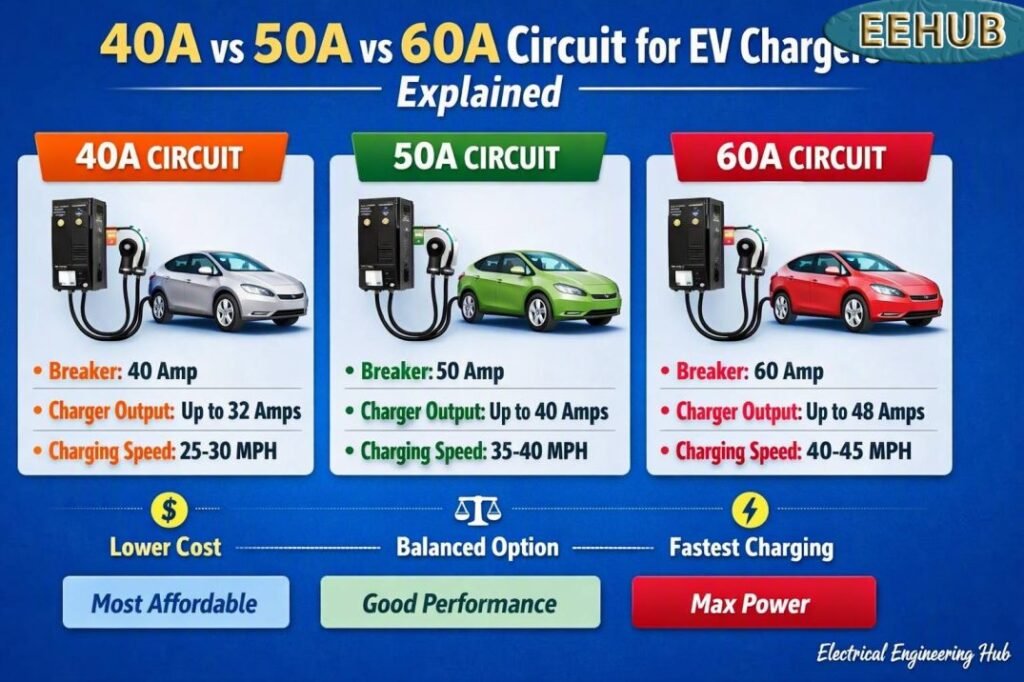
Table of Contents
Table of Contents
40A vs 50A vs 60A EV Charger Circuit Comparison
| Feature | 40A Circuit | 50A Circuit | 60A Circuit |
|---|---|---|---|
| Maximum Continuous Charger Output | 32A | 40A | 48A |
| Typical Charging Power | 7.7 kW | 9.6 kW | 11.5 kW |
| Typical Wire Size | 8 AWG Copper | 6 AWG Copper | 6 AWG Copper (often THHN in conduit) |
| Typical Breaker | 40A Double Pole | 50A Double Pole | 60A Double Pole |
| Best For | Plug-in chargers | Mid-range charging | Fast home charging |
| Future Proof | Good | Better | Excellent |
Recommended Circuit Sizes for EV Chargers
| Charger Output | Minimum Circuit Size |
|---|---|
| 32A Charger | 40A Circuit |
| 40A Charger | 50A Circuit |
| 48A Charger | 60A Circuit |
What Is a 60 Amp EV Charger Circuit?
A 60 amp ev charger circuit is a dedicated 240-volt electrical circuit protected by a 60A double-pole breaker. Following the National Electrical Code (NEC) 80% continuous load rule, this circuit safely supplies up to 48 amps continuously to an EV charger.
Because EV charging is considered a continuous electrical load, the charger cannot draw the full 60 amps continuously. Instead, it is limited to 48 amps.
This circuit size is commonly installed for premium hardwired Level 2 chargers that provide faster charging speeds and better long-term flexibility.
Common applications include:
- Tesla Wall Connector
- EVIQO Level 2 EV Charger 48A
- ChargePoint Home Flex
- Emporia EV Charger
- Wallbox Pulsar Plus
Choosing between a 40A, 50A, or 60A circuit is only part of the decision.
See our Wallbox EV Charger Cost and Installation guide to estimate your complete project cost before hiring an installer.
Why Does a 60A Circuit for EV Charger Only Deliver 48A?
Many homeowners wonder why a 60A breaker only powers a 48A charger.
The answer lies in NEC Article 625 and the continuous load rule.
Continuous loads must not exceed 80% of the circuit rating.
| Circuit Rating | Maximum Continuous Charging Current |
|---|---|
| 40A | 32A |
| 50A | 40A |
| 60A | 48A |
This safety requirement prevents excessive heating of breakers, conductors, and electrical connections during several hours of continuous charging.
40A vs 50A vs 60A Charging Speed
Charging speed depends on the current supplied by the charger.
Assuming a standard 240V supply:
| Circuit | Charger Output | Charging Power |
|---|---|---|
| 40A | 32A | 7.7 kW |
| 50A | 40A | 9.6 kW |
| 60A | 48A | 11.5 kW |
The difference becomes noticeable during overnight charging.
For drivers covering long daily distances, the faster charging available from a 60 amp ev charger circuit significantly reduces charging time.
Charging Time Comparison
Approximate charging speeds vary depending on vehicle efficiency.
| Circuit | Estimated Miles Added Per Hour |
|---|---|
| 40A | 25–30 miles |
| 50A | 30–37 miles |
| 60A | 40–46 miles |
These values are typical estimates and may vary depending on battery temperature, vehicle charging limits, and supply voltage.
The right breaker size should also match your charging equipment and installation budget.
Read our detailed Wallbox EV Charger Cost and Installation guide for cost breakdowns, installation tips, and charger recommendations before you buy.
Wire Size Requirements
Selecting the correct conductor size is essential for safety.
| Circuit | Typical Copper Wire |
|---|---|
| 40A | 8 AWG |
| 50A | 6 AWG |
| 60A | 6 AWG Copper (depending on insulation type and installation method) |
Always follow your local electrical code because conductor ampacity depends on:
- Conductor insulation
- Ambient temperature
- Conduit fill
- Installation method
- Local code requirements
Installation Cost Comparison
Larger circuits generally cost more because they require heavier wiring and larger breakers.
| Circuit | Typical Installation Cost |
|---|---|
| 40A | $400–$900 |
| 50A | $500–$1,100 |
| 60A | $700–$1,500 |
The final price depends on:
- Distance from electrical panel
- Panel upgrades
- Permit fees
- Labor rates
- Existing electrical infrastructure
Although the initial investment is higher, many homeowners prefer a 60 amp ev charger circuit because it avoids future electrical upgrades.
EVIQO 48A Charger Example
The EVIQO Level 2 EV Charger is an excellent example of a charger designed for a 60A installation.
Example Specifications
| Feature | Value |
|---|---|
| Maximum Output | 48A |
| Required Breaker | 60A |
| Supply Voltage | 240V |
| Maximum Charging Power | 11.5 kW |
| Installation | Hardwired |
Using the NEC continuous load rule:
60A × 80% = 48A
This allows the EVIQO charger to operate safely at its full charging capacity while complying with electrical safety standards.
If your electrical panel has sufficient capacity, installing a 60A circuit for the EVIQO charger offers excellent charging performance and prepares your home for future EV upgrades.
Learn More About the EVIQO Level 2 EV Charger
Planning a fast home charging setup? Read our in-depth EVIQO Level 2 EV Charger 48 Amp Review to explore charging performance, smart features, installation requirements, and real-world testing before making your purchase decision.
When Is a 40A Circuit Enough?
A 40A circuit is ideal if:
- Your vehicle charges at 32A or less.
- You drive fewer than 40 miles daily.
- Your electrical panel has limited spare capacity.
- You want the lowest installation cost.
Many compact EVs never require more than 32A charging.
When Should You Choose a 50A Circuit?
A 50A circuit works well when:
- Your charger outputs 40A.
- You want faster charging than a 40A installation.
- Your panel cannot support a 60A breaker.
- You are replacing an existing NEMA 14-50 outlet.
This option provides a good balance between charging speed and installation cost.
When Is a 60A Circuit EV Charger the Best Choice?
A 60 amp ev charger circuit is usually the best option if:
- You are installing a 48A hardwired charger.
- You own a large battery EV.
- Multiple EVs may be purchased in the future.
- You want the fastest Level 2 charging available at home.
- Your electrical service has enough available capacity.
Although the upfront cost may be slightly higher, it provides better long-term value.
Can Every Home Support a 60A Circuit for EV Charger?
Not always.
Before installation, an electrician should perform a residential load calculation.
The evaluation typically includes:
- Main service rating
- Existing electrical loads
- HVAC equipment
- Electric water heater
- Electric range
- Dryer
- Future electrical demand
If your panel lacks sufficient capacity, a service upgrade or load management solution may be necessary.
Safety Tips
For safe installation:
- Use a dedicated circuit.
- Install the correct breaker size.
- Follow NEC requirements.
- Use properly sized conductors.
- Hire a qualified electrician.
- Obtain permits where required.
- Test the installation before regular use.
Proper installation improves reliability and extends the life of your charging equipment.
CTA: See Why Homeowners Choose EVIQO
If you’re considering a 60 amp ev charger circuit, the EVIQO Level 2 EV Charger 48 Amp is worth a closer look. Check out our complete EVIQO Level 2 EV Charger Review for detailed specifications, installation tips, key features, pros and cons, and the latest Amazon deals available for homeowners.
Frequently Asked Questions
Is a 60A breaker required for a 48A EV charger?
Yes. A 48A charger requires a dedicated 60A breaker because continuous loads are limited to 80% of the circuit rating.
Can I install a 48A charger on a 50A circuit?
No. A 50A circuit supports only 40A continuous charging. A 48A charger requires a 60A circuit.
Is a 60A circuit faster than a 50A circuit?
Yes. A 60A circuit for EV Charger allows a 48A charger to deliver approximately 11.5 kW, compared to about 9.6 kW from a 50A circuit with a 40A charger.
Does every EV benefit from a 60A circuit?
Not necessarily. Some electric vehicles have onboard chargers that cannot accept 48A. In those cases, charging speed will be limited by the vehicle.
Is hardwiring better than using a NEMA 14-50 outlet?
For 48A charging, hardwiring is generally required and offers greater reliability, fewer connection points, and compliance with most manufacturer installation requirements.
Follow Us on Social:
Subscribe our Newsletter on Electrical Insights for latest updates from Electrical Engineering Hub
#40Avs50Avs60ACircuit, #EVCircuitSizing, #EVChargerInstallation, #Level2EVCharger, #EVBreakerSize, #ElectricVehicleCharging, #HomeEVCharging, #NECCode, #EVChargingGuide, #ElectricalEngineering
