
Solar Wireless Electric Vehicle Charging System | Advanced Smart EV Charging Solution with Renewable Solar Power & Wireless Efficiency
Electric mobility is rapidly changing how cities and industries think about energy consumption and transportation. Among the most innovative developments in this space is the Solar Wireless Electric Vehicle Charging System, which combines renewable solar energy with contactless charging technology. This solution is designed to make EV charging more convenient, sustainable, and future-ready by removing the need for traditional plug-in infrastructure.
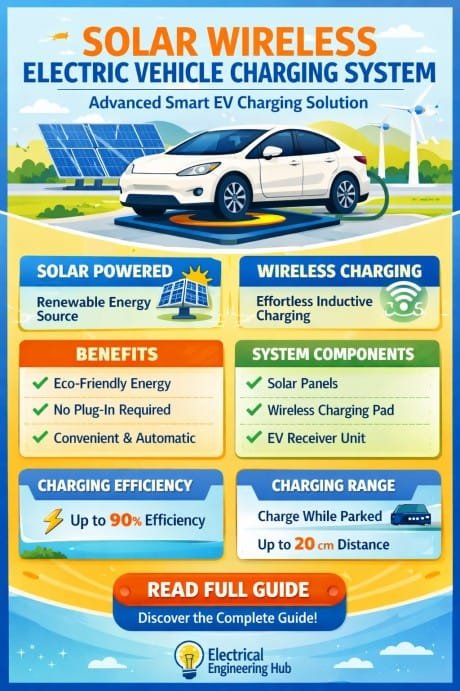
Table of Contents
As electric vehicles become more common, the demand for efficient and clean charging systems continues to rise. The Solar Wireless Electric Vehicle Charging System is emerging as a powerful answer to this demand. It integrates photovoltaic solar panels, energy storage systems, and wireless power transfer pads to deliver seamless charging without cables. This not only improves user convenience but also supports global sustainability goals by reducing dependency on fossil-fuel-based electricity grids.
Evolution of Smart EV Charging and Solar Integration
The evolution of EV charging has moved from slow home chargers to fast DC charging stations, and now toward fully automated wireless systems. In this journey, the Solar Wireless Electric Vehicle Charging System represents a major leap forward in energy innovation.
Use our online tool EV Charger Load Calculation Tool
Earlier charging systems required physical connectors, careful handling, and long waiting times. With advancements in inductive charging and solar photovoltaic technology, modern systems now allow vehicles to charge simply by parking over a charging pad. The integration of solar energy ensures that power generation is clean, decentralized, and cost-effective.
The Solar Wireless Electric Vehicle Charging System is particularly valuable in regions with high sunlight availability, where solar energy can significantly reduce grid dependency and operational costs. This makes it an ideal solution for urban infrastructure, smart cities, and eco-friendly transportation networks.
How the Solar Wireless Charging Technology Works
The working principle of a Solar Wireless Electric Vehicle Charging System is based on three core technologies: solar power generation, energy conversion, and wireless energy transfer.
Solar panels first capture sunlight and convert it into direct current (DC) electricity. This energy is then stored in a battery storage system or directly fed into a power conditioning unit. The wireless charging pad installed on the ground uses electromagnetic induction to transfer energy to a receiver coil installed in the EV.
When the vehicle is parked correctly over the pad, an alternating magnetic field is created between the transmitter and receiver coils. This field induces an electric current inside the vehicle’s battery system, charging it efficiently without physical contact.
Know more about Electric Vehicle Charging Station Cost
The Solar Wireless Electric Vehicle Charging System also includes smart control units that manage energy flow, safety cut-offs, and charging optimization based on battery status.
Energy Flow Breakdown
| Stage | Process Description | Technology Used |
|---|---|---|
| Solar Capture | Sunlight converted to DC electricity | Photovoltaic panels |
| Energy Storage | Electricity stored for stable supply | Lithium-ion batteries |
| Power Conversion | DC converted to AC for transmission | Inverters |
| Wireless Transfer | Energy transmitted without cables | Inductive coupling pads |
| Vehicle Charging | Battery receives and stores energy | EV onboard receiver system |
Core Components of the System
A fully functional Solar Wireless Electric Vehicle Charging System consists of several integrated components working in harmony to ensure efficient energy transfer.
The primary components include solar photovoltaic modules, battery energy storage systems, power management units, wireless charging pads, and EV-compatible receiver coils. Each component plays a critical role in maintaining system efficiency and stability.
Know more about ChargePoint Charging Station Cost
Smart sensors and communication modules are also integrated to monitor charging status, detect vehicle positioning, and ensure safety during operation. This makes the system highly automated and user-friendly.
In addition, grid connectivity is often included as a backup option to ensure uninterrupted charging even during low sunlight conditions. This hybrid approach improves reliability and energy security.
Advantages of Solar-Based Wireless EV Charging
The Solar Wireless Electric Vehicle Charging System offers multiple benefits that make it a strong contender for future transportation infrastructure.
One of the most important advantages is complete elimination of charging cables, which reduces wear and tear and improves user convenience. Drivers simply park their vehicles over a designated pad, and charging begins automatically.
Another major benefit is sustainability. By relying on solar energy, the system significantly reduces carbon emissions and supports clean energy adoption. It also reduces electricity costs in the long term.
Safety is also enhanced since there is no physical connector, reducing risks of electric shock, connector damage, or exposure to harsh weather conditions.
The system also supports automation and smart city integration, where EV charging can be managed through mobile apps, AI-based scheduling, and real-time monitoring systems.
Find all about EV Charging Station Code Requirements
Key Benefits Summary
| Benefit Area | Description |
|---|---|
| Convenience | No plug-in required, automatic charging |
| Sustainability | Uses renewable solar energy |
| Safety | No exposed electrical connectors |
| Maintenance | Reduced mechanical wear and tear |
| Smart Integration | Compatible with IoT and smart grids |
Applications in Modern Infrastructure
The Solar Wireless Electric Vehicle Charging System is suitable for a wide range of applications across residential, commercial, and public infrastructure.
In residential communities, it can be installed in parking spaces to provide convenient overnight charging. In commercial buildings and shopping malls, it supports high-traffic EV users by enabling fast and automated charging during short stays.
Public transport systems, including electric buses and taxis, can also benefit from this technology. Wireless charging pads installed at stops or depots allow vehicles to charge without manual intervention.
Highways and smart roads are also exploring dynamic wireless charging lanes, where vehicles can charge while in motion. Although still under development, this concept aligns closely with the capabilities of the Solar Wireless Electric Vehicle Charging System.
Use our free tool Electric Vehicle Charging Time Calculator
Efficiency Comparison with Traditional Charging
To understand the value of this technology, it is important to compare it with conventional EV charging methods.
| Feature | Traditional Charging | Solar Wireless Electric Vehicle Charging System |
|---|---|---|
| Charging Method | Plug-in cable | Contactless wireless transfer |
| Energy Source | Grid electricity | Solar + hybrid storage |
| User Effort | Manual connection required | Fully automatic |
| Installation | Simple but limited flexibility | Advanced infrastructure setup |
| Environmental Impact | Depends on grid mix | Highly eco-friendly |
This comparison shows that wireless solar-based systems are more aligned with future energy trends and sustainable development goals.
Challenges and Technical Considerations
Despite its advantages, the Solar Wireless Electric Vehicle Charging System still faces some technical and economic challenges.
One of the main concerns is energy efficiency loss during wireless transfer, which is slightly higher compared to wired charging. However, ongoing research in resonant inductive coupling is improving efficiency levels.
Installation costs are also relatively high due to advanced components and infrastructure requirements. This can limit early adoption in cost-sensitive markets.
Use our free tool Electric Car Charging Vs Petrol Calculator
Alignment precision is another factor, as vehicles must be properly positioned over the charging pad for optimal performance. Future systems are expected to use automated parking assistance to solve this issue.
Weather dependency of solar panels is also a consideration, although battery storage systems help reduce this limitation significantly.
Future of Wireless Solar EV Charging Technology
The future of the Solar Wireless Electric Vehicle Charging System is closely linked to advancements in renewable energy, artificial intelligence, and smart transportation systems.
Researchers are working on improving long-distance wireless power transfer, higher efficiency coils, and faster charging speeds. Integration with smart grids will allow dynamic energy distribution based on demand and availability.
In the coming years, this system is expected to become a standard feature in smart cities, highway infrastructure, and autonomous vehicle networks. The combination of solar energy and wireless technology represents a major shift toward cleaner and more intelligent mobility solutions.
As electric vehicle adoption continues to grow globally, this technology will play a key role in reducing carbon emissions and improving energy independence for transportation systems.
Read in detail about how to reset chargepoint home charger
Conclusion
The Solar Wireless Electric Vehicle Charging System represents a major innovation in the field of electric mobility. By combining renewable solar energy with advanced wireless charging technology, it offers a clean, efficient, and highly convenient solution for modern transportation needs.
From residential use to large-scale public infrastructure, this system has the potential to transform how EVs are powered and managed. Despite current challenges, continuous technological improvements are making it more practical and widely adoptable.
With its strong focus on sustainability, automation, and energy efficiency, it stands as a key component in the future of smart transportation ecosystems.
Get complete information about level 2 charger home installation cost
Get new guides in your feed. Follow Electrical Insights on LinkedIn for new electrical standards guides, calculators and design tips from Azad Circuit Hub.
#SolarWirelessElectricVehicleChargingSystem,#SolarEVCharging,#WirelessEVCharging,#EVChargingStation,#SolarEnergy,#RenewableEnergy,#SmartCharging,#ElectricVehicle,#CleanEnergy,#GreenTechnology
