
Neoteck Non Contact Voltage Detector Review: 12–1000V AC Tester Guide
When I am troubleshooting a residential panel, checking an outlet, or tracing a live conductor, I usually start with a quick non-contact test before reaching for a multimeter. It gives me a fast indication of whether AC voltage may be present without requiring direct contact with the conductor.
In this Neoteck Non Contact Voltage Detector review, I am looking at the Neoteck 12–1000V AC Voltage Tester with audible beeps, LED alerts, and a built-in flashlight. I have worked as an electrical engineer for more than 15 years, including panel work, industrial automation, PLCs, and electrical troubleshooting. From that experience, I see a voltage detector as a screening tool rather than a replacement for a properly rated multimeter or two-pole tester.
Neoteck Non Contact Voltage Detector Features
| Feature | Neoteck Detector |
|---|---|
| Voltage detection range | 12–1000V AC |
| Detection type | Non-contact AC voltage |
| Visual indication | LED alert |
| Audible indication | Yes |
| Flashlight | Built-in |
| Wire identification | Live and null wire indication |
| Typical applications | Outlets, switches, cables, breakers |
| Contact with conductor | Not required |
| Best use | Quick AC voltage screening |
The wide 12–1000V AC detection range makes this tester suitable for many basic electrical inspection and troubleshooting tasks. It can be useful around outlets, switches, cables, circuit breakers, and other AC wiring.
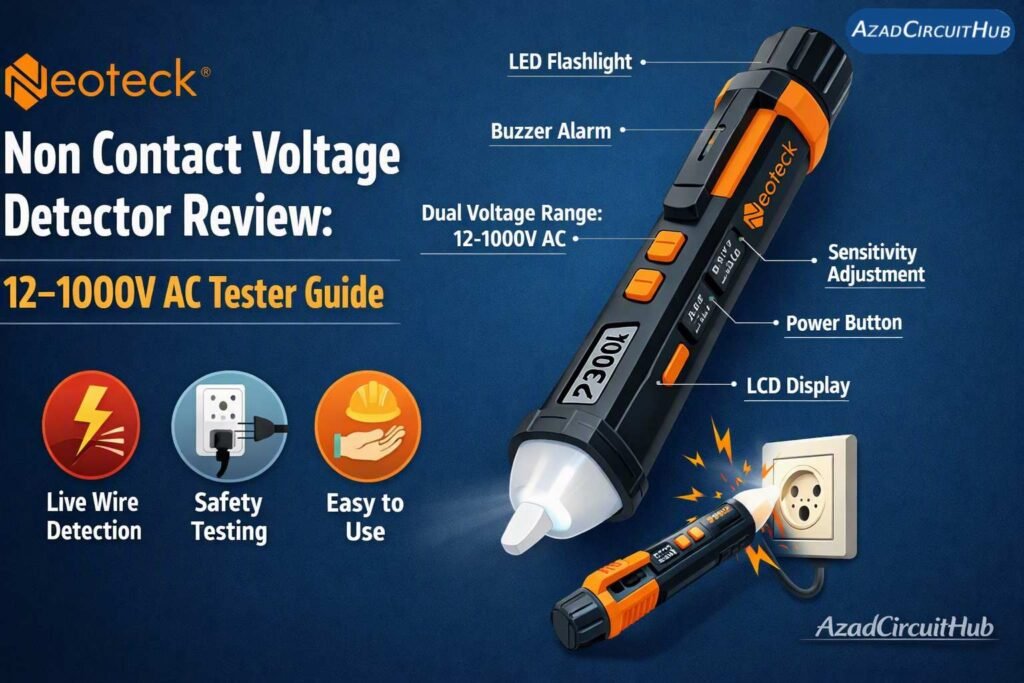
Table of Contents
Table of Contents
Check the Neoteck Detector on Amazon
If you need an inexpensive pocket tester for quick checks around the home, workshop, or electrical panel, the Neoteck model is worth checking.
Check Neoteck Non Contact Voltage Detector Price on Amazon
How the Neoteck Non Contact Voltage Detector Works
A non-contact voltage detector senses the electric field around an energized AC conductor. You do not need to touch the copper conductor directly. When the sensor detects an AC electric field within its operating range, the tester provides an audible and visual indication.
This makes the tool useful for an initial check before opening an electrical enclosure or working around wiring.
The Neoteck unit combines audible beeps with LED indication. That combination is useful in noisy environments where a visual indication is easier to notice, or in darker locations where the built-in flashlight can help illuminate the work area.
However, the detector should not be treated as proof that a circuit is safe. A proper electrical test procedure requires a suitably rated instrument and verification of the circuit condition.
Neoteck 12–1000V AC Detection Range
The stated 12–1000V AC range covers a broad range of common electrical applications. That includes low-voltage AC detection as well as typical residential and commercial mains voltage.
For an electrician, the value is mainly speed. Instead of immediately exposing test leads or making contact with a terminal, I can first scan the area for a possible energized conductor.
The tester can be useful for:
- Checking power outlets
- Tracing energized wires
- Checking switches
- Inspecting circuit breakers
- Locating live conductors
- Performing quick cable checks
- Troubleshooting basic AC wiring
- Checking electrical equipment before further testing
The actual detection distance can vary with conductor size, insulation, voltage, grounding, and surrounding electrical fields.
Live and Null Wire Identification
One useful feature of this Neoteck voltage detector is its ability to help identify live and null wires. This can make basic outlet and wiring checks faster.
Still, wire identification should be confirmed with an appropriate electrical test method. A non-contact tester detects an electrical field. It does not provide the same information as measuring voltage directly between conductors.
This distinction is important when troubleshooting a suspected open neutral, shared circuit, induced voltage, or other unusual wiring condition.
If you are comparing this type of tool with other options, my guide to the best non contact voltage tester covers the features that matter when selecting a detector for electrical work.
Audible Beep, LED Alert and Flashlight
The combination of sound and light is practical in field work. When I am working inside a panel or around equipment, I do not always have a clear view of the tester tip.
The audible alert provides a quick indication, while the LED warning gives a visual confirmation. The flashlight is another useful addition for outlets, junction areas, switches, and dark panels.
These features are simple, but they improve usability during quick inspections.
A voltage detector should still be checked against a known energized source before and after testing where the applicable safety procedure requires it. This helps confirm that the instrument is functioning correctly.
Where I Would Use the Neoteck Detector
In practical electrical troubleshooting, I would use this type of tester for preliminary checks rather than final voltage verification.
For example, if an outlet is reported as dead, I can use the detector to quickly check whether AC voltage is present. If the detector responds, I can then move to a properly rated meter for actual voltage measurements.
It is also convenient when checking a group of breakers or tracing wiring where I need a quick indication before carrying out more detailed testing.
For homeowners, the compact format can make it useful for basic electrical checks. For professionals, its value is mainly as a quick screening tool that can stay in a tool bag or pocket.
Safety Considerations
A non-contact voltage detector should never be considered a substitute for safe isolation procedures.
A detector may fail to indicate voltage under certain conditions, and it can also respond to nearby energized conductors or induced electrical fields. Insulation, conductor arrangement, low battery condition, and the electrical environment can affect detection.
For electrical work, follow the applicable safety procedure and use properly rated test equipment.
When a circuit is supposed to be de-energized, verify the absence of voltage with an appropriate test instrument before touching conductors.
This is also why I would use a no touch voltage detector as an initial screening device rather than relying on it as the only instrument for a safety-critical decision.
Neoteck Detector Pros and Limitations
| Advantages | Limitations |
|---|---|
| Wide 12–1000V AC range | Not a replacement for a multimeter |
| Non-contact operation | Detection can vary with conditions |
| Audible warning | Can respond to nearby electrical fields |
| LED indication | Not intended for direct voltage measurement |
| Built-in flashlight | Requires battery power |
| Useful for quick troubleshooting | Proper electrical safety procedures still apply |
For its intended role, the combination of voltage detection, sound, visual alert, and flashlight makes the Neoteck a practical pocket tool.
Is the Neoteck Detector Worth Buying?
The answer depends on what you expect from it. If you want a compact AC voltage detector for quick checks, the Neoteck 12–1000V model offers several useful features in one small tool.
It is particularly suited to preliminary checks around outlets, switches, cables, and breakers. The wide voltage range also makes it more versatile than a detector designed only for standard household voltage.
From an electrical engineering perspective, I would consider it a useful addition to a toolbox, but not the primary instrument for confirming voltage levels or proving a circuit is electrically safe.
Check the Current Amazon Price
If the price is competitive, this can be a useful low-cost addition to a home or professional electrical toolkit.
Buy the Neoteck 12–1000V Non Contact Voltage Detector on Amazon
If you are comparing several detector types, my broader guide to are non-contact voltage testers reliable explains the situations where these tools work well and where direct electrical measurement is still necessary.
Frequently Asked Questions
What voltage can the Neoteck voltage detector detect?
The listed detection range is 12–1000V AC. Actual detection performance can depend on the conductor, insulation, electrical environment, and other conditions.
Can the Neoteck detector identify live wires?
It is designed to detect AC voltage without direct contact and can help identify energized conductors. However, wire identification should be confirmed with appropriate electrical testing when accuracy is important.
Is the Neoteck voltage detector safe to use?
It is designed for non-contact voltage detection, which reduces the need to make direct contact with an energized conductor. However, it should not replace proper electrical safety procedures or appropriately rated test equipment.
Can I use it to prove a circuit is dead?
No. A non-contact detector should not be the sole method for proving a circuit is de-energized. Use an appropriate, properly rated voltage-testing instrument and follow the required isolation and verification procedure.
Does the Neoteck detector work on DC voltage?
The listed specification is for AC voltage detection from 12–1000V. It should not be treated as a DC voltage tester unless the manufacturer specifically states that the model supports DC detection.
Final Verdict
The Neoteck 12–1000V AC voltage detector is designed around a simple job: quickly indicate the possible presence of AC voltage without direct conductor contact. Its broad voltage range, audible alert, LED indication, and flashlight make it useful for quick electrical inspections.
For an electrician or electrical engineer, its biggest advantage is speed. I can use a tool like this to screen an area before moving to a multimeter for precise measurements.
For homeowners, it can provide a convenient first check around outlets, switches, cables, and breakers. Just remember that detecting voltage and proving a circuit is safe are two different tasks.
If you need a compact tester for preliminary AC voltage checks, check the Neoteck Non Contact Voltage Detector on Amazon and compare its current price and availability before buying.
Related Guides
- Fluke T6-600 Electrical Tester Review
- Best Voltage Tester for Ignition Coils
- Best Non-Contact Voltage Tester for Electric Fence
- Best Non-Contact Voltage Tester for Christmas Lights
Get new guides in your feed. Follow Electrical Insights on LinkedIn for new electrical standards guides, calculators and design tips from Azad Circuit Hub.
#NeoteckVoltageDetector, #NonContactVoltageDetector, #VoltageDetector, #VoltageTester, #ElectricalTesting, #ElectricianTools, #NCVT, #ElectricalSafety, #VoltageTesterReview, #Neoteck
