
Electrical Load Balancing: Single & Three Phase Systems
Electrical load balancing is the process of distributing electrical loads across available circuits or phases so that no phase, feeder, transformer, or electrical panel carries an unnecessary share of the total demand. It is important in residential wiring, commercial buildings, industrial plants, generators, transformers, and utility distribution networks.
In a single-phase system, balancing mainly means distributing circuits properly across feeders and avoiding overloaded conductors. In a three-phase system, the goal is to keep the current on each phase as close as practical while maintaining voltage quality and safe equipment operation.
| Parameter | Single-Phase System | Three-Phase System |
|---|---|---|
| Typical voltage | 120/230/240 V | 400/230 V or 208/120 V |
| Main balancing concern | Circuit loading | Phase current |
| Number of phases | 1 | 3 |
| Neutral | Usually required | Often required in 4-wire systems |
| Common applications | Homes, small shops | Commercial and industrial facilities |
| Main benefit of balancing | Prevents circuit overload | Reduces phase imbalance |
| Typical loads | Lighting, sockets, appliances | Motors, HVAC, pumps, large equipment |
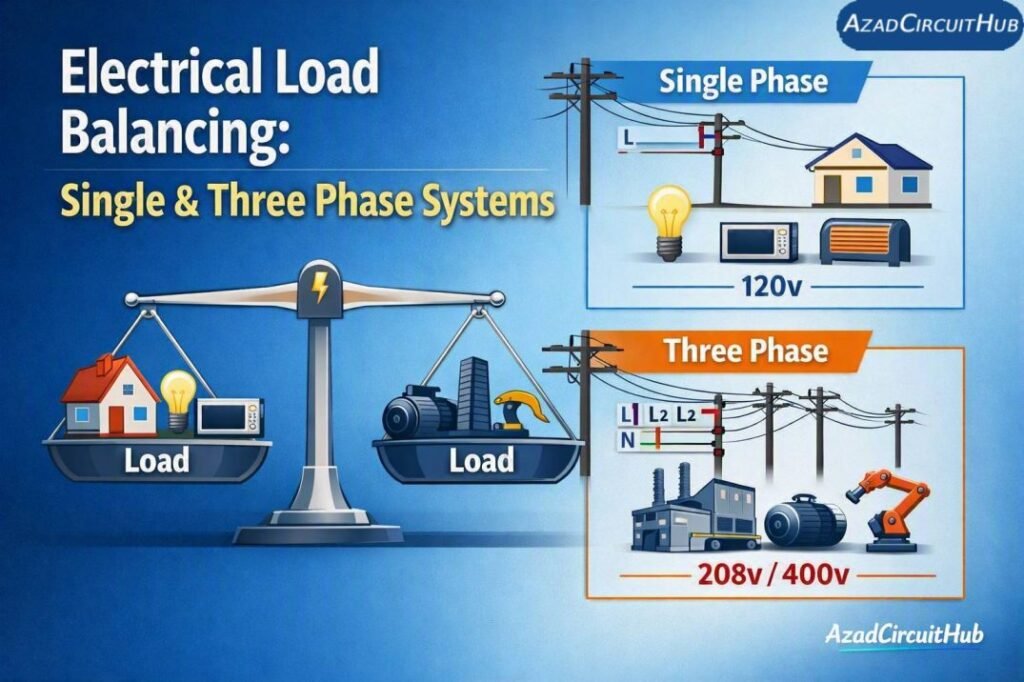
Table of Contents
Table of Contents
What Is Electrical Load Balancing?
Electrical load balancing means arranging loads so that the available electrical capacity is used evenly. In a three-phase installation, this normally means distributing single-phase loads between L1, L2, and L3 instead of putting most of the demand on one phase.
A balanced load has approximately equal current on each phase. A balanced three-phase load also produces a symmetrical current system, which is particularly useful for motors and other three-phase equipment.
For example, consider a three-phase panel with 30 A on L1, 29 A on L2, and 31 A on L3. This is reasonably balanced. If the readings are 50 A, 18 A, and 15 A, the panel has a significant phase imbalance that should be investigated.
Balanced load definition
A balanced load is a condition where the phase currents and, for a symmetrical three-phase load, the phase impedances are substantially equal. Small differences occur in real installations because lighting, receptacles, HVAC units, pumps, and other equipment operate at different times.
Why Is Load Balancing Important?
Proper electricity load balancing improves the use of available distribution capacity. It can also reduce unwanted heating and voltage problems.
The main benefits include:
- Lower neutral current in a balanced four-wire system
- Better utilization of transformers and feeders
- Reduced voltage imbalance
- Lower conductor heating
- Better three-phase motor performance
- Reduced nuisance tripping
- Improved generator loading
- More usable panel capacity
- Better electrical distribution
- Easier fault finding and maintenance
The advantages of load balancing 3 phase systems become especially important when a facility has many single-phase loads connected to a common three-phase supply.
| Problem | Possible Effect |
|---|---|
| One phase heavily loaded | Overheating or breaker trips |
| Unequal phase currents | Voltage imbalance |
| High neutral current | Neutral conductor heating |
| Poor generator balance | Reduced usable capacity |
| Uneven transformer loading | Additional losses and heating |
| Poor panel distribution | Limited spare capacity |
Load Balancing in a Single-Phase System
A single-phase supply does not have multiple phases to balance against each other. However, electrical load balancing still matters at the panel and feeder level.
A residential panel may contain lighting circuits, socket outlets, water heaters, air conditioners, ovens, EV chargers, and other high-demand equipment. These circuits should be arranged according to the panel design, conductor rating, breaker rating, and applicable electrical code.
For example, a high-power electric heater should not be placed on a circuit already carrying a significant continuous load. The designer should consider the demand of the complete installation rather than simply adding the breaker ratings.
A home load balancing assessment should therefore include:
- Main service rating
- Panel rating
- Individual circuit ratings
- Continuous loads
- Large appliances
- EV charging equipment
- HVAC equipment
- Solar or battery systems
- Future loads
- Demand and diversity factors
Three-Phase Load Balancing
Three-phase load balancing is more important where a 3 phase 4 wire system supplies both three-phase and single-phase loads.
A three-phase four-wire distribution system normally contains L1, L2, L3, and neutral. Three-phase equipment can be connected across all three phases, while single-phase loads can be connected between one phase and neutral.
The designer should distribute single-phase circuits between the three phases.
| Circuit | Load | Assigned Phase |
|---|---|---|
| Lighting Zone 1 | 10 A | L1 |
| Lighting Zone 2 | 9 A | L2 |
| Lighting Zone 3 | 11 A | L3 |
| Socket Circuit 1 | 16 A | L1 |
| Socket Circuit 2 | 15 A | L2 |
| Socket Circuit 3 | 16 A | L3 |
| Water Heater | 20 A | L1 |
| Pump | 18 A | L2 |
| HVAC Auxiliary | 19 A | L3 |
This type of load schedule 3 phase planning allows the engineer to see the expected phase current before installation.
3 Phase Balanced Load Example
Suppose a facility has three equal single-phase resistive loads of 5 kW connected individually to L1, L2, and L3.
At a line-to-neutral voltage of 230 V:
Current = Power ÷ Voltage
Current per phase:
5,000 ÷ 230 ≈ 21.7 A
Therefore:
- L1 ≈ 21.7 A
- L2 ≈ 21.7 A
- L3 ≈ 21.7 A
This is a balanced load condition.
For a balanced three-phase load, the approximate relationship is:
P = √3 × V × I × PF
Therefore, the electrical load balancing formula for a balanced three-phase system can be rearranged as:
I = P ÷ (√3 × V × PF)
Where:
- P = three-phase power in watts
- V = line-to-line voltage
- I = line current
- PF = power factor
For real installations, engineers should use the actual system voltage, power factor, conductor ratings, demand factors, and applicable electrical standards.
How to Balance 3 Phase Power
Balancing 3 phase loads starts with an accurate load schedule. Record the expected current or power of every single-phase circuit and identify which phase currently supplies it.
Then distribute circuits across L1, L2, and L3.
A practical procedure is:
- List every single-phase load.
- Record its rated or measured current.
- Identify continuous and intermittent loads.
- Assign circuits to L1, L2, and L3.
- Add the expected current on each phase.
- Move suitable circuits between phases.
- Measure the actual current after commissioning.
- Recheck the panel under normal operating conditions.
The objective is not always mathematical equality at every moment. Loads change throughout the day, so the design should consider the operating pattern of the facility.
Balancing Loads on an Electrical Panel
Electrical panel load balancing is particularly useful when a panel has many single-phase circuits.
A clamp meter can be used to measure the current on each phase while the facility is operating normally. Measurements should be taken during periods of high demand because a panel that appears balanced during light operation may become heavily unbalanced during peak use.
| Measurement | L1 | L2 | L3 |
|---|---|---|---|
| Morning | 32 A | 29 A | 31 A |
| Afternoon | 45 A | 41 A | 44 A |
| Peak period | 58 A | 52 A | 57 A |
These readings indicate a relatively even distribution. If one phase repeatedly shows a much higher current, suitable circuits may be redistributed.
Only qualified personnel should modify energized electrical equipment, and circuits must be isolated where required by the applicable safety procedure.
Load Balancing in Electrical Power Distribution Systems
At a larger scale, load balancing in electrical power distribution systems extends beyond individual panels. Distribution transformers, feeders, substations, and generators all have operating limits.
Utilities also consider load patterns across distribution networks. Uneven single-phase demand can contribute to phase imbalance, increased losses, and inefficient use of transformer capacity.
A load balancing transformer or phase balancer may be used in certain applications where conventional circuit redistribution is not sufficient. However, equipment selection depends on the system voltage, capacity, load characteristics, control requirements, and local electrical standards.
Electrical Load Balancing Technology
Modern electrical load balancing technology can use current transformers, smart meters, energy management systems, automatic switching equipment, and digital controllers.
An automatic 3 phase load balancer can monitor phase currents and redistribute selected loads according to programmed operating rules. Some systems are designed for specific residential, commercial, EV charging, or industrial applications.
A 3 phase load balancing device can also be useful where several variable loads operate simultaneously. However, automatic systems should not be treated as a replacement for proper feeder sizing, protection coordination, or sound electrical design.
How to Balance an Electrical Panel Safely
Before balancing loads, check the panel schedule and identify the circuit connected to each breaker. Measure operating current with suitable test equipment and compare the results with the rated capacity of breakers, conductors, busbars, and the main service.
For a three-phase panel, calculate the phase currents:
Phase imbalance (%) = Maximum deviation from average current ÷ Average current × 100
For example, if the measured currents are 40 A, 42 A, and 38 A:
Average current:
(40 + 42 + 38) ÷ 3 = 40 A
The maximum deviation is 2 A.
Phase imbalance:
2 ÷ 40 × 100 = 5%
The acceptable limit depends on the equipment, design requirements, and applicable standards. Motors and sensitive equipment may require tighter control than general distribution loads.
Single Phase Load vs Three Phase Load
A single phase load receives power through one phase and neutral, or between two conductors depending on the system arrangement. A three phase load uses all three phases and is commonly found in motors, pumps, compressors, industrial heaters, and large HVAC equipment.
| Feature | Single-Phase Load | Three-Phase Load |
|---|---|---|
| Supply | One phase | Three phases |
| Common use | Residential and light commercial | Commercial and industrial |
| Balancing | Circuit distribution | Phase distribution |
| Motors | Smaller applications | Industrial motors |
| Power delivery | Pulsating | More uniform |
| Typical wiring | Phase + neutral | Three or four-wire arrangement |
Advantages of a 3 Phase 4 Wire System
A three-phase four-wire system provides flexibility because it can supply both three-phase and single-phase loads.
Important advantages include:
- Supports mixed loads
- Provides a neutral for line-to-neutral loads
- Allows phase load balancing
- Suitable for commercial distribution
- Supports three-phase motors
- Simplifies distribution of many single-phase circuits
The 3 phase 4 wire system is commonly used on commercial and industrial distribution networks where both three-phase equipment and single-phase loads are present.
Load Balancing Report
A professional electrical load balancing report should document the condition of the system before and after corrective work.
A useful report can include:
| Report Item | Information |
|---|---|
| Site | Building or facility name |
| Supply | Voltage and phase arrangement |
| Transformer | Rating and loading |
| Main panel | Rating and identification |
| L1 current | Measured value |
| L2 current | Measured value |
| L3 current | Measured value |
| Neutral current | Measured value |
| Phase imbalance | Calculated percentage |
| Major loads | Equipment list |
| Corrective action | Circuit redistribution or equipment changes |
| Final readings | Post-balancing measurements |
Photos of the main panel, phase identification, meter readings, cable arrangement, and relevant equipment can also be included in the report. A useful technical diagram can show L1, L2, L3, neutral, single-phase circuits, and three-phase loads.
Electrical Load Balancing for Generators
Electrical Load Balancing for Generators is important because uneven phase loading can increase neutral current, voltage imbalance, heating, and generator stress. For a three-phase generator, distribute single-phase loads as evenly as practical across L1, L2, and L3 while considering continuous and starting loads.
| Generator Rating | Typical 3-Phase Current at 400 V, PF 0.8 | Practical Phase-Balance Target |
|---|---|---|
| 30 kVA | 43.3 A | Keep phases closely balanced |
| 50 kVA | 72.2 A | Minimize phase-current difference |
| 100 kVA | 144.3 A | Check phase currents under peak load |
| 250 kVA | 360.8 A | Balance large single-phase loads carefully |
A useful design check is to keep phase currents as close as practicable; IEC-based generator and installation design should also account for allowable voltage imbalance and manufacturer limits. Starting currents from motors, pumps, compressors, and HVAC equipment must be included because they can temporarily impose much higher demand.
| Check | What to Monitor |
|---|---|
| Phase current | L1, L2, L3 |
| Voltage | Phase-to-phase and phase-to-neutral |
| Power factor | Generator operating PF |
| Neutral current | Especially with nonlinear loads |
| Motor starting | Starting kVA/current |
Good Electrical Load Balancing also means checking the generator manufacturer’s permitted phase imbalance rather than relying on a single universal percentage.
What Is Balanced Load in a Three-Phase System?
A balanced load in a 3 phase system has equal or nearly equal phase currents and symmetrical phase impedances. For an ideal balanced three-phase load, the three phase currents have equal magnitude and are separated by 120 electrical degrees.
In practical installations, exact balance is rarely maintained because loads switch on and off throughout the day. The engineering objective is to keep the system within acceptable operating limits.
Frequently Asked Questions
What is load balancing in electrical systems?
Load balancing in electrical systems is the distribution of electrical demand across available circuits or phases to prevent excessive loading on one part of the distribution system. In three-phase installations, it normally involves distributing single-phase loads evenly between the phases.
How do you calculate electrical load balancing?
Start by measuring or calculating the current on each phase. Find the average current, determine the maximum deviation from that average, and calculate the percentage imbalance. For design work, use the expected demand rather than simply adding breaker ratings.
How do you balance phases on a 3 phase panel?
List the single-phase circuits and their expected currents, then distribute them across L1, L2, and L3. After installation, measure actual phase currents under representative operating conditions and redistribute suitable circuits if one phase remains significantly higher.
What are the advantages of load balancing 3 phase systems?
Three-phase load balancing can improve utilization of transformers, generators, feeders, and panel capacity. It can also reduce phase voltage imbalance, unwanted heating, and problems associated with heavily loaded phases.
What is a 3 phase load balancer?
A 3 phase load balancer is equipment or a control system designed to monitor and manage loads between three phases. Depending on its design, it may use measurement devices, switching equipment, controllers, or power electronics to redistribute selected loads automatically.
Final Takeaway
Electrical load balancing is both a design practice and an operating consideration. In single-phase installations, the focus is on sensible circuit distribution and avoiding overloaded feeders. In three-phase systems, the additional objective is to distribute phase demand as evenly as practical.
Good load schedules, accurate measurements, appropriate protection, and regular inspection are the foundation of effective phase load balancing. Automatic equipment can provide additional control where required, but it should complement rather than replace correct electrical design.
For homes, commercial buildings, generators, transformers, and industrial distribution systems, balancing loads properly can help make better use of existing electrical capacity while reducing unnecessary stress on the distribution equipment.
Related Guides
Get new guides in your feed. Follow Electrical Insights on LinkedIn for new electrical standards guides, calculators and design tips from Azad Circuit Hub.
#ElectricalLoadBalancing, #ElectricalEngineering, #ThreePhaseSystems, #SinglePhase, #LoadBalancing, #PowerDistribution, #ElectricalDesign, #ElectricalSafety, #PowerSystems, #ElectricianTips
