
Load Balancing for EV Charging Stations
As electric vehicles become more common, charging stations can place a large and highly variable demand on an electrical system. A few Level 2 chargers may be manageable on an existing panel, but a commercial site with 10, 20, or more chargers can quickly approach its transformer, switchboard, feeder, or service capacity.
Load Balancing for EV Charging Stations helps distribute charging demand across available electrical capacity instead of allowing multiple chargers to operate at their maximum current at the same time. A properly designed system can reduce peak demand, avoid unnecessary service upgrades, and maintain safe operation while still providing useful charging for drivers.
| EV charging setup | Typical power per port | Main load concern |
|---|---|---|
| Residential Level 2 | 7.2–9.6 kW | Main panel capacity |
| Commercial Level 2 | 7.2–19.2 kW | Feeder and demand |
| DC fast charging | 25–350+ kW | Transformer and service capacity |
| Workplace charging | 7.2–19.2 kW | Simultaneous demand |
| Apartment charging | 7.2–11.5 kW | Shared electrical capacity |
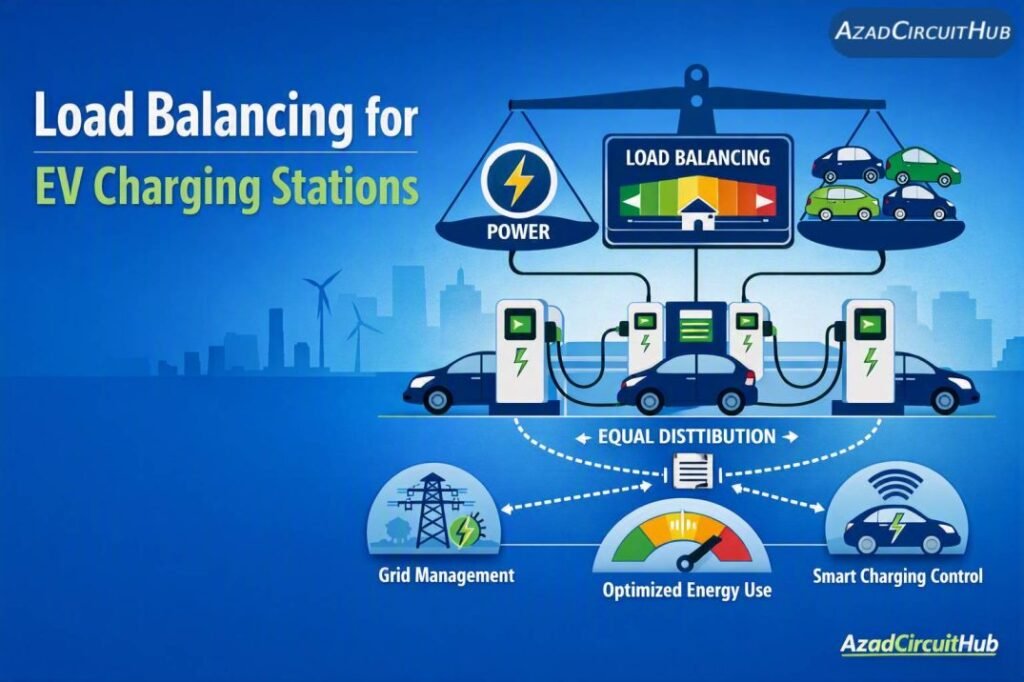
Table of Contents
Table of Contents
What Is Load Balancing for EV Charging Stations?
Load Balancing for EV Charging Stations is the controlled distribution of available electrical power among multiple EV chargers. Instead of allowing every charger to draw its maximum rated current, the charging system monitors the available capacity and adjusts individual charging loads.
For example, suppose a facility has a 400 A service and the building is already using 250 A. Only part of the service capacity remains available for EV charging. A load management controller can allocate the remaining capacity between several chargers.
The chargers may therefore operate at different currents:
| Charger | Available current | Charging status |
|---|---|---|
| EV Charger 1 | 40 A | Full charging |
| EV Charger 2 | 32 A | Reduced charging |
| EV Charger 3 | 24 A | Reduced charging |
| EV Charger 4 | 24 A | Reduced charging |
| EV Charger 5 | 16 A | Minimum charging |
This approach keeps the combined EV load within the configured electrical limit.
Why EV Charging Stations Need Load Management
EV charging is different from many conventional building loads because several chargers can operate for long periods at relatively high power. If charging begins at the same time, the resulting demand can create a significant peak.
A simple Level 2 charger operating at 240 V and 40 A consumes about:
240 × 40 = 9,600 W or 9.6 kW
Ten identical chargers could therefore demand approximately 96 kW if they all operate simultaneously at full output.
Real installations must also account for continuous-load requirements, existing building demand, conductor ampacity, overcurrent protection, voltage drop, transformer capacity, and applicable electrical codes.
| Number of Level 2 chargers | Approx. power at 9.6 kW each |
|---|---|
| 2 | 19.2 kW |
| 4 | 38.4 kW |
| 6 | 57.6 kW |
| 10 | 96 kW |
| 20 | 192 kW |
These values are simple connected-load examples. Actual demand depends on charger ratings, vehicle acceptance, charging schedules, control settings, and the site’s load profile.
Electrical Load balancing can be used to understand how the EV load should be coordinated with existing building demand, feeder capacity, and other major electrical equipment.
How Dynamic Load Balancing Works
Dynamic load balancing uses real-time measurements to determine how much capacity is available. Current transformers, smart meters, energy meters, or other monitoring equipment can provide information to an energy management controller.
The controller then calculates the available EV charging capacity.
A simplified calculation is:
Available EV capacity = Maximum allowable site load − Current building load
For example, if the permitted site load is 500 A and the building is currently using 330 A, approximately 170 A remains for controlled EV charging, subject to the actual design requirements and code limitations.
The system can then divide this available capacity between connected vehicles.
| Site condition | Building load | EV capacity available | Control response |
|---|---|---|---|
| Low building demand | 250 A | 250 A | Chargers can increase output |
| Normal demand | 350 A | 150 A | Chargers share available capacity |
| High demand | 440 A | 60 A | Charging output is reduced |
| Near limit | 480 A | 20 A | EV charging is heavily restricted |
This is often more effective than simply setting every charger to a fixed current.
Static vs Dynamic EV Load Balancing
There are two common approaches.
Static load management assigns a predetermined maximum to each charger. For example, six chargers might each be limited to 24 A regardless of what the rest of the building is consuming.
Dynamic load management changes charging power according to real-time site demand.
| Feature | Static balancing | Dynamic balancing |
|---|---|---|
| Real-time monitoring | Limited | Yes |
| Adjusts to building demand | No | Yes |
| Installation complexity | Lower | Higher |
| Utilization of spare capacity | Limited | Better |
| Suitable for large sites | Sometimes | Often preferred |
| Demand response | Limited | Strong |
Dynamic control is particularly useful where building demand changes significantly during the day.
EV Charger Load Calculation Example
Consider a commercial parking facility with eight Level 2 chargers. Each charger is rated at 9.6 kW.
Without load management:
8 × 9.6 kW = 76.8 kW
If the electrical design permits only 48 kW for EV charging, the system cannot simply allow all eight chargers to operate at their full rating simultaneously.
A controlled system could allocate the available power according to charging priority.
| Charger group | Number of vehicles | Allocated power |
|---|---|---|
| Priority vehicles | 2 | 9.6 kW each |
| Standard vehicles | 4 | 4.8 kW each |
| Lower priority | 2 | 2.4 kW each |
| Total | 8 | 48 kW |
The exact allocation should be determined by the charging system and electrical design rather than relying on an arbitrary distribution.
For larger installations, an EV Charger Load Management System can coordinate multiple charging points and prevent the combined EV load from exceeding the configured limit.
Key Electrical Limits to Check
Load balancing does not replace proper electrical engineering. Before installing multiple EV chargers, the designer should review the complete power system.
| Item | What to check |
|---|---|
| Service capacity | Available utility and main service capacity |
| Main breaker | Rating and actual design limitations |
| Feeder | Ampacity, installation method and temperature |
| Panelboard | Bus rating and available capacity |
| Transformer | kVA rating and existing loading |
| Voltage | Nominal voltage and voltage drop |
| Demand | Existing and projected peak demand |
| Protection | Breaker coordination and fault ratings |
| Conductors | Ampacity and termination ratings |
| Metering | Real-time load measurement capability |
Applicable requirements may include the NEC, local electrical regulations, utility requirements, and the manufacturer’s installation instructions. The final design should be checked by a qualified electrical professional.
Load Balancing Strategies for Commercial EV Sites
A charging station does not always need to divide available power equally. Priority-based charging can provide better results.
For example, a workplace may prioritize vehicles that need to leave soon, while an apartment building may allocate charging according to scheduled departure times.
Common strategies include:
- Equal power sharing
- First-come, first-served charging
- Priority-based charging
- Scheduled charging
- Minimum-current charging
- Dynamic site-limit control
- Solar-assisted charging
- Battery-supported charging
- Time-of-use charging
The selected strategy should match the site’s operating requirements.
Benefits of Load Balancing
A well-designed system can provide several practical benefits.
| Benefit | Practical result |
|---|---|
| Peak-load control | Reduces simultaneous maximum demand |
| Better capacity utilization | Uses available electrical capacity efficiently |
| Lower upgrade requirements | May reduce the need for immediate service expansion |
| Improved reliability | Helps prevent overload conditions |
| Flexible charging | Supports more vehicles from existing capacity |
| Energy management | Allows charging to respond to building demand |
| Future expansion | Makes additional chargers easier to manage |
However, load management should not be used to compensate for an undersized electrical installation. Conductors, protective devices, panels, transformers, and other equipment must still be correctly selected.
When Should You Use an EV Load Management System?
Load management becomes increasingly useful as the number of charging points grows or where electrical capacity is limited.
It is particularly relevant for:
- Apartment and condominium parking
- Hotels
- Offices
- Shopping centers
- Fleet depots
- Hospitals
- Universities
- Airports
- Workplace charging
- Public parking facilities
For a small residential installation, a simple load calculation may be sufficient. A large commercial installation may require metering, communications, charging priorities, demand monitoring, and integration with an energy management system.
For larger multi-port installations, an EV Charger Load Management System can help coordinate charging demand with the site’s electrical limits and operating schedule.
Frequently Asked Questions
1. What is load balancing for EV charging stations?
Load balancing distributes available electrical capacity between multiple EV chargers. It prevents the combined charging load from exceeding a predefined electrical limit by adjusting charger output.
2. How many EV chargers can run on one electrical service?
There is no universal number. The answer depends on service capacity, existing building demand, charger power, feeder ratings, transformer capacity, voltage, and the applicable electrical requirements. Load management can allow more charging points to operate within a limited available capacity.
3. Does load balancing reduce EV charging speed?
It can reduce charging power when available electrical capacity is limited. However, the reduction can be temporary. When other building loads decrease or vehicles finish charging, available capacity can increase and the system may raise charging power.
4. Is dynamic load balancing better than static load balancing?
They serve different applications. Static control uses predetermined limits, while dynamic control responds to actual electrical demand. Dynamic control can make better use of spare capacity where building demand changes throughout the day.
5. Can load balancing avoid an electrical service upgrade?
In some installations, intelligent load management may allow additional EV chargers to operate without immediately increasing the site’s service capacity. It does not eliminate the need for an upgrade where the existing electrical infrastructure cannot safely support the required load.
Get new guides in your feed. Follow Electrical Insights on LinkedIn for new electrical standards guides, calculators and design tips from Azad Circuit Hub.
#LoadBalancingForEVChargingStations, #EVCharging, #EVChargers, #EVChargingInfrastructure, #EVLoadManagement, #ElectricVehicleCharging, #EVChargingStations, #ElectricalLoadBalancing, #EVChargingSolutions, #SmartEVCharging
