Demand Factor for EV Charging Stations: NEC Load Calculation Guide
Electric vehicle charging stations can create a large electrical load, especially when several chargers operate at the same time. However, the connected load is not always equal to the actual peak demand. This is where the demand factor for EV charging stations becomes useful for electrical design, transformer sizing, feeder selection, and utility planning.
A proper calculation helps engineers estimate realistic peak demand without assuming that every EV charger will operate at full output simultaneously. The correct value depends on the charger type, number of ports, charging behavior, operating schedule, site usage, and applicable electrical code or utility requirements.
Quick answer: There is no single NEC-mandated demand factor that applies to every commercial EV charging station. For preliminary planning, engineers may model 100%, 80%, 70%, 60%, or lower utilization assumptions, but the final value should be supported by site data, EVSE controls, and the applicable code or utility requirement.
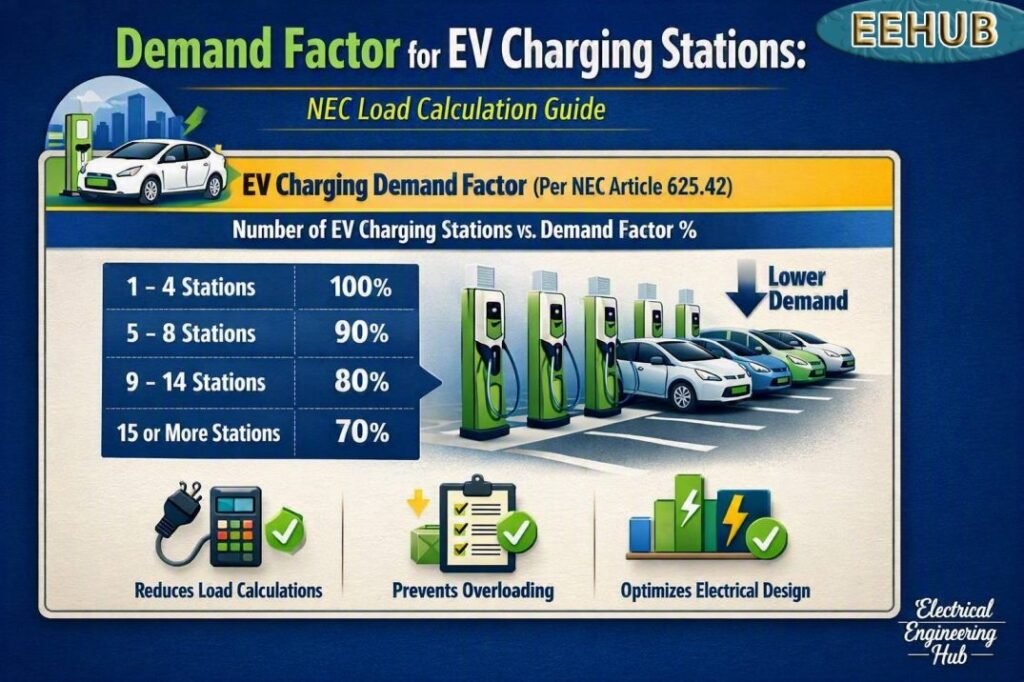
Table of Contents
Table of Contents
Quick Demand Factor Reference Table
| EV Charging Site | Typical Planning Demand Factor | Example Use |
|---|---|---|
| Small workplace charging | 50–70% | Chargers used mainly during working hours |
| Apartment/condo charging | 60–80% | Multiple vehicles with staggered charging |
| Retail parking | 50–70% | Irregular charging sessions |
| Fleet charging depot | 70–100% | Predictable but concentrated charging |
| DC fast charging site | 70–100% | High-power, short-duration charging |
| Uncontrolled charging | Up to 100% | All chargers assumed available simultaneously |
| Managed EV charging | 50–80%* | Load controlled by an energy management system |
*These are engineering planning ranges, not universal code-prescribed rates.
What Is the Demand Factor for EV Charging Stations?
The demand factor for EV charging stations compares the maximum actual demand of the charging installation with its total connected load.
The basic formula is:
Demand Factor = Maximum Demand ÷ Total Connected Load
For example, suppose a parking facility has 20 Level 2 chargers rated at 11.5 kW each.
Total connected load:
20 × 11.5 kW = 230 kW
If the highest measured simultaneous demand is 161 kW:
Demand factor = 161 ÷ 230 = 0.70
Therefore, the site’s demand factor is 70%.
This does not mean that each charger is permanently limited to 70%. It simply describes the relationship between the station’s maximum observed demand and its connected charging capacity.
For broader electrical design work, use a demand factor in power system guide to evaluate connected load, maximum demand, and diversity before selecting major electrical equipment.
Demand Factor vs Diversity Factor
These terms are often confused during EV infrastructure design.
| Factor | Formula | Main Purpose |
|---|---|---|
| Demand factor | Maximum demand ÷ connected load | Measures actual peak demand |
| Diversity factor | Sum of individual maximum demands ÷ system maximum demand | Shows how loads overlap |
| Load factor | Average load ÷ maximum demand | Measures utilization over time |
| Utilization factor | Maximum demand ÷ rated capacity | Shows how much equipment capacity is used |
Demand factor is particularly useful when estimating the maximum electrical demand of a group of EV chargers.
For example, if a site has 300 kW of connected EV charging equipment but its maximum demand is expected to reach 210 kW, the demand factor is 70%.
Common Demand Factor Rates for EV Charging
There is no universal “EV charger demand factor” that can safely be applied to every installation. The following values are better treated as preliminary design assumptions.
| Planning Rate | Connected Load | Estimated Peak Demand |
|---|---|---|
| 100% | 300 kW | 300 kW |
| 90% | 300 kW | 270 kW |
| 80% | 300 kW | 240 kW |
| 70% | 300 kW | 210 kW |
| 60% | 300 kW | 180 kW |
| 50% | 300 kW | 150 kW |
A 100% demand factor is the conservative approach when simultaneous full-load operation is possible and there is insufficient operational data.
A 70% demand factor may be reasonable for preliminary planning at a site where charging sessions overlap only partially. However, it should not automatically be used for final electrical calculations.
How to Calculate EV Charging Demand
Consider a commercial parking lot with:
- 24 Level 2 EV chargers
- Charger rating: 11.5 kW
- Supply: 208/240 V class equipment
- Preliminary demand factor: 70%
First calculate the connected load:
24 × 11.5 = 276 kW
Then calculate estimated maximum demand:
276 × 0.70 = 193.2 kW
The estimated EV charging demand is therefore approximately 193 kW.
If the chargers operate on a three-phase system, the corresponding current can then be estimated using:
I = P ÷ (√3 × V × PF)
Assuming 208 V three-phase operation and a power factor of 0.95:
I = 193,200 ÷ (1.732 × 208 × 0.95)
I ≈ 565 A
This value is useful for preliminary feeder and switchgear planning, but the final calculation must account for actual charger specifications, conductor requirements, continuous-load rules, voltage drop, temperature, and other applicable requirements.
For more electrical load calculations, use a demand factor in power system guide to compare different demand assumptions before finalizing equipment ratings.
NEC Considerations for EV Charging Stations
The National Electrical Code treats EV charging equipment as a significant electrical load. NEC Article 625 covers electric vehicle charging systems, while Article 220 provides load-calculation requirements that may apply depending on the installation.
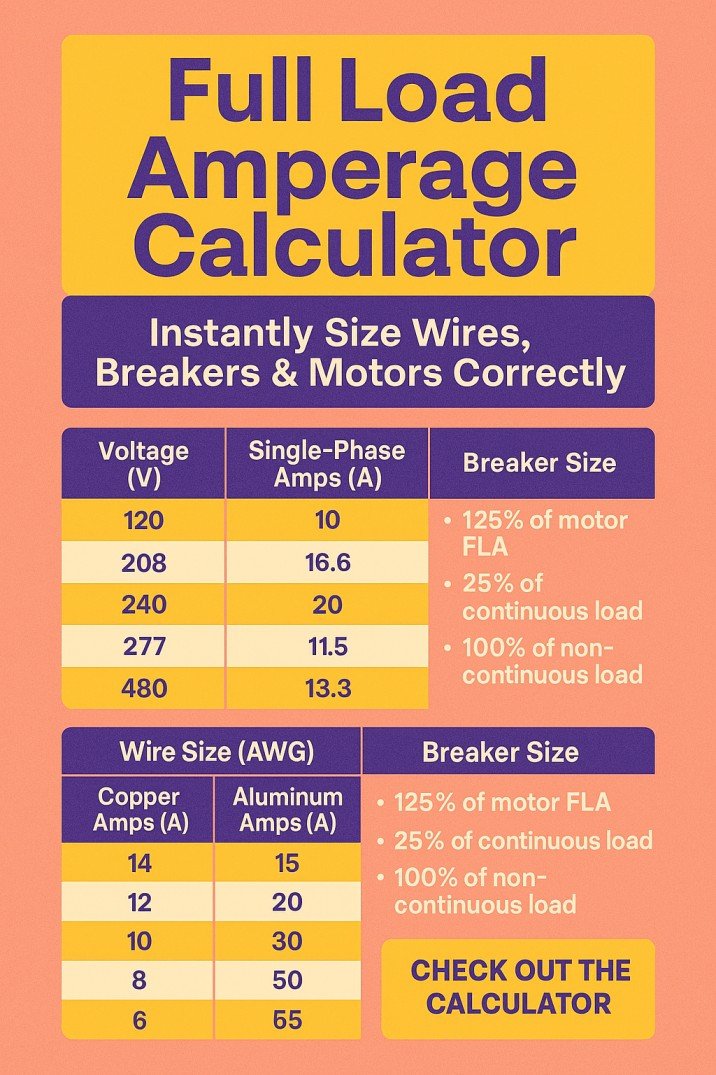
A key consideration is the continuous nature of EV charging. Under NEC requirements, continuous loads are generally calculated at 125% for feeder and branch-circuit sizing.
For example, a charger delivering 48 A continuously may require equipment and circuit sizing based on:
48 A × 125% = 60 A
This is one reason the demand factor should not be confused with the continuous-load multiplier.
The demand factor estimates how much of the overall connected charging load may occur at the same time. The 125% continuous-load requirement is a separate electrical design consideration.
Always check the NEC edition adopted by the authority having jurisdiction because requirements and exceptions can vary by edition and application.
What Factors Affect EV Charging Demand?
Several conditions can significantly change the actual peak load.
Number of Charging Ports
More charging ports increase the connected load. However, adding ports does not necessarily mean the peak demand will increase proportionally if the chargers use load management.
Charger Power Rating
A 7.2 kW Level 2 charger has a very different impact on a transformer than a 19.2 kW charger or a 150 kW DC fast charger.
Charging Schedule
Workplace chargers may experience a large demand after employees arrive. Residential charging can shift toward evening hours, while fleet depots may have concentrated overnight demand.
Energy Management Systems
Managed charging can limit the combined output of several EVSE units. For example, ten chargers rated at 11.5 kW could have 115 kW of connected capacity while a charging management system limits simultaneous output to 70 kW.
In that situation, the system’s effective peak demand can be substantially lower than its nameplate connected load.
Vehicle Battery State of Charge
A vehicle does not necessarily draw the same power throughout its entire charging session. Charging power can decrease as the battery approaches a high state of charge.
Utility Requirements
Utilities may have their own requirements for service demand calculations, transformer loading, demand charges, power quality, and interconnection studies. A utility-approved calculation should take priority where required.
Demand Factor Example for a DC Fast Charging Station
Suppose a charging plaza has eight DC fast chargers rated at 150 kW each.
Connected load:
8 × 150 = 1,200 kW
If the engineering study assumes an 80% peak demand:
1,200 × 0.80 = 960 kW
At 100%, the design demand would instead be 1,200 kW.
That 240 kW difference can have a major effect on transformer capacity, switchgear, service conductors, utility service requirements, and potentially demand charges.
For this type of facility, actual charging-session data is far more useful than simply selecting a generic percentage.
How to Select the Right Demand Factor
A practical approach is to evaluate the installation in stages:
- Calculate the total EVSE connected load.
- Identify the maximum possible simultaneous charging load.
- Review charger power ratings and control settings.
- Determine whether load management is installed.
- Review expected charging schedules.
- Examine historical charging data if available.
- Check utility requirements.
- Apply applicable NEC load-calculation rules.
- Size the transformer, feeder, and switchgear accordingly.
- Add appropriate capacity for future EV charger expansion.
For an existing facility, measured interval data can provide a much better basis than an assumed percentage. For a new installation, the design should consider the worst credible operating condition.
You can also use a demand factor in power system guide to test 50%, 60%, 70%, 80%, 90%, and 100% scenarios and compare the resulting electrical demand.
Why Using 100% Is Sometimes the Best Choice
A lower demand factor can reduce the calculated service demand, but using an overly optimistic value can create serious problems.
If a site actually reaches 100% simultaneous charging while the design assumed 60%, the transformer and feeder may experience much higher loading than expected.
A conservative 100% assumption is particularly useful when:
- Charger usage is unknown
- No load management is installed
- The site serves a large fleet
- Fast charging is expected
- Charging occurs during a narrow time window
- Future expansion is planned
- Utility requirements call for conservative calculations
Actual monitoring can later support a more accurate demand model.
Demand Factor and Transformer Sizing
EV charging can place a substantial continuous load on transformers. For example, a station with 500 kW of connected EV charging capacity could have a calculated peak demand of:
| Demand Factor | Peak EV Demand |
|---|---|
| 100% | 500 kW |
| 80% | 400 kW |
| 70% | 350 kW |
| 60% | 300 kW |
Transformer selection should not be based only on these numbers. Engineers also need to consider power factor, ambient conditions, harmonics, existing building loads, transformer loading limits, future expansion, and utility standards.
Common Mistakes to Avoid
One of the biggest mistakes is assuming that every EV charging installation can use the same demand percentage.
Other common errors include:
- Treating demand factor as a code-mandated universal percentage
- Ignoring continuous-load requirements
- Using charger nameplate power without checking actual output
- Forgetting existing building loads
- Ignoring future charging expansion
- Assuming load management will always operate as intended
- Using historical data without checking peak intervals
- Selecting transformer capacity without considering power factor
A sound design combines EV charging demand with the complete electrical load profile of the facility.
FAQs About EV Charging Demand
What is a typical demand factor for EV charging stations?
There is no single standard rate for all installations. Preliminary engineering studies may evaluate values from 50% to 100%, depending on charging behavior, charger type, and load management. Final calculations should be supported by site data and applicable requirements.
Is 100% demand factor required for EV chargers?
Not universally. A 100% assumption may be appropriate when simultaneous full-load operation is possible or when there is not enough information to justify a lower value. The applicable electrical code and utility requirements should always be checked.
Does NEC specify an EV charging demand factor?
The NEC does not provide one universal demand factor that applies to every commercial EV charging station. EVSE load calculations must be evaluated under the applicable NEC requirements for the installation.
Are EV chargers considered continuous loads?
EV charging can qualify as a continuous load when it operates at maximum current for three hours or more. Where the NEC continuous-load rule applies, circuit and feeder sizing generally uses 125% of the continuous load.
How do I calculate EV charging station demand?
Multiply the total connected EV charger load by the selected demand factor:
Maximum Demand = Connected EV Load × Demand Factor
For example, 400 kW of connected charging equipment at a 75% planning factor gives an estimated peak demand of 300 kW. The selected factor should be justified by operating data, controls, and applicable requirements.
Final Takeaway
The demand factor for EV charging stations is an important planning value for estimating the maximum electrical demand of multiple EV chargers. It helps engineers avoid blindly treating the entire charger nameplate capacity as simultaneous demand while still allowing a conservative design when operating conditions are uncertain.
There is no universal 50%, 70%, or 80% rate that applies to every EV charging project. A suitable value depends on charger type, utilization, charging schedules, energy management, fleet requirements, utility rules, and measured load data.
For preliminary planning, comparing several scenarios from 50% through 100% provides a useful sensitivity analysis. For final design, combine the selected demand assumption with NEC continuous-load requirements and the actual electrical characteristics of the charging equipment.
Use a demand factor in power system guide to evaluate EV charging loads alongside other facility loads and make the resulting electrical design easier to verify.
Get new guides in your feed. Follow Electrical Insights on LinkedIn for new electrical standards guides, calculators and design tips from Azad Circuit Hub.
#DemandFactor, #EVChargingStations, #EVCharging, #NEC, #EVCharger, #ElectricalDesign, #EVInfrastructure, #LoadCalculation, #EVChargingLoad, #ElectricalEngineering