
Best Portable EV Charger Level 1 & 2: Top 5 Picks for Home and Travel
A reliable portable EV charger can make electric vehicle ownership much easier, especially for drivers who charge at home, travel between properties, or need a backup charging option. Unlike a fixed wall charger, a portable unit can be carried in the vehicle and connected to different outlets when suitable power is available.
In this guide, I compare five practical options for Level 1 and Level 2 charging, including models with J1772 compatibility, adjustable current, long cables, and dual-voltage operation. As an electrical engineer with hands-on experience in electrical systems and equipment selection, I focus on the factors that matter beyond advertised charging speed, including outlet compatibility, circuit capacity, cable length, portability, and everyday usability.
Our Recommendation
For most drivers who have a suitable 240V circuit and want substantially faster charging, the ELEGRP 40A model stands out from this group.
Top 5 Best Portable EV Chargers Compared
The table below gives you a quick overview before we look at each charger in detail.
| EV Charger | Charging Level | Current | Voltage | Cable | Plug Options | Best For |
|---|---|---|---|---|---|---|
| ELEGRP Level 2 EV Charger | Level 2 | 40A | 240V | 25 ft | NEMA 14-50 | Fast home & portable charging |
| BOKMAN Portable EV Charger | Level 1 & 2 | 16A | 120/240V | 20 ft | NEMA 5-15/6-20 | Home and travel |
| VDLPOWERVP EV Charger | Level 1 & 2 | 16A | 110-240V | 20 ft | NEMA 5-15/6-20 | Flexible charging |
| EVDANCE Portable EV Charger | Level 1 & 2 | Up to 16A | 120/240V | 25 ft | NEMA 5-15/6-20 | Longer reach |
| YLITES J1772 EV Charger | Level 1 & 2 | 8-16A | 120/240V | 25 ft | NEMA 5-15/6-20 | Travel and variable circuits |
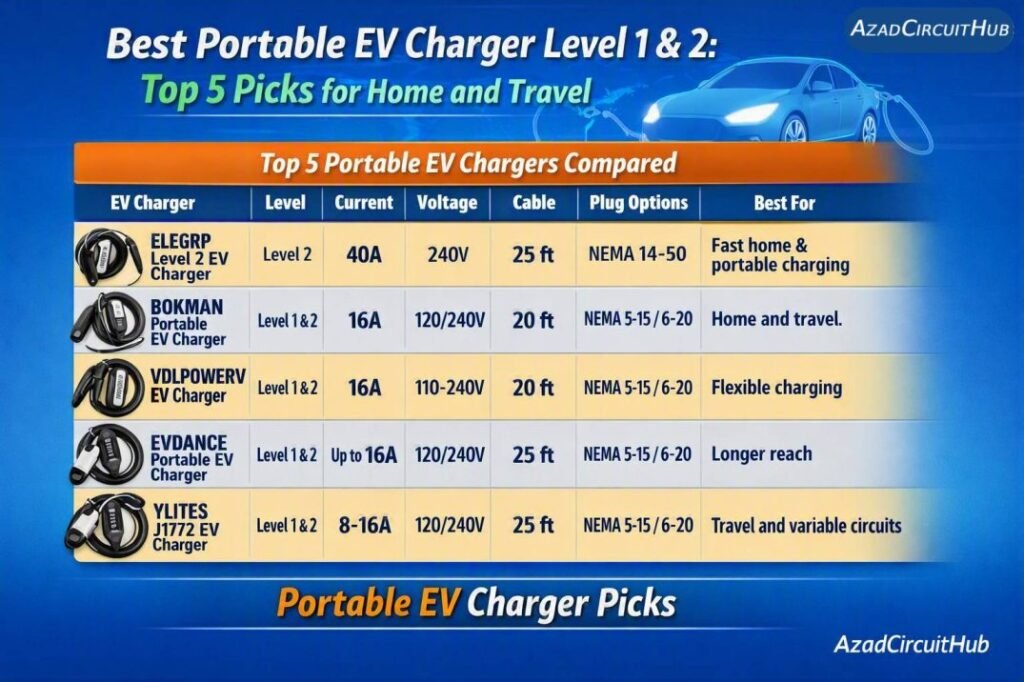
Table of Contents
Table of Contents
1. ELEGRP Level 2 EV Charger 40A
The ELEGRP Level 2 EV Charger is the strongest choice in this comparison for drivers who want higher-power charging without installing a permanently mounted EVSE.
It is rated for 40A at 240V and uses a NEMA 14-50 plug. The 25-foot cable is useful when the parking position is not immediately beside the electrical outlet.
The J1772 connection makes it suitable for many North American EVs and plug-in hybrids that use the SAE J1772 charging standard.
| Feature | ELEGRP 40A |
|---|---|
| Charging | Level 2 |
| Maximum current | 40A |
| Voltage | 240V |
| Plug | NEMA 14-50 |
| Cable length | 25 ft |
| Connector | SAE J1772 |
| Certification | ETL certified |
| Ideal use | Home, garage, travel backup |
A 40A EVSE can draw substantial continuous current, so the branch circuit and receptacle must be properly sized for the installation. Do not assume that a NEMA 14-50 outlet automatically means every 40A setting is appropriate. Follow the EVSE instructions, vehicle requirements, and applicable electrical code.
Check the ELEGRP 40A Level 2 EV Charger on Amazon for current price and availability.
If you are comparing more permanently installed alternatives, see our Best Level 2 EV Charger guide for additional charging options.
2. BOKMAN Portable Level 1 & 2 EV Charger
The BOKMAN portable unit is designed for drivers who want one charger that can work with both common household power and a higher-voltage outlet.
It supports up to 16A and comes with a 20-foot cable. The NEMA 5-15 and NEMA 6-20 options make it useful for residential charging and travel where compatible receptacles are available.
This makes it a practical best portable level 1 ev charger option for drivers who do not always have access to a dedicated 240V charging circuit.
Its dual-voltage capability also makes it useful as a backup. A driver can use Level 1 charging from a suitable 120V receptacle and switch to Level 2 when a compatible 240V supply is available.
Check the BOKMAN Portable Level 1 & 2 EV Charger on Amazon to see the latest price and customer availability.
3. VDLPOWERVP Level 1 & 2 EV Charger
The VDLPOWERVP portable EVSE offers another dual-voltage approach, with a 20-foot cable and up to 16A charging capability. It supports 110V to 240V operation and includes NEMA 5-15 and NEMA 6-20 plug options.
For drivers who regularly move between a home garage, workplace, vacation property, or other locations, this flexibility can be useful.
The unit is designed for SAE J1772 vehicles, making it relevant to a broad range of EVs and PHEVs using that connector.
When choosing among portable EV chargers, check the actual outlet and circuit available at your destination rather than choosing solely by maximum advertised amperage.
4. EVDANCE Level 1 & 2 EV Charger
The EVDANCE model adds a 25-foot cable to its dual-voltage design. It supports 12A at 120V and up to 16A at 240V, with NEMA 5-15 and 6-20 plug options.
The longer cable can be particularly helpful when the outlet is positioned farther from the vehicle.
It is also ETL listed and uses a J1772 connector for compatible EVs and plug-in hybrids.
For someone looking for a best portable electric car charger that can cover both everyday home charging and travel, the EVDANCE offers a useful combination of cable length and voltage flexibility.
5. YLITES 8-16A J1772 Portable EV Charger
This fifth option is aimed at drivers who want more control over charging current. It supports Level 1 and Level 2 operation, with adjustable current from 8A to 16A.
The 25-foot cable provides good reach, while the 1-12 hour timer can help users schedule charging around their normal routine. Read complete YLITES Portable Level 1&2 EV Charger Review here.
The IP66 rating is another useful feature for outdoor applications, although weather resistance should not be confused with permission to leave electrical equipment exposed to conditions outside the manufacturer's instructions.
YLITES adjustable current makes it a useful best portable EVSE choice when different circuits have different available capacity.
Which Portable EV Charger Should You Buy?
The right charger depends heavily on the electrical supply available where you normally park.
| Your Situation | Suitable Type |
|---|---|
| Standard 120V household outlet | Level 1, 8-16A |
| 240V NEMA 6-20 circuit | Level 2, up to 16A |
| 240V NEMA 14-50 circuit | Higher-power Level 2 |
| Frequent road trips | Dual-voltage portable EVSE |
| Long distance from outlet | 25-ft cable |
| Multiple circuit conditions | Adjustable-current charger |
| Faster home charging | 32-40A Level 2 |
For a dedicated 240V installation with adequate circuit capacity, I would look first at the ELEGRP 40A model. For travel flexibility, a dual-voltage 16A unit can be easier to carry and use across different locations.
Level 1 vs Level 2 Portable Charging
Level 1 normally uses a 120V household supply and is convenient for overnight charging when daily driving requirements are modest. Level 2 uses approximately 208-240V and can provide considerably more charging power.
For example, a 16A charger at 240V has an input power of about 3.84 kW before accounting for charging losses. A 16A charger at 120V is about 1.92 kW.
Actual charging speed depends on the vehicle's onboard charger, battery state, temperature, electrical supply, and other factors.
If your main goal is faster home charging, our best ev charger level 2 guide covers additional Level 2 options.
What Makes a High-Quality Portable EV Charger?
When comparing a high quality portable EV charger, look beyond amperage. Electrical safety, connector quality, cable construction, certification, temperature management, and protection features are important.
A good portable unit should also be easy to store without excessive cable weight. A 20- or 25-foot cable can be convenient, but it adds bulk compared with a shorter cable.
For portable charging station applications, consider where the charger will actually be used. A garage, workplace, hotel, campground, or vacation property may have different outlet configurations and circuit limitations.
Also check whether your vehicle uses J1772 or another charging connector. Some EVs require an adapter when using a J1772 EVSE.
Portable EV Charger Manufacturers and Buying Considerations
There are many portable EV charger manufacturers offering products across different price ranges. When comparing brands, look for clear electrical specifications, recognized certification where applicable, warranty information, replacement support, and detailed installation requirements.
Search listings carefully because similarly named products may have different amperage ratings or plug configurations.
A VEEV USB power adaptor, phone charger, or general power accessory should not be confused with an EVSE. An EV charging device is designed specifically to manage the connection between the electrical supply and vehicle.
Can a Portable Power Station Charge an EV?
A portable power station for EV charging sounds attractive, but there is an important limitation: EVs require considerable electrical energy.
A typical portable battery station designed for phones, laptops, or small appliances usually cannot provide meaningful EV range. Even a large battery system may offer only limited energy compared with the capacity of an EV battery.
For this reason, a portable power station for EV charging is generally a specialized solution rather than a replacement for a properly supplied EVSE.
A true portable electric vehicle charging station can be useful in commercial, emergency, fleet, or roadside applications, but its battery capacity, inverter rating, output voltage, and vehicle compatibility must all be evaluated.
Portable EV Charger vs Fixed Wall Charger
A portable EV charger is convenient because it can be moved between locations. A wall-mounted Level 2 EVSE, however, can provide a cleaner permanent installation and may be easier for daily charging.
| Factor | Portable EVSE | Fixed Wall EVSE |
|---|---|---|
| Mobility | Excellent | Limited |
| Travel use | Excellent | Poor |
| Installation | Usually simpler | Requires permanent installation |
| Cable management | Manual | Usually integrated |
| Multiple locations | Convenient | Not practical |
| Daily home use | Good | Very good |
For homeowners who travel regularly, keeping a portable EV charger in the vehicle can also provide useful backup capability even when a fixed charger is installed at home.
Safety Tips Before Using a Portable EV Charger
Always inspect the plug, cable, connector, and receptacle before charging. Avoid using damaged extension cords or loose outlets.
Use a properly grounded circuit and follow the EVSE manufacturer's current limits. Continuous EV charging places a sustained load on the electrical system, so an outlet that works for occasional appliance use may not be appropriate for prolonged high-current charging.
If you are unsure about circuit capacity, have the installation checked by a qualified electrician.
FAQs About Portable EV Chargers
What is the best portable EV charger for home use?
For drivers with a suitable 240V NEMA 14-50 circuit, the ELEGRP 40A Level 2 model provides a higher-power portable charging option. Drivers limited to 120V or a smaller 240V circuit may prefer a dual-voltage 16A model.
Can a portable EV charger be used with Level 1 and Level 2?
Yes. Several portable EVSE models support both levels when used with the appropriate plug and electrical supply. Always verify the voltage and amperage requirements before connecting the charger.
What is the best portable charger for an electric car while traveling?
A dual-voltage J1772 EVSE with interchangeable or compatible NEMA plugs can be practical for travel. A longer 20- or 25-foot cable can also help when parking arrangements vary.
Are portable EV chargers safe?
A properly designed and appropriately certified EVSE can be safe when used according to its instructions and connected to a suitable electrical circuit. Inspect the equipment regularly and avoid damaged or overloaded receptacles.
Can I leave a portable EV charger outside?
Some models have weather-resistant ratings, but the specific manufacturer's instructions should always be followed. An IP rating does not mean the entire charging setup can be exposed indefinitely to rain, flooding, or other harsh conditions.
Final Buying Advice
The best portable EV charger is not necessarily the one with the highest amperage. The better match depends on your vehicle, outlet, circuit capacity, cable length, charging requirements, and how often you need to move the EVSE.
For higher-power charging from a suitable 240V NEMA 14-50 supply, the ELEGRP 40A model is the standout option in this comparison. For drivers who prioritize portability and the ability to use both 120V and 240V supplies, the BOKMAN, VDLPOWERVP, EVDANCE, and YLITES 8-16A models provide more flexible alternatives.
Before ordering, confirm your vehicle connector, outlet type, required amperage, and circuit capacity. That simple check can prevent an expensive mismatch and help you get the most practical charging setup for your EV.
Related Guides & Tools
- WOLFBOX Portable EV Charger PE40 vs PE32 Review
- YLITES Portable Level 1&2 EV Charger Review
- Lectron Level 2 EV Charger Review
Get new guides in your feed. Follow Electrical Insights on LinkedIn for new electrical standards guides, calculators and design tips from Azad Circuit Hub.
#PortableEVCharger, #EVCharger, #Level2EVCharger, #Level1EVCharger, #ElectricVehicle, #EVCharging, #EVAccessories, #HomeEVCharging, #EVTravel, #EVChargerGuide
