NEC Code for Smoke Detector Locations: What the 2023 NEC and NFPA 72 Require
Disclosure: Some links below are affiliate links. As an Amazon Associate I earn from qualifying purchases, at no extra cost to you. See the affiliate disclosure.
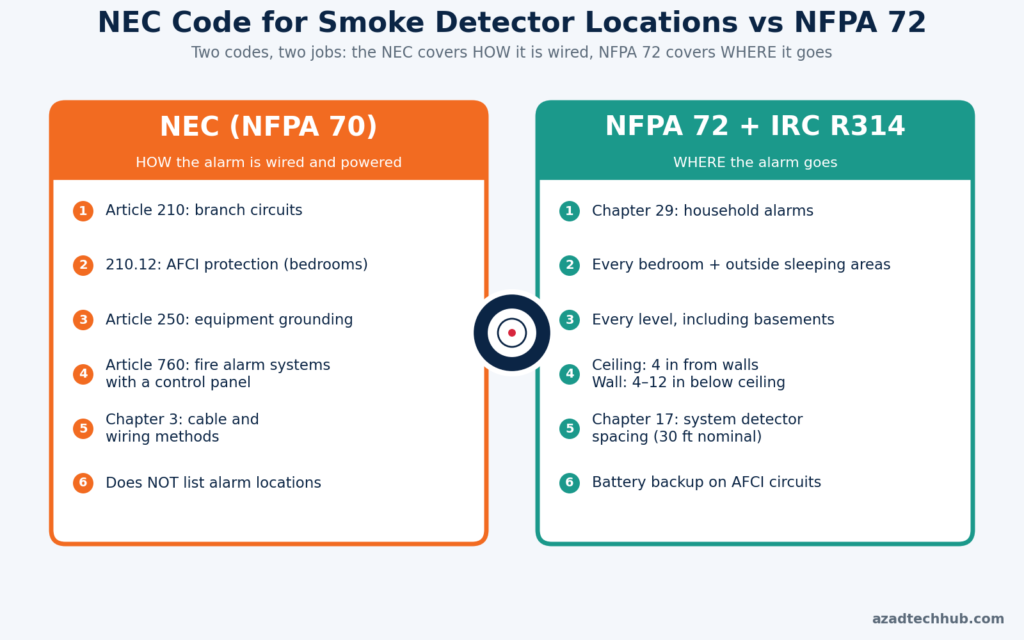
The NEC code for smoke detector locations is one of the most misunderstood topics in home electrical work. Most people expect Article 210 or Article 760 to list which rooms need an alarm and how high to mount it. It does not. The National Electrical Code (NFPA 70) governs how a smoke alarm is wired and powered, while NFPA 72 and your local residential code decide where it goes. This guide separates the two so you can place every alarm correctly and pass inspection the first time.
Quick answer: The NEC does not list smoke alarm locations. Placement comes from NFPA 72 (Chapter 29 for homes) and the International Residential Code, section R314. Put an alarm in every sleeping room, outside each sleeping area, and on every level including the basement. Mount it on the ceiling at least 4 inches from a wall, or on a wall with the top of the alarm 4 to 12 inches below the ceiling. The NEC code for smoke detector locations only matters for the circuit that powers them.
If you are also sizing the breaker for a hardwired alarm circuit, read our NEC article for overcurrent protection first. For the wider code picture, start with the home electrical wiring NEC code guide for the USA.
Table of Contents
Table of Contents
What Is the NEC Code for Smoke Detector Locations?
The honest answer is that the NEC has no table of smoke alarm locations. It is an installation standard for wiring, so it only touches smoke alarms in four places:
- Article 210 (branch circuits) and section 210.12, which requires arc-fault (AFCI) protection for many dwelling-unit circuits, including bedroom circuits.
- Article 760, which covers fire alarm systems that use a control panel. Standalone 120-volt smoke alarms that are not tied to a panel are generally outside its scope.
- Chapter 3 wiring methods, which govern the cable or conduit you use for the circuit and the interconnect wire.
- Article 250, which requires proper equipment grounding. Our NEC article for grounding and bonding explains the rules.
One more point of confusion: the NEC is published every three years, with editions in 2020, 2023 and 2026. There is no 2022 edition. If you searched for the NEC code for smoke detector locations 2022, you most likely want the 2022 edition of NFPA 72, which is a different document with a different job.
For more code explainers like this, browse our Electrical Standards library.
Why the NEC Code for Smoke Detector Locations Points to NFPA 72
NFPA 72, the National Fire Alarm and Signaling Code, covers the application, installation, location, performance and testing of fire alarm equipment. For smoke detector placement, three parts matter:
- Chapter 29 covers household fire alarm systems and single- and multiple-station smoke alarms. This is where the home rules for required locations and mounting live.
- Chapter 17 covers initiating devices. This is where spacing for system smoke detectors in commercial buildings is set, with a nominal 30 feet between detectors on a smooth ceiling.
- Chapter 10 covers general installation requirements for fire alarm systems other than household systems.
So, if you are asking what chapter of NFPA 72 contains the requirements for location and spacing of smoke detectors, the answer is Chapter 29 for homes and Chapter 17 for system detectors. Chapter and clause numbers shift between editions, and parts of the 2025 edition were renumbered, so always confirm the clause in the edition your authority having jurisdiction (AHJ) has adopted.
NFPA 72 smoke detector requirements PDF
Many readers search for an NFPA 72 smoke detector requirements PDF. NFPA 72 is copyrighted, so I cannot host it here. The legal free option is read-only online access through the NFPA 72 page. Free access works for a quick look, but a printed handbook is easier to search and tab during a job.
Recommended reference: The NFPA 72 handbook adds commentary and diagrams that the bare code lacks. Check NFPA 72 handbooks on Amazon below:

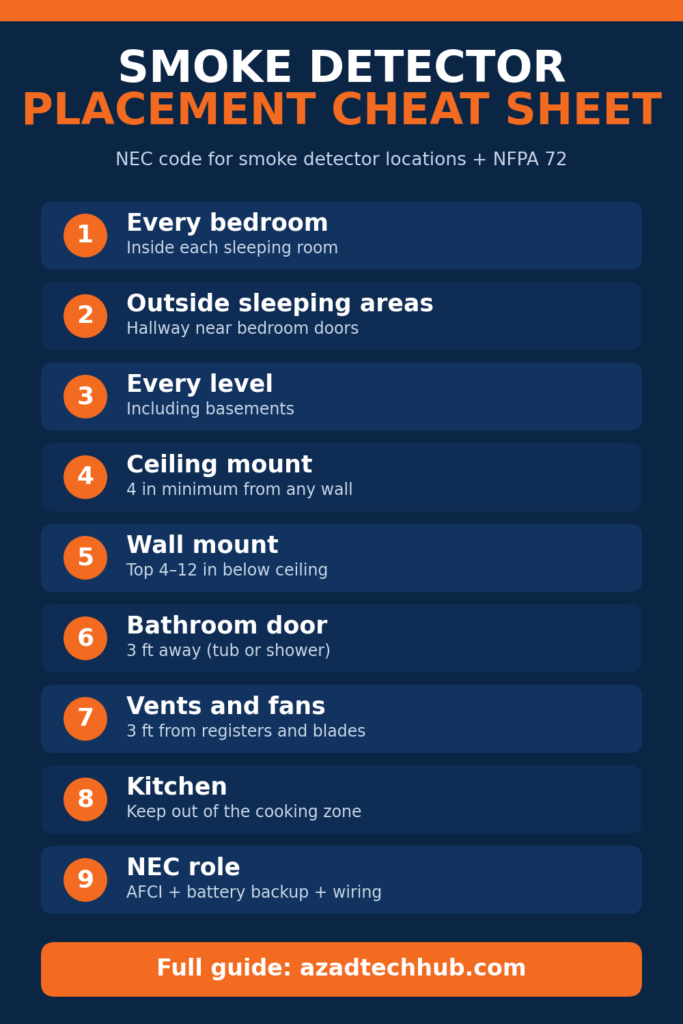
Residential Smoke Detector Requirements: Which Rooms Need an Alarm
What people quote as the NEC code for smoke detector locations in a home is really NFPA 72 Chapter 29 plus the International Residential Code (IRC) section R314, which most states adopt with local amendments. The baseline is the same in both.
| Location | Smoke alarm required? | Notes |
|---|---|---|
| Inside every sleeping room | Yes | Applies to every bedroom, including guest rooms |
| Outside each separate sleeping area, in the immediate vicinity of the bedrooms | Yes | Usually the hallway outside the bedroom doors |
| Every additional level, including basements | Yes | Habitable attics count as a level |
| Crawl spaces and uninhabitable attics | No | Not required by the baseline code |
| Kitchen | Not required | If you add one, respect the cooking-appliance distances below |
| Living and family rooms | Often added | Many local amendments and fire departments recommend them |
In new construction, the alarms must be interconnected, so when one sounds, they all sound. Existing homes may be handled differently by local rules, which is another reason to call your AHJ.
NEC Code for Smoke Detectors in Bedrooms
For bedrooms, the NEC code for smoke detector locations comes down to a simple rule: one alarm inside every sleeping room, plus one outside the sleeping area. The NEC enters through the power side. Bedroom branch circuits must have AFCI protection under 210.12, and 120-volt smoke alarms count as devices on that circuit. NFPA 72 allows a smoke alarm on an AFCI-protected circuit as long as the alarm has a secondary power source, which means a battery backup.
This is why a hardwired alarm with a sealed battery is the safest choice for bedrooms. If the arc-fault breaker trips, the alarm keeps protecting the room.
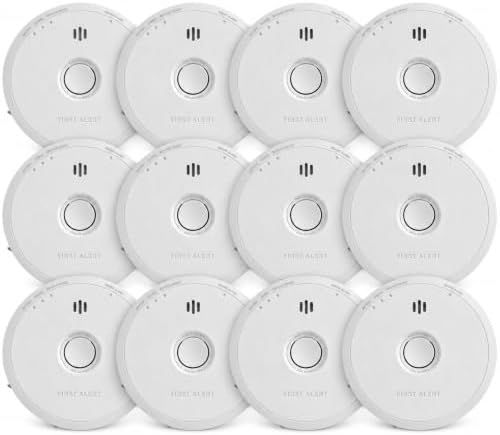
Recommended for bedrooms: A hardwired, interconnectable, photoelectric smoke alarm with battery backup. Compare hardwired smoke alarms on Amazon below.


Smoke Detector Placement Diagram and Clearances
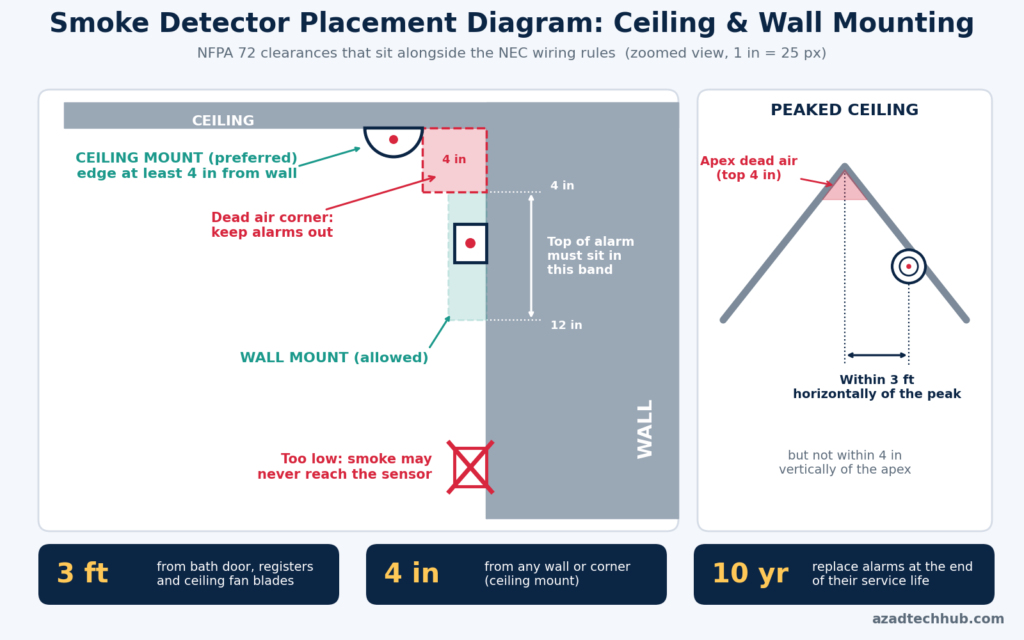
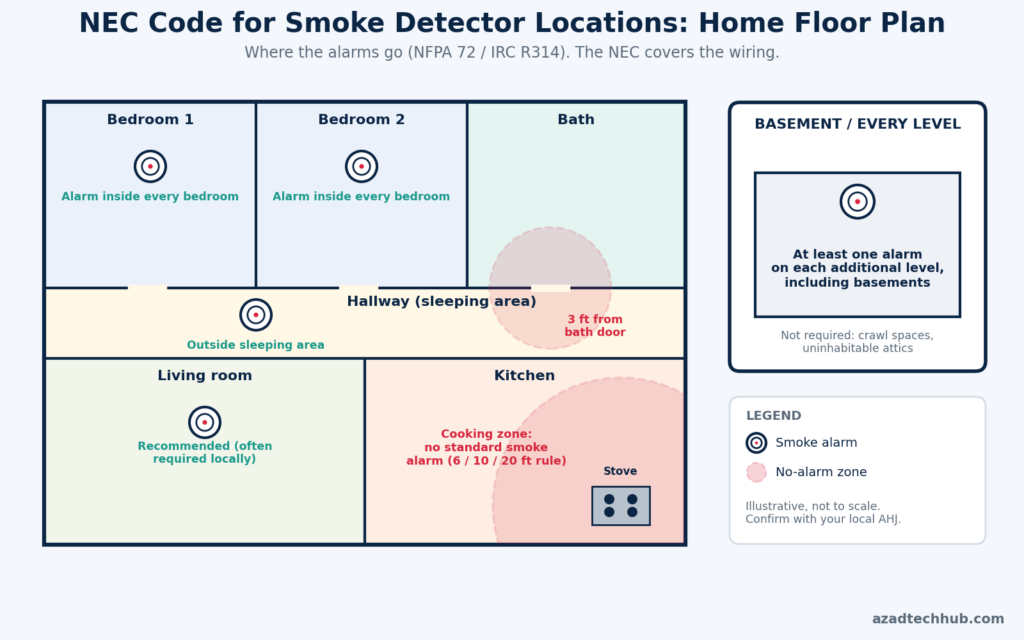
Treat the chart below as the practical companion to the NEC code for smoke detector locations. The NEC covers the wiring, and these distances cover the position. Smoke rises and spreads along the ceiling, so every rule is about keeping the alarm in that moving layer and away from dead air and drafts.
| Situation | Placement rule |
|---|---|
| Ceiling mount | At least 4 inches from any wall |
| Wall mount | Top of the alarm 4 to 12 inches below the ceiling |
| Corners | Stay out of the dead air pocket, at least 4 inches from the junction |
| Peaked or sloped ceiling | Within 3 feet horizontally of the peak, but not within 4 inches vertically of the apex |
| Bathroom with a tub or shower | At least 3 feet from the door or opening |
| Supply registers and ceiling fan blades | At least 3 feet away |
| Cooking appliances | See the kitchen rule below |
Kitchen rule. Under the 2022 edition of NFPA 72, a photoelectric alarm goes at least 6 feet horizontally from a permanently installed cooking appliance. An ionization alarm with a silencing switch goes at least 10 feet away, and one without a switch goes at least 20 feet away. The 2025 edition reworked this into a 10-foot exclusion zone and a 10-to-20-foot band for alarms listed as resistant to cooking nuisance alarms. Check which edition your jurisdiction uses.
Recommended near the kitchen: A photoelectric alarm or a dedicated heat alarm resists cooking false alarms better than a basic ionization unit. Shop photoelectric smoke alarms on Amazon.


Where Should Smoke Detectors Not Be Installed?
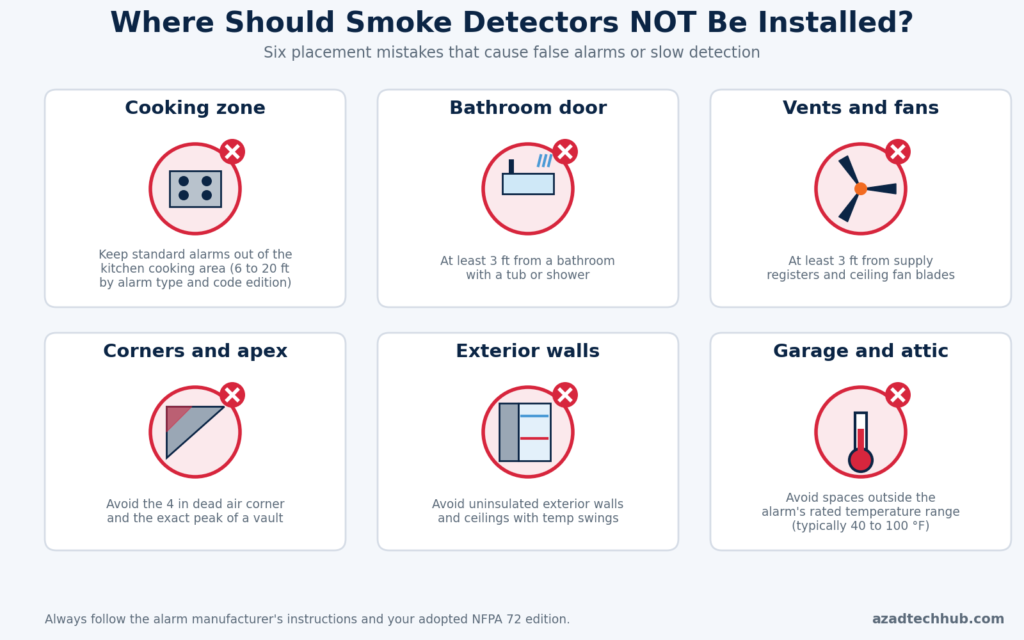
A wrong spot can break compliance even when you follow the NEC code for smoke detector locations on the wiring side. Avoid these locations:
- Inside the cooking zone. Steam and grease smoke cause nuisance alarms, and people end up removing the battery.
- Within 3 feet of a bathroom door when the bathroom has a tub or shower. Humidity triggers false alarms.
- Near supply registers, return vents and ceiling fans. Moving air dilutes smoke before it reaches the sensor.
- In the dead air space at a ceiling-wall corner or at the exact peak of a vaulted ceiling.
- On an uninsulated exterior wall or ceiling, where temperature swings affect the sensor.
- In unheated garages, attics and other spaces outside the temperature range printed on the alarm, which is typically about 40°F to 100°F.
- In dusty or damp areas such as workshops and laundry rooms, unless the alarm is listed for them.
If an alarm keeps chirping after you move it, our guide to smoke detector beeping and how to stop it walks through the usual causes.
Can You Mount a Smoke Detector on a Wall Instead of the Ceiling?
Yes. The NEC code for smoke detector locations does not forbid wall mounting, and NFPA 72 explicitly allows it. The ceiling is preferred because smoke rises, but a wall-mounted alarm is compliant when the top of the alarm sits 4 to 12 inches below the ceiling. Never mount it lower, and read the manufacturer’s instructions, since some models set tighter limits than the baseline.
Wiring and Power: Where the NEC Actually Applies
This is the part of the NEC code for smoke detector locations that inspectors actually check: the circuit, the backup and the interconnect.
- Primary power. Alarms in new homes use 120-volt building power with a battery backup. The circuit must not have a wall switch controlling it, and only the breaker may disconnect it.
- AFCI protection. Section 210.12 applies to many dwelling circuits, so the backup battery matters. Our guide to NEC requirements for ground fault protection covers how AFCI and GFCI protection differ.
- Interconnect wiring. Interconnected alarms commonly use 14/3 NM-B cable, with the third conductor carrying the interconnect signal. Follow the alarm maker’s wiring diagram.
- Interconnect limits. NFPA 72 limits an interconnected group to 18 initiating devices, of which no more than 12 can be smoke alarms.
- Cable and conduit. Size the cable with our AC cable size calculator, and if you run conduit, check the fill with the conduit fill calculator.
- Safety. Kill the breaker and confirm the circuit is dead with a tester before touching the old alarm. See our picks for the best non-contact voltage tester.
Recommended tool: A reliable non-contact voltage tester confirms the circuit is dead in seconds. See voltage testers on Amazon below.


If you cannot run new cable, a wireless interconnected alarm with a 10-year sealed battery is a practical retrofit. Browse wireless interconnected smoke alarms on Amazon →
Smoke Alarms vs Fire Alarm Systems: When NFPA 72 Chapter 17 Takes Over
A stand-alone smoke alarm is not a fire alarm system. Once you add a control panel, the rules change. For buildings with a panel, the NEC code for smoke detector locations shifts to Article 760 for wiring, and the Chapter 17 spacing rules apply to system detectors.
If your project is bigger than a house, these guides on our site go deeper:
- Residential fire alarm system guide for homes that use a panel and monitoring.
- Fire alarm system installation, step by step for design, wiring and testing.
- Addressable fire alarm system for larger buildings with individually identified devices.
- Best wireless fire alarm system for retrofits where rewiring is hard.
- Best commercial fire alarm system for compliance-driven commercial projects.
- NFPA 20 fire pump testing for the sprinkler water supply side of fire protection.
You can also browse every post in the Fire Alarm System category.
Frequently Asked Questions
What is the NEC code for smoke detector locations in a house?
There is no location rule in the NEC. Smoke detector location is set by NFPA 72 and the IRC. The NEC covers wiring, AFCI protection and power for the alarm circuit.
What is the code for smoke detector location?
The NEC code for smoke detector locations points you to NFPA 72 and IRC R314, which say to place alarms inside every sleeping room, outside each sleeping area, and on every level including basements. Mount them on the ceiling or within 4 to 12 inches below it on a wall, per NFPA 72 and IRC R314.
Where are smoke detectors supposed to be located in a home?
Bedrooms, the hallway outside bedrooms, and each additional floor, including the basement. Many fire departments also recommend the living room and any finished attic.
What are the NEC code requirements for smoke detectors?
The NEC requires proper branch circuit wiring under Article 210, AFCI protection where 210.12 applies, grounding under Article 250, and Article 760 compliance if a fire alarm control panel is involved. It does not set the room-by-room placement.
Are there 2023 NEC smoke detector requirements that differ from older editions?
The NEC code for smoke detector locations did not gain placement rules; they stayed in NFPA 72. The 2023 and 2026 NEC still deal with circuit protection and wiring. Check which edition your state or city has adopted, because many jurisdictions lag behind the newest code.
What chapter of NFPA 72 covers smoke detector location and spacing?
Chapter 29 covers household smoke alarms, and Chapter 17 covers location and spacing of system smoke detectors. Verify the numbering in your adopted edition.
Where should smoke detectors not be installed?
Avoid the kitchen cooking zone, bathroom doors, vents, ceiling fans, ceiling corners, the exact peak of a vaulted ceiling, and unconditioned spaces outside the alarm’s temperature range.
Can you mount a smoke detector on a wall instead of the ceiling?
Yes, when the top of the alarm is 4 to 12 inches below the ceiling and the manufacturer allows it.
Final Thoughts on the NEC Code for Smoke Detector Locations
The NEC code for smoke detector locations is really two questions with two answers. Where the alarm goes is decided by NFPA 72 and your local residential code. How the alarm is wired and powered is decided by the NEC. Put alarms in every bedroom, outside each sleeping area and on every level, keep them clear of kitchens, bathrooms and vents, and use a battery backup on AFCI-protected circuits.
Bookmark this page, check your adopted code edition, and explore the rest of our Electrical Standards guides and product reviews before your next project.
Disclaimer: This guide is educational and does not replace the NEC, NFPA 72 or advice from a licensed electrician or your local fire marshal. Always verify requirements against the edition adopted by your authority having jurisdiction.
Get new guides in your feed. Follow Electrical Insights on LinkedIn for new electrical standards guides, calculators and design tips from Azad Circuit Hub.