IEEE Standard for Cable Insulation Resistance Test – Complete Guide for Accurate Testing, Compliance & Safety
The ieee standard for cable insulation resistance test is a critical reference for engineers, technicians, and maintenance professionals working with electrical systems. Insulation resistance testing plays a vital role in ensuring cable health, preventing failures, and maintaining operational safety. When performed according to recognized standards, it provides reliable data that helps detect deterioration, moisture ingress, and insulation weaknesses before they become serious problems.
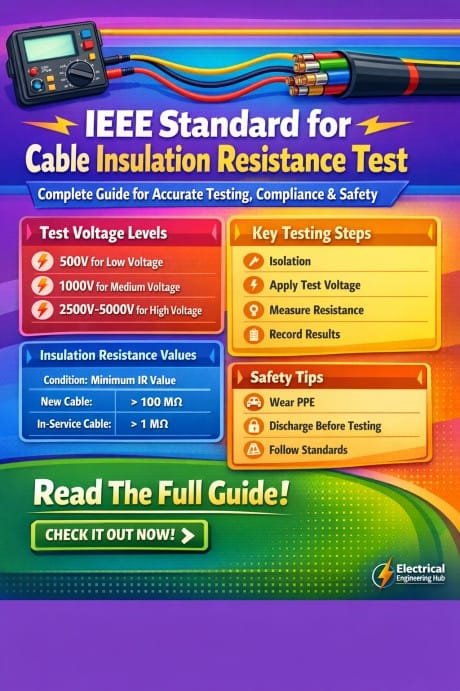
Table of Contents
This guide explains the fundamentals, procedures, compliance requirements, and practical insights needed to perform accurate testing in line with the ieee standard for cable insulation resistance test.
Understanding Insulation Resistance Testing
Insulation resistance testing measures the resistance offered by cable insulation against leakage current. High resistance indicates good insulation quality, while low resistance signals degradation or contamination.
Know more about IEC Standard for Neutral to Earth Voltage – Limits, Measurement & Safety Guidelines
The ieee standard for cable insulation resistance test emphasizes consistency in test voltage, duration, and environmental conditions to ensure meaningful results. This testing is commonly performed using a megohmmeter (Megger), which applies a DC voltage and measures resistance in megaohms or gigaohms.
Key objectives of insulation resistance testing include:
- Assessing insulation integrity
- Identifying aging or damaged insulation
- Verifying installation quality
- Supporting preventive maintenance programs
Relevant IEEE Standards and Guidelines
Several IEEE standards contribute to the framework of insulation resistance testing. While the ieee standard for cable insulation resistance test is often referenced broadly, the following standards are commonly applied in practice:
| IEEE Standard | Description | Application Area |
|---|---|---|
| IEEE 43 | Recommended Practice for Testing Insulation Resistance of Rotating Machinery | Motors & generators |
| IEEE 400 | Guide for Field Testing of Shielded Power Cable Systems | Power cables |
| IEEE 400.2 | Guide for Insulation Resistance Testing of Shielded Power Cables | Medium voltage cables |
| IEEE 1185 | Guide for Cable Condition Assessment | Diagnostic testing |
These standards provide structured procedures, recommended test voltages, and interpretation methods that align with the ieee standard for cable insulation resistance test practices.
Find all about Capacitor Bank Sizing for Power Factor Correction – Step by Step
Test Equipment and Setup
Accurate testing depends heavily on proper equipment selection and setup. The ieee standard for cable insulation resistance test highlights the importance of using calibrated and reliable instruments.
Essential Equipment
- Megohmmeter (Insulation Resistance Tester)
- Test leads with proper insulation rating
- Grounding cables
- Safety gloves and PPE
- Temperature and humidity measuring devices
Typical Test Voltage Selection
| Cable Rating | Recommended Test Voltage |
|---|---|
| Up to 1 kV | 500 V DC |
| 1 kV to 5 kV | 1000 V DC |
| 5 kV to 15 kV | 2500 V DC |
| Above 15 kV | 5000 V DC |
Following correct voltage levels is crucial under the ieee standard for cable insulation resistance test to avoid damaging insulation while still obtaining accurate readings.
Find all about IEC Standard for Relay Testing: Best Guide
Step-by-Step Testing Procedure
Performing insulation resistance testing requires a systematic approach. The ieee standard for cable insulation resistance test outlines the following procedure:
1. Preparation
- De-energize and isolate the cable
- Discharge any stored energy
- Clean cable terminals to remove dust and moisture
- Ensure proper grounding
2. Connection
- Connect the megohmmeter leads between conductor and الأرض (ground)
- For multi-core cables, test each core individually
3. Test Execution
- Apply the specified DC voltage
- Maintain the test for at least 1 minute
- Record resistance readings at intervals if required
4. Post-Test Actions
- Discharge the cable safely
- Remove test connections
- Document results for analysis
Consistency in these steps ensures compliance with the ieee standard for cable insulation resistance test and improves result reliability.
Find all about BS 7671 Wiring Regulations: Expert Guide to Compliance, Safety, and Practical Applications
Factors Affecting Test Results
Several external and internal factors can influence insulation resistance readings. Understanding these variables is essential for proper interpretation.
Environmental Factors
- Temperature variations
- Humidity levels
- Surface contamination
Cable Condition Factors
- Aging of insulation
- Mechanical damage
- Moisture ingress
- Chemical exposure
The ieee standard for cable insulation resistance test recommends temperature correction to normalize readings, ensuring fair comparison over time.
Interpretation of Test Results
Interpreting insulation resistance values requires both technical knowledge and experience. Absolute values alone may not always indicate insulation health.
Know all about ieee and iec standards
General Guidelines
| Resistance Value | Condition |
|---|---|
| > 1000 MΩ | Excellent insulation |
| 100 – 1000 MΩ | Good condition |
| 10 – 100 MΩ | Marginal |
| < 10 MΩ | Poor, requires action |
The ieee standard for cable insulation resistance test also encourages trending analysis. A gradual decline over time is often more important than a single low reading.
Polarization Index (PI)
PI is the ratio of 10-minute resistance to 1-minute resistance:
PI = R(10 min) / R(1 min)
| PI Value | Interpretation |
|---|---|
| > 2.0 | Healthy insulation |
| 1.0 – 2.0 | Marginal |
| < 1.0 | Poor insulation |
Using PI alongside the ieee standard for cable insulation resistance test provides deeper insight into insulation condition.
Know more about Transformer Oil Testing: 9 Important Tests for Healthiness
Safety Considerations
Safety is a critical aspect of insulation resistance testing. The ieee standard for cable insulation resistance test emphasizes strict adherence to safety practices.
Key Safety Measures
- Always de-energize equipment before testing
- Use proper personal protective equipment (PPE)
- Ensure proper grounding before and after testing
- Never touch test leads during operation
- Clearly mark test areas to prevent accidental contact
Neglecting safety procedures can lead to severe electrical hazards, especially when dealing with high-voltage systems.
Compliance and Documentation
Compliance with standards is not only a technical requirement but also a regulatory necessity in many industries. The ieee standard for cable insulation resistance test supports documentation for audits, maintenance records, and system validation.
Know more about IEC Standard for MV Cable Testing: Complete Acceptance, Routine & Type Test Guide
Documentation Checklist
- Cable identification details
- Test voltage applied
- Environmental conditions
- Measured resistance values
- Date and time of testing
- Technician details
Proper documentation ensures traceability and supports long-term asset management strategies.
Best Practices for Accurate Testing
To achieve reliable and repeatable results, the following best practices should be followed in line with the ieee standard for cable insulation resistance test:
- Perform tests under stable environmental conditions
- Use calibrated instruments regularly
- Maintain consistent test duration
- Apply temperature correction factors
- Record and analyze historical data
Consistency and discipline in testing significantly improve diagnostic accuracy.
Common Mistakes to Avoid
Even experienced technicians can make errors that affect test outcomes. Avoiding these mistakes ensures compliance with the ieee standard for cable insulation resistance test:
- Testing energized cables
- Ignoring temperature effects
- Using incorrect test voltage
- Skipping discharge process
- Misinterpreting results without trend analysis
Awareness of these issues helps maintain testing integrity and safety.
Know more about IEC Standard for Insulation Resistance Test – Procedures, Limits & Best Practices Explained
Practical Applications in Industry
The ieee standard for cable insulation resistance test is widely applied across various sectors:
- Power generation and transmission
- Industrial manufacturing plants
- Oil and gas facilities
- Renewable energy systems
- Commercial electrical installations
Regular insulation resistance testing helps reduce downtime, improve reliability, and extend cable life.
Conclusion
The ieee standard for cable insulation resistance test provides a structured and reliable framework for evaluating cable insulation health. By following standardized procedures, using appropriate equipment, and understanding result interpretation, professionals can ensure accurate testing and maintain high safety standards.
Know more about IEC Standard for Earthing System
Consistent application of these guidelines not only enhances system reliability but also supports preventive maintenance strategies. Whether in commissioning or routine inspection, adherence to the ieee standard for cable insulation resistance test remains essential for achieving compliance, operational efficiency, and long-term asset protection.
Follow Us on Social:
Subscribe our Newsletter on Electrical Insights for latest updates from Electrical Engineering Hub
#IEEEStandard, #CableTesting, #InsulationResistanceTest, #ElectricalTesting, #MeggerTest, #HighVoltageTesting, #ElectricalEngineering, #CableInsulation, #TestingStandards, #PowerSystem
