Raylix Level 1&2 EV Charger Review: Best Budget Option?
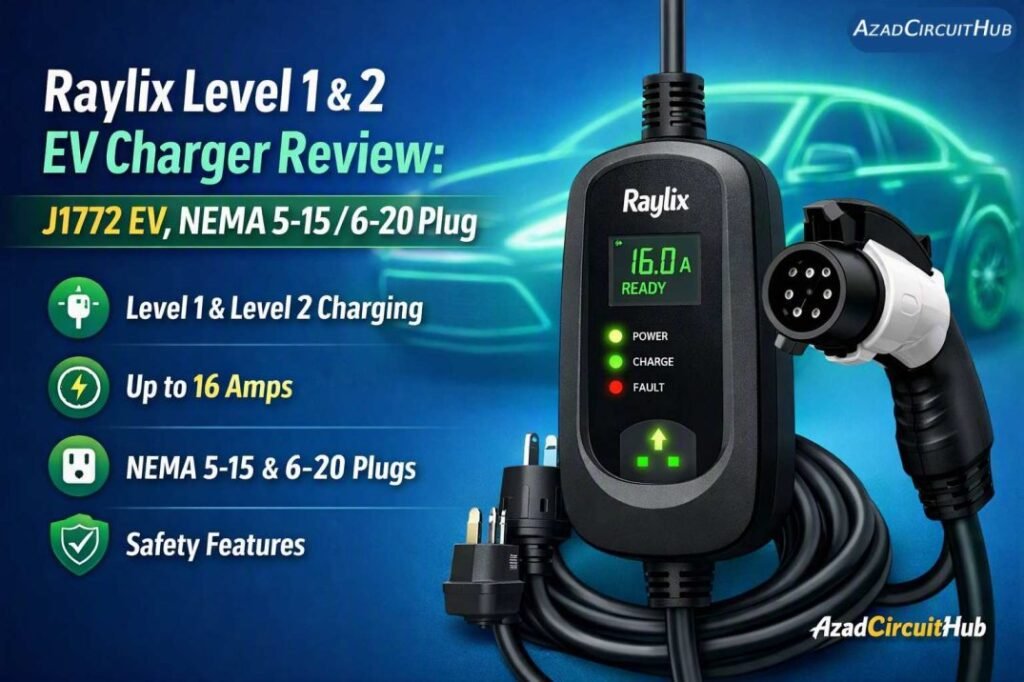
If you want one portable EV charger that can work with both a standard household outlet and a higher-voltage 240V circuit, the Raylix 2026 upgraded model is an interesting option. This Raylix Level 1&2 EV Charger Review looks at its adjustable current, dual-voltage operation, J1772 connector, 21-foot cable, timer function, and NEMA 5-15/6-20 plug setup.
I approach EV charger reviews from an electrical engineering background, with more than 15 years of practical experience working with electrical panels, industrial equipment, controls, and power systems. With portable EVSE equipment, I pay particular attention to current settings, voltage compatibility, cable length, plug configuration, and how the charger fits into a home’s existing electrical circuit.
Raylix Level 1&2 EV Charger Review at a Glance
| Feature | Raylix 2026 Upgraded EV Charger |
|---|---|
| Charging Level | Level 1 & Level 2 |
| Vehicle Connector | J1772 |
| Input Voltage | 110–240V |
| Current Range | 8–16A |
| Plug Options | NEMA 5-15 / 6-20 |
| Cable Length | 21 feet |
| Current Adjustment | Yes |
| Timer | Yes |
| Design | Portable |
| Vehicle Compatibility | J1772 EVs |
| Home Charging | Yes |
| Portable Charging | Yes |
The biggest attraction is flexibility. You can use a lower-current Level 1 setup from a standard 120V outlet and move to a 240V circuit when a suitable NEMA 6-20 connection is available.
What Makes the Raylix Portable EV Charger Different?
Many inexpensive portable EV chargers are built around one voltage and one current level. Raylix takes a different approach by allowing adjustable current from 8A to 16A and supporting 110–240V operation.
That makes it useful for drivers who may charge at different locations. For example, 120V charging can be convenient at home or while traveling, while a 240V connection can provide substantially more charging power.
The charger uses the J1772 connector, making it suitable for many EVs and plug-in hybrids that use the J1772 AC charging inlet.
The 21-foot charging cable is another practical feature. A longer cable can make parking and outlet positioning easier, especially when the electrical outlet is not directly beside the vehicle.
Level 1 vs Level 2 Charging With Raylix
The same charger can operate at different voltage levels, but the available charging power changes significantly.
| Setup | Voltage | Current | Approx. Power |
|---|---|---|---|
| Level 1 | 120V | 8A | 0.96 kW |
| Level 1 | 120V | 12A | 1.44 kW |
| Level 1 | 120V | 16A | 1.92 kW |
| Level 2 | 240V | 8A | 1.92 kW |
| Level 2 | 240V | 12A | 2.88 kW |
| Level 2 | 240V | 16A | 3.84 kW |
These are theoretical electrical power figures. Actual energy delivered to the battery will vary because of vehicle charging efficiency, battery conditions, temperature, and other factors.
For drivers who need a higher-output home charging solution, my broader guide to the best level 2 ev charger options covers higher-current residential EVSE products.
Adjustable 8–16A Charging Current
The adjustable current setting is one of the most useful features of this Raylix EV charger.
A portable EVSE does not need to operate at its maximum current all the time. If you are connected to a circuit with other loads, selecting a lower current can help reduce the load placed on that circuit.
The 8A, 10A, 12A, and 16A settings can give drivers more control over charging. However, the correct setting depends on the electrical circuit, outlet, plug configuration, and applicable local electrical requirements.
As an electrical engineer, I would not select 16A simply because the charger offers it. The circuit and receptacle should be suitable for the intended continuous charging load.
NEMA 5-15 and NEMA 6-20 Plug Compatibility
The Raylix charger is designed around NEMA 5-15 and NEMA 6-20 connections, giving it useful flexibility.
A NEMA 5-15 outlet is the familiar household receptacle used for Level 1 charging. At 120V, charging is relatively slow, but it can be enough for drivers with modest daily mileage.
A NEMA 6-20 connection provides 240V power and can significantly increase charging power when used with the appropriate circuit.
The important point is that a 6-20 receptacle should be installed on a properly configured 240V branch circuit. Do not assume that any outlet with a similar physical appearance is suitable for EV charging.
21-Foot Charging Cable
Cable length matters more than it may appear when using a portable EV charger.
The Raylix model comes with a 21-foot charging cable, which gives the driver additional reach between the electrical outlet and the vehicle. This can be helpful in garages, driveways, or temporary charging locations where outlet placement is less convenient.
A longer cable can also reduce the need to position the vehicle very close to the electrical outlet.
However, the cable should be routed carefully. Avoid placing it where vehicles can drive over it, where it can become a trip hazard, or where it may be exposed to unnecessary mechanical stress.
Adjustable Charging Timer
The built-in timer function can be useful when you want charging to operate during a particular period.
For example, a driver may want to plug in after returning home and schedule charging for later. This can also make it easier to align charging with an existing electricity-use routine.
The timer should be viewed as a convenience feature rather than a substitute for proper electrical protection or a dedicated energy-management system.
Raylix J1772 Compatibility
The Raylix charger uses a J1772 vehicle connector. This standard is widely used for AC charging by many EVs and plug-in hybrid vehicles.
Before buying, check the charging inlet on your specific vehicle. Some newer EVs use NACS, while many vehicles still use J1772. If your vehicle has a different connector, you may need an appropriate adapter, assuming the vehicle manufacturer permits that configuration.
The charger itself should not be selected solely by brand. Connector compatibility is the first thing I would confirm.
Who Should Consider the Raylix EV Charger?
This portable EVSE may make sense for several types of drivers:
- J1772 EV and plug-in hybrid owners
- Drivers who need Level 1 and Level 2 flexibility
- Apartment or rental-property residents
- Owners who want a portable charging cable
- Drivers who travel between locations
- Homeowners with a suitable NEMA 6-20 circuit
- Users who want adjustable charging current
It is less suitable if you specifically need a high-current 40A, 48A, or 80A home charging station.
If you are comparing more powerful fixed residential units, check my guide to the best level 2 ev charger choices before deciding.
Raylix EV Charger Buying Considerations
The portable design is the main reason to consider this charger. Instead of buying separate equipment for basic Level 1 and moderate Level 2 charging, the Raylix unit can provide both options within its 8–16A range.
Before purchasing, check:
- Your vehicle's connector type
- Maximum AC charging rate
- Available household voltage
- NEMA outlet type
- Branch-circuit capacity
- Required current setting
- Cable routing
- Indoor or outdoor installation conditions
- Local electrical requirements
Ready to check the current price? Shop Raylix Level 1&2 EV Charger on Amazon
Amazon pricing and availability can change, so verify the exact model, plug configuration, and included accessories on the product page before ordering.
How Fast Can the Raylix Charger Charge an EV?
Charging time depends heavily on battery capacity and the current selected.
At 120V and 16A, the charger can theoretically provide about 1.92 kW. At 240V and 16A, that rises to approximately 3.84 kW.
For a simplified example, a 60 kWh battery would theoretically require around 31 hours at 1.92 kW if charging from empty under ideal conditions. At 3.84 kW, the same calculation is around 16 hours. Real charging time will be different because EVs do not charge at a perfectly constant rate and charging losses occur.
This is why Level 2 charging at 240V can be much more practical for regular home charging.
Raylix Level 1&2 EV Charger Review: Pros and Limitations
Pros
- Supports 110–240V operation
- Adjustable 8–16A current
- J1772 connector
- NEMA 5-15 and 6-20 plug support
- Long 21-foot cable
- Portable design
- Timer function
- Suitable for Level 1 and lower-power Level 2 charging
Limitations
- Maximum current is only 16A
- Not intended for high-power 40A or 48A charging
- J1772 connector limits direct compatibility with some NACS vehicles
- Charging speed at 120V is relatively slow
- Circuit and outlet suitability still need to be verified
Is Raylix a Good Choice for Portable EV Charging?
For someone who values portability and dual-voltage flexibility, the Raylix specification is appealing. Its adjustable current and 110–240V input allow it to cover several common charging situations without requiring a large, permanently mounted charging station.
The main limitation is output. At 16A maximum, it is not competing directly with higher-power 32A, 40A, or 48A Level 2 EV chargers.
That is not necessarily a problem. If your daily driving needs are moderate and you value portability, a lower-current charger can be perfectly practical.
For drivers specifically looking for a permanent home charging station, compare it with the best level 2 ev charger models that offer higher charging currents.
Frequently Asked Questions
Is the Raylix EV charger Level 1 or Level 2?
It supports both. At 120V it can operate as a Level 1 charger, while 240V operation provides Level 2 charging. Its adjustable current range is 8–16A.
What plug does the Raylix EV charger use?
The listed model supports NEMA 5-15 and NEMA 6-20 connections. Confirm the exact configuration supplied with the model you purchase.
Is Raylix compatible with J1772 EVs?
Yes. The listed Raylix model uses a J1772 vehicle connector and is designed for compatible J1772 electric vehicles and plug-in hybrids.
How much power does the Raylix charger provide?
At 120V and 16A, the theoretical output is about 1.92 kW. At 240V and 16A, it is approximately 3.84 kW.
Is a 16A EV charger safe to use at home?
Safety depends on the complete electrical installation, not just the charger's rated current. The outlet, branch circuit, wiring, protection, and installation method should all be suitable for continuous EV charging.
Final Verdict on the Raylix EV Charger
The Raylix portable EV charger is built around flexibility rather than maximum charging speed. Its 8–16A adjustable current, 110–240V operation, J1772 connector, NEMA 5-15/6-20 compatibility, timer, and 21-foot cable make it a versatile option for drivers who want portable Level 1 and lower-power Level 2 charging.
Its 16A maximum output is the key limitation to keep in mind. Drivers who need rapid home charging should look at higher-current Level 2 equipment, while those who value portability and moderate charging requirements may find the Raylix specification more appropriate.
Check the latest Raylix price, availability, and customer reviews on Amazon: Buy Raylix Level 1&2 EV Charger on Amazon
Get new guides in your feed. Follow Electrical Insights on LinkedIn for new electrical standards guides, calculators and design tips from Azad Circuit Hub.
#RaylixEVCharger, #RaylixChargerReview, #EVChargerReview, #Level1EVCharger, #Level2EVCharger, #J1772Charger, #NEMA515, #NEMA620, #EVCharging, #HomeEVCharging