
Diversity Factor for Air Conditioner
When several air conditioners operate in the same building, it is unlikely that every unit will run at its maximum electrical load at exactly the same time. This difference between connected load and expected maximum demand is where diversity becomes useful. The diversity factor for air conditioner helps engineers estimate a more realistic demand for feeders, transformers, generators, and distribution panels.
Unlike some NEC demand factors, there is no single universal code value that applies to every air-conditioning installation. The correct value depends on the building type, number of units, operating pattern, climate, controls, and whether the equipment is central or individually controlled.
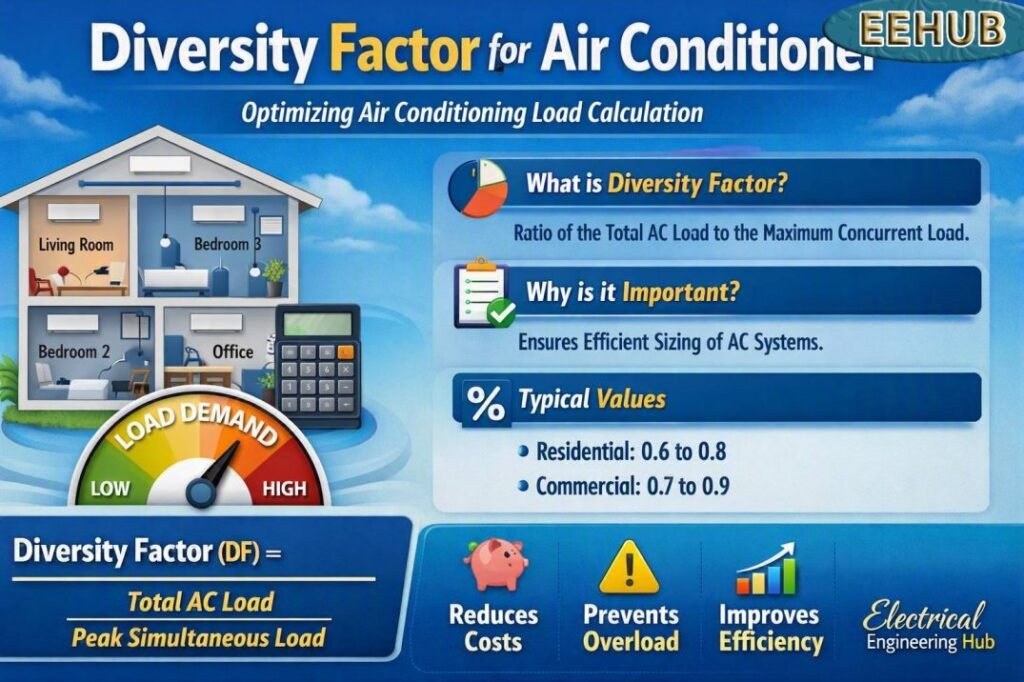
Table of Contents
Table of Contents
Quick Reference: Air Conditioner Diversity Factors
| Installation type | Typical diversity factor range | Practical design starting point |
|---|---|---|
| Single residential dwelling | 1.00 | 1.00 |
| 2–5 residential AC units | 0.90–1.00 | 0.95 |
| 6–10 residential units | 0.80–0.95 | 0.90 |
| 11–20 apartment AC units | 0.70–0.90 | 0.80 |
| 21–50 apartment units | 0.60–0.80 | 0.70 |
| Large residential complex | 0.50–0.70 | 0.60 |
| Small commercial office | 0.70–0.90 | 0.80 |
| Large commercial building | 0.60–0.80 | 0.70 |
| Central HVAC system | Project-specific | Load calculation required |
These values are engineering planning ranges rather than mandatory NEC rates. The final design should use applicable electrical codes, HVAC design data, manufacturer information, and actual operating conditions.
Planning note: A lower diversity factor means a lower expected simultaneous load. Do not use a low value simply to reduce cable or transformer size.
What Is Diversity Factor for Air Conditioner?
The diversity factor for air conditioner compares the total connected AC load with the maximum demand expected from all units operating together.
The basic formula is:
Diversity Factor = Sum of Individual Maximum Demands ÷ Maximum Demand of the Group
For example, suppose ten air conditioners each have a maximum electrical demand of 3 kW.
Total connected load:
10 × 3 = 30 kW
If the expected maximum demand of the group is 24 kW:
Diversity Factor = 30 ÷ 24 = 1.25
This is an important point: in traditional electrical engineering terminology, diversity factor is normally greater than 1. If you want to apply a percentage to connected load, you are actually using the reciprocal relationship, commonly called a coincidence or demand factor.
Therefore:
Demand/Simultaneous Load Factor = 1 ÷ Diversity Factor
For a diversity factor of 1.25:
1 ÷ 1.25 = 0.80
So the expected simultaneous load is 80% of the connected load.
Diversity Factor vs Demand Factor for AC Loads
These terms are often mixed in electrical load calculations. Keeping them separate makes the design much easier to understand.
| Parameter | Formula | Example |
|---|---|---|
| Connected load | Number of units × unit load | 10 × 3 = 30 kW |
| Demand factor | Maximum demand ÷ connected load | 24 ÷ 30 = 0.80 |
| Diversity factor | Connected load ÷ maximum demand | 30 ÷ 24 = 1.25 |
| Maximum demand | Connected load × demand factor | 30 × 0.80 = 24 kW |
For a detailed comparison of load diversity, demand factors, and electrical installation calculations, use the diversity factor in electrical installations guide and related examples.
How to Calculate AC Load Diversity
Consider an apartment building with 20 split air-conditioning units. Each unit has a rated electrical input of 2.5 kW.
Step 1: Find connected load
20 × 2.5 kW = 50 kW
Step 2: Estimate simultaneous demand
Assume engineering analysis indicates that about 80% of the connected AC load may operate during the design peak.
50 × 0.80 = 40 kW
Step 3: Calculate diversity factor
Diversity Factor = 50 ÷ 40
Diversity Factor = 1.25
This means the total installed AC capacity is 1.25 times the maximum expected simultaneous demand.
However, the 80% operating assumption should not be accepted automatically. Apartment occupancy, outdoor temperature, thermostat settings, unit efficiency, and tenant behavior can change the actual peak.
Typical Rates for Different Building Types
The number of AC units is one of the most important factors affecting diversity. A building with many independently controlled units generally has more opportunity for non-simultaneous operation.
| Number of AC units | Suggested simultaneous-load range | Equivalent diversity factor |
|---|---|---|
| 1 | 100% | 1.00 |
| 2–5 | 90–100% | 1.00–1.11 |
| 6–10 | 80–95% | 1.05–1.25 |
| 11–20 | 70–90% | 1.11–1.43 |
| 21–50 | 60–80% | 1.25–1.67 |
| 51+ | 50–75% | 1.33–2.00 |
These ranges are useful for preliminary calculations only. A final electrical design should be based on actual load characteristics rather than relying solely on a generic percentage.
Example for a Multi-Storey Building
Suppose a five-storey apartment building has 40 air conditioners. Each unit draws 1.8 kW at its rated electrical input.
Connected AC load:
40 × 1.8 = 72 kW
If the estimated peak simultaneous load is 70%:
72 × 0.70 = 50.4 kW
The corresponding diversity factor is:
72 ÷ 50.4 = 1.43
For preliminary distribution planning, the designer can therefore consider approximately 50.4 kW as the expected maximum AC demand rather than assuming all 40 units continuously consume their full rated input.
For more electrical load calculations, you can also use the diversity factor in electrical installations resource to compare AC demand with other building loads.
What Affects AC Diversity?
The correct diversity value can change considerably from one project to another. Several factors should be reviewed before selecting a design value.
Building occupancy
Residential buildings may have different usage patterns from offices, hotels, schools, or retail spaces. Occupants do not necessarily switch their air conditioners on at the same time.
Outdoor temperature
Hot weather can increase compressor running time. In extreme summer conditions, the assumed diversity may be higher than during mild weather.
AC type
Split systems, VRF systems, packaged units, chillers, and rooftop units have different operating characteristics. Variable-speed compressors can also reduce the relationship between rated capacity and actual electrical demand.
Building orientation and insulation
Solar heat gain, glazing, insulation, roof construction, and building orientation affect cooling demand. Two buildings with the same number of AC units can have very different peak electrical loads.
Thermostat settings
If occupants select very low temperature settings during hot weather, compressors may operate for longer periods. This can increase simultaneous demand.
Why Diversity Matters in Electrical Design
Using diversity correctly can prevent unnecessary oversizing of electrical infrastructure while maintaining adequate capacity.
It can affect:
- Main distribution board sizing
- Feeder cable selection
- Circuit breaker ratings
- Transformer capacity
- Generator sizing
- Electrical panel loading
- Voltage-drop calculations
- Standby power requirements
- Energy management strategies
For example, assuming 100% operation of every AC unit in a large apartment project could produce a much higher calculated demand than the building is likely to experience. On the other hand, using an excessively low demand assumption can overload equipment during a severe summer peak.
That is why diversity should be supported by realistic load data whenever possible.
Diversity Factor for Central Air Conditioning
Central HVAC systems require a different approach. A chiller plant may include multiple chillers, chilled-water pumps, cooling towers, air-handling units, and variable-speed drives.
Instead of applying one blanket percentage to the entire system, engineers normally analyze:
- Cooling load of the building
- Chiller operating sequence
- Number of chillers
- Pump operation
- Fan operation
- Diversity between occupied zones
- Equipment standby capacity
- Peak outdoor design conditions
Manufacturer data should also be used to determine actual electrical input at the required operating point.
Practical Design Tips
When calculating AC electrical demand, follow these practices:
- Start with the actual nameplate or manufacturer electrical input.
- Separate connected load from maximum demand.
- Do not confuse diversity factor with demand factor.
- Consider the number and type of AC units.
- Review the building’s occupancy schedule.
- Check local electrical code requirements.
- Use HVAC design information where available.
- Consider extreme summer operating conditions.
- Avoid reducing feeder capacity solely because of an assumed diversity percentage.
- Allow suitable capacity for future expansion.
If you are working on a larger electrical load schedule, the diversity factor in electrical installations guide can help organize demand calculations across different types of loads.
Frequently Asked Questions
What is a typical diversity factor for air conditioners?
A practical diversity factor may range from about 1.05 to 1.67 for many multi-unit residential applications, corresponding roughly to 95% to 60% simultaneous loading. The appropriate value depends on the number of units and building operating conditions.
Is there a fixed NEC diversity factor for air conditioners?
No single NEC diversity factor applies universally to all air-conditioning systems. Electrical load calculations must follow the applicable NEC requirements for the specific equipment and installation, while HVAC demand should be determined using appropriate engineering data.
Should I use 100% load for one air conditioner?
For a single AC unit, using 100% of the applicable calculated load is a conservative approach because there is no group diversity. The actual circuit must still be sized according to the equipment nameplate and applicable code requirements.
What is the difference between diversity factor and demand factor?
Diversity factor is the sum of individual maximum demands divided by the maximum demand of the group. Demand factor is maximum demand divided by connected load. For the same load group, they are mathematical reciprocals.
Can diversity reduce the size of an AC feeder?
It can reduce the calculated demand used for system-level planning, but it should not be used blindly to reduce individual branch-circuit requirements. Feeder and service calculations must comply with the applicable electrical code and equipment requirements.
Final Takeaway
The diversity factor for air conditioner is useful when several cooling units share the same electrical distribution system. A typical multi-unit installation may operate at roughly 60% to 90% of its connected AC load during a design peak, giving an approximate diversity factor of 1.11 to 1.67. These are planning values, not universal code rates.
For accurate engineering work, base the calculation on equipment data, occupancy, climate, HVAC design conditions, operating schedules, and applicable electrical standards. This approach provides a more reliable estimate for feeders, panels, transformers, and backup power systems while avoiding both unnecessary oversizing and unsafe under-sizing.
Related Guides & Tools
Get new guides in your feed. Follow Electrical Insights on LinkedIn for new electrical standards guides, calculators and design tips from Azad Circuit Hub.
#DiversityFactor, #AirConditioner, #HVACLoadCalculation, #ACLoadCalculation, #ElectricalLoad, #HVACDesign, #DemandFactor, #AirConditioning, #ElectricalEngineering, #HVACEngineering
