
Cable Derating Factors Explained: Grouping, Temperature & Depth
Choosing a cable by its nameplate current rating alone can lead to overheating, insulation damage, and nuisance tripping. A cable installed in free air may carry more current than the same cable buried underground, inside conduit, or grouped with several other circuits. This is why cable selection must account for installation conditions.
Cable Derating Factors are correction factors used to reduce the allowable current-carrying capacity of a conductor when surrounding conditions make heat dissipation more difficult. Common factors include ambient temperature, cable grouping, installation depth, soil thermal resistivity, and installation method.
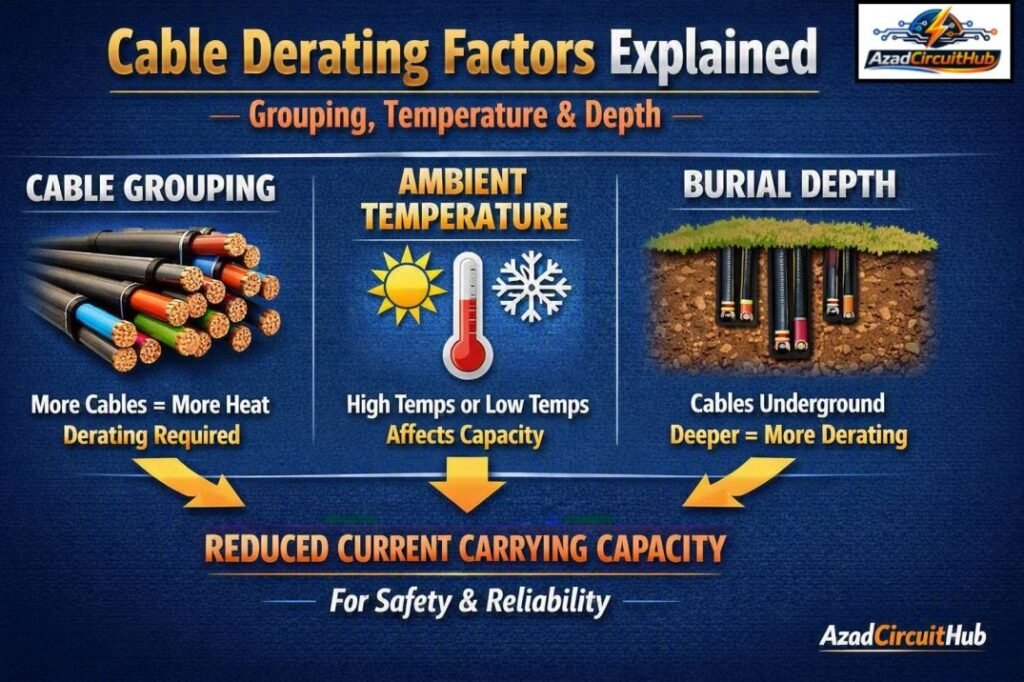
Table of Contents
Table of Contents
Quick Reference: Common Cable Derating Factors
| Installation condition | Typical effect | Why correction is needed |
|---|---|---|
| High ambient temperature | Reduces ampacity | Heat cannot escape as easily |
| Multiple cables grouped together | Reduces ampacity | Adjacent cables add heat |
| Increased burial depth | May reduce ampacity | Heat has a longer path to escape |
| Poor soil thermal resistivity | Reduces ampacity | Soil removes heat less effectively |
| Cable installed in conduit | Can reduce ampacity | Restricted heat dissipation |
| Direct sunlight | May reduce ampacity | Solar heating raises conductor temperature |
| Thermal insulation around cable | Can significantly reduce ampacity | Heat becomes trapped |
| Multiple circuits in trunking | Reduces ampacity | Heat accumulates within the enclosure |
The actual correction value depends on the cable type, conductor material, insulation temperature rating, installation method, and applicable electrical standard.
What Are Cable Derating Factors?
Cable Derating Factors adjust the maximum current a cable can safely carry under specific installation conditions. Manufacturers and electrical standards normally publish current ratings based on defined reference conditions. If the real installation differs from those conditions, the rated ampacity may need to be reduced.
For example, a cable may have a base current rating of 40 A under a particular reference condition. If grouping and ambient temperature factors are 0.80 and 0.91 respectively, the adjusted capacity becomes:
Adjusted ampacity = Base ampacity × Grouping factor × Temperature factor
Adjusted ampacity = 40 × 0.80 × 0.91 = 29.12 A
Therefore, a 40 A nominal rating does not automatically mean the cable can safely carry 40 A in every installation.
Main Cable Derating Factors to Consider
Several installation conditions can affect cable ampacity. The most important ones should be checked before selecting conductor size.
Ambient Temperature
Temperature has a major effect on current-carrying capacity. As the surrounding temperature increases, the difference between conductor temperature and ambient temperature becomes smaller. The cable therefore has less ability to release heat.
For a cable with a maximum conductor operating temperature of 90°C, an installation at 40°C ambient will have a different allowable current than one at 20°C.
Temperature correction factors are normally provided by cable manufacturers or electrical standards.
| Ambient condition | Expected impact |
|---|---|
| Low ambient temperature | Higher allowable ampacity |
| Standard reference temperature | No correction or factor of 1.00 |
| Moderately high temperature | Reduced ampacity |
| Very high temperature | Significant ampacity reduction |
Always use the temperature correction table that matches the cable insulation system. PVC, XLPE, EPR, and other insulation materials have different thermal limits.
Cable Grouping
When several loaded cables are installed together, each conductor produces heat. Closely spaced cables can transfer heat to one another, increasing the temperature around the conductors.
This is one of the most common Cable Derating Factors in commercial, industrial, and solar installations.
A single cable installed with plenty of free space may operate close to its normal rating. Several circuits installed in the same conduit, tray, trunking, or duct may require a grouping correction.
| Number of loaded circuits | General effect |
|---|---|
| 1 | Little or no grouping correction |
| 2 | Small reduction may apply |
| 3–4 | Greater heat accumulation |
| 5–6 | Significant correction may be required |
| Many circuits | Detailed installation calculation recommended |
Do not assume that unused conductors always have the same thermal impact as fully loaded circuits. The applicable standard defines how circuits and loaded conductors should be counted.
Burial Depth
Underground cables transfer heat through the surrounding soil. When the burial depth increases, heat may have a longer path to reach the surface.
The effect of depth depends on cable spacing, soil conditions, installation arrangement, and whether cables are installed directly in the ground or inside ducts.
For underground power cables, Cable Derating Factors should therefore include the installation depth and soil thermal characteristics rather than relying only on a standard air rating.
Soil Thermal Resistivity
Soil thermal resistivity describes how easily the surrounding soil allows heat to move away from the cable.
Dry or poorly conducting soil can retain more heat around an underground cable. Moisture content, soil composition, compaction, and seasonal conditions can all influence thermal performance.
| Soil condition | Thermal performance |
|---|---|
| Moist, well-compacted soil | Generally better heat transfer |
| Normal engineered backfill | Predictable thermal performance |
| Dry soil | Reduced heat transfer |
| High-resistivity soil | Greater cable heating |
For large underground feeders, accurate soil data can be important because an optimistic thermal assumption may result in an undersized cable.
Cable Derating Calculation Example
Consider a copper XLPE cable with a reference ampacity of 75 A. Suppose the installation has:
- Ambient temperature factor = 0.91
- Grouping factor = 0.80
- Depth factor = 0.95
The corrected ampacity is:
75 × 0.91 × 0.80 × 0.95 = 51.87 A
The cable can therefore carry approximately 51.9 A under the stated conditions.
If the design load is 50 A, the cable may satisfy the thermal ampacity requirement. However, cable selection should not stop at this calculation. Voltage drop, short-circuit withstand, protective device coordination, installation method, and local code requirements should also be checked.
For faster conductor selection, you can use an electrical cable size calculator to compare cable sizes, current capacity, voltage drop, and installation conditions before finalizing the design.
How Multiple Derating Factors Work Together
Correction factors are normally multiplied rather than simply added or subtracted.
The general relationship is:
Iz = Ib × k1 × k2 × k3 × …
Where:
- Iz = corrected current-carrying capacity
- Ib = base cable ampacity
- k1 = temperature correction factor
- k2 = grouping factor
- k3 = installation or depth factor
For example:
| Parameter | Value |
|---|---|
| Base ampacity | 100 A |
| Temperature factor | 0.91 |
| Grouping factor | 0.80 |
| Installation factor | 0.95 |
| Final ampacity | 69.16 A |
The combined factor is:
0.91 × 0.80 × 0.95 = 0.6916
Therefore, the original 100 A rating is reduced to about 69.2 A.
This demonstrates why several moderate corrections can produce a substantial reduction in usable cable capacity.
Cable Derating and Voltage Drop
Ampacity is only one part of cable sizing. A conductor may have enough thermal capacity but still produce excessive voltage drop over a long run.
Voltage drop depends mainly on conductor resistance, reactance, cable length, load current, conductor material, and power factor.
For long feeders, motor circuits, EV chargers, solar systems, and remote loads, both thermal capacity and voltage drop should be checked.
| Cable selection check | Main purpose |
|---|---|
| Ampacity | Prevents excessive conductor heating |
| Voltage drop | Maintains acceptable load voltage |
| Short-circuit rating | Ensures conductor survives fault current |
| Protective device rating | Provides proper overload protection |
| Installation method | Determines applicable correction factors |
| Environmental conditions | Accounts for actual operating conditions |
Using an electrical cable size calculator can simplify the initial sizing process, especially when several installation parameters need to be compared.
Cable Derating for Different Installation Methods
Cable installation method has a direct effect on heat dissipation. The same conductor can have different allowable current ratings depending on whether it is installed in free air, conduit, trunking, cable tray, or underground.
Cable Tray
Cables on an open tray generally have better airflow than cables enclosed in conduit. However, tightly packed trays can still experience heat buildup.
Conduit
Conduit restricts airflow around the cable. Multiple circuits in the same conduit can require additional correction.
Underground Duct
Duct installations require consideration of soil thermal properties, burial depth, duct spacing, and the number of circuits installed together.
Direct Burial
Direct-buried cables depend heavily on surrounding soil for thermal transfer. Backfill quality and soil resistivity can therefore have a significant influence on ampacity.
Common Cable Derating Mistakes
Even experienced installers can overlook correction factors when working from standard ampacity tables. Common mistakes include:
- Using the free-air rating for an enclosed installation.
- Ignoring the number of loaded circuits.
- Applying an ambient temperature factor from the wrong insulation type.
- Forgetting underground burial conditions.
- Assuming cable tray spacing has no thermal effect.
- Checking ampacity but ignoring voltage drop.
- Selecting a cable before determining the actual installation method.
- Applying correction factors from an unrelated standard.
The safest approach is to establish the installation conditions first and then select the appropriate ampacity table and correction factors.
Practical Cable Sizing Checklist
Before finalizing a cable size, check these parameters:
| Check | Question |
|---|---|
| Load current | What is the maximum continuous and normal load? |
| Conductor | Copper or aluminum? |
| Insulation | PVC, XLPE, EPR, or another type? |
| Installation | Tray, conduit, trunking, air, duct, or buried? |
| Ambient temperature | What is the expected maximum temperature? |
| Grouping | How many loaded circuits are together? |
| Depth | How deep is the underground cable installed? |
| Soil | What is the expected thermal resistivity? |
| Voltage drop | Is the calculated drop within the design limit? |
| Protection | Is the breaker or fuse correctly coordinated? |
| Fault current | Can the cable withstand the prospective short circuit? |
For a quick preliminary check, use an electrical cable size calculator to evaluate current capacity and voltage drop, then verify the final selection against the applicable electrical code and manufacturer data.
Cable Derating Factors for Solar and Industrial Systems
Solar plants, battery systems, industrial feeders, and control panels often contain multiple cables in close proximity. DC strings may be installed in cable trays, while AC feeders can share ducts or conduits.
High outdoor temperatures can also raise conductor temperatures considerably. In rooftop solar applications, cables may be exposed to direct sunlight and elevated ambient temperatures. These conditions should be reflected in the cable ampacity calculation.
Industrial installations may introduce additional concerns such as heat-producing equipment, enclosed cable trenches, large motor feeders, and dense cable trays.
The key principle is simple: cable ampacity must reflect the actual installation rather than an ideal laboratory condition.
Standards and Manufacturer Data
Cable ampacity and correction factors vary by region and installation method. Depending on the project, designers may work with standards such as IEC 60364, IEC 60287, BS 7671, NEC, or local electrical regulations.
Manufacturer datasheets are also important because cable construction, insulation rating, conductor arrangement, and installation assumptions can differ between products.
Never combine correction factors from unrelated tables without checking that they are intended to be used together.
FAQs About Cable Derating Factors
What is the purpose of cable derating?
Cable derating reduces the allowable current when installation conditions increase conductor temperature or restrict heat dissipation. It helps prevent overheating and premature insulation failure.
Does cable grouping reduce ampacity?
Yes. Multiple loaded cables installed close together can increase heat accumulation. A grouping correction may therefore be required based on the number of circuits and the installation arrangement.
Does temperature affect cable current rating?
Yes. Higher ambient temperatures generally reduce the allowable current because the cable has less thermal capacity available before reaching its maximum conductor temperature.
Does burial depth affect underground cable sizing?
It can. Greater burial depth may affect heat dissipation, although the actual correction depends on soil conditions, cable arrangement, spacing, and the applicable calculation method.
Can I use a standard cable ampacity without derating?
Only when the actual installation conditions match the assumptions behind that ampacity rating. If temperature, grouping, installation method, or other conditions differ, appropriate correction factors should be applied.
Final Takeaway
Correct cable selection requires more than matching the load current to a conductor’s published ampacity. Temperature, grouping, burial depth, soil conditions, installation method, voltage drop, and fault withstand can all affect the final conductor size.
Cable Derating Factors provide a practical way to account for these real-world conditions. Applying the correct factors helps maintain safe conductor temperatures and improves the reliability of electrical installations.
For preliminary sizing and design checks, an electrical cable size calculator can help compare conductor sizes and voltage-drop results. Always confirm the final cable selection against the applicable electrical standard, project specifications, and cable manufacturer’s data.
Get new guides in your feed. Follow Electrical Insights on LinkedIn for new electrical standards guides, calculators and design tips from Azad Circuit Hub.
#CableDeratingFactors, #CableDerating, #CableSizing, #ElectricalCables, #CableAmpacity, #ElectricalEngineering, #CableInstallation, #TemperatureDerating, #CableGrouping, #ElectricalDesign
