Arduino Projects Ideas For Environment: Top High-Impact DIY IoT & Smart Green Solutions for Students and Engineers
In recent years, environmental monitoring and smart automation have become essential for building a sustainable future. With rising pollution levels, water scarcity, and climate change challenges, students and engineers are increasingly turning toward low-cost embedded systems to create real-world solutions. Among these, Arduino-based systems stand out because they are flexible, affordable, and easy to integrate with sensors and IoT platforms.
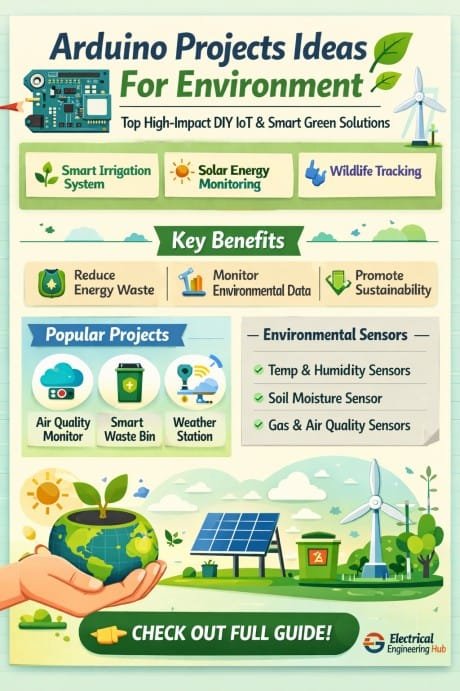
Table of Contents
Arduino Projects Ideas For Environment are gaining strong attention in academic research, DIY communities, and smart agriculture applications. These projects help monitor air quality, soil health, water usage, and energy consumption in real time. By combining microcontrollers with sensors and wireless communication modules, learners can design systems that contribute directly to environmental protection.
The growing interest in Arduino Projects Ideas For Environment is not limited to classrooms. Farmers, environmental engineers, and startups are also adopting these solutions for precision farming, smart irrigation, and pollution tracking systems. The simplicity of Arduino boards allows even beginners to build scalable prototypes that can later be upgraded into industrial applications.
Know more about Arduino Project Ideas For Electrical Engineering
This article explores practical ideas, components, and methods to build impactful environmental projects using Arduino while maintaining strong relevance for academic and professional use.
Why Arduino is Transforming Environmental Innovation
Arduino has become a powerful tool in environmental engineering due to its simplicity and adaptability. It supports multiple sensors and communication modules, making it ideal for real-time data collection systems. Many innovators prefer Arduino Projects Ideas For Environment because they can quickly prototype and test environmental models without heavy investment.
Another major advantage is the compatibility with IoT platforms. Data collected through Arduino can be transmitted to cloud dashboards, enabling remote monitoring of pollution levels, temperature changes, and soil conditions. This capability is essential in modern smart city and smart agriculture systems.
Arduino Projects Ideas For Environment also encourage hands-on learning, which improves problem-solving skills and technical understanding among students. Instead of theoretical knowledge, learners build practical systems that reflect real-world environmental challenges.
Find all about Raspberry Pi Projects For Beginners
Key Environmental Applications Using Arduino Systems
Arduino technology can be applied across multiple environmental sectors. These applications not only help in monitoring but also in controlling and reducing environmental damage. Below are some common use cases:
- Air quality monitoring systems using MQ gas sensors
- Smart irrigation systems based on soil moisture detection
- Water quality monitoring for lakes and pipelines
- Weather monitoring stations for climate data collection
- Noise pollution detection systems in urban areas
- Solar energy tracking and optimization systems
These applications demonstrate how Arduino Projects Ideas For Environment can be adapted for both rural and urban challenges. From agriculture fields to smart cities, Arduino provides scalable and efficient solutions.
High-Impact Arduino Environmental Project Ideas
The following table presents some practical and high-impact project ideas suitable for students, engineers, and researchers working on environmental innovation.
| Project Name | Core Function | Key Sensors Used | Application Area |
|---|---|---|---|
| Smart Air Quality Monitor | Detects pollution levels | MQ135, PM2.5 sensor | Urban environments |
| Automated Irrigation System | Controls water usage | Soil moisture sensor | Agriculture |
| River Water Quality Tracker | Measures contamination | pH sensor, turbidity sensor | Water bodies |
| Smart Weather Station | Collects climate data | DHT11, BMP180 | Meteorology |
| Noise Pollution Detector | Monitors sound levels | Sound sensor module | Cities |
Arduino Projects Ideas For Environment like these are widely used in academic projects and hackathons due to their practical impact and real-world relevance. They also provide an excellent foundation for IoT-based environmental research systems.
Know more about Arduino UNO R3 Pinout
Arduino Projects Ideas For Environment continue to evolve as new sensors and communication technologies become available, making them more accurate and efficient for long-term environmental tracking.
Essential Components and Sensors for Environmental Projects
Building a reliable system requires selecting the right hardware components. Arduino boards work with a wide range of sensors and modules that can capture environmental data efficiently.
| Component | Purpose | Example Usage |
|---|---|---|
| Arduino Uno/Nano | Main controller | Processes sensor data |
| DHT11/DHT22 | Temperature & humidity | Weather monitoring |
| MQ Gas Sensors | Air pollution detection | Industrial safety |
| Soil Moisture Sensor | Water level in soil | Smart irrigation |
| pH Sensor | Water acidity measurement | Water quality testing |
| GSM Module | Data transmission | Remote monitoring systems |
Arduino Projects Ideas For Environment often depend on combining multiple sensors into a single integrated system. For example, a smart farming solution may use soil moisture, temperature, and humidity sensors together to optimize irrigation schedules automatically.
Know more about Raspberry Pi vs Arduino
Arduino Projects Ideas For Environment become more powerful when paired with cloud platforms such as ThingSpeak, Firebase, or Blynk, enabling real-time visualization and analysis.
Step-by-Step Development Approach for Arduino Environmental Systems
Creating an effective environmental monitoring system involves a structured development process. This ensures accuracy, efficiency, and scalability.
First, define the environmental problem you want to solve, such as air pollution or water wastage. Next, select appropriate sensors based on the data required. After that, connect sensors to the Arduino board and test individual outputs.
Once hardware testing is complete, integrate communication modules like Wi-Fi or GSM for data transmission. Finally, connect the system to a dashboard or mobile application for real-time monitoring.
Arduino Projects Ideas For Environment become more reliable when proper calibration is done for each sensor. This improves data accuracy and ensures meaningful analysis.
Arduino Projects Ideas For Environment also benefit from iterative testing, where small improvements are made based on real-world performance data.
Know more about Arduino Project Ideas For Final Year Student
Advantages of Arduino-Based Environmental Monitoring
Arduino-based systems offer multiple benefits, especially in environmental applications where cost and scalability are important factors.
- Low-cost implementation compared to industrial systems
- Easy programming and open-source flexibility
- Strong community support and resources
- Scalable from small prototypes to large systems
- Real-time data collection and analysis capability
These advantages make Arduino Projects Ideas For Environment suitable for students, researchers, and even small organizations working on sustainability initiatives.
Another important benefit is the ability to integrate renewable energy sources like solar panels, making these systems energy-efficient and suitable for remote locations.
Arduino Projects Ideas For Environment also encourage innovation in green technology, helping users design smarter and more efficient environmental solutions.
Future Scope of Arduino in Environmental Technology
The future of Arduino in environmental monitoring looks highly promising. With advancements in IoT, AI, and cloud computing, Arduino-based systems are becoming smarter and more autonomous.
Machine learning integration allows predictive analysis of environmental patterns, such as forecasting air pollution or predicting water shortages. This adds significant value to Arduino Projects Ideas For Environment, making them more than just monitoring tools.
Know more about How to Check Transistor With Multimeter
In the coming years, these systems are expected to play a key role in smart cities, sustainable agriculture, and disaster management systems. Their adaptability ensures they remain relevant across various environmental challenges.
Arduino Projects Ideas For Environment will continue to inspire innovation among students and engineers who aim to contribute to environmental sustainability through technology.
Conclusion
Environmental challenges require practical and scalable solutions, and Arduino provides an ideal platform for building them. From smart irrigation systems to air quality monitoring stations, the possibilities are vast and impactful. With proper design and implementation, Arduino-based systems can significantly improve environmental awareness and resource management.
The continued growth of Arduino Projects Ideas For Environment reflects the increasing demand for affordable and intelligent environmental monitoring systems. As technology evolves, these projects will become even more powerful, helping create a cleaner and more sustainable future for everyone.
Find all about How to Connect A4988 to ESP32
Get new guides in your feed. Follow Electrical Insights on LinkedIn for new electrical standards guides, calculators and design tips from Azad Circuit Hub.
#ArduinoProjectsIdeasForEnvironment,#Arduino,#GreenTech,#SmartEnvironment,#IoTSustainability,#EcoFriendlyTech,#EnvironmentalMonitoring,#DIYElectronics,#CleanEnergy,#ClimateTech