
Arduino ESP32 Project Ideas: 17 IoT Projects from Beginner to Advanced
Looking for Arduino ESP32 project ideas you can actually build? This guide lists 17 projects, sorted from a few-hour beginner build to multi-week advanced systems. For each one you get the difficulty, the main parts and what you will learn, plus links to deeper step-by-step guides on smart homes, relays and Wi-Fi modules.
“Arduino ESP32” simply means programming an ESP32 board with the Arduino IDE and the Espressif Arduino core. You write familiar Arduino code, but you get Wi-Fi, Bluetooth and a dual-core processor on a board that costs only a few dollars. If you have never set it up, start with our guide to getting started with the Arduino IDE and ESP32.
Where to start
- Brand new? Build project 1 (WiFi LED web server), then project 3 (smart relay switch).
- Want smart home builds? Jump to the top 10 ESP-based smart home projects for beginners.
- Not sure which board to buy? Read the best WiFi modules for smart home projects comparison.
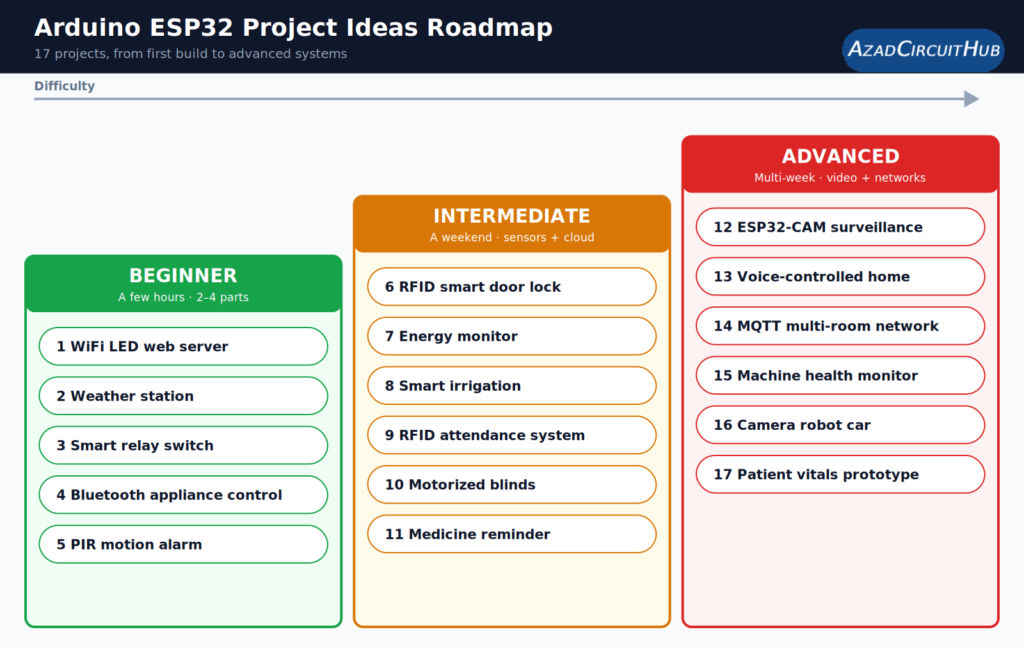
Table of Contents
Table of Contents
Why the ESP32 suits IoT projects
| Feature | Why it matters for your project |
|---|---|
| Built-in Wi-Fi (2.4 GHz) | Web servers, cloud dashboards and phone control without extra modules |
| Bluetooth (original ESP32: Classic + BLE) | Direct phone control and beacons; some newer variants are BLE only |
| Dual-core processor | Run network code and sensor or motor code at the same time |
| Many GPIOs, ADC, PWM, I2C, SPI, UART | Connect several sensors, displays and drivers at once |
| Low-power sleep modes | Battery-powered sensors that last much longer |
| Arduino IDE support | Reuse the Arduino libraries and tutorials you already know |
Pin choice matters on the ESP32, so keep our ESP32 pinout guide open while you plan any build.
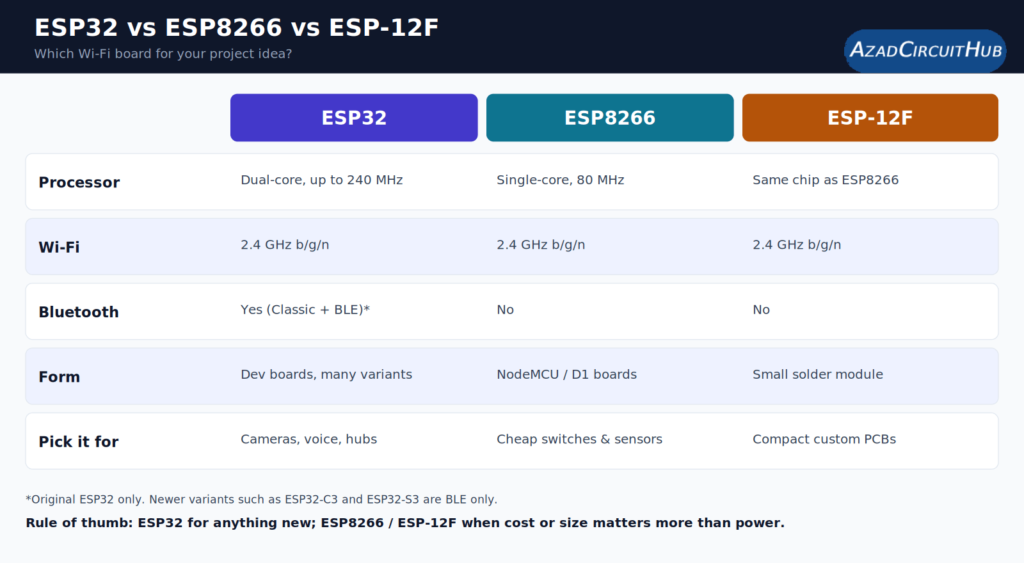
Choosing an ESP32, ESP8266 or ESP-12F for your project
Almost every project below runs on an ESP32. Simple projects such as relay switches and basic sensors also run happily on the cheaper ESP8266 or its compact ESP-12F module. For specs, pros and cons and an ESP-12F vs ESP32 comparison, read our full guide to the best WiFi modules for smart home projects, and see the ESP12F pinout if you pick the small module.
Six rules before you wire anything
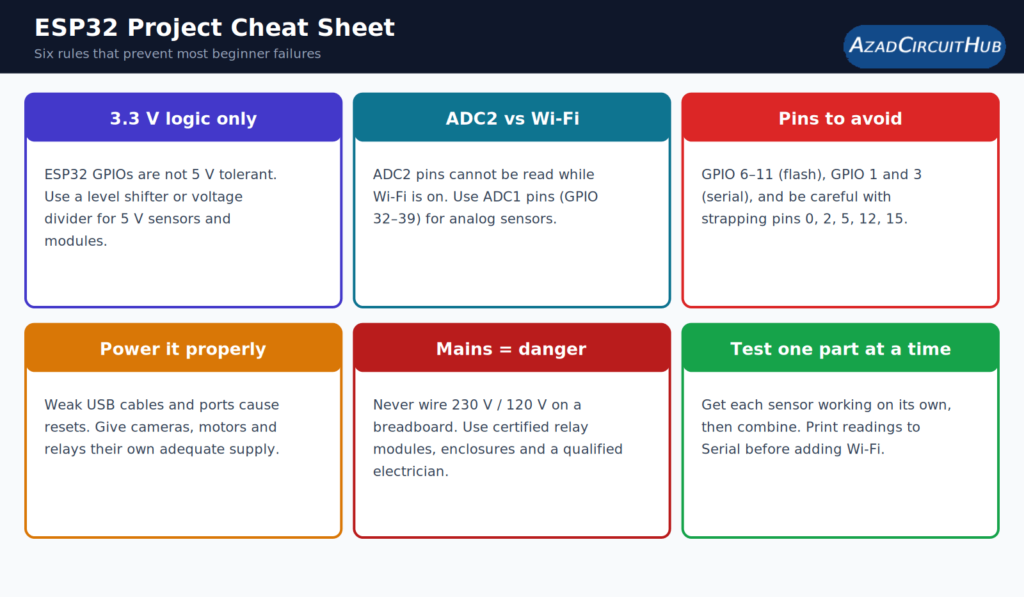
Most failed ESP32 builds come down to the same few mistakes: wrong voltage, wrong pins or a weak power supply.
- 3.3 V logic only. ESP32 GPIOs are not 5 V tolerant. Use a level shifter or voltage divider for 5 V sensors and modules.
- ADC2 vs Wi-Fi. ADC2 pins cannot be read while Wi-Fi is on. Use ADC1 pins (GPIO 32–39) for analog sensors.
- Pins to avoid. GPIO 6–11 (flash) and GPIO 1 and 3 (serial); be careful with strapping pins 0, 2, 5, 12 and 15.
- Power it properly. Weak USB cables and ports cause resets. Give cameras, motors and relays their own adequate supply.
- Mains = danger. Never wire 230 V / 120 V on a breadboard. Use certified relay modules, enclosures and a qualified electrician.
- Test one part at a time. Get each sensor working on its own, then combine. Print readings to Serial before adding Wi-Fi.
Mains safety: projects that switch lights, fans, pumps or measure line voltage can involve 120–230 V. Use certified relay modules, proper enclosures, fused supplies and, where required, a qualified electrician. If you are unsure, prototype the logic with a low-voltage LED or 5 V load first.
Beginner Arduino ESP32 project ideas
These five projects need only a few parts and teach the core skills: reading sensors, switching outputs and putting data on the network.
1. WiFi LED web server
Beginner · a few hours. Host a simple web page on the ESP32 and switch LEDs from your phone or browser. It is the classic first Wi-Fi project.
Parts: ESP32, LEDs, resistors, breadboard. Learn: web server basics, GPIO output.
2. ESP32 weather station
Beginner · half a day. Read temperature, humidity and pressure and show them on an OLED display or a cloud dashboard.
Parts: ESP32, DHT22 or BME280, optional OLED. Learn: I2C, sensor libraries, data logging.
3. Smart relay switch
Beginner · half a day. Switch a lamp or fan over Wi-Fi from an app. Follow our step-by-step guide to build a smart home relay with ESP12F; the same logic works on an ESP32.
Parts: ESP board, relay module, 5 V supply. Learn: relay switching, app control.
4. Bluetooth appliance control
Beginner · half a day. Use the ESP32’s Bluetooth to turn low-voltage loads on and off from a phone app, with no router needed.
Parts: ESP32, relay or MOSFET module. Learn: Bluetooth serial / BLE, output control.
5. PIR motion alarm
Beginner · a few hours. Detect movement with a PIR sensor, sound a buzzer and send a phone alert. A good intro to event-driven code; more variations are in the beginner ESP smart home projects list.
Parts: ESP32, PIR sensor, buzzer. Learn: interrupts, notifications.
Intermediate Arduino ESP32 project ideas
These builds add cloud services, access control, power measurement or motors.
6. RFID smart door lock
Intermediate · a weekend. Unlock a servo or solenoid lock with an RFID card or PIN and log each entry over Wi-Fi. Always keep a mechanical override so you are never locked out.
Parts: ESP32, RC522 RFID reader, servo or solenoid with its own supply. Learn: SPI, access control logic.
7. IoT energy monitor
Intermediate · a weekend. Track power use and send readings to ThingSpeak, Blynk or Home Assistant. Prefer a non-invasive current clamp over cutting into mains wiring.
Parts: ESP32, SCT-013 clamp or a certified energy meter module. Learn: ADC, calibration, dashboards.
8. Smart irrigation system
Intermediate · a weekend. Water plants automatically when soil moisture drops below a set point, and watch the soil data remotely.
Parts: ESP32, soil moisture sensor, relay, small pump. Learn: calibration, threshold control.
9. RFID attendance system
Intermediate · a weekend. Scan cards, timestamp them and store records in a cloud sheet or database. Popular for classroom and workshop projects.
Parts: ESP32, RFID reader, display, buzzer. Learn: NTP time, HTTP requests, databases.
10. Motorized blinds or curtains
Intermediate · a weekend. Open and close blinds with a stepper motor on a schedule or from your phone. You will need a stepper driver, so follow our A4988 stepper motor driver with ESP32 guide.
Parts: ESP32, A4988, NEMA 17, 12 V supply. Learn: stepper control, limit switches.
11. Medicine reminder
Intermediate · a weekend. Sound an alarm and show instructions at set times, and push a phone alert if a dose is missed.
Parts: ESP32, RTC or NTP, LCD, buzzer. Learn: scheduling, notifications.
Advanced Arduino ESP32 project ideas
These projects combine video, voice, networking or sensor analysis and are good portfolio pieces.
12. ESP32-CAM surveillance
Advanced · multi-day. Stream video and capture images on motion. The common AI-Thinker ESP32-CAM has no USB port, so you need a USB-to-serial adapter to flash it, and it needs a stable 5 V supply.
Parts: ESP32-CAM, USB-serial adapter, PIR sensor. Learn: streaming, image handling.
13. Voice-controlled home
Advanced · multi-day. Control lights and appliances with Alexa or Google Assistant using a service such as Home Assistant or Sinric Pro.
Parts: ESP32, relays, a voice assistant. Learn: cloud APIs, MQTT, device naming.
14. MQTT multi-room hub
Advanced · multi-week. Link many ESP nodes with MQTT or ESP-NOW and manage them from Home Assistant or Node-RED. See the WiFi module for smart home comparison when choosing nodes.
Parts: several ESP boards, MQTT broker. Learn: networking, scalable design.
15. Machine health monitor
Advanced · multi-week. Log vibration and temperature from a motor or pump to spot early faults. Treat it as a prototype, not a safety system. Related ideas: Arduino project ideas for electrical engineering.
Parts: ESP32, MPU6050 or ADXL345, temperature sensor. Learn: sampling, thresholds, trends.
16. Camera robot car
Advanced · multi-week. Drive a Wi-Fi robot from your browser while watching a live camera feed, then add obstacle avoidance.
Parts: ESP32-CAM, motor driver, DC motors, ultrasonic sensor. Learn: motor control, video streaming.
17. Patient vitals prototype
Advanced · multi-week. Read pulse and temperature and send them to a dashboard. This is an educational prototype only: hobby sensors such as the MAX30100 are not medical-grade and must not be used for diagnosis.
Parts: ESP32, MAX30100 or similar, temperature sensor. Learn: signal filtering, data privacy.
Quick comparison of all 17 projects
| # | Project | Level | Key parts | Best board |
|---|---|---|---|---|
| 1 | WiFi LED web server | Beginner | LEDs | Any ESP |
| 2 | Weather station | Beginner | DHT22 / BME280 | Any ESP |
| 3 | Smart relay switch | Beginner | Relay module | ESP8266 / ESP-12F / ESP32 |
| 4 | Bluetooth appliance control | Beginner | Relay / MOSFET | ESP32 |
| 5 | PIR motion alarm | Beginner | PIR, buzzer | Any ESP |
| 6 | RFID smart door lock | Intermediate | RC522, servo | ESP32 |
| 7 | Energy monitor | Intermediate | Current clamp | ESP32 |
| 8 | Smart irrigation | Intermediate | Soil sensor, pump | ESP32 |
| 9 | RFID attendance | Intermediate | RFID, display | ESP32 |
| 10 | Motorized blinds | Intermediate | A4988, NEMA 17 | ESP32 |
| 11 | Medicine reminder | Intermediate | LCD, buzzer | Any ESP |
| 12 | ESP32-CAM surveillance | Advanced | ESP32-CAM | ESP32-CAM |
| 13 | Voice-controlled home | Advanced | Relays, assistant | ESP32 |
| 14 | MQTT multi-room hub | Advanced | Several nodes | ESP32 + ESP8266 |
| 15 | Machine health monitor | Advanced | Vibration sensor | ESP32 |
| 16 | Camera robot car | Advanced | Motor driver, camera | ESP32-CAM |
| 17 | Patient vitals prototype | Advanced | MAX30100 | ESP32 |

- All-in-One ESP32 Starter Kit for Every Level: Explore 100+ hands-on projects, from basic electronics to advanced IoT app…
- Rich Applications and Engaging Projects: Unlock a world of possibilities with the SunFounder ESP32 Kit. From basic exper…
Software and cloud tools for ESP32 projects
| Tool | Use it for |
|---|---|
| Arduino IDE | Writing and uploading code (see the ESP32 Arduino IDE setup guide) |
| PlatformIO | Larger projects with library and board management |
| Blynk | Quick mobile dashboards |
| ThingSpeak | Sensor data logging and charts |
| MQTT broker (e.g. Mosquitto) | Messaging between many devices |
| Home Assistant / ESPHome | Smart home integration and voice assistants |
| Firebase | Cloud database for apps and attendance records |
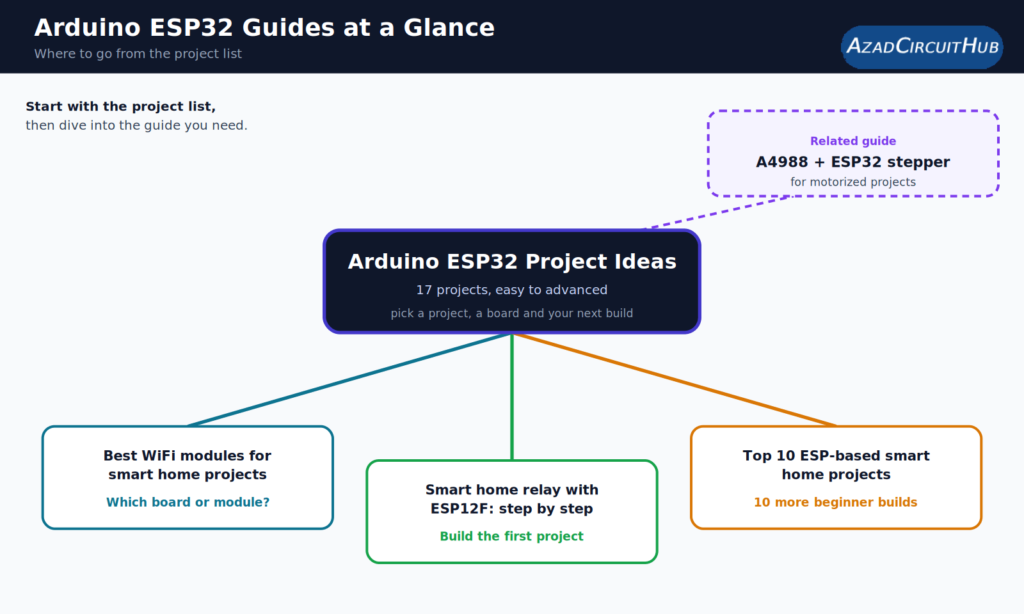
Where to go next
Pick one beginner build, finish it, then move one step up. If you are building for coursework, our lists of Arduino project ideas for final-year students and Arduino Uno R3 project ideas add more options for non-WiFi boards.
- Best WiFi Modules for Smart Home Projects: ESP8266, ESP32 and ESP-12F compared, with specs and picks.
- Smart Home Relay with ESP12F: a complete step-by-step relay build.
- Top 10 ESP-Based Smart Home Projects: ten more beginner smart home builds.
- A4988 Stepper Driver with ESP32: motor control for blinds, sliders and robots.
Arduino ESP32 project ideas FAQ
What are good Arduino ESP32 project ideas for beginners?
Start with a WiFi LED web server, a weather station, a smart relay switch, a Bluetooth appliance controller or a PIR motion alarm. Each uses only a few parts and teaches one core skill.
Can I program an ESP32 with the Arduino IDE?
Yes. Install the Espressif ESP32 board package in the Arduino IDE and you can use familiar setup() and loop() code, plus most Arduino libraries.
ESP32 or ESP8266 for a smart home project?
Use an ESP32 for cameras, Bluetooth, voice control and anything needing more power. Use an ESP8266 or ESP-12F for simple switches and sensors where low cost or small size matters. The WiFi modules comparison covers the trade-offs in detail.
Is it safe to control mains appliances with an ESP32?
Only with proper precautions: a certified relay module, an insulated enclosure, correct fusing and, where required, a qualified electrician. Do not wire mains voltage on a breadboard.
Which ESP32 pins should I avoid?
Avoid GPIO 6–11 (connected to flash), GPIO 1 and 3 (serial), input-only pins 34–39 for outputs, and take care with strapping pins 0, 2, 5, 12 and 15. Our ESP32 pinout guide has the full map.
Do I need a cloud service for ESP32 projects?
No. Many projects run entirely on your local network using the ESP32’s own web server or a local MQTT broker. Cloud platforms such as Blynk or ThingSpeak add remote access and charts.
Get new guides in your feed. Follow Electrical Insights on LinkedIn for new electrical standards guides, calculators and design tips from Azad Circuit Hub.
