NEC Article for Grounding and Bonding: Article 250 Explained (2026)
The NEC article for grounding and bonding is Article 250 of NFPA 70, the National Electrical Code. Whether you want the NEC article for grounding and bonding as a PDF, a quizlet-style study set, or a quick table, this guide gives you the answer first and the detail after. I have worked in power systems, protection and industrial automation for over 15 years, and Article 250 is the part of the code I see misread most often on site.
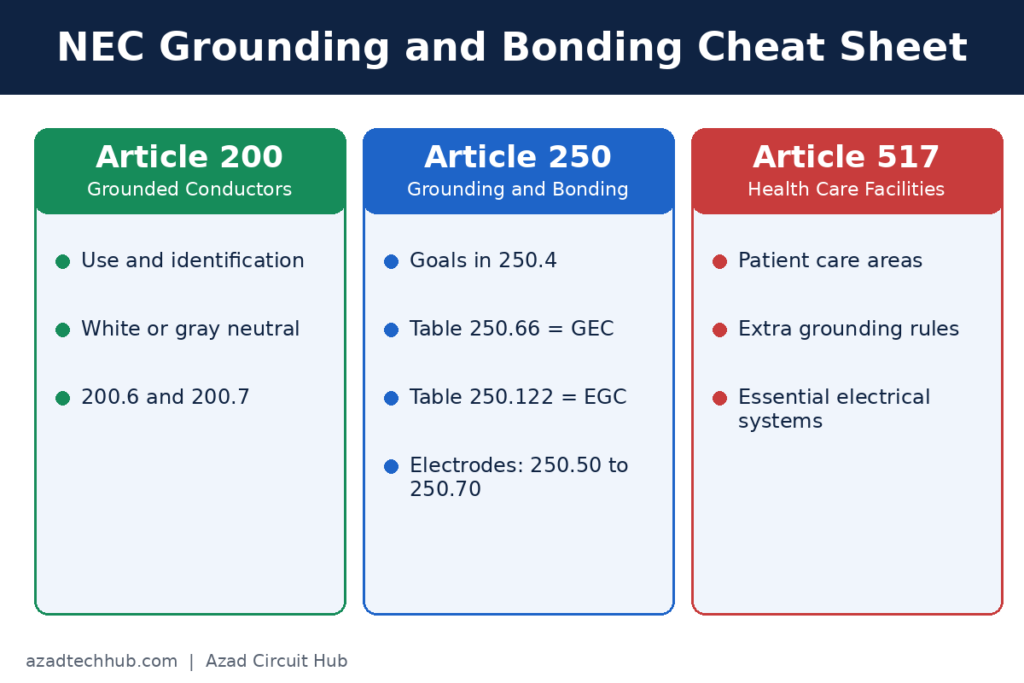
Quick answer: The NEC article for grounding and bonding is Article 250. Section 250.4 sets the performance goals, Table 250.66 sizes the grounding electrode conductor, and Table 250.122 sizes the equipment grounding conductor. Article 200 covers grounded conductor identification, and Article 517 covers health care facilities.
Grounding conductors also take up space inside a raceway. Once you size them, check the fit with our conduit fill calculator, because the NEC counts the ground wire in the fill.
Contents: what the NEC article for grounding and bonding covers, NEC 250.4 and the 10 parts, NEC 250 grounding table, ground rods, Articles 200 and 517, PDF and quizlet, FAQ.
Table of Contents : what the NEC article for grounding and bonding covers, NEC 250.4 and the 10 parts, NEC 250 grounding table, ground rods, Articles 200 and 517, PDF and quizlet, FAQ.
Table of Contents
What Is the NEC Article for Grounding and Bonding?
Article 250 is the NEC article for grounding and bonding. Its title is “Grounding and Bonding,” and it sets the minimum rules for connecting an electrical system to earth and for connecting metal parts together so fault current can flow safely.
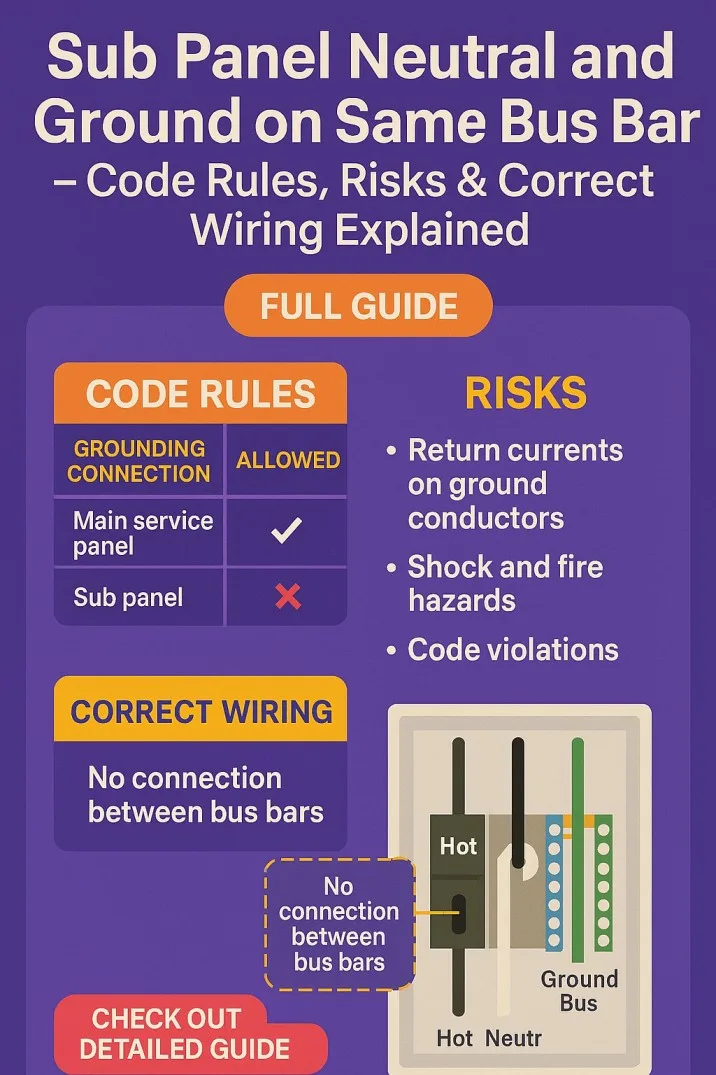
Think of it as two jobs. Grounding connects the system to the earth. Bonding connects metal parts to each other. Both exist so a fault trips the breaker quickly instead of leaving metal enclosures energized. The NEC article for grounding and bonding is therefore a safety article first and a wiring article second.
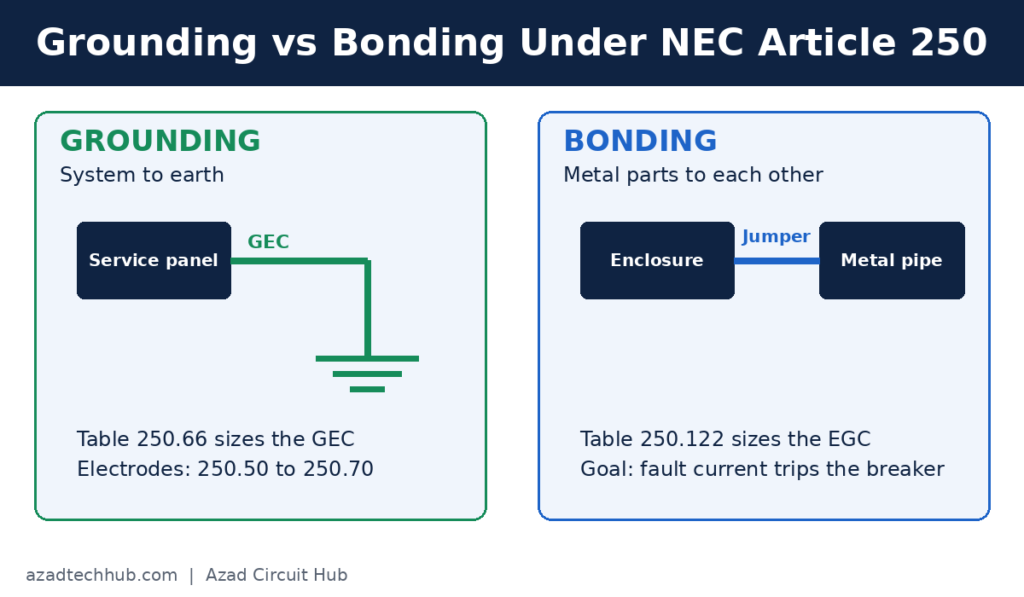
Article 250 is also linked to many others. Table 250.3 lists additional articles with their own grounding and bonding rules, so always check the article for the specific equipment or location you are working on.
NEC 250.4: What Does It Cover?
Section 250.4 is the performance section of the NEC article for grounding and bonding. Instead of telling you how to install something, it tells you what the finished system must achieve. It is split into grounded systems, 250.4(A), and ungrounded systems, 250.4(B).
For grounded systems, 250.4(A) covers:
- Electrical system grounding, to limit voltage from lightning, line surges and contact with higher-voltage lines.
- Equipment grounding, to keep non-current-carrying metal parts at earth potential.
- Bonding of electrical equipment, to create a low-impedance path.
- Bonding of electrically conductive materials, such as metal piping.
- An effective ground-fault current path, so an overcurrent device opens fast.
The rest of Article 250 explains how to meet those five goals. When an inspector questions your design, 250.4 is usually the section that settles the argument.
The 10 Parts of the NEC Article for Grounding and Bonding
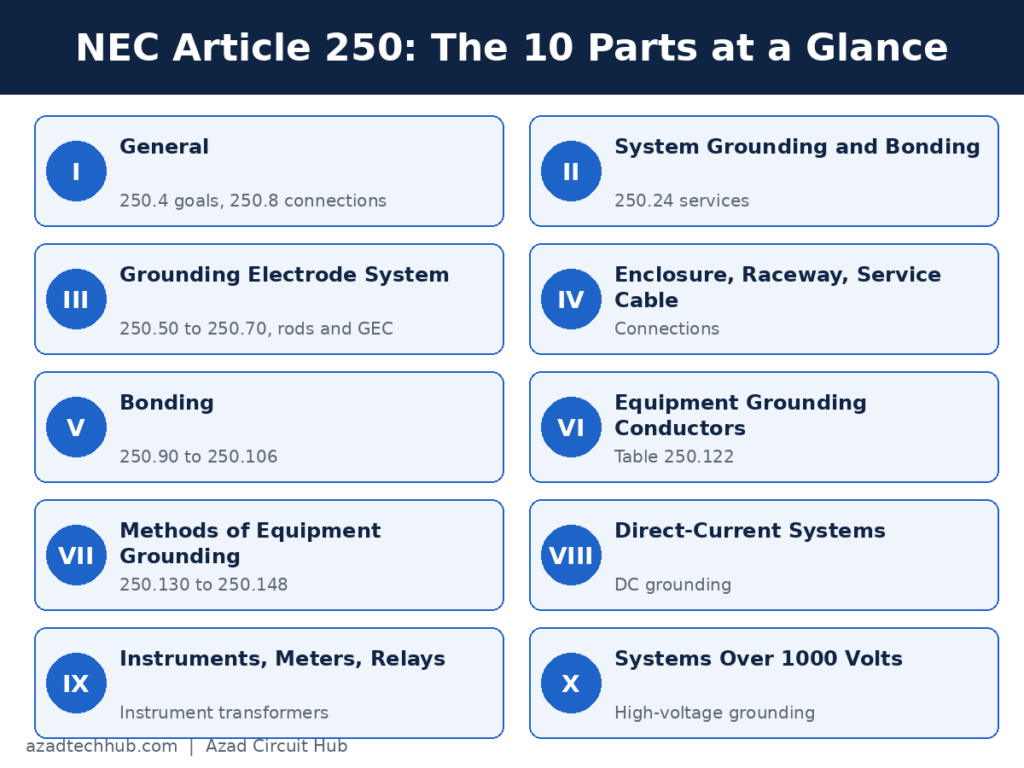
Article 250 is divided into ten parts, each marked with a Roman numeral. Part numbering and titles can shift slightly between code editions, so confirm against the edition your jurisdiction has adopted.
| Part | Topic | Key sections |
|---|---|---|
| I | General | 250.1 to 250.12, including 250.4 and 250.8 |
| II | System grounding and bonding | 250.20 to 250.36, including 250.24 for services |
| III | Grounding electrode system and conductor | 250.50 to 250.70 |
| IV | Enclosure, raceway and service cable connections | 250.80 to 250.86 |
| V | Bonding | 250.90 to 250.106 |
| VI | Equipment grounding and conductors | 250.110 to 250.126 |
| VII | Methods of equipment grounding | 250.130 to 250.148 |
| VIII | Direct-current systems | DC grounding rules |
| IX | Instruments, meters and relays | Grounding of instrument transformers |
| X | Systems over 1000 volts | High-voltage grounding |
The infographic below maps the same ten parts so you can use it as a quick reference.
NEC 250 Grounding Table: Sizing Conductors
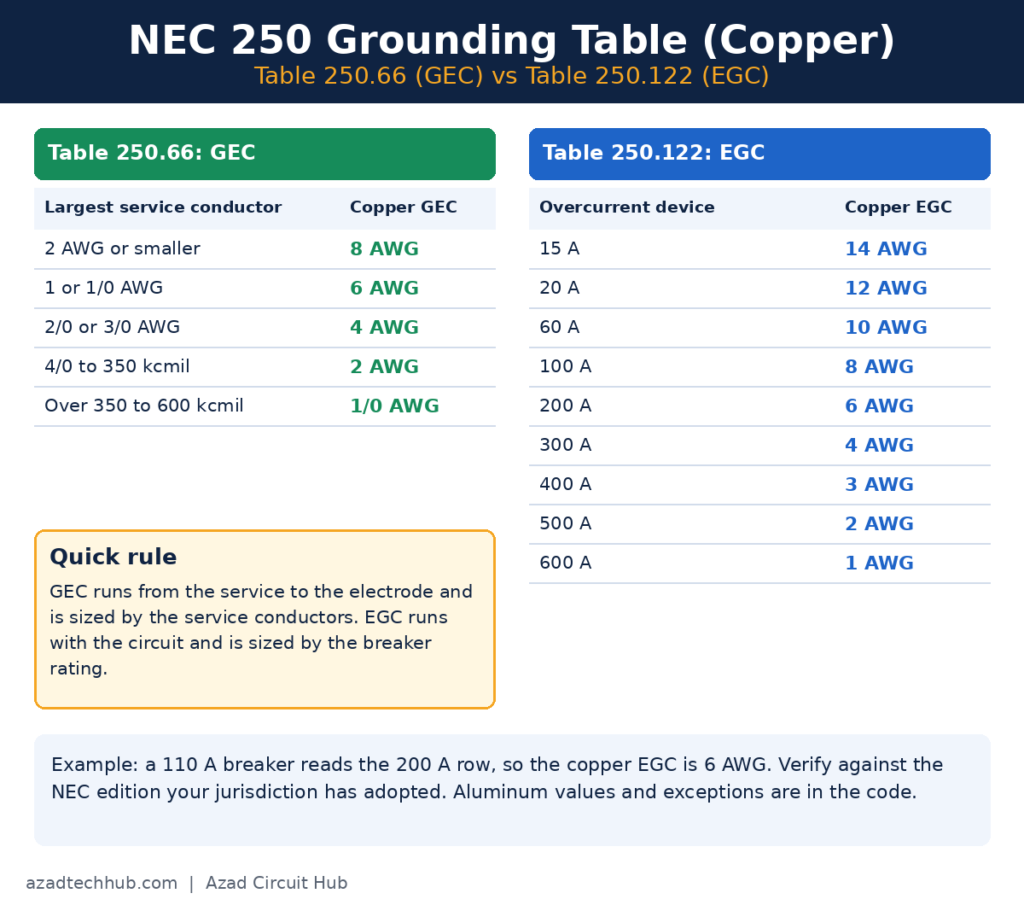
Most people searching for an NEC 250 grounding table want one of two tables, and they are easy to confuse. Table 250.66 sizes the grounding electrode conductor (GEC), which runs from the service to the electrode. Table 250.122 sizes the equipment grounding conductor (EGC), which runs with the circuit.
Table 250.66 (copper GEC, based on the largest ungrounded service conductor):
| Largest ungrounded service conductor (copper) | Copper GEC |
|---|---|
| 2 AWG or smaller | 8 AWG |
| 1 AWG or 1/0 AWG | 6 AWG |
| 2/0 AWG or 3/0 AWG | 4 AWG |
| 4/0 AWG to 350 kcmil | 2 AWG |
| Over 350 kcmil to 600 kcmil | 1/0 AWG |
Table 250.122 (copper EGC, based on the overcurrent device rating):
| Overcurrent device (amps) | Copper EGC |
|---|---|
| 15 | 14 AWG |
| 20 | 12 AWG |
| 60 | 10 AWG |
| 100 | 8 AWG |
| 200 | 6 AWG |
| 300 | 4 AWG |
| 400 | 3 AWG |
| 500 | 2 AWG |
| 600 | 1 AWG |
Read Table 250.122 by the breaker rating, not the wire size. A 110 amp device falls into the 200 amp row, so it needs a 6 AWG copper EGC. Aluminum columns, the full tables and exceptions are in the code, so verify before you build.
For worked examples, read our guides on the NEC 250.66 table for grounding electrode conductor size and grounding cable size as per NEC. If you work to international rules, compare with earthing cable size as per IEC.
Do not forget conduit fill
The EGC is a conductor like any other, so it counts toward raceway fill. If you upsize it for voltage drop under 250.122(B), it takes even more room. After you pick the conductor, confirm the conduit with the conduit fill calculator, and see the NEC Chapter 9 Table 1 conduit fill percentages for the 53%, 31% and 40% limits. For large boxes on the same run, our guide to NEC 314.28 pull box sizing is the next check. For the phase conductors themselves, use the AC cable size calculator.
Grounding Electrodes and Ground Rods
Part III of the NEC article for grounding and bonding covers the grounding electrode system. Section 250.50 requires all electrodes present at the building to be bonded together, such as a concrete-encased electrode, a ground ring or a metal water pipe. Where none exist, you drive made electrodes such as ground rods under 250.52 and 250.53.
Key rod rules from recent editions, which you should confirm for your edition:
- A rod must have at least 8 feet in contact with the soil.
- Multiple rods are spaced at least 6 feet apart.
- A single rod that does not measure 25 ohms or less to earth needs a supplemental electrode.
- The GEC to a rod is not required to be larger than 6 AWG copper, and to a concrete-encased electrode not larger than 4 AWG copper.
A listed 5/8 inch by 8 foot copper-bonded ground rod with an acorn clamp is the standard starter kit.
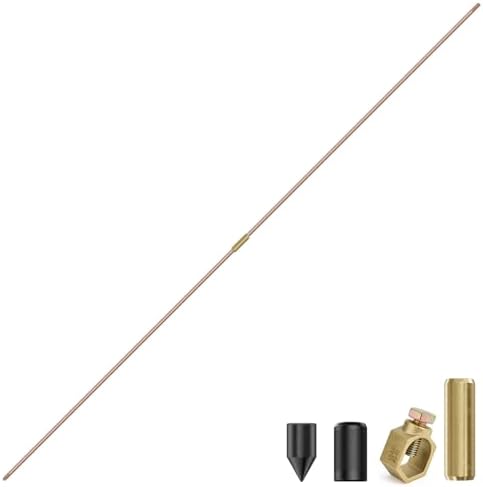
- 【Reliable Materials for Long-term Outdoor Use】The grounding rod is made of copper-clad steel, which enhances strength an…
- 【Standard Size for Broad Compatibility】After connection it can reach up to 8 feet in length,5/8 inches in diameter, flex…
If you need to prove the 25 ohm figure, a ground resistance tester removes the guesswork.
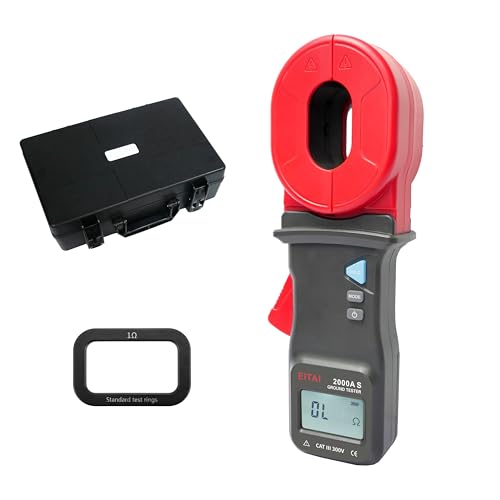
- With English customer service and technical support, we offer a smooth and secure user experience.
- 【Precision Measurement for Critical Systems】0.01Ω–500Ω Extended Range with 0.001Ω Resolution, engineered for critica…
Which Other NEC Articles Matter? Articles 200, 250 and 517
Grounding is spread across several articles, which is why people ask which one to read. The short version:
- Article 200 covers the use and identification of grounded conductors, which in practice means the white or gray neutral.
- Article 250 is the NEC article for grounding and bonding itself.
- Article 517 covers health care facilities and adds extra grounding rules for patient care areas.
Canadian readers should note the Canadian Code is not the same document. See Canadian Electrical Code vs NEC differences before you mix the two.
NEC Article for Grounding and Bonding PDF and Free Download
Many searches ask for the NEC article for grounding and bonding PDF or a free download. The NEC is copyrighted by NFPA, so I will not host the text here. The legal free route is read-only online access, which you can reach from the NFPA 70 page.
Free read-only access is fine for a quick look, but searching and highlighting are easier in a printed book.
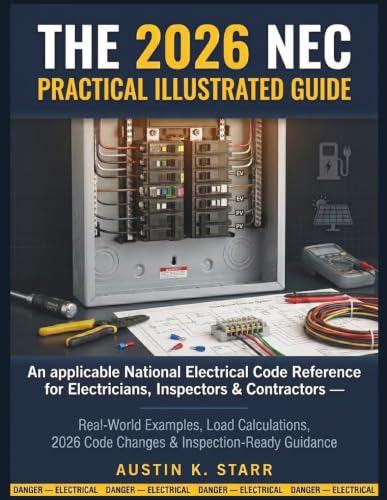
Tabs and a highlighter make Article 250 far quicker to navigate during an exam or an inspection.
For a visual cheat sheet, download the image below and save it to your phone.
NEC Article for Grounding and Bonding Quizlet: Practice Questions
If you are studying with a quizlet deck, test yourself with these original questions first. Answers are below each question.
- Which article is the NEC article for grounding and bonding? Article 250.
- Which table sizes the equipment grounding conductor? Table 250.122.
- Which table sizes the grounding electrode conductor? Table 250.66.
- Which section lists the performance goals? Section 250.4.
- What does Article 200 cover? Identification and use of grounded conductors.
- What does Article 517 cover? Health care facilities.
Tools for Grounding and Bonding Work
Clean terminations are part of a compliant ground. A good pair of strippers avoids nicked conductors, so see our picks of the best wire strippers for electricians. A plug-in receptacle tester is a cheap way to catch an open ground.
If you install EV chargers, the equipment ground matters even more. Size the circuit with our EV charger cable size calculator and compare models in our guide to the best Level 2 EV charger.
Common Grounding and Bonding Mistakes
- Using the GEC table for the EGC, or the reverse.
- Reading Table 250.122 by wire size instead of breaker rating.
- Forgetting to count the ground wire in conduit fill.
- Reconnecting the neutral to ground on the load side of the service disconnect.
- Skipping the supplemental electrode when the rod is unmeasured.
- Assuming an older code edition still applies to a new permit.
Frequently Asked Questions
What is NEC Article 250 grounding and bonding?
NEC Article 250 is the article that sets the minimum requirements for grounding and bonding electrical systems and equipment. It covers system grounding, electrodes, bonding of metal parts, and the path fault current must take.
What is the NEC code for grounding?
The NEC code for grounding is Article 250. Section 250.4 gives the goals, Part III covers electrodes, and Tables 250.66 and 250.122 size the conductors.
Which NEC article is for grounding and bonding?
Article 250. This is the NEC article for grounding and bonding, and Table 250.3 points to other articles with extra requirements.
What does NEC 250.4 cover?
Section 250.4 covers the general requirements: system grounding, equipment grounding and bonding, bonding of conductive materials, and an effective ground-fault current path, for both grounded and ungrounded systems.
What does NEC Article 200 cover?
Article 200 covers the use and identification of grounded conductors, such as white or gray insulation for the neutral.
What does NEC Article 517 cover?
Article 517 covers health care facilities, including grounding of patient care areas and essential electrical systems.
Is there an NEC article for grounding and bonding PDF I can download for free?
The NFPA offers free read-only online access, but a free printable PDF of the code is not available from this site because the NEC is copyrighted.
Conclusion
The NEC article for grounding and bonding is Article 250, and it rewards a methodical read: start with 250.4, learn the ten parts, and use Tables 250.66 and 250.122 for sizing. Bookmark this page, check your adopted edition, and use the conduit fill calculator before you pull the conductors. For more code guides, browse our Electrical Standards section.
Disclaimer: This guide is educational and does not replace the NEC or a licensed electrician. Always verify against the edition your local authority has adopted. Some links above are affiliate links. We may earn a commission at no extra cost to you, as explained on our affiliate disclosure page.
Get new guides in your feed. Follow Electrical Insights on LinkedIn for new electrical standards guides, calculators and design tips from Azad Circuit Hub.