Home Backup Power Guide: Generators & Monitoring (USA)
Home Backup Power helps homeowners maintain essential electrical services during storms, grid failures, equipment faults, and utility outages. In the United States, the right backup system depends on the home’s electrical load, service voltage, fuel supply, transfer equipment, battery capacity, and expected outage duration.
A reliable system does more than keep the lights on. It protects refrigerators, sump pumps, communication equipment, heating controls, medical devices, and other critical loads. Engineers and electrical consultants must also consider grounding, overcurrent protection, voltage quality, transfer switching, and compliance with the National Electrical Code (NEC).
This guide explains how to assess household loads, select generators and battery systems, install monitoring equipment, and verify performance using practical engineering methods.
Home Backup Power: Generator and Battery Comparison
The following table compares common backup options for American homes.
| Backup System | Typical Capacity | Best Application | Main Limitation |
|---|---|---|---|
| Portable gasoline generator | 3–10 kW | Essential household circuits | Fuel storage and manual operation |
| Portable dual-fuel generator | 5–12 kW | Flexible emergency backup | Fuel availability and maintenance |
| Standby natural gas generator | 10–26 kW or more | Automatic whole-home or partial-home backup | Installation cost and gas supply |
| Portable power station | 0.3–3 kWh | Routers, phones, lights, small electronics | Limited stored energy |
| Home battery system | 5–20 kWh per unit, depending on model | Quiet backup and selected household loads | Cost and finite stored energy |
| Solar-plus-battery system | Depends on array and battery | Longer outages with suitable sunlight, Know more about which charge controller type suits your battery bank | Weather, inverter, and battery constraints |
| UPS system | Hundreds of VA to several kVA | Computers, networking, and control electronics | Usually limited runtime |
For solar-plus-battery systems, the choice between MPPT and PWM charge controllers affects how efficiently panel output reaches the battery. You can compare specific models in our guide to the best MPPT and PWM solar charge controllers.
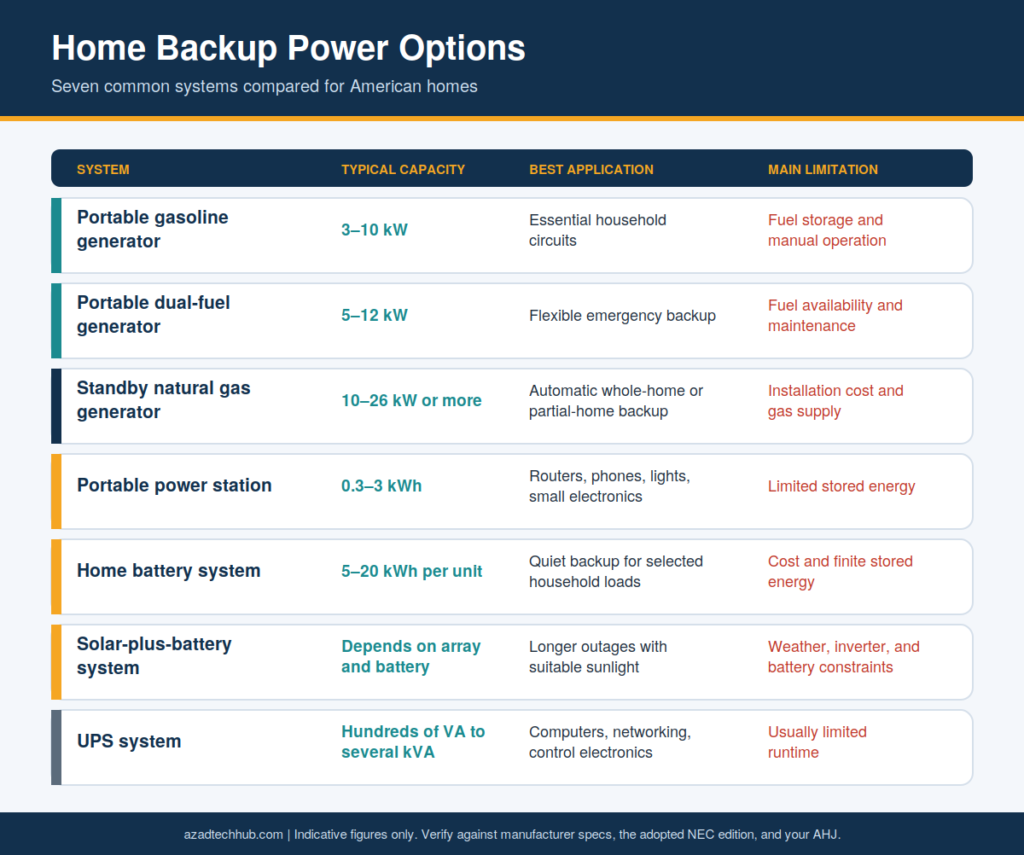
These figures are indicative ranges, not guaranteed ratings for every product. Generator output, battery usable capacity, starting current, and inverter capability must be checked against the manufacturer’s specifications.
How to Assess Household Loads Before Choosing a System
The first step in designing Home Backup Power is to prepare a load schedule. Do not select a generator based only on the home’s square footage or the rating of its main breaker.
List the equipment that must remain operational during an outage. Separate essential loads from optional loads, then record each device’s running watts, starting watts, voltage, and operating schedule.
| Household Equipment | Typical Running Power | Starting or Peak Consideration |
|---|---|---|
| Refrigerator | 100–300 W | Compressor starting surge |
| LED lighting | 5–15 W per lamp | Usually low |
| Wi-Fi router and modem | 10–30 W combined | Usually low |
| Desktop computer | 150–500 W | Depends on components |
| Sump pump | 500–1,500 W | Motor starting current |
| Window air conditioner | 500–1,500 W | Compressor starting surge |
| Furnace blower | 300–800 W | Motor starting current |
| Electric water heater | 3,000–5,500 W | High continuous demand |
| Electric clothes dryer | 4,000–6,000 W | High continuous demand |
| Central air conditioner | Model-dependent | Compressor starting demand can be substantial |
Actual values vary widely. Use nameplate ratings, manufacturer data, or measured consumption instead of treating these figures as design values.
Calculate the Required Generator Capacity
For a simple preliminary estimate, add the running power of loads expected to operate at the same time.
Formula:
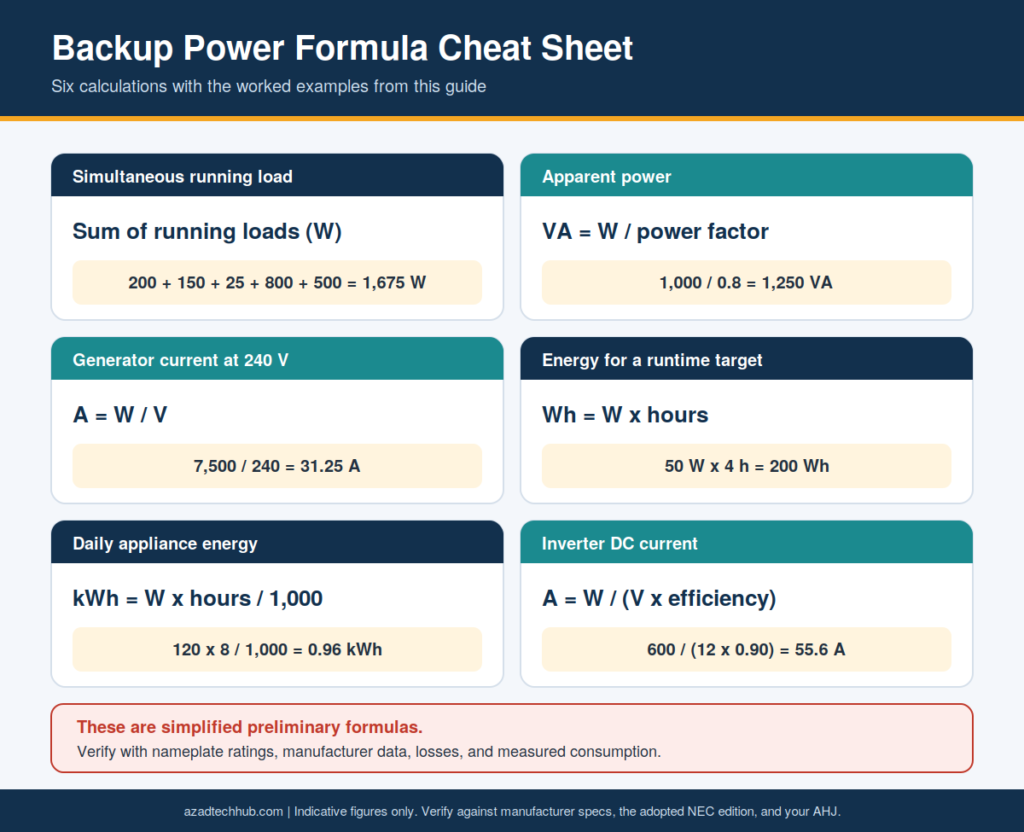
Required running power (W) = Sum of simultaneous running loads (W)
For example, assume the essential loads are:
| Load | Running Power |
|---|---|
| Refrigerator | 200 W |
| Lighting | 150 W |
| Router and modem | 25 W |
| Sump pump | 800 W |
| Furnace blower | 500 W |
| Total | 1,675 W |
If the sump pump has a starting demand of 2,000 W above its running requirement, a simplified conservative estimate is:
Required capacity = 1,675 W + 2,000 W = 3,675 W
A generator with adequate continuous output above this figure may be suitable, provided its surge rating, motor-starting capability, voltage regulation, and other simultaneous starting loads are also checked. Manufacturer starting-power guidance takes priority over this simplified calculation.
For larger homes, evaluate the load schedule at the actual operating voltage and power factor. Resistive loads are often close to unity power factor, but motors, compressors, and electronic equipment may draw more apparent power than their wattage alone suggests.
Formula:
Apparent power (VA) = Real power (W) / Power factor
For a 1,000 W load at a power factor of 0.8:
Apparent power = 1,000 / 0.8 = 1,250 VA
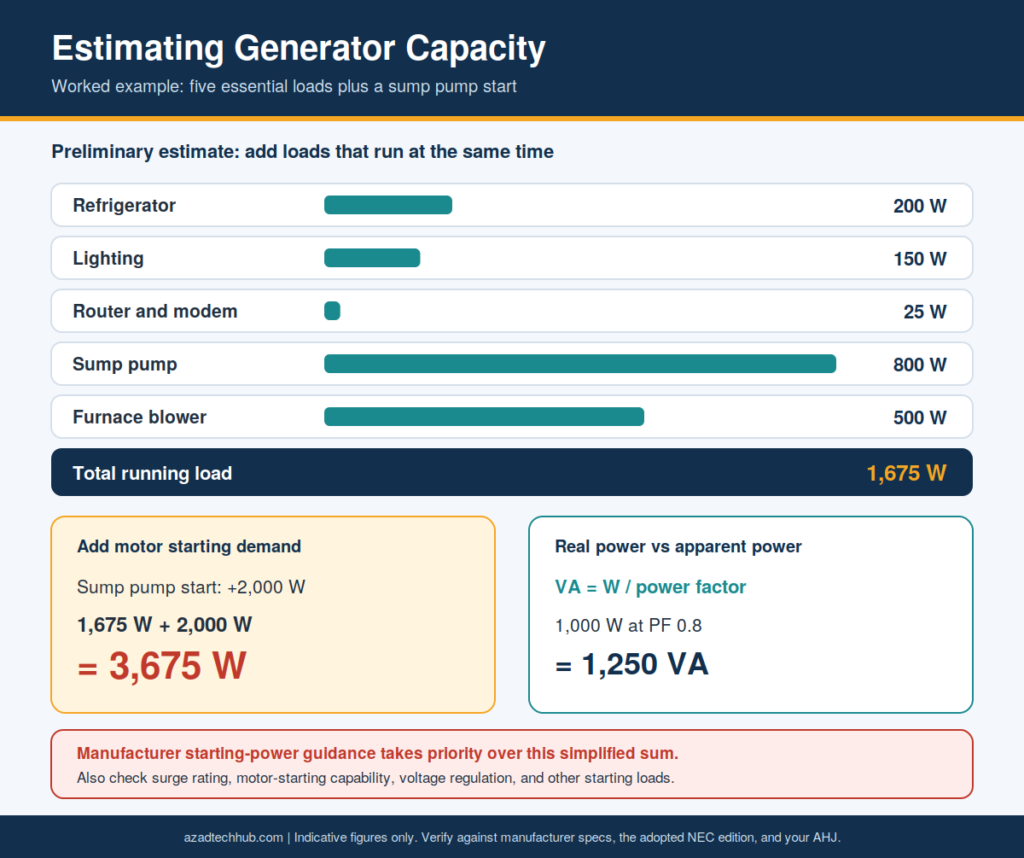
This distinction matters when selecting generators, inverters, and UPS systems.
Safe Grounding and Bonding for Portable Generator Installations
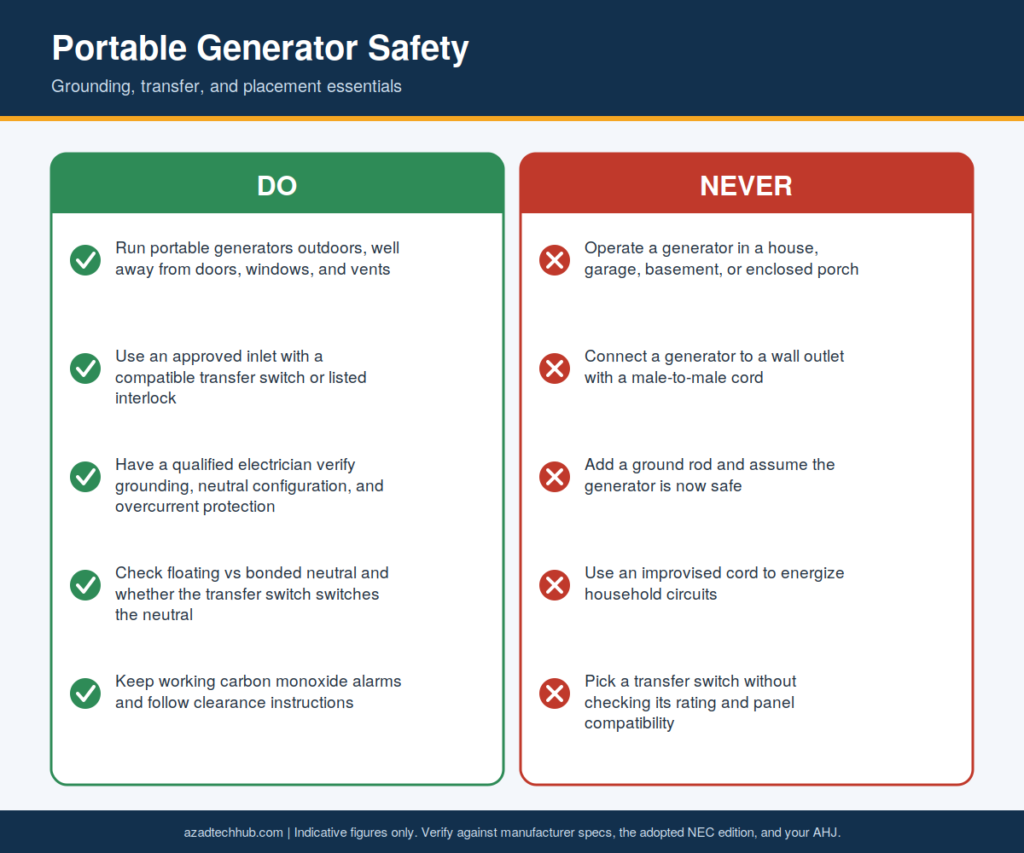
Grounding is a critical part of Home Backup Power safety. A portable generator must be connected and operated according to its listing, manufacturer’s instructions, the transfer arrangement, and applicable NEC requirements.
First, identify whether the generator has a floating or bonded neutral. Next, determine whether the transfer switch switches the neutral conductor. These details affect whether the generator is treated as a separately derived system and how neutral-to-ground bonding must be arranged.
A qualified electrician should verify the equipment grounding conductor, grounding and bonding provisions, neutral configuration, and overcurrent protection. Do not add a ground rod and assume this makes a generator safe. A ground rod alone does not replace the required equipment grounding path. For a refresher on grounding electrodes, bonding, and equipment grounding conductors in a home, see our home electrical wiring guide.
Portable generators must always operate outdoors, well away from doors, windows, vents, and other openings. Never operate one in a house, garage, basement, or enclosed porch. Follow the manufacturer’s clearance instructions and use working carbon monoxide alarms.
Selecting Transfer Equipment for a 7,500-Watt Generator
A transfer switch safely separates the home from utility power while allowing selected circuits to operate from a generator. It prevents dangerous backfeeding into utility lines and helps protect utility workers and equipment.
For a generator rated at 7,500 W, check the rated output voltage and current before selecting transfer equipment.
At 240 V, a simplified calculation for a balanced, unity-power-factor load is:
Current (A) = Power (W) / Voltage (V)
Current = 7,500 / 240 = 31.25 A
This does not mean every 7,500 W generator can supply 31.25 A on every output. Many portable generators provide both 120 V and 240 V output, with limits on individual receptacles and winding capacity. Verify the nameplate ratings and load balance.
A transfer switch or listed interlock arrangement must be compatible with the panel, generator, feeder conductors, neutral configuration, and overcurrent protection. The switch must be properly rated for the intended load and installation. Feeder sizing, subpanels, and neutral isolation are covered in our residential wiring guide.
Never connect a generator to a household receptacle using a male-to-male cord. This creates an electrocution and fire hazard.
Estimating Backup Capacity for a 2,000-Square-Foot Home
Home size can provide a rough starting point, but square footage does not determine electrical demand. Two homes of the same size may have very different loads because of electric heating, central air conditioning, electric cooking, water heating, and vehicle charging.
For a 2,000-square-foot home, begin by identifying whether the goal is essential-circuit backup, partial-home backup, or whole-home operation.
| Backup Strategy | Main Loads | Design Approach |
|---|---|---|
| Essential circuits | Refrigerator, lights, router, selected outlets | Load schedule and starting watts |
| Partial-home backup | Essential loads plus selected HVAC or kitchen equipment | Load calculation and load management |
| Whole-home backup | Most or all household circuits | Service and dwelling load assessment |
| Battery-supported critical loads | Electronics, lighting, refrigeration, selected pumps | Usable kWh, inverter output, and runtime |
A generator in the 5–10 kW range may suit some essential-load plans, while larger systems may be needed for homes with substantial HVAC or electric heating demand. These are planning ranges, not recommendations based on square footage alone.
An electrical consultant should review the service rating, existing panel, largest motor loads, starting sequence, and expected simultaneous demand before finalizing the system.
Choosing a Portable Power Station for Outages on a $500 Budget
Portable power stations provide battery storage and inverter output in a compact unit. They are useful for networking equipment, phones, LED lighting, laptops, and some small appliances. However, a low purchase price often means limited stored energy or output.
Compare both watt-hours and watts. Watt-hours describe stored energy, while watts describe the power the unit can supply at a given moment.
For example, a 500 Wh battery does not necessarily provide 500 Wh to connected AC equipment because inverter losses and operating limits reduce usable energy.
Check these specifications before purchasing:
- Usable battery capacity in Wh.
- Continuous AC output and short-term surge rating.
- Pure sine wave output for sensitive electronics.
- Battery chemistry and expected cycle life.
- Recharge time from AC or solar.
- Output voltage and frequency.
- Manufacturer warranty and safety certifications.
If you plan to recharge a LiFePO4 battery from solar panels, choose a controller designed for it. Our guide to the best solar charge controllers for LiFePO4 batteries explains what to look for.
For a $500 budget, prioritize essential loads rather than trying to operate refrigerators, heaters, or pumps without confirming their starting requirements. Prices and available capacity change, so compare current product specifications before buying. For budget solar recharging, see the best MPPT solar charge controllers under $100.
Sizing a UPS for Home Networking Equipment
A UPS keeps routers, modems, switches, and access points operating during short outages. It can also provide time for a safe shutdown of servers, network-attached storage, and computers.
Begin by adding the actual power draw of each device. Do not use the total wattage printed on every power adapter as the only measure of consumption; where possible, measure the equipment under normal operating conditions.
For example:
| Device | Measured Load |
|---|---|
| Modem | 10 W |
| Router | 12 W |
| Network switch | 20 W |
| Small access point | 8 W |
| Total | 50 W |
If the target runtime is four hours, the theoretical energy requirement is:
Energy (Wh) = Power (W) × Time (h)
Energy = 50 × 4 = 200 Wh
The UPS battery must provide more than 200 Wh of nominal energy because of conversion losses, battery discharge limits, aging, and load-dependent performance. Select the UPS using its published runtime curve at the expected load, not its VA rating alone.
Also check output waveform, surge protection, replaceable battery availability, USB or network monitoring, and automatic shutdown support.
Calculating Battery Runtime for a Sump Pump
Sump pumps are important in homes exposed to basement flooding. Their backup systems must account for motor startup, run time, water inflow, and the possibility of repeated cycling.
A practical first estimate is:
Battery runtime (hours) = Usable battery energy (Wh) / Average load (W)
For example, assume a backup battery provides 1,000 Wh of usable energy and a sump pump averages 500 W while operating.
Runtime = 1,000 / 500 = 2 hours
This result assumes continuous operation at 500 W. If the pump cycles on for 10 minutes and off for 20 minutes, its average energy demand may be lower, provided the water inflow and pump duty cycle remain stable.
For a more realistic calculation:
Average power (W) = Running power (W) × Duty cycle
A 500 W pump with a 33% duty cycle has an estimated average running demand of:
Average power = 500 × 0.33 = 165 W
Estimated runtime = 1,000 / 165 = 6.06 hours
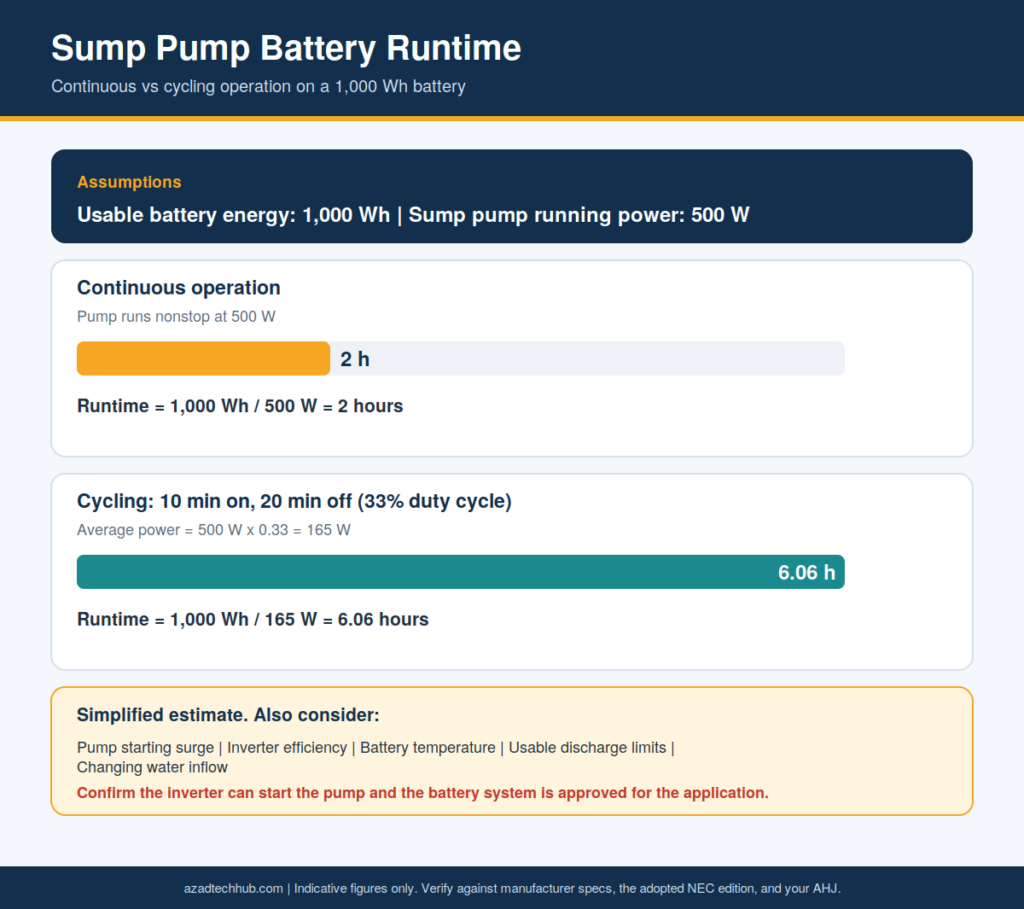
This is a simplified estimate. Pump starting surges, inverter efficiency, battery temperature, usable discharge limits, and changing water conditions must be considered. Verify that the inverter can start the pump and that the battery system is approved for the intended application.
Monitoring Whole-Home Electricity Use During an Outage
Energy monitoring helps engineers understand base load, identify high-demand circuits, and determine whether a generator or battery is being overloaded. A whole-home energy monitor may use current transformers (CTs) around service conductors, voltage references, or compatible smart-meter data.
Before installation, confirm the monitor’s service-voltage rating, current range, CT orientation, conductor compatibility, and supported panel configuration. Some products require installation inside an energized service panel. That work should be completed by a qualified electrician.
A useful monitoring setup can track:
- Real-time power in watts.
- Energy consumption in kWh.
- Voltage and current, where supported.
- Circuit-level demand.
- Historical peaks and trends.
- Generator or battery operating status, when compatible.
For meaningful readings, check that the CT direction and phase assignment are correct. Incorrect placement can produce negative or inaccurate readings. Confirm monitor readings against a suitable reference meter and the utility meter where appropriate.
During backup operation, monitoring can reveal whether the refrigerator, sump pump, HVAC system, or other large loads are creating unexpected peaks.
Measuring Appliance Consumption with a Plug-In Power Meter
A plug-in energy meter can measure the consumption of many 120 V household appliances without modifying fixed wiring. These meters are useful for refrigerators, computers, televisions, fans, and other equipment connected through compatible receptacles.
Connect the meter between the receptacle and the appliance, then record watts, voltage, current, power factor, and accumulated kWh if the meter supports those functions.
To estimate daily energy consumption:
Daily energy (kWh) = Power (W) × Operating time (h) / 1,000
For a 120 W appliance running for eight hours:
Daily energy = 120 × 8 / 1,000 = 0.96 kWh
For cycling appliances, measure consumption over a full operating period rather than multiplying the instantaneous running wattage by 24 hours.
Do not use a plug-in meter on loads that exceed its voltage, current, or power rating. It is not suitable for directly measuring hardwired equipment or high-current 240 V appliances unless the instrument is specifically designed and listed for that application.
Choosing a Pure Sine Wave Inverter for Small Backup Loads
A pure sine wave inverter converts DC battery power into AC power with a waveform suitable for a wide range of household electronics. It can be a good option for routers, computers, lighting, and other sensitive loads when the output voltage and frequency match the equipment requirements.
Select the inverter based on continuous power, surge capacity, DC input voltage, output voltage, efficiency, cooling, and low-voltage protection.
For example, a 600 W load supplied by a 12 V battery at 90% inverter efficiency requires approximately:
DC current (A) = AC power (W) / (DC voltage (V) × Efficiency)
DC current = 600 / (12 × 0.90) = 55.6 A
This is a substantial DC current. The battery, cables, fuse, disconnect, and terminals must all be rated for the expected current and fault conditions. Cable length and voltage drop are particularly important on low-voltage DC systems. If the 12 V battery will be recharged from solar panels, see our guide to the best MPPT charge controller for a 12V 200Ah battery.
An inverter rated below 1,000 W may be suitable for small loads, but it will not necessarily start a refrigerator or sump pump. Check motor-starting requirements before relying on it for those applications.
Protecting Gaming PCs and Monitors from Power Disturbances
Gaming PCs, workstations, and monitors can be affected by voltage disturbances, switching transients, and sudden outages. A properly selected surge protective device can help reduce the risk from transient overvoltages, but it does not replace a UPS or provide backup energy.
For a gaming setup, check the total equipment load, the power supply’s input rating, the monitor load, and the UPS output capability if continued operation is required.
A surge protector should have suitable ratings and recognized safety certification for the US market. For whole-home protection, a listed surge protective device installed at the service equipment may complement point-of-use protection. Proper grounding and bonding remain essential. Our wiring guide explains how to add whole-home surge protection at the main panel.
A UPS with an appropriate waveform and sufficient output capacity can help maintain power during short interruptions. For a desktop with a high-performance graphics card, size the UPS from the actual load and runtime requirement, not the advertised maximum VA figure alone.
Installation, Testing, and Maintenance Checklist
A Home Backup Power installation should be verified before an outage occurs. Commissioning confirms that the equipment operates as intended and that transfer, protection, and monitoring functions work correctly.
Use the following checklist as an engineering review aid:
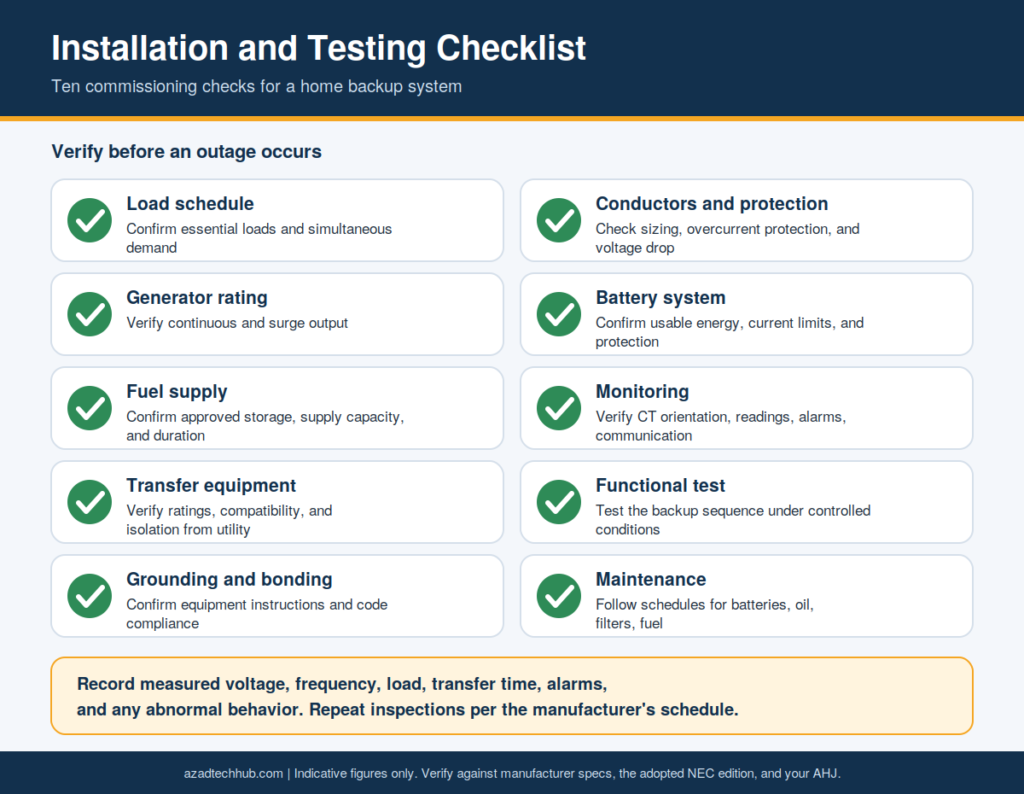
For standby systems, verify automatic transfer operation and return-to-utility behavior according to the manufacturer’s commissioning procedure. For portable generators, test the approved connection method and selected circuits without creating a backfeed risk.
Record measured voltage, frequency, load, transfer time where applicable, alarms, and any abnormal behavior. Repeat inspections according to the equipment manufacturer’s maintenance schedule and applicable local requirements.
US Codes, Permits, and Safety Requirements
Electrical backup systems in the United States must comply with the locally adopted electrical code, permitting requirements, equipment listings, and utility rules. The adopted edition of the NEC varies by jurisdiction, and local amendments may apply.
Relevant requirements may include provisions for generators, transfer equipment, grounding and bonding, overcurrent protection, wiring methods, and surge protection. NFPA 70 is the National Electrical Code, while NFPA 110 addresses emergency and standby power systems in applicable installations.
Natural gas or propane connections may require a licensed professional and compliance with applicable fuel-gas codes. Standby generator placement must meet manufacturer clearances, local ordinances, and carbon monoxide safety requirements.
Before installation, consult the local authority having jurisdiction (AHJ), the utility, and qualified electrical and fuel-system contractors as needed. Do not assume that a product’s advertised capacity or a general online diagram establishes code compliance.
Frequently Asked Questions
What size generator is needed to power an entire house?
The required size depends on the home’s calculated demand, HVAC equipment, electric heating, water heating, cooking loads, and motor-starting requirements. Prepare a load schedule and determine which loads may operate together before selecting a generator.
Can a portable generator power a house through a regular wall outlet?
No. Connecting a generator to a household outlet using an improvised cord can energize circuits and utility lines in an unsafe way. Use an approved inlet and compatible transfer switch or another code-compliant arrangement installed by a qualified electrician.
How long can a home battery power essential appliances?
Runtime depends on usable battery energy and average load. A 5 kWh battery supplying a steady 500 W load has a theoretical runtime of 10 hours before losses and reserve limits. Actual runtime will be shorter and varies with inverter efficiency, battery settings, and load changes.
Is a generator better than a battery backup system?
A generator can support longer outages when fuel is available, while batteries provide quiet operation and rapid response. The better option depends on outage duration, fuel access, required power, noise restrictions, maintenance, and budget. A hybrid system can combine the strengths of both.
Do I need an electrician to install a home backup generator?
Permanent generator connections, transfer equipment, panel modifications, and many whole-home monitoring installations require qualified electrical work and may need permits. Requirements depend on the equipment and jurisdiction. Follow the manufacturer’s instructions and local code, and use a qualified electrician for work inside service panels.
Final Engineering Recommendations
A reliable Home Backup Power system starts with measured loads, realistic runtime targets, and a clear plan for how electricity will be transferred and distributed during an outage. Generator wattage alone is not enough; engineers must also evaluate starting current, voltage quality, protection, grounding, battery performance, and operating conditions.
For most US homes, the practical process is to identify essential loads, measure actual consumption, calculate generator or battery requirements, select compatible transfer equipment, and verify the complete installation. Monitoring then helps confirm the system’s performance and identify changes in household demand.
The best system is one that can operate safely under real outage conditions, not simply one with the largest advertised capacity. Always verify equipment ratings, applicable codes, local permits, and manufacturer instructions before installation or commissioning.
Get new guides in your feed. Follow Electrical Insights on LinkedIn for new electrical standards guides, calculators and design tips from Azad Circuit Hub.