
Victron SmartSolar 100 30 Review (Best MPPT?)
If you are building a small off-grid solar system and want an MPPT charge controller that offers strong efficiency, reliable protection, and useful monitoring, the Victron Energy SmartSolar MPPT 100V 30A deserves a close look. In this victron smartsolar 100 30 review, I will cover its specifications, real-world advantages, limitations, compatibility, and whether it is the right choice for your solar setup.
Being an Electrical Engineer with 15 years of experience in electrical systems maintenance, I pay particular attention to charging efficiency, PV voltage limits, protection features, wiring requirements, and long-term reliability when reviewing solar equipment. Victron has built a strong reputation in these areas, and the SmartSolar 100/30 is one of its more practical controllers for small and medium off-grid systems.
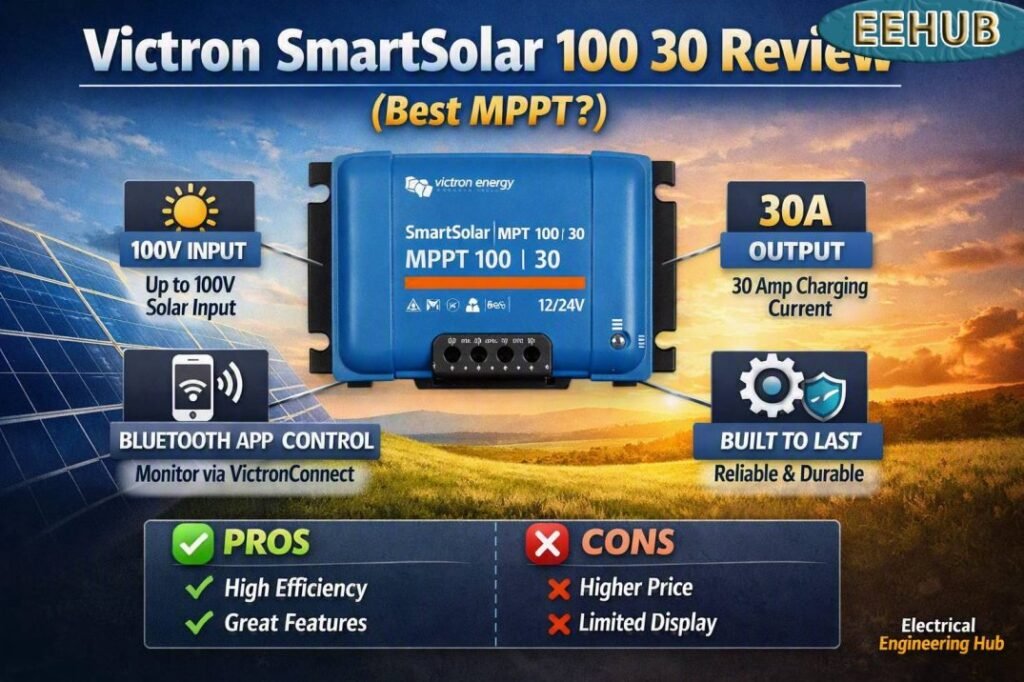
Table of Contents
Table of Contents
Victron SmartSolar MPPT 100/30 Specifications
The table below summarizes the key specifications before we get into the detailed analysis.
| Feature | Victron Energy SmartSolar MPPT 100/30 |
|---|---|
| Controller type | MPPT solar charge controller |
| Maximum PV voltage | 100V |
| Maximum charging current | 30A |
| Recommended PV power | Up to approximately 440W at 12V / 880W at 24V |
| Nominal battery voltage | 12V / 24V |
| Maximum efficiency | Up to 98% |
| Bluetooth | Built-in |
| Battery chemistry | Lead-acid and lithium-compatible |
| Protection | Over-temperature, over-current and PV-related protections |
| Configuration | VictronConnect app |
| Cooling | Natural convection |
| System applications | RV, marine, cabin, backup and off-grid solar |
| Brand | Victron Energy |
What Is the Victron SmartSolar 100/30?
The Victron Energy SmartSolar MPPT 100/30 is a 30-amp maximum power point tracking solar charge controller designed for 12V and 24V battery systems. Its 100V PV input rating gives you considerably more flexibility than many basic PWM controllers.
The main purpose of an MPPT controller is to continuously adjust the solar panel operating point so available PV energy can be converted into useful battery charging power more efficiently.
This is particularly useful when solar panel voltage is significantly higher than battery voltage. Instead of simply matching panel voltage to the battery, the controller converts excess PV voltage into additional charging current, within its rated limits.
Victron SmartSolar 100 30 Review: Performance
Performance is the biggest reason to consider this controller.
Victron specifies efficiency of up to 98%, which means very little energy is wasted inside the controller under favorable operating conditions. Actual performance will depend on PV voltage, battery voltage, ambient temperature, cable losses, battery condition, and system configuration.
For example, a 24V battery bank can make particularly good use of the 100/30 because the controller can handle substantially more PV power than it can on a 12V system.
A useful design reference is:
| Battery System | Approx. Maximum PV Power at 30A |
|---|---|
| 12V | 440W |
| 24V | 880W |
These figures should be treated as practical design references rather than a substitute for Victron's current installation specifications.
The controller can also take advantage of higher PV voltage, which can reduce current on the solar cable compared with a low-voltage panel arrangement. That can help reduce voltage drop and cable size in suitable installations.
Built-In Bluetooth Is a Major Advantage
One of my favorite features of this controller is built-in Bluetooth connectivity.
You can use the VictronConnect mobile application to configure and monitor the charge controller without needing a separate display in many installations.
Depending on the connected system and settings, the app can provide information such as:
- Solar voltage
- Solar current
- Battery voltage
- Charging current
- Solar power
- Historical charging information
- Controller status
- Configured charging parameters
This is much more convenient than repeatedly opening an enclosure to check LEDs or connect an external meter.
For an off-grid system installed in a cabin, RV, workshop, or remote solar installation, remote configuration and monitoring can save considerable time.
Buy the Victron SmartSolar MPPT 100/30
If you have decided that a 30A MPPT controller fits your PV and battery configuration, the Victron Energy SmartSolar MPPT 100V 30A is worth checking on Amazon for current pricing and availability.
Before ordering, confirm the exact model, battery voltage, PV voltage, and required charging current for your installation.
MPPT Charging for 12V and 24V Systems
The SmartSolar 100/30 supports both 12V and 24V battery systems, making it suitable for a range of small solar installations.
For a 12V system, 30A of charging current represents a substantial amount of charging capability. However, you should not select the controller based only on the battery capacity.
PV array voltage and power must also remain within the controller's limits.
For example, if you have a 24V battery bank and around 600W to 800W of solar panels, this controller can be a very sensible option. A larger PV array may require moving to a higher-current SmartSolar model.
Battery Compatibility and Charging Control
Another strong point is its flexible charging configuration.
The controller can be configured for different battery technologies and charging requirements. This is especially important when using lithium batteries because their charging parameters differ from traditional flooded lead-acid batteries.
For lithium systems, always follow the battery manufacturer's recommended charging voltage, temperature limits, and protection requirements.
The charge controller should not be treated as a replacement for a properly designed battery management system when using lithium batteries.
Protection Features
Solar charge controllers operate continuously in environments where voltage, current, temperature, and load conditions can change. Protection features therefore matter as much as headline efficiency.
The SmartSolar series includes protections designed to help safeguard the controller and connected system against conditions such as excessive temperature and current.
Good installation practice remains essential. Correct fuse or breaker selection, properly sized conductors, secure terminals, suitable PV disconnects, and correct polarity are still required.
A high-quality controller cannot compensate for poor electrical installation.
Is the 100V PV Rating Enough?
For many small solar installations, 100V is more than adequate. However, you need to calculate the maximum open-circuit voltage of the entire PV string.
Do not size a string using the panel's nominal operating voltage alone.
Cold temperatures can increase PV open-circuit voltage. Therefore, the calculated maximum string Voc under the lowest expected temperature must remain within the controller's allowable PV voltage.
This is one of the most important checks before purchasing the controller.
Victron SmartSolar 100 30 Review: Pros and Cons
| Pros | Cons |
|---|---|
| Excellent MPPT efficiency | 30A output limits system size |
| Built-in Bluetooth | 100V PV limit requires careful string design |
| Strong monitoring through VictronConnect | More expensive than basic PWM controllers |
| Suitable for 12V and 24V systems | No large built-in display |
| Good configuration flexibility | Higher cost may not suit very small systems |
| Compact and reputable design | Requires proper PV and battery protection |
Who Should Buy the SmartSolar 100/30?
This controller is a particularly good fit for users who want more than a basic solar regulator.
Consider it if you are installing:
- A small off-grid cabin system
- An RV solar system
- A marine battery charging system
- A workshop solar installation
- A backup battery system
- A small 12V or 24V solar array
- A system where Bluetooth monitoring is valuable
It may not be the best option if your array requires more than 30A of charging current or your PV string can exceed the controller's voltage limit.
For larger solar installations, stepping up to a higher-current MPPT controller can be more economical than trying to operate a 30A controller at its limits.
Is Victron SmartSolar 100/30 Better Than a PWM Controller?
For most installations where panel voltage is substantially above battery voltage, an MPPT controller is the better technical choice.
PWM controllers are simpler and often cheaper, but they generally cannot harvest available PV energy as effectively when using higher-voltage solar modules.
The Victron also provides better monitoring and configuration options than many entry-level PWM products.
If the goal is maximum value rather than simply the lowest purchase price, the SmartSolar 100/30 makes a strong case.
For a wider comparison of MPPT and PWM options, see our guide to best solar charge controller before choosing your final model.
Installation Tips
Correct installation is critical for both safety and performance.
Before commissioning the system:
- Confirm the PV string's maximum cold-weather Voc.
- Verify that the battery voltage matches the controller configuration.
- Select appropriately sized PV and battery cables.
- Install required fuses, breakers, and disconnects.
- Check polarity carefully before connecting conductors.
- Configure battery charging parameters through VictronConnect.
- Confirm charging voltage and current during operation.
- Keep the controller adequately ventilated.
Always follow the manufacturer's current installation manual and applicable electrical codes for the installation location.
What I Like About the Victron 100/30
The combination of MPPT performance, Bluetooth connectivity, compact design, and configuration flexibility makes this controller stand out.
From an electrical maintenance perspective, the monitoring capability is particularly useful. Troubleshooting becomes easier when you can see PV voltage, charging current, battery voltage, and controller status from your phone.
That information can help identify problems such as inadequate solar irradiance, wiring voltage drop, incorrect battery settings, or an undersized PV array.
If you are comparing several models before buying, our best solar charge controller guide can help you compare MPPT controllers by system size, battery voltage, and application.
Final Verdict
After looking at its specifications, functionality, and practical applications, the Victron Energy SmartSolar MPPT 100V 30A is one of the strongest choices for small 12V and 24V solar systems.
It is not the cheapest 30A charge controller available, but that is not really its selling point. Its value comes from efficient MPPT charging, reliable configuration options, built-in Bluetooth monitoring, and Victron's established ecosystem.
The main limitation is its 30A charging capacity and 100V PV input ceiling. If those limits fit your system, however, it is difficult to ignore.
In this victron smartsolar 100 30 review, my overall assessment is that the SmartSolar 100/30 is an excellent MPPT charge controller for appropriately sized off-grid systems and a strong candidate for users who prioritize monitoring, efficiency, and long-term usability.
See the Victron SmartSolar 100/30 on Amazon and check today's price
Frequently Asked Questions
Is the Victron SmartSolar 100/30 worth it?
Yes, especially if you want an efficient MPPT controller with built-in Bluetooth monitoring. It costs more than basic controllers, but the additional configuration and monitoring features can justify the price.
How many watts can a Victron 100/30 handle?
The commonly referenced maximum PV power is about 440W on a 12V system and 880W on a 24V system. Always check the manufacturer's latest specifications and ensure the PV voltage remains within the controller's limits.
Can the Victron SmartSolar 100/30 charge lithium batteries?
Yes. It can be configured for lithium battery applications, but the correct charging parameters must be selected according to the battery manufacturer's requirements. A compatible battery management system is also important.
Can I connect solar panels in series to a Victron 100/30?
Yes, provided the resulting maximum PV open-circuit voltage remains within the controller's 100V limit under the coldest expected operating conditions. Never size the string from nominal panel voltage alone.
Is Victron SmartSolar better than PWM?
For many solar applications, yes. MPPT technology can extract more useful energy from the PV array, particularly when panel voltage is higher than battery voltage. The SmartSolar also adds advanced monitoring and configuration through VictronConnect.
Related Guides & Tools
- PWM charge controller vs mppt
- cheap mppt solar charge controller
- Renogy vs Victron Solar Charge Controller
- Best 40 Amp MPPT Charge Controller
- Solar Charge Controller Sizing Calculator
Get new guides in your feed. Follow Electrical Insights on LinkedIn for new electrical standards guides, calculators and design tips from Azad Circuit Hub.
#VictronSmartSolar, #SmartSolar10030, #MPPTChargeController, #VictronEnergy, #SolarChargeController, #MPPTSolar, #SolarPower, #OffGridSolar, #SolarSystem, #SolarReview
