IEEE Standard for Gas Insulated Switchgear: Complete Guide to Design, Testing & Compliance
Gas insulated switchgear has become a preferred solution in modern power systems due to its compact size, high reliability, and enhanced safety. Understanding the ieee standard for gas insulated switchgear is essential for engineers, consultants, and project managers who deal with high voltage substations and transmission networks. This guide explains the design principles, testing requirements, and compliance framework that define best practices in the industry.
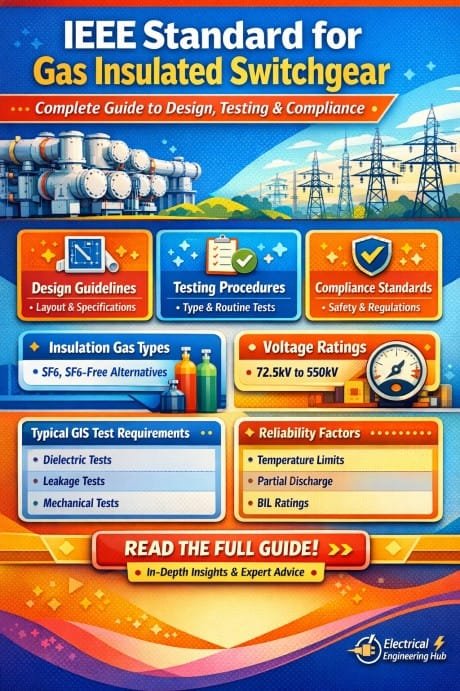
Table of Contents
Introduction to Gas Insulated Switchgear
Gas insulated switchgear (GIS) uses sulfur hexafluoride (SF6) or alternative insulating gases to provide insulation between electrical components. Compared to air insulated switchgear, GIS requires less space and offers better protection against environmental factors such as dust, humidity, and pollution.
The ieee standard for gas insulated switchgear provides a structured approach to ensure safety, performance, and long-term reliability. It aligns with global engineering practices while addressing critical electrical and mechanical requirements.
Use our online tool for free Sub Panel Breaker Size Calculator – Find the Right Breaker for Your Electrical Sub Panel
Key IEEE Standards for Gas Insulated Switchgear
Several IEEE standards govern different aspects of GIS systems. These standards cover design, testing, operation, and maintenance.
| Standard Number | Title | Scope |
|---|---|---|
| IEEE C37.122 | Gas-Insulated Substations | Covers high voltage GIS assemblies |
| IEEE C37.123 | Guide for SF6 Gas Handling | Focuses on safe gas management |
| IEEE C37.100 | Definitions for Power Switchgear | Standard terminology |
| IEEE C37.04 | Rating Structure | Defines rating parameters |
The ieee standard for gas insulated switchgear integrates these documents to ensure consistency in system design and operation.
Design Requirements Under IEEE Standards
Design plays a crucial role in ensuring GIS reliability and safety. The ieee standard for gas insulated switchgear outlines several important design criteria.
Use our online tool for free Sub Panel Wire Size Calculator – Accurate Wire Gauge & Load Sizing Tool
Electrical Design Considerations
Electrical performance must meet system voltage and fault current requirements. Key aspects include:
- Rated voltage and insulation levels
- Short-circuit withstand capability
- Dielectric strength of insulating gas
- Switching performance under load and fault conditions
Proper insulation coordination is essential to avoid failures. Engineers must also consider transient overvoltages and lightning impulse withstand levels.
Mechanical Design Considerations
Mechanical strength ensures that GIS components can withstand operational and environmental stress.
- Pressure-resistant enclosures
- Sealing systems to prevent gas leakage
- Structural integrity under seismic conditions
- Thermal expansion management
Use our online tool for free Wire Size Calculator for Subpanels and Feeders – NEC Guidelines Included
The ieee standard for gas insulated switchgear emphasizes robust enclosure design to handle internal arc faults safely.
Environmental and Safety Design
Modern GIS systems must comply with environmental guidelines, especially regarding SF6 gas handling.
- Gas leakage monitoring systems
- Use of eco-friendly gas alternatives
- Proper ventilation and safety interlocks
- Fire and explosion protection measures
These requirements ensure safe operation and reduce environmental impact.
Components of Gas Insulated Switchgear
Understanding GIS components helps in better implementation of the ieee standard for gas insulated switchgear.
| Component | Function |
|---|---|
| Circuit Breaker | Interrupts fault currents |
| Disconnect Switch | Isolates sections for maintenance |
| Earthing Switch | Grounds isolated sections |
| Busbars | Conduct electrical power |
| Instrument Transformers | Measurement and protection |
| Gas Compartments | Insulation and arc quenching |
Each component must meet specific performance criteria defined in IEEE guidelines.
Know more about Industrial Control Panel Design Software – Best Tools, Features & Pro Tips for Engineers
Testing Requirements for GIS
Testing ensures that the equipment meets design specifications and operates reliably. The ieee standard for gas insulated switchgear categorizes tests into different types.
Type Tests
Type tests verify the design under extreme conditions.
- Lightning impulse test
- Power frequency withstand test
- Temperature rise test
- Short-circuit current test
These tests confirm that the equipment can handle real-world stress scenarios.
Routine Tests
Routine tests are performed on every unit before delivery.
- Partial discharge measurement
- Gas leakage test
- Mechanical operation test
- Insulation resistance test
Routine testing ensures consistency in manufacturing quality.
Use our online tool for free Electrical Panel Upgrade Cost Calculator: Best Tool
Special Tests
Special tests are conducted based on project requirements.
- Seismic testing
- Environmental testing
- Electromagnetic compatibility testing
The ieee standard for gas insulated switchgear allows flexibility to include additional tests depending on site conditions.
Compliance and Certification
Compliance with IEEE standards is essential for project approval and long-term reliability.
Documentation Requirements
Manufacturers must provide detailed documentation including:
- Design calculations
- Test reports
- Operation manuals
- Maintenance guidelines
Proper documentation ensures transparency and traceability.
Know more about mcc panel design software
Quality Assurance
Quality control processes must be implemented throughout manufacturing.
- Material inspection
- Process validation
- Final inspection before dispatch
The ieee standard for gas insulated switchgear requires strict adherence to quality benchmarks.
International Alignment
IEEE standards often align with IEC standards, making it easier for global projects to adopt common practices. However, project specifications may require compliance with both standards.
Advantages of Following IEEE Standards
Adhering to the ieee standard for gas insulated switchgear offers several benefits.
- Improved system reliability
- Enhanced operational safety
- Reduced maintenance costs
- Better performance under harsh conditions
- Compliance with regulatory requirements
These advantages make IEEE standards a preferred choice for utilities and industrial projects.
Installation and Maintenance Guidelines
Proper installation and maintenance are essential for long-term GIS performance.
Explore everything about electrical control panel design training
Installation Best Practices
- Ensure proper alignment of components
- Maintain cleanliness during assembly
- Monitor gas pressure and quality
- Follow torque specifications for connections
Maintenance Strategy
- Periodic gas analysis
- Visual inspection for leaks
- Functional testing of switching devices
- Monitoring of partial discharge levels
The ieee standard for gas insulated switchgear highlights predictive maintenance to avoid unexpected failures.
Common Challenges in GIS Systems
Despite its advantages, GIS systems face certain challenges.
| Challenge | Solution |
|---|---|
| Gas leakage | Regular monitoring and sealing improvements |
| Partial discharge | Advanced detection systems |
| High initial cost | Lifecycle cost analysis |
| SF6 environmental impact | Use of alternative gases |
Understanding these challenges helps engineers implement effective solutions.
Find out the mcc panel design guide pdf in detail here.
Future Trends in Gas Insulated Switchgear
The GIS industry is evolving rapidly with new technologies.
- Development of SF6-free switchgear
- Digital monitoring and smart diagnostics
- Integration with smart grids
- Compact and modular designs
The ieee standard for gas insulated switchgear continues to evolve to accommodate these advancements.
Conclusion
The ieee standard for gas insulated switchgear provides a comprehensive framework for designing, testing, and maintaining GIS systems. By following these standards, engineers can ensure high performance, safety, and reliability in electrical networks.
Know more about GIS vs AIS Switchgear: Best Key Differences Every Electrical Engineer Must Know
From design considerations to compliance requirements, every aspect of GIS is governed by structured guidelines. As power systems continue to grow in complexity, adherence to IEEE standards will remain critical for successful project execution and long-term sustainability.
Follow Us on Social:
Subscribe our Newsletter on Electrical Insights for latest updates from Electrical Engineering Hub
#ieeestandardforgasinsulatedswitchgear, #gasinsulatedswitchgear, #GISstandards, #powersystemprotection, #highvoltageengineering, #electricalstandards, #substationdesign, #switchgearengineering, #ieeestandards, #powertransmission
