
DIN Standard Copper Alloys: Specifications, Grades, Properties & Industrial Applications Guide
DIN standard copper alloys form the backbone of many industrial and engineering applications due to their reliability, consistent quality, and well-defined specifications. These alloys are governed by the Deutsches Institut für Normung (DIN), ensuring uniformity in composition, mechanical properties, and performance across different industries. Understanding din standard copper alloys is essential for engineers, manufacturers, and procurement professionals who require dependable materials for precision applications.
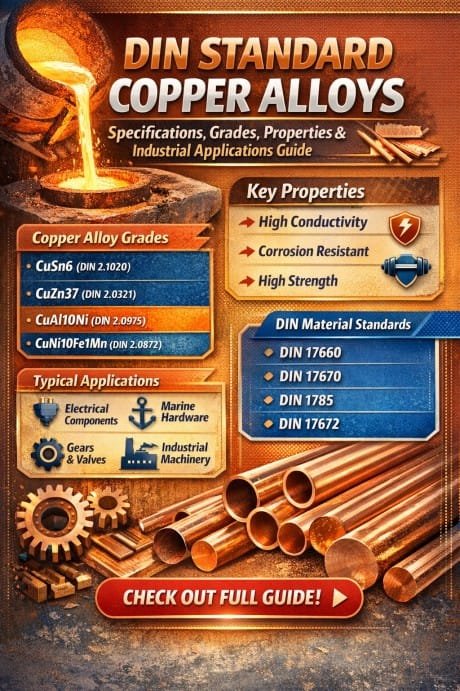
Table of Contents
What Are DIN Standard Copper Alloys
DIN standard copper alloys refer to copper-based materials that comply with German DIN specifications. These standards define chemical composition, mechanical strength, corrosion resistance, and dimensional tolerances. The aim is to ensure that materials sourced from different suppliers maintain the same quality and performance.
Know more about IEC Standard for Neutral to Earth Voltage – Limits, Measurement & Safety Guidelines
Copper alloys under DIN standards include brass, bronze, and special high-performance copper grades. These materials are widely used in electrical systems, marine environments, construction, and heavy machinery.
Key Characteristics of DIN Standard Copper Alloys
DIN standard copper alloys are known for a combination of mechanical and physical properties that make them suitable for diverse applications. These include:
- High electrical and thermal conductivity
- Excellent corrosion resistance
- Good machinability
- High ductility and formability
- Strong wear resistance in specific grades
These properties make din standard copper alloys a preferred choice in industries where durability and conductivity are critical.
Common DIN Grades of Copper Alloys
Different DIN grades are designed for specific industrial requirements. Each grade has a unique composition and set of properties. The table below highlights some commonly used grades.
Find all about Capacitor Bank Sizing for Power Factor Correction – Step by Step
Table: Popular DIN Copper Alloy Grades
| DIN Grade | Material Type | Composition Highlights | Key Applications |
|---|---|---|---|
| CuZn37 (CW508L) | Brass | Copper + Zinc | Plumbing, decorative items |
| CuZn39Pb3 (CW614N) | Free-cutting Brass | Copper + Zinc + Lead | Machined components |
| CuSn6 (CW452K) | Phosphor Bronze | Copper + Tin | Springs, electrical connectors |
| CuAl10Fe5Ni5 | Aluminum Bronze | Copper + Aluminum + Iron + Nickel | Marine, heavy-duty components |
| CuNi10Fe1Mn | Copper Nickel | Copper + Nickel | Heat exchangers, marine systems |
These grades demonstrate the diversity within din standard copper alloys, each tailored to meet specific engineering needs.
Chemical Composition and Standards
DIN standards strictly regulate the chemical composition of copper alloys. This ensures consistent performance and reliability. For example, brass alloys typically contain copper and zinc in varying proportions, while bronze alloys may include tin, aluminum, or silicon.
Find all about IEC Standard for Relay Testing: Best Guide
Table: Typical Composition Ranges
| Alloy Type | Copper (%) | Other Elements (%) |
|---|---|---|
| Brass | 55–90 | Zinc, Lead |
| Bronze | 80–95 | Tin, Aluminum, Silicon |
| Copper Nickel | 70–90 | Nickel, Iron |
By maintaining strict composition limits, din standard copper alloys deliver predictable mechanical and physical behavior in industrial applications.
Mechanical and Physical Properties
The performance of din standard copper alloys depends on their mechanical strength, hardness, and conductivity. These properties vary depending on the alloy composition and processing method.
Table: General Properties Overview
| Property | Range |
|---|---|
| Tensile Strength | 200 – 800 MPa |
| Hardness | 50 – 300 HB |
| Electrical Conductivity | 15% – 100% IACS |
| Thermal Conductivity | High |
| Corrosion Resistance | Excellent |
These characteristics make din standard copper alloys suitable for both structural and functional applications.
Find all about BS 7671 Wiring Regulations: Expert Guide to Compliance, Safety, and Practical Applications
Advantages of Using DIN Standard Copper Alloys
DIN standards offer several advantages that make these materials reliable and widely accepted across global markets.
- Standardization ensures consistent quality
- Easy material selection for engineers
- Compatibility with international systems
- High durability and long service life
- Wide availability in different forms
Because of these benefits, din standard copper alloys are often specified in technical drawings and engineering projects.
Industrial Applications of DIN Copper Alloys
DIN standard copper alloys are used in a wide range of industries due to their versatility and performance. Their applications include both heavy-duty and precision components.
Electrical Industry
Copper alloys are widely used in electrical components due to their high conductivity. Applications include:
- Electrical connectors
- Busbars
- Switchgear components
Know more about IEC Standard for MV Cable Testing: Complete Acceptance, Routine & Type Test Guide
Marine and Offshore Industry
Certain alloys like aluminum bronze and copper-nickel are highly resistant to seawater corrosion. Common uses include:
- Shipbuilding components
- Propellers
- Heat exchangers
Automotive and Mechanical Engineering
In the automotive sector, din standard copper alloys are used for:
- Bearings and bushings
- Radiators and heat exchangers
- Hydraulic components
Construction and Architecture
Copper alloys are also used in building applications for their aesthetic appeal and durability:
- Roofing and cladding
- Plumbing fittings
- Decorative fixtures
Know more about Phase to Phase Clearance as per IEC 61439: Best Guide
Comparison with Other International Standards
DIN standards are often compared with ASTM, EN, and JIS standards. While the composition may be similar, naming conventions and slight variations in properties exist.
Table: DIN vs Other Standards
| DIN Grade | EN Equivalent | ASTM Equivalent |
|---|---|---|
| CuZn37 | CW508L | C27400 |
| CuSn6 | CW452K | C51900 |
| CuAl10Fe5Ni5 | CW307G | C63000 |
Understanding these equivalents helps in sourcing and substituting din standard copper alloys across global markets.
Selection Guide for DIN Copper Alloys
Choosing the right alloy depends on application requirements. Consider the following factors:
- Required strength and hardness
- Exposure to corrosion or chemicals
- Electrical or thermal conductivity needs
- Machinability requirements
- Cost and availability
By evaluating these parameters, engineers can select the most suitable din standard copper alloys for their projects.
Know more about OSHA Electrical Safety Standard 1910 – Workplace Electrical Safety | Safety Experts
Processing and Fabrication
DIN standard copper alloys can be processed using various methods depending on the grade. Common processes include:
- Casting
- Forging
- Rolling
- Machining
Free-cutting brass alloys are ideal for high-speed machining, while bronze alloys are better suited for wear-resistant applications. Proper processing ensures optimal performance and longevity.
Future Trends and Demand
The demand for din standard copper alloys continues to grow due to increasing industrialization and the need for sustainable materials. Copper alloys are recyclable and environmentally friendly, making them suitable for modern applications.
Learn more in detail on NEMA 250 Enclosures – Electrical Enclosure Standards | Best Manufacturing Companies in USA
Emerging sectors such as renewable energy, electric vehicles, and advanced electronics are driving the demand for high-performance copper alloys. DIN standards continue to evolve to meet these technological advancements.
Conclusion
DIN standard copper alloys play a critical role in modern engineering and manufacturing. Their standardized specifications, diverse grades, and reliable properties make them indispensable across industries. From electrical systems to marine applications, these alloys offer a balance of strength, conductivity, and corrosion resistance.
Understanding din standard copper alloys helps in making informed material choices, ensuring efficiency, durability, and cost-effectiveness in industrial applications. Learn more about NFPA 70 National Electrical Code | Electrical Safety Experts
Follow Us on Social:
Subscribe our Newsletter on Electrical Insights for latest updates from Electrical Engineering Hub
DINStandardCopperAlloys, #CopperAlloys, #DINStandards, #EngineeringMaterials, #MetalIndustry, #IndustrialStandards, #CopperGrades, #Manufacturing, #MaterialScience, #AlloySpecifications
