
WAGO 221-413 vs 221-415: Which to Buy? Features, Specs & Comparison
Choosing between WAGO lever connectors can seem simple until you need to decide how many conductors your junction actually requires. The WAGO 221 series is popular with electricians because its lever mechanism makes wire connections fast, accessible, and easy to inspect. But the number of ports matters.
In this WAGO 221-413 vs 221-415 comparison, I will explain the practical differences between the 3-conductor 221-413 and 5-conductor 221-415. I have worked as an electrical engineer for more than 15 years across electrical panels, industrial automation, PLC systems, and power installations. When selecting wiring accessories, I look at conductor compatibility, installation space, connection reliability, and the job the component is actually intended to perform.
WAGO 221-413 vs 221-415: Quick Comparison
| Feature | WAGO 221-413 | WAGO 221-415 |
|---|---|---|
| Conductor positions | 3 | 5 |
| Series | 221 | 221 |
| Connection type | Lever | Lever |
| Wire connection | Up to 3 conductors | Up to 5 conductors |
| Compact design | Yes | Yes |
| Reusable connection | Yes | Yes |
| Typical application | Smaller splices | Larger multi-wire splices |
| Best for | 2–3 wire connections | 2–5 wire connections |
| Pack listed here | 50 connectors | 50 connectors |
The biggest difference is straightforward: the 221-413 has three connection ports, while the 221-415 has five. Both are designed around the same WAGO 221 lever-connector concept.
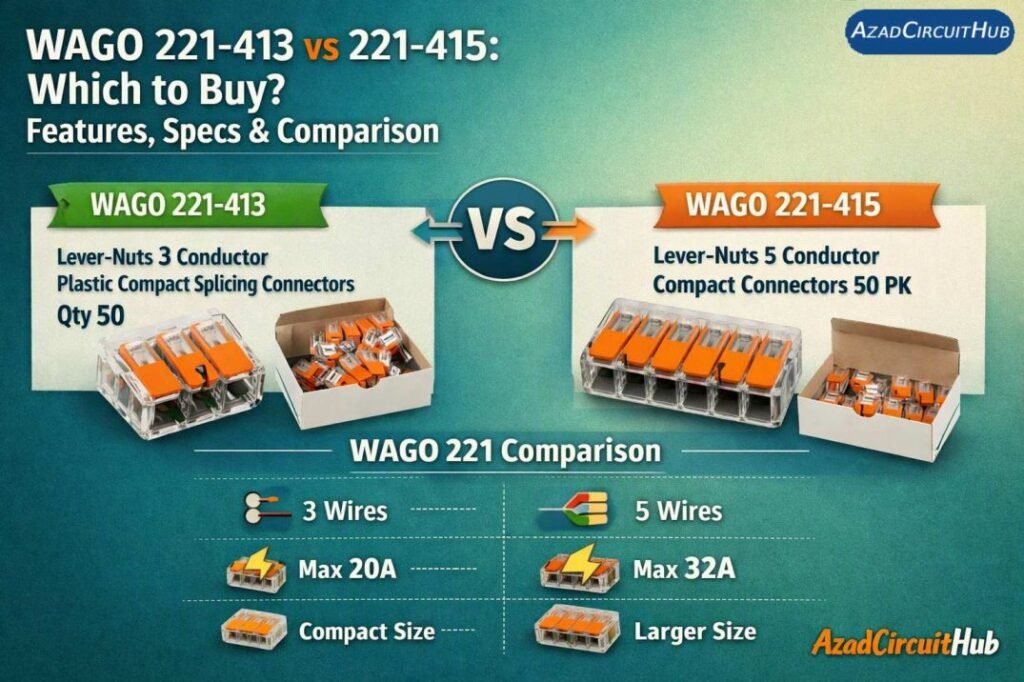
Table of Contents
Table of Contents
WAGO 221-413: Best for Three Conductors
The WAGO 221-413 is a 3-conductor compact splicing connector. It is a good choice when your electrical connection requires two or three conductors in one splice.
The transparent housing makes it easier to visually inspect the connection, while the orange levers allow individual conductors to be inserted and released without relying on a traditional twist-and-tape connection.
For example, the 221-413 can be useful when joining three wires in a junction box, extending conductors, or making compact wiring connections where a larger connector would take unnecessary space.
One advantage of choosing the smaller connector is that you do not have unused ports taking up room.
Want the 3-conductor version? Check WAGO 221-413 50-Pack on Amazon
WAGO 221-415: When You Need Five Conductors
The WAGO 221-415 provides five conductor positions in the same general compact lever-connector family. This makes it more suitable for applications where several wires need to be connected to the same electrical point.
For example, a junction may require five conductors to share a common connection. Instead of using multiple smaller connectors and additional jumpers, a 5-port connector can simplify the arrangement.
The extra two ports are the main reason to choose the 221-415. It is not necessarily a "better" connector than the 221-413. It simply accommodates more conductors.
If you regularly work on lighting circuits, control wiring, junction boxes, or electrical panel modifications, having 5-conductor lever connectors available can be useful.
For larger multi-wire splices, Shop WAGO 221-415 50-Pack on Amazon.
WAGO 221-413 vs 221-415: Main Difference
The decision becomes much easier when you focus on the number of conductors.
The 221-413 is designed for connections involving up to three conductors. The 221-415 increases that capacity to five conductors.
| Your Connection | Better Choice |
|---|---|
| 2 conductors | 221-413 |
| 3 conductors | 221-413 |
| 4 conductors | 221-415 |
| 5 conductors | 221-415 |
| Small compact splice | 221-413 |
| Multi-wire junction | 221-415 |
| General electrical toolbox | Consider 221-415 |
| Mostly small repairs | 221-413 |
This is why the WAGO 221-413 vs 221-415 question should be answered based on the work you expect to do, rather than simply buying the connector with more ports.
Which WAGO Connector Is Easier to Use?
Both connectors use individual levers. The lever is lifted, the prepared conductor is inserted, and the lever is closed to secure the connection.
This design can be particularly convenient during troubleshooting because the conductor can be released without cutting the wire or destroying the connector.
The 221-413 can feel slightly less cumbersome when only a few wires are involved. The 221-415 provides more flexibility when you need several conductors at the same connection point.
For field work, I prefer carrying both sizes when the job involves a mixture of junction and control wiring. However, if you want to keep only one type in a basic electrical toolbox, the 5-port version offers greater flexibility.
Wire Size and Compatibility Matter
Do not select a WAGO connector based only on the number of ports. You also need to verify that the conductor type, conductor size, and application are compatible with the specific WAGO product.
WAGO 221 connectors are commonly used with solid, stranded, and finely stranded conductors within the manufacturer's specified range. Always check the current WAGO datasheet and product markings for the exact model you are purchasing.
Proper wire preparation is also important. Strip the insulation to the manufacturer's specified length. Avoid damaged, excessively nicked, or poorly prepared conductors.
A lever connector is not a substitute for correct electrical workmanship.
Where Are WAGO 221 Connectors Used?
The WAGO 221 series is useful across residential, commercial, industrial, and DIY electrical applications where the specific connector rating and local electrical requirements permit its use.
Common applications include:
- Lighting connections
- Junction boxes
- Control wiring
- Panel wiring
- Equipment connections
- Electrical repairs
- Building automation
- Temporary troubleshooting connections
- Low-voltage control circuits
- Wire extensions
The transparent housing is also useful during inspection because the conductor insertion can be visually checked.
221-413 vs 221-415: Which One Should You Buy?
If almost all of your work involves two- or three-conductor splices, I would choose the WAGO 221-413. It is compact and avoids paying for unused connection positions.
If you regularly encounter four- or five-conductor junctions, the 221-415 is the better option. It gives you additional connection capacity without requiring multiple connectors for the same splice.
For electricians and technicians who do varied work, buying the 50-piece 221-415 pack can also make sense because its five ports provide more flexibility. However, it is still worth keeping 3-port connectors available for tight installations.
The best choice is therefore based on conductor count, available space, and the type of wiring jobs you normally handle.
WAGO 221-413 vs 221-415: My Pick
After comparing the two, my pick for general-purpose electrical work is the WAGO 221-415 because five connection positions provide greater flexibility.
That does not mean the 221-413 is inferior. In a simple three-wire junction, the 221-413 is actually the more appropriate choice. It is smaller and has exactly the capacity required.
For someone building a toolbox from scratch, I would consider buying both. The 221-413 handles smaller splices, while the 221-415 covers larger multi-conductor connections.
Check the current Amazon price for the WAGO 221-413 50-Pack.
Or compare the WAGO 221-415 50-Pack if you need five conductors per connection.
Buying Tips for WAGO Lever Connectors
Before ordering a bulk pack, check these points:
- Confirm the exact WAGO model number.
- Check the number of conductor ports.
- Verify supported conductor types.
- Check the permitted wire-size range.
- Confirm the electrical ratings for your application.
- Buy genuine products from a reputable seller.
- Check whether the connector is suitable for the installation environment.
- Follow applicable electrical codes and manufacturer instructions.
If you work on multiple projects, buying a 50-piece pack can be more economical than purchasing individual connectors.
Frequently Asked Questions
What is the difference between WAGO 221-413 and 221-415?
The main difference is the number of connection positions. The 221-413 accepts up to three conductors, while the 221-415 accepts up to five conductors.
Is WAGO 221-415 better than 221-413?
Not necessarily. The 221-415 is more versatile for multi-wire connections, while the 221-413 is better suited to smaller three-conductor splices. The right model depends on your wiring application.
Can I use WAGO 221-413 for two wires?
Yes, provided the conductors and application meet the manufacturer's specifications. A three-port connector does not require all three ports to be occupied.
Can WAGO 221-415 connect five wires?
Yes. The 221-415 is the five-conductor version of the compact WAGO 221 lever connector family, subject to the applicable conductor and product specifications.
Are WAGO 221 connectors reusable?
The lever mechanism allows conductors to be released and replaced, which makes the connectors convenient for certain maintenance and troubleshooting tasks. Follow WAGO's instructions and inspect the connector and conductor before reuse.
Final Verdict
The WAGO 221-413 vs 221-415 choice comes down to one simple question: how many conductors do you need to connect?
Choose the 221-413 for two- or three-conductor splices where a compact connector is enough. Choose the 221-415 when four or five conductors need to share the same connection.
For general electrical work, I prefer having both available. The small difference in connector size can make a noticeable difference when working inside crowded junction boxes or control panels.
For most professionals, genuine WAGO connectors are worth keeping in the toolbox because the lever mechanism makes wire connections quick, accessible, and easy to inspect. Just make sure the exact product rating and conductor requirements match your installation before using it.
Get new guides in your feed. Follow Electrical Insights on LinkedIn for new electrical standards guides, calculators and design tips from Azad Circuit Hub.
#WAGO221413, #WAGO221415, #WAGOConnectors, #WAGO221, #WireConnectors, #ElectricalConnectors, #ElectricalWiring, #LeverNuts, #ElectricianTools, #WiringAccessories


