Klein RT210 GFCI Tester Review: Features, Testing Guide & Buying Advice
The Klein RT210 is a simple receptacle tester designed to check standard North American AC outlets for common wiring problems and test GFCI operation. In this klein rt210 gfci tester review, I look at where this compact tool works well, what it can detect, and where it should not replace more advanced electrical test equipment.
As an electrical engineer with more than 15 years of field experience in electrical panels, industrial automation, PLC systems, and troubleshooting, I value testers that provide a quick first check before deeper testing. The RT210 fits that role well. It is small, easy to use, and useful for electricians, maintenance technicians, inspectors, DIY users, and homeowners who need a quick receptacle check.
Klein RT210 Features at a Glance
| Feature | Klein Tools RT210 |
|---|---|
| Product type | Receptacle / GFCI tester |
| Main purpose | Outlet wiring and GFCI testing |
| Outlet type | Standard North American AC receptacles |
| GFCI test button | Yes |
| Wiring fault indication | Yes |
| Common faults detected | Open ground, open neutral, open hot, reversed wiring |
| Display | LED indicator pattern |
| Form factor | Compact plug-in tester |
| Best use | Quick outlet troubleshooting |
| Brand | Klein Tools |
The RT210 is not a multimeter or insulation tester. Its strength is speed. Plug it into a receptacle, read the indicator pattern, and you can quickly determine whether the outlet appears correctly wired or has one of several common faults.
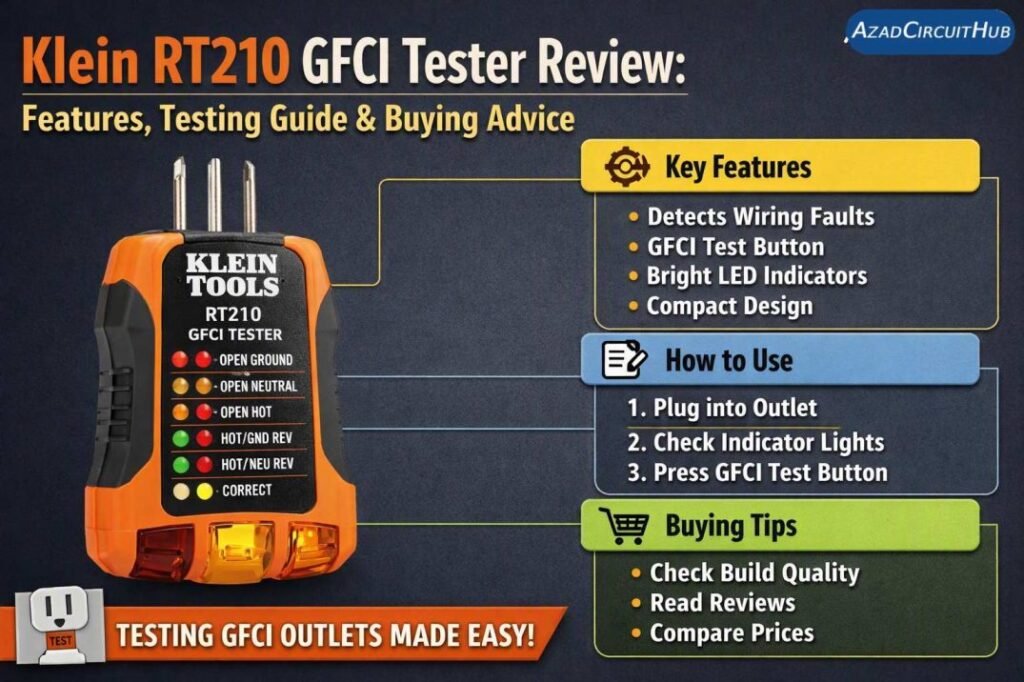
Table of Contents
Table of Contents
What Does the Klein RT210 Test?
The RT210 is designed to identify several common wiring conditions in standard AC receptacles. Its LED indicators provide a visual code that helps the user interpret the result.
Typical conditions include:
- Correct wiring
- Open ground
- Open neutral
- Open hot
- Hot and ground reversed
- Hot and neutral reversed
- GFCI operation
This makes the tester particularly useful when checking multiple receptacles during maintenance or troubleshooting.
However, an outlet tester has limitations. It should not be treated as proof that an electrical installation is completely safe. Some wiring faults cannot be detected by a simple plug-in receptacle tester.
For more comprehensive electrical troubleshooting, I recommend pairing an outlet tester with appropriate voltage measurement equipment. My guide to the best non contact voltage tester covers another useful first-line tool for checking for the presence of AC voltage.
Klein RT210 GFCI Test Function
The GFCI test button is one of the most useful features of the RT210. It allows the user to check whether a GFCI-protected receptacle or circuit responds as expected when the test function is activated.
A GFCI is designed to interrupt power when it detects an imbalance between current leaving and returning through the circuit. The RT210 provides a convenient way to initiate a test from the receptacle.
A successful test should result in the appropriate interruption of power. If the GFCI does not respond, further investigation is needed.
The tester does not replace the manufacturer's test/reset buttons or a professional GFCI analyzer when detailed measurements are required.
How to Use the Klein RT210
Using the tester is straightforward.
- Insert the RT210 into the receptacle.
- Observe the LED indicator pattern.
- Compare the pattern with the tester's identification chart.
- If the wiring indication is abnormal, investigate the circuit.
- For a GFCI outlet, press the test button.
- Confirm that the GFCI responds as expected.
- Reset the GFCI before continuing normal use.
Always follow safe electrical work practices. If an outlet shows an unexpected condition, do not assume that the problem is minor.
Klein RT210 for Outlet Troubleshooting
One of the strongest reasons to own a receptacle tester is the time it can save during repetitive checks. For example, if several outlets in a renovation project need inspection, manually testing every conductor with a multimeter can take longer.
The RT210 provides a quick indication at the receptacle itself.
It can be useful for:
- Home electrical inspections
- Maintenance work
- Renovation projects
- Troubleshooting receptacles
- Checking newly installed outlets
- Basic GFCI testing
- Identifying common wiring errors
For an electrician, it works well as a quick screening tool. For a homeowner, it can help identify obvious problems before calling an electrician.
Check the current Klein RT210 price on Amazon: Buy Klein Tools RT210 Outlet Tester on Amazon
Limitations You Should Know
A common mistake with inexpensive outlet testers is assuming that a "correct" indication means everything behind the receptacle is safe.
It does not.
A plug-in tester has a limited measurement capability. It cannot replace a multimeter, clamp meter, insulation resistance tester, or professional electrical installation tester where those instruments are required.
For example, certain open-neutral, grounding, voltage, or connection problems may require additional testing. A tester can also indicate an apparently acceptable condition even though another problem exists elsewhere in the circuit.
This is why I treat the RT210 as a screening and troubleshooting tool rather than a complete electrical diagnostic instrument.
RT210 vs Multimeter
The RT210 and a digital multimeter serve different purposes.
| Capability | RT210 | Digital Multimeter |
|---|---|---|
| Quick outlet check | Excellent | Good |
| Wiring indication | Yes | Requires interpretation |
| GFCI test | Yes | Not normally a dedicated function |
| Voltage measurement | Limited | Yes |
| Resistance measurement | No | Yes |
| Continuity | No | Yes |
| Current measurement | No | Depends on meter |
| Detailed troubleshooting | Limited | Much better |
| Ease of use | Very easy | Requires more skill |
For routine receptacle screening, the RT210 is faster. For detailed troubleshooting, a quality multimeter is far more versatile.
Is the Klein RT210 Worth Buying?
For its intended purpose, the RT210 makes sense as a compact outlet tester. Its biggest advantage is convenience. It takes very little space in a tool bag and can quickly provide information about a receptacle.
Klein Tools is also a familiar brand among electrical professionals, which makes the RT210 a practical choice for users who want a dedicated receptacle tester rather than a generic model.
If you regularly inspect outlets, troubleshoot wiring, or work on residential electrical systems, keeping one in your tool bag can be worthwhile.
For buyers comparing several models, my best gfci tester guide provides a broader look at outlet and GFCI testing options.
Practical Buying Advice
Before purchasing an outlet tester, consider what you actually need it to do.
The RT210 is a good fit when you want:
- Quick receptacle wiring checks
- Basic GFCI testing
- A compact tool
- Simple LED indications
- A tester from an established electrical-tool brand
- A low-cost addition to a professional tool bag
It is not the right single tool if you need detailed voltage, current, resistance, insulation, or power-quality measurements.
I would also keep a non-contact voltage detector or properly rated voltage tester available for preliminary checks. My guide to the best non contact voltage tester can help if that is the next tool you need.
Frequently Asked Questions
What does the Klein RT210 detect?
The RT210 is designed to identify common receptacle wiring conditions, including correct wiring, open ground, open neutral, open hot, and certain reversed wiring conditions. It also provides a GFCI test function.
Can the Klein RT210 test a GFCI outlet?
Yes. The RT210 includes a GFCI test button intended to check whether a GFCI-protected receptacle or circuit responds to the test.
Is the Klein RT210 safe for electricians?
It is a useful screening tool for electricians and maintenance professionals when used according to its instructions and within its intended application. It should not replace appropriate professional test equipment for complex electrical diagnostics.
Does the RT210 replace a multimeter?
No. The RT210 and a multimeter have different purposes. The RT210 is optimized for quick receptacle and GFCI checks, while a multimeter provides much broader electrical measurement capabilities.
Is the Klein RT210 good for homeowners?
Yes, it can be useful for homeowners who want a simple way to identify common outlet wiring problems and perform a basic GFCI test. Any abnormal result or suspected electrical fault should be investigated by a qualified electrician when the user is not trained to perform electrical work.
Final Verdict
The Klein RT210 is a focused tool rather than an all-purpose electrical tester. Its value comes from making common receptacle checks fast and simple.
In this klein rt210 gfci tester review, the main strengths are its compact design, straightforward LED indication, common wiring fault detection, and built-in GFCI testing function. Those features make it useful for electricians, maintenance technicians, inspectors, and homeowners.
The key is understanding its limits. A receptacle tester can quickly identify certain common problems, but it cannot provide the complete electrical diagnosis that a multimeter or professional installation tester can provide.
For anyone who regularly checks North American AC outlets, the RT210 is a practical tool to keep within reach.
Check the latest Klein RT210 availability and price on Amazon: Shop Klein Tools RT210 Outlet Tester
Get new guides in your feed. Follow Electrical Insights on LinkedIn for new electrical standards guides, calculators and design tips from Azad Circuit Hub.
#KleinRT210, #GFCITester, #KleinTools, #GFCITesting, #OutletTester, #ElectricalTesting, #ElectricianTools, #ElectricalSafety, #CircuitTester, #GFCI