IS 1255 Cable Laying – Complete Installation Guide, Standards & Best Practices
Power cables are the backbone of every electrical distribution system. Whether used in industrial plants, commercial buildings, utility networks, or infrastructure projects, proper cable installation directly affects system reliability, safety, and service life. IS 1255 Cable Laying is the primary Indian standard that provides detailed recommendations for the installation and maintenance of power cables up to and including 33 kV rating.
Understanding IS 1255 Cable Laying is essential for electrical engineers, contractors, consultants, and maintenance teams. The standard covers cable route selection, trench dimensions, cable handling methods, jointing practices, testing requirements, and safety precautions. Following these guidelines helps reduce cable failures, improve operational efficiency, and ensure compliance with engineering best practices.
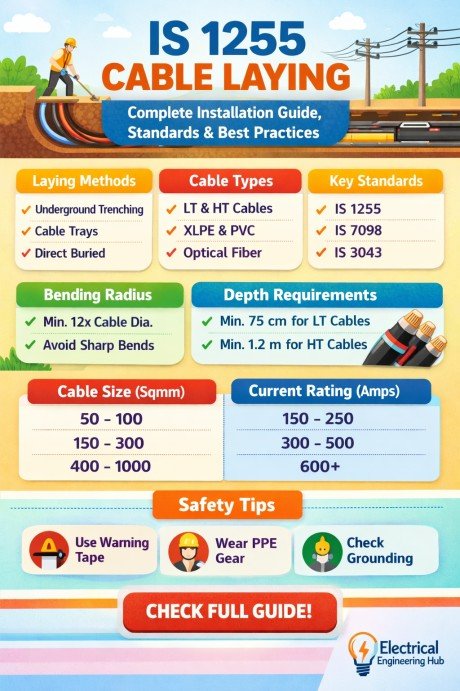
Table of Contents
What is IS 1255 Cable Laying?
IS 1255 Cable Laying refers to the Indian Standard titled “Code of Practice for Installation and Maintenance of Power Cables Up to and Including 33 kV Rating.” It establishes procedures for installing underground power cables safely and efficiently.
Key Takeaways
Check Key Takeaways
- IS 1255 provides installation and maintenance guidelines for power cables up to 33 kV.
- Proper route selection improves cable reliability and service life.
- Correct trench dimensions and cable handling practices are critical.
- Following standard recommendations reduces cable failures and downtime.
- Compliance enhances electrical safety and maintenance efficiency.
The standard provides guidance for:
- Underground cable installation
- Cable trench construction
- Cable pulling methods
- Cable jointing and termination
- Cable protection measures
- Cable testing and commissioning
- Maintenance of power cable systems
The objective is to minimize mechanical damage, electrical faults, and premature insulation deterioration during the cable lifecycle.
Learn more about earthing cable size as per iec
Importance of IS 1255 Cable Laying
Proper cable installation is often more important than cable selection itself. Even high-quality cables can fail if installed incorrectly.
Benefits of following IS 1255 Cable Laying include:
- Improved cable lifespan
- Reduced maintenance costs
- Enhanced electrical safety
- Better system reliability
- Compliance with industry standards
- Lower risk of insulation damage
- Easier fault location and maintenance
For engineers working on underground power distribution networks, adherence to this standard significantly improves long-term system performance.
For Accurate and Easy Cable Capacity, use our online tool Cable Trench Fill Calculator
Scope of the Standard
The standard applies to power cables with voltages up to 33 kV and covers various installation environments.
| Installation Area | Coverage Under IS 1255 |
|---|---|
| Underground trenches | Yes |
| Duct installations | Yes |
| Industrial facilities | Yes |
| Utility distribution systems | Yes |
| Building services | Yes |
| Cable tunnels | Yes |
| Indoor cable routing | Yes |
The standard addresses both new installations and maintenance activities.
Discover everything about cable bending radius iec standard
Route Selection Requirements
One of the most important aspects of IS 1255 Cable Laying is selecting a suitable cable route.
The cable route should:
- Avoid waterlogged areas
- Stay clear of future excavation zones
- Minimize road crossings
- Avoid chemical contamination
- Allow easy maintenance access
- Reduce mechanical damage risks
Proper route planning prevents future operational issues and reduces repair expenses.
For a deeper understanding of related requirements, engineers should also review the comprehensive guide on underground cable installation standards, which complements the recommendations provided in this standard.
Cable Trench Requirements
Cable trenches must be designed to protect cables from external damage and environmental effects.
The trench dimensions depend on:
- Cable size
- Number of cables
- Voltage level
- Future expansion requirements
A typical trench should provide adequate spacing between cables for heat dissipation and maintenance access.
Find out more about iec 61439 busbar clearance
| Parameter | Recommended Practice |
|---|---|
| Trench depth | As per voltage and site conditions |
| Bottom surface | Smooth and level |
| Bedding material | Fine sand or sifted soil |
| Backfilling | Free from stones and debris |
| Warning protection | Protective tiles or covers |
Proper trench preparation helps prevent insulation damage during installation.
Cable Handling and Transportation
Improper handling is a major cause of cable damage before commissioning.
According to IS 1255 Cable Laying recommendations:
- Use cable drums in an upright position.
- Roll drums only in the indicated direction.
- Avoid dropping cable drums.
- Use suitable lifting equipment.
- Protect cable ends from moisture ingress.
Careful transportation and storage maintain insulation integrity and conductor quality.
Explore details on iec standard for underground cable laying
Cable Pulling Practices
Cable pulling must be performed carefully to avoid mechanical stress.
Important guidelines include:
- Maintain permissible pulling tension.
- Use cable rollers at regular intervals.
- Avoid sharp bends.
- Apply approved cable lubricants where necessary.
- Monitor cable movement continuously.
Excessive pulling force can damage conductors, insulation, and cable sheaths.
Minimum Bending Radius
The bending radius depends on cable type and construction.
| Cable Type | Typical Minimum Bending Radius |
|---|---|
| Single-core cable | As specified by manufacturer |
| Multi-core cable | As specified by manufacturer |
| Armoured cable | Greater bending radius required |
| XLPE cable | Follow manufacturer recommendations |
Always verify project specifications and manufacturer instructions before installation.
Explore details on iec standard for underground cable laying
Cable Spacing Requirements
Adequate spacing prevents overheating and simplifies maintenance activities.
The spacing should consider:
- Current carrying capacity
- Heat dissipation
- Future cable additions
- Accessibility for repairs
Insufficient spacing can increase operating temperature and reduce cable life expectancy.
Cable Jointing and Termination
Cable joints and terminations are often the weakest points in a cable system. Therefore, IS 1255 Cable Laying places significant emphasis on proper workmanship.
Best practices include:
- Use approved jointing kits.
- Ensure clean working conditions.
- Prevent moisture contamination.
- Follow manufacturer instructions.
- Test joints before energization.
Qualified personnel should always perform cable jointing operations.
Get complete information about iec standard for busbar sizing
Cable Protection Methods
Underground cables require protection against accidental damage.
Common protection measures include:
- Brick covers
- RCC slabs
- Cable tiles
- HDPE ducts
- Protective pipes
The protection method depends on site conditions and the likelihood of excavation activities.
| Protection Method | Application |
|---|---|
| Brick protection | Residential areas |
| RCC covers | Heavy traffic zones |
| HDPE ducts | Road crossings |
| Steel pipes | High-risk locations |
| Cable markers | Route identification |
Know more about Phase to Phase Clearance as per IEC 61439
Testing Before Commissioning
Testing is mandatory before a cable system is energized.
Recommended tests include:
- Insulation resistance test
- Continuity test
- Sheath integrity test
- Phase identification
- High-voltage test where applicable
Testing confirms installation quality and identifies defects before operation. Use this tool if you are trying to calculate cable size for underground cables. Try here Underground Cable Size Calculator – Find Correct Wire Size for Long Distance Runs
Maintenance Guidelines
Regular maintenance extends cable service life and improves reliability.
Maintenance activities include:
- Route inspection
- Cable marker verification
- Joint inspection
- Thermal scanning
- Insulation testing
Periodic inspections help identify problems before they develop into major failures.
Find all about Phase to Phase Clearance in 132 kV
Common Installation Mistakes to Avoid
Many cable failures occur due to poor installation practices.
Avoid the following:
- Excessive cable pulling force
- Inadequate trench depth
- Improper cable bending
- Poor joint workmanship
- Lack of cable protection
- Incorrect backfilling material
- Missing cable route markers
Eliminating these mistakes significantly improves long-term system performance.
Conclusion
IS 1255 Cable Laying serves as a comprehensive guide for installing and maintaining power cables up to 33 kV. The standard covers every critical aspect of underground cable systems, including route selection, trench construction, cable handling, jointing, testing, and maintenance.
Know more about IEC Standard for MV Cable Testing
By implementing the recommendations outlined in IS 1255 Cable Laying, engineers can improve safety, reduce failure rates, and maximize cable service life. Whether working on utility networks, industrial projects, or commercial installations, following these best practices ensures a reliable and efficient electrical distribution system.
Frequently Asked Questions
1. What is IS 1255 Cable Laying?
IS 1255 Cable Laying is the Indian Standard that provides guidelines for the installation and maintenance of power cables up to and including 33 kV voltage rating.
2. Why is IS 1255 Cable Laying important?
It helps ensure safe installation practices, improves cable reliability, reduces failures, and extends the operational life of power cable systems.
3. Does IS 1255 apply to underground cables?
Yes. The standard primarily focuses on underground cable installation, including trenching, protection, jointing, testing, and maintenance procedures.
4. What tests are recommended before cable commissioning?
Common tests include insulation resistance testing, continuity testing, sheath integrity checks, phase identification, and high-voltage testing where required.
5. How can cable life be increased according to IS 1255?
Cable life can be improved through proper route selection, correct trench preparation, careful cable handling, quality jointing, adequate protection, and periodic maintenance inspections.
Get new guides in your feed. Follow Electrical Insights on LinkedIn for new electrical standards guides, calculators and design tips from Azad Circuit Hub.
#IS1255CableLaying,#CableLaying,#IS1255,#ElectricalInstallation,#PowerCables,#CableInstallation,#ElectricalEngineering,#UndergroundCables,#CableStandards,#ElectricalSafety
