IEC60364 Bonding
Electrical safety in low-voltage installations depends heavily on proper bonding practices, especially in residential, commercial, and industrial environments. The concept of safety equipotential connection ensures that all exposed conductive parts remain at the same electrical potential, reducing the risk of electric shock and equipment damage. In this context, iec60364 bonding plays a central role in maintaining system integrity and compliance with international safety standards.
At its core, iec60364 bonding focuses on connecting metallic parts, protective conductors, and structural elements so that dangerous potential differences are eliminated. This is especially important in fault conditions where leakage currents or insulation failures may occur. Proper implementation also improves system reliability and reduces electromagnetic interference in sensitive installations.
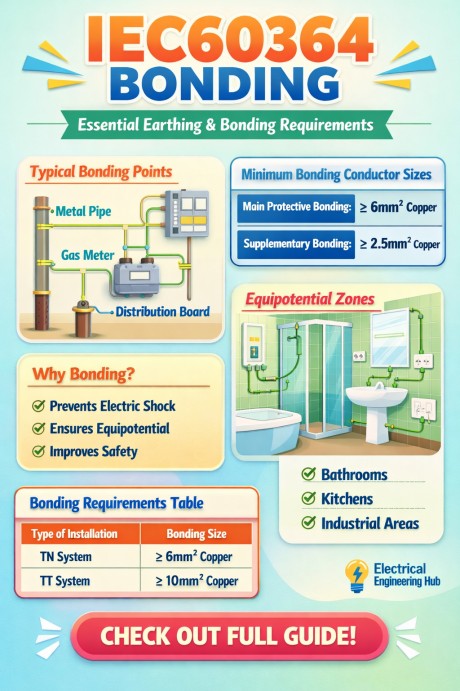
Table of Contents
Table of Contents
Engineers and electricians working with low-voltage systems rely on these principles to ensure safe operation of installations in accordance with global best practices. A poor bonding design can lead to hazardous touch voltages, equipment malfunction, and non-compliance during inspections.
Learn more about earthing cable size as per iec
What is Bonding in Electrical Installations under IEC Standards
iec60364 bonding refers to the systematic interconnection of all exposed and extraneous conductive parts within an electrical installation to achieve equipotential conditions.
This includes metallic pipes, structural steel, cable trays, and electrical enclosures. The purpose is to ensure that in the event of a fault, no dangerous voltage difference exists between simultaneously accessible conductive parts.
In practical terms, bonding is divided into two key categories:
- Main equipotential bonding
- Supplementary equipotential bonding
These systems work together to stabilize voltage levels across the installation and support the protective earthing system.
Table 1: Overview of Bonding Types
| Type of Bonding | Purpose | Typical Application |
|---|---|---|
| Main bonding | Connects incoming metallic services | Water pipes, gas pipes |
| Supplementary bonding | Localized protection | Bathrooms, industrial machinery |
The correct application of iec60364 bonding ensures that fault currents are safely directed to the earth, reducing the risk of electric shock. Discover everything about cable bending radius iec standard
Importance of Equipotential Bonding in Electrical Safety
The primary objective of equipotential bonding is safety. Without it, voltage differences between conductive parts can become hazardous during insulation failure.
In large installations, differences in resistance and stray currents can create unexpected voltage gradients. Proper bonding eliminates these risks by maintaining a uniform electrical potential across all connected metalwork. Explore details on IEC 60364 Voltage Drop
Key Benefits
- Reduces electric shock hazards
- Improves fault current clearing time
- Enhances reliability of protective devices
- Minimizes electromagnetic interference
- Supports compliance with inspection standards
Find out more about iec 61439 busbar clearance
The importance of iec60364 bonding becomes even more evident in environments such as hospitals, factories, and data centers where continuous operation and safety are critical.
Types of Bonding Systems and Their Applications
Electrical installations use different bonding systems depending on the complexity and risk level of the environment. The principles of iec60364 bonding remain consistent, but implementation varies.
Table 2: Bonding System Classification
| System Type | Description | Usage Area |
|---|---|---|
| TN System | Neutral directly earthed | Residential buildings |
| TT System | Separate earth electrode | Rural installations |
| IT System | Isolated or impedance earthed | Hospitals, labs |
Each system requires careful consideration of conductor sizing, earth resistance, and connection points to ensure safety and performance.
In industrial setups, supplementary bonding is often added to further reduce touch voltage risks, especially near conductive flooring and machinery. Explore details on iec standard for underground cable laying
Requirements for Bonding Conductors and Installation Practices
The effectiveness of any bonding system depends on proper conductor selection and installation techniques. In iec60364 bonding, conductor sizing is determined based on fault current levels and installation conditions.
Copper is the most commonly used material due to its high conductivity and mechanical strength. Aluminum may be used in specific applications but requires careful termination to prevent oxidation issues. Find all about IEC 60364 Part 5-54
Essential Installation Guidelines
- Ensure low resistance connections at all joints
- Use corrosion-resistant clamps and terminals
- Maintain continuity across all metallic structures
- Avoid sharp bends in bonding conductors
- Regularly test continuity and resistance levels
A well-designed bonding network also complements protective devices such as circuit breakers and residual current devices (RCDs), ensuring faster disconnection during faults.
Find all about Standard Depth of Underground Cables
Internal Reference to Earthing Practices
Understanding grounding principles is essential when implementing iec60364 bonding in real-world installations. Bonding and earthing work together to create a safe fault current path and stabilize system voltage under abnormal conditions.
For a deeper understanding of grounding systems and protective design principles, you can refer to the detailed guide on iec 60364 earthing, which explains electrode design, resistance limits, and system coordination in electrical networks.
The relationship between bonding and earthing ensures that all exposed conductive parts are safely connected to the earth reference point, minimizing risk during fault conditions.
Common Mistakes and Best Practices in Bonding Systems
Even experienced installers can make errors that compromise system safety. Understanding these mistakes helps improve installation quality and long-term reliability.
Dive deeper into instrument earthing iec standard
Common Mistakes
- Incomplete bonding of metallic services
- Loose or corroded connections
- Undersized bonding conductors
- Ignoring supplementary bonding in wet areas
- Poor labeling and documentation
Best Practices
- Perform regular continuity testing
- Use certified components and clamps
- Follow standardized color coding
- Maintain clear installation records
- Ensure compliance with inspection requirements
In modern electrical design, iec60364 bonding is not just a regulatory requirement but a critical safety measure that directly impacts system performance.
Know more about Phase to Phase Clearance as per IEC 61439
Key Takeaways
- Equipotential bonding ensures uniform voltage across all conductive parts
- Proper bonding reduces shock risk and improves system stability
- Selection of conductor size and material is critical
- Bonding works closely with earthing systems for full protection
- Regular inspection and testing are essential for long-term safety
Frequently Asked Questions
1. What is the main purpose of iec60364 bonding in electrical systems?
The main purpose is to eliminate dangerous potential differences between conductive parts, ensuring safety during fault conditions. Know more about 7 Common Mistakes in Electrical Outlet Height
2. How does bonding differ from earthing?
Bonding connects metallic parts together, while earthing connects them to the ground. Both systems work together for protection.
3. Where is supplementary bonding required?
It is commonly required in high-risk areas such as bathrooms, industrial floors, and medical environments where contact with conductive parts is frequent.
4. What materials are used for bonding conductors?
Copper is the preferred material due to its conductivity and durability, though aluminum is used in some specialized applications. Know more about IEC 60364-1
5. Why is iec60364 bonding important in industrial installations?
In industrial environments, it ensures equipment safety, reduces downtime, and minimizes risk of electric shock due to complex electrical networks.
Find all about IEC 60364-6
Conclusion
Proper implementation of iec60364 bonding is essential for achieving safe and compliant electrical installations. It ensures that all exposed and extraneous conductive parts remain at the same electrical potential, significantly reducing the risk of electric shock and equipment failure. When combined with a well-designed earthing system, it forms the backbone of electrical safety in modern infrastructure. Explore all about IEC 60364 5 52
Follow Us on Social:
Subscribe our Newsletter on Electrical Insights for latest updates from Electrical Engineering Hub
#iec60364bonding,#IEC60364,#bonding,#earthing,#electricalsafety,#grounding,#IECstandards,#lowvoltage,#installation,#powerengineering
