
Standard Trench Sizes for Instrument Cables
Proper planning of trench dimensions is one of the most important steps in reliable signal transmission systems. Instrument cables are sensitive to electrical noise, moisture, and mechanical stress, so their installation requires precise civil design. In industrial plants, refineries, and power stations, engineers often rely on defined trenching practices to ensure safety and long-term performance.
Understanding Standard Trench Sizes for Instrument Cables helps engineers maintain proper separation, protection, and accessibility during maintenance. These sizes are not arbitrary; they are based on industry practices, cable type, soil conditions, and installation environment. In many projects, following Standard Trench Sizes for Instrument Cables ensures reduced interference, better shielding performance, and improved operational safety.
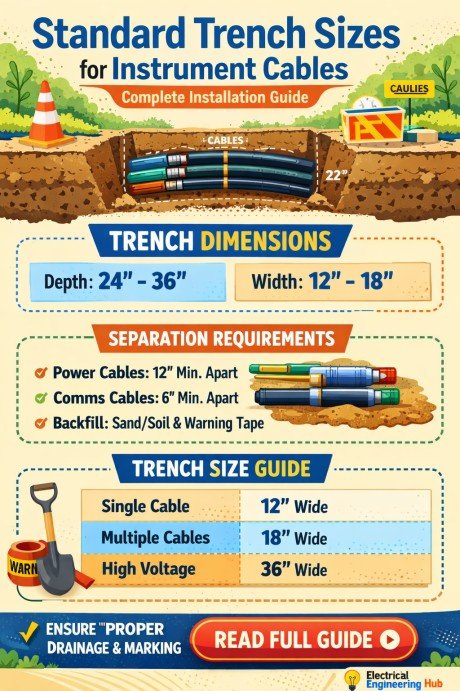
Table of Contents
Table of Contents
This guide explains trench design, recommended dimensions, compliance practices, and field installation tips used in modern electrical infrastructure projects.
Use this tool if you are trying to calculate cable size for underground cables. Try here Underground Cable Size Calculator – Find Correct Wire Size for Long Distance Runs
Design Considerations for Instrument Cable Trenches
Before defining trench geometry, engineers must evaluate several technical and environmental factors. These include soil resistivity, water table level, mechanical load above ground, and proximity to other utilities. Instrument cables often run alongside power cables, so electromagnetic interference control becomes a key concern.
When planning Standard Trench Sizes for Instrument Cables, designers also consider future expansion needs. Extra space inside the trench allows additional cables without re-excavation. Cable separation is also critical to prevent signal distortion in sensitive control systems.
A well-designed trench typically includes sand bedding, protective covers, warning tape, and proper drainage. These layers not only protect cables but also stabilize temperature and moisture levels around the installation.
For a deeper understanding of layout principles, you can explore professional guidelines on underground cable laying, which explain routing, protection, and installation methods in detail.
Designing electrical system? Use this clearance and creepage calculator for accurate distances
Recommended Standard Trench Sizes
In practical engineering, trench dimensions vary slightly depending on project standards such as IEC, IEEE, and company specifications. However, general benchmarks are widely accepted in the industry.
Below is a typical reference table used in many industrial installations:
| Installation Type | Trench Depth (mm) | Trench Width (mm) | Application Notes |
|---|---|---|---|
| Single instrument cable run | 450 – 600 | 300 – 400 | Light-duty control circuits |
| Multiple instrument cables | 600 – 750 | 400 – 600 | Process plants and control rooms |
| Shared trench with power cables | 750 – 1000 | 600 – 900 | Requires separation barriers |
| Duct bank installation | 800 – 1200 | 700 – 1200 | Heavy industrial zones |
These values represent commonly accepted Standard Trench Sizes for Instrument Cables in industrial environments. However, adjustments are often made based on soil conditions and mechanical load requirements.
In chemical plants or refineries, deeper trenches are preferred to reduce accidental damage and thermal influence from nearby equipment.
For Accurate and Easy Cable Capacity, use our online tool Cable Trench Fill Calculator
Depth and Width Guidelines
Proper depth selection plays a major role in protecting instrument cables from surface activities such as excavation, traffic loads, and construction work. In most cases, Standard Trench Sizes for Instrument Cables require a minimum cover depth of 450 mm for light installations and up to 1000 mm for high-risk areas.
Width selection depends on the number of cables and required spacing between them. Adequate spacing reduces electromagnetic interference and allows easier heat dissipation. For instance, shielded instrument cables may require additional separation from power lines within the same trench. Find all about IEC 60634 Cable Design
A typical cross-section includes:
- 100 mm sand bedding at the bottom
- Cable placement with spacing blocks
- Protective tiles or bricks above cables
- Warning tape placed 300 mm below ground level
- Proper backfilling with compacted soil layers
These layered protections ensure long-term reliability of Standard Trench Sizes for Instrument Cables in demanding industrial conditions.
Installation Practices and Safety
Correct installation practices are essential to maintain system integrity. During trenching, sharp objects and uneven surfaces must be avoided to prevent cable jacket damage. Engineers also ensure that bending radius limits are strictly followed during placement.
Moisture control is another important factor. Water accumulation inside trenches can degrade insulation resistance over time. Therefore, drainage provisions or gravel layers are often included in the design.
Know more about Why Power Cables Insulation Rated for High Voltage
In large industrial projects, coordination with other utilities is mandatory. This avoids conflicts with pipelines, drainage systems, and electrical conduits. Proper planning of Standard Trench Sizes for Instrument Cables ensures safe integration with other underground services.
Cable identification markers and route markers are installed at regular intervals to simplify future maintenance and troubleshooting.
Key Takeaways
- Standard trench dimensions ensure safe and reliable instrument cable performance
- Depth and width vary depending on environmental and load conditions
- Proper layering with sand, tiles, and warning tape improves protection
- Electromagnetic interference control depends on spacing and trench design
- Compliance with industry practices improves long-term system reliability
Understanding Standard Trench Sizes for Instrument Cables is essential for reducing maintenance costs and avoiding system failures in critical operations.
Common Standards and Compliance
International standards such as IEC 60364, IEEE guidelines, and local electrical codes provide reference values for trench design and installation safety. These standards ensure uniformity across projects and reduce risks associated with improper installation.
We recommend this tool for anyone struggling with the sizing of subpanels. Try here Wire Size Calculator for Subpanels and Feeders – NEC Guidelines Included
Compliance also involves documentation of trench routes, depth verification, and inspection during backfilling stages. In many projects, quality control teams verify each stage of installation to ensure adherence to Standard Trench Sizes for Instrument Cables.
Following these standards also improves coordination during future expansions or upgrades, especially in complex industrial environments where multiple systems coexist.
FAQs
1. What are Standard Trench Sizes for Instrument Cables used for?
They define safe excavation dimensions for installing instrument cables while ensuring protection from mechanical damage, moisture, and interference.
2. Why is trench depth important in instrument cable installation?
Proper depth in Standard Trench Sizes for Instrument Cables protects cables from surface load, accidental digging, and environmental exposure. Explore our professional online tool for quick calculations kw to cable size calculator
3. Can instrument cables and power cables be installed in the same trench?
Yes, but they require separation barriers and correct spacing as per Standard Trench Sizes for Instrument Cables guidelines.
4. What materials are used inside instrument cable trenches?
Typical materials include sand bedding, protective tiles, warning tape, and compacted backfill to ensure stability and protection.
5. Are Standard Trench Sizes for Instrument Cables the same worldwide?
Not exactly. They vary slightly depending on IEC, IEEE, and local electrical codes, but general engineering principles remain consistent.
Follow Us on Social:
Subscribe our Newsletter on Electrical Insights for latest updates from Electrical Engineering Hub
#StandardTrenchSizes,#InstrumentCableTrenching,#CableInstallation,#ElectricalEngineering,#UndergroundCables,#TrenchDesign,#IECStandards,#EngineeringGuidelines,#SiteInstallation,#PowerSystems
