Fluke 107 AC/DC Digital Multimeter Review: Features, Accuracy & Buying Guide
The Fluke 107 is a compact digital multimeter designed for electricians, technicians, maintenance work, and everyday electrical troubleshooting. Its small size makes it different from larger Fluke meters such as the 87V, but that can be an advantage when you need a meter that fits easily into a tool bag.
I have worked as an electrical engineer for more than 15 years, including panel work, industrial automation, PLCs, troubleshooting, and electrical testing. In field work, I often find that the meter you actually carry is more useful than a larger instrument left in the workshop. This Fluke107 AC/DC Digital Multimeter review looks at its practical features, limitations, and the type of electrical work it suits.
Fluke 107 Features at a Glance
| Feature | Fluke 107 Specification |
|---|---|
| Display | Digital LCD |
| DC Voltage | Up to 600 V |
| AC Voltage | Up to 600 V |
| DC Current | Up to 10 A |
| Resistance | Up to 40 MΩ |
| Capacitance | Up to 100 μF |
| Frequency | Up to 100 kHz |
| Diode Test | Yes |
| Continuity | Yes |
| Display Counts | 6000 counts |
| CAT Rating | CAT III 600 V |
| Battery | 2 × AAA |
| Form Factor | Compact handheld |
| Main Use | Electrical troubleshooting and maintenance |
The specifications make the Fluke 107 a useful general-purpose meter for low-voltage electrical testing and routine maintenance. It is not designed to replace every specialist meter, but it covers many measurements that electricians perform every day.
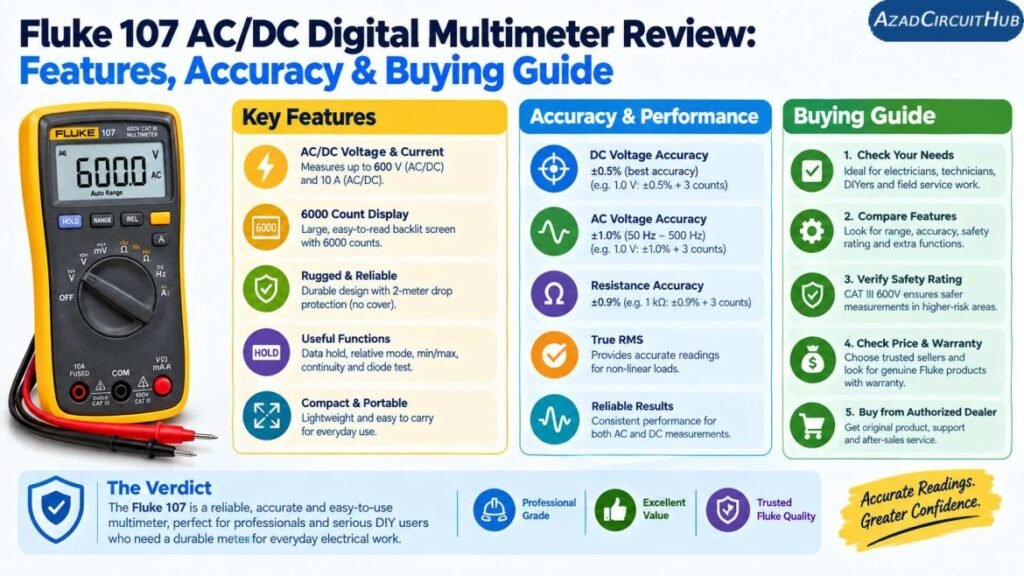
Table of Contents
Table of Contents
Build Quality and Portability
One of the strongest reasons to consider the Fluke 107 is its compact design. It is considerably easier to carry around than many full-size industrial multimeters.
The rotary selector is simple to operate, and the digital display provides a clear reading during routine measurements. For technicians who spend much of the day moving between panels, machines, control cabinets, and electrical equipment, this compact format can be convenient.
The meter also includes a built-in battery compartment and uses two AAA batteries. That is useful because replacement batteries are easy to find.
If you are comparing several meters for professional field work, my guide to the best multimeter for electricians covers additional Fluke and competing models for different testing requirements.
Voltage and Current Measurement
The Fluke 107 measures both AC and DC voltage, with voltage measurement up to 600 V. This makes it useful for checking common electrical circuits, control systems, power supplies, and equipment.
The meter also measures DC current up to 10 A. Current measurement should always be performed with the correct test lead connection and meter setting. Incorrectly connecting a current meter across a voltage source can cause a short circuit and potentially damage the instrument or circuit.
For normal troubleshooting, the Fluke 107 provides the basic voltage, current, and resistance functions expected from a professional handheld digital multimeter.
Check the current Fluke 107 price on Amazon: Buy Fluke 107 AC/DC Digital Multimeter on Amazon
Resistance, Continuity and Diode Testing
Resistance measurement is useful when checking components, wiring, coils, and circuits that are safely de-energized. The Fluke 107 measures resistance up to 40 MΩ.
Continuity testing is another feature that gets frequent use in electrical troubleshooting. A quick continuity check can help identify an open conductor, blown fuse, broken connection, or faulty switch.
The diode test function is useful when checking semiconductor components. It can help technicians assess whether a diode is conducting in the expected direction.
Before performing resistance, continuity, or diode measurements, disconnect the circuit from its power source and verify that it is de-energized.
Capacitance and Frequency Testing
The Fluke 107 also includes capacitance measurement up to 100 μF and frequency measurement up to 100 kHz.
Capacitance testing can be useful when checking certain capacitors used in electrical and electronic equipment. Frequency measurement can help when troubleshooting control signals, power supplies, generators, and other AC or electronic circuits.
These functions make the meter more versatile than a basic voltage tester. However, specialized instruments may be more suitable for applications requiring advanced waveform analysis, high-frequency measurements, or detailed power-quality information.
For electricians building a practical test kit, I recommend comparing the meter's actual functions with your normal work instead of paying for features you may rarely use.
CAT III 600 V Safety Rating
Safety is one of the most important specifications when choosing a multimeter.
The Fluke107 carries a CAT III 600 V measurement category rating. CAT ratings describe the environments and transient conditions for which test equipment is designed when used within its stated voltage limits.
CAT III equipment is intended for measurements in building installations and distribution systems, including fixed equipment and distribution panels within its rating.
However, the CAT rating does not make an unsafe measurement safe. The test leads, meter condition, measurement procedure, PPE, and electrical installation all matter.
As an electrical engineer, I treat the meter's safety category as only one part of the overall measurement process.
Is the Fluke 107 Good for Electricians?
The Fluke107 can be a practical choice for electricians who need a compact meter for general troubleshooting. Its AC/DC voltage, current, resistance, continuity, diode, capacitance, and frequency functions cover many everyday measurements.
Its compact size is particularly useful for technicians who already carry several other tools.
There are, however, situations where a larger or more specialized meter is preferable. Industrial electricians working around demanding motor systems, variable frequency drives, high-energy equipment, or advanced power measurements may need additional functions.
If your work involves frequent field measurements, compare the Fluke 107 with other options in my guide to a multimeter for electricians before deciding.
Fluke 107 vs Larger Fluke Multimeters
The Fluke 107 occupies a different position from advanced models such as the Fluke 87V.
| Requirement | Fluke 107 | Advanced Industrial Meter |
|---|---|---|
| Compact size | Excellent | Usually larger |
| Basic voltage testing | Yes | Yes |
| Resistance | Yes | Yes |
| Continuity | Yes | Yes |
| Diode testing | Yes | Yes |
| Capacitance | Yes | Yes |
| Frequency | Yes | Yes |
| Advanced troubleshooting | Limited | More extensive |
| Portability | Strong point | Depends on model |
| Heavy industrial work | Limited | Better suited |
The choice depends on the job. If you mainly troubleshoot electrical panels, control circuits, equipment, and general wiring, the 107 provides a useful set of functions without taking much space.
What I Like About the Fluke 107
Several features make the Fluke 107 attractive for practical field use:
- Compact and lightweight design
- AC and DC voltage measurement
- DC current measurement
- Resistance measurement
- Continuity testing
- Diode testing
- Capacitance measurement
- Frequency measurement
- CAT III 600 V rating
- Easy-to-carry format
- Simple control layout
Its biggest practical advantage is portability. A meter that is easy to carry can become a daily troubleshooting tool rather than something reserved for occasional testing.
Looking for alternatives? Compare my recommended multimeter for electricians options before choosing a meter for your electrical tool kit.
What Could Limit the Fluke 107?
The Fluke 107 is not intended to be an all-purpose replacement for every professional multimeter.
For example, electricians who regularly work with demanding industrial equipment may want advanced features found on higher-end meters. Depending on the application, useful features can include specialized motor-drive measurements, temperature measurement, low-pass filtering, higher current capability, advanced min/max functions, or additional electrical troubleshooting modes.
This does not make the 107 unsuitable. It simply means the meter should be selected around the actual measurement tasks you perform.
Should You Buy the Fluke 107?
The Fluke 107 makes sense for users who want a compact Fluke digital multimeter with the core functions needed for everyday electrical testing.
It is particularly appealing when portability, basic AC/DC measurements, resistance, continuity, capacitance, and frequency testing matter more than advanced industrial functions.
Amazon buying option: See Fluke 107 AC/DC Digital Multimeter on Amazon
For a broader comparison, you can also review my best multimeter for electricians guide to see where the Fluke 107 fits among other professional testing options.
Frequently Asked Questions
Is the Fluke 107 a true RMS multimeter?
The Fluke 107 is a compact general-purpose digital multimeter, but buyers should check the current manufacturer specification before purchasing if true-RMS measurement is a specific requirement. True RMS capability can be important when measuring distorted or non-sinusoidal AC waveforms.
Can the Fluke 107 measure 240V?
Yes. Its AC voltage measurement range extends to 600 V. A 240V circuit is therefore within the stated voltage range, provided the measurement is performed correctly and the installation falls within the meter's safety category.
Can the Fluke 107 measure current?
Yes. The Fluke 107 includes DC current measurement up to 10 A. Always follow the meter's lead configuration and measurement procedure when measuring current.
Is the Fluke 107 suitable for electricians?
It can be suitable for electricians who mainly need a compact meter for general electrical troubleshooting. Those working extensively with industrial drives, high-energy systems, or advanced diagnostics may need a more specialized Fluke meter.
What batteries does the Fluke 107 use?
The Fluke 107 uses two AAA batteries. This makes battery replacement relatively straightforward when the meter is used regularly in the field.
Final Verdict
The Fluke 107 is best understood as a compact professional digital multimeter for everyday electrical measurements rather than an advanced industrial troubleshooting instrument. Its combination of AC/DC voltage, DC current, resistance, continuity, capacitance, frequency, and diode testing gives it useful coverage for routine work.
From my experience working with electrical systems, portability matters more than many buyers realize. If you want a small meter that can stay in your tool bag and handle common electrical checks, the Fluke 107 deserves consideration.
Always verify the latest specifications, included accessories, and Amazon pricing before ordering, as product listings and packages can change.
Get new guides in your feed. Follow Electrical Insights on LinkedIn for new electrical standards guides, calculators and design tips from Azad Circuit Hub.
#Fluke107, #Fluke107Multimeter, #DigitalMultimeter, #MultimeterReview, #FlukeMultimeter, #ACDCMultimeter, #ElectricalTesting, #ElectricianTools, #TestEquipment, #ElectricalEngineering