
EV Charger Installation Cost UK: Commercial vs Residential
The EV charger installation cost UK homeowners and businesses face can vary widely depending on the charger, electrical supply, cable route, parking layout and site requirements. A simple home installation may cost a few hundred pounds, while a commercial charging site can require several thousand pounds or more.
For businesses, the biggest cost difference usually comes from the number and power rating of charge points. A single 7.4kW AC charger is very different from a multi-point workplace installation with load management, upgraded electrical capacity and groundworks.
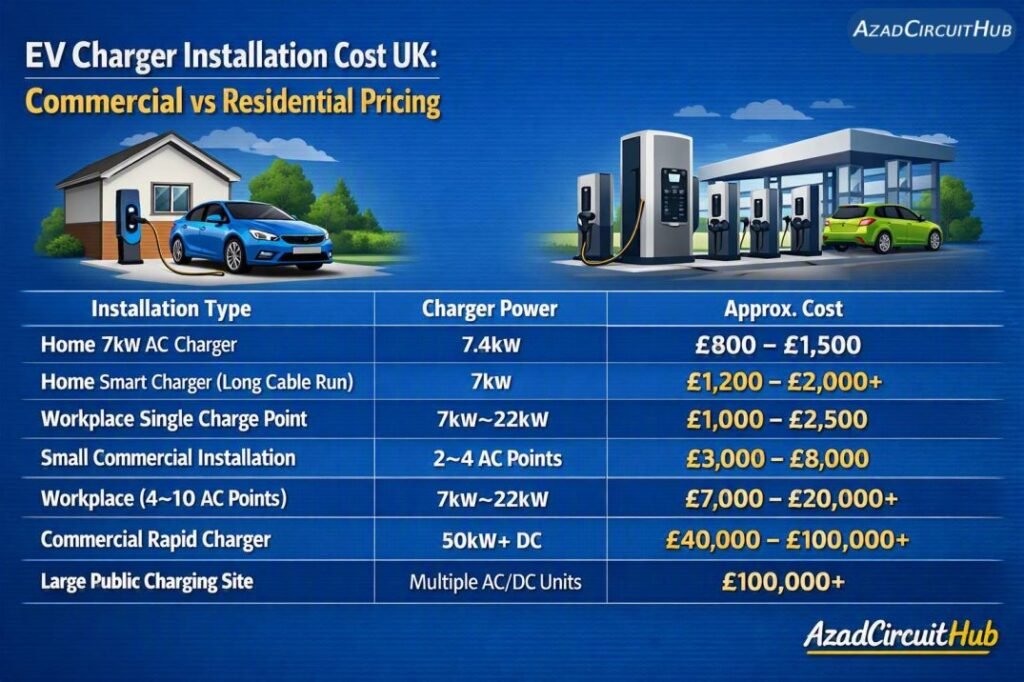
Table of Contents
Table of Contents
EV Charger Installation Cost UK at a Glance
The following figures provide useful planning ranges for typical UK installations. Actual prices vary by property, installer, equipment and electrical work required.
| Installation type | Typical charger power | Approximate installed cost |
|---|---|---|
| Home 7kW AC charger | 7.4kW | £800–£1,500 |
| Home smart charger with longer cable run | 7kW | £1,200–£2,000+ |
| Workplace single charge point | 7kW–22kW | £1,000–£2,500 |
| Small commercial installation | 2–4 AC points | £3,000–£8,000 |
| Workplace 4–10 AC points | 7kW–22kW | £7,000–£20,000+ |
| Commercial rapid charger | 50kW+ DC | £40,000–£100,000+ |
| Large public charging site | Multiple AC/DC units | £100,000+ |
These are indicative budgeting figures rather than fixed quotations. Civil works, grid upgrades and unusually long cable routes can increase the final price substantially.
Residential EV Charge Point Installation Cost
For most UK homes, a 7kW smart AC charger is the standard choice. It can provide enough overnight charging for many electric vehicles without requiring the cost and electrical capacity associated with a rapid DC charger.
A typical EV charge point installation cost for a straightforward home installation is around £800 to £1,500, including the charger and standard installation.
The price can increase when the consumer unit needs upgrading, the parking space is far from the house, or the cable needs to pass through difficult areas.
| Home installation factor | Typical effect on price |
|---|---|
| 7kW smart charger | £500–£900 equipment |
| Standard installation | £300–£600 |
| Longer cable route | £100–£500+ |
| Consumer unit/electrical upgrades | £200–£1,000+ |
| Groundworks or trenching | £500–£2,000+ |
| Additional protection equipment | £100–£400+ |
Homeowners should also check whether their chosen installer offers an installation package that includes cable, protection, commissioning and certification.
If you are comparing equipment before arranging installation, our guide to the Best Level 2 EV Charger can help you compare suitable AC charging options and features.
Commercial EV Charger Installation Cost UK
The commercial EV charger installation cost UK businesses should budget for depends heavily on the size of the charging system. A small office may only need two 7kW AC points, while a fleet depot could require several 22kW chargers or DC rapid charging.
A basic commercial installation with two AC charge points may cost roughly £3,000 to £8,000. Larger workplace projects can move into the £10,000–£20,000+ range once multiple chargers, electrical distribution, load management and civil works are included.
| Commercial project | Approximate installed cost |
|---|---|
| 1 × 7kW AC point | £1,000–£2,500 |
| 2 × 7kW AC points | £2,500–£5,000 |
| 4 × 7kW AC points | £5,000–£10,000 |
| 4 × 22kW AC points | £8,000–£15,000+ |
| 8–10 AC charge points | £12,000–£25,000+ |
| 50kW DC rapid charger | £40,000–£70,000+ |
| 100kW+ DC charger installation | £60,000–£120,000+ |
These figures can rise considerably where the local electricity network cannot support the required charging load.
Commercial EV Charger Cost and Equipment Prices
The commercial EV charger cost is only one part of the project budget. Hardware prices depend on power output, connectivity, payment facilities, warranty, software and whether the charger supports dynamic load management.
A commercial AC charger may cost approximately £1,000 to £4,000 or more before installation. Higher-powered DC equipment can cost tens of thousands of pounds.
For example, a business installing four AC chargers might spend £5,000–£12,000 on hardware and then pay additional amounts for cabling, distribution equipment, protection, installation, testing and commissioning.
Cost of Installing Commercial EV Charging Station
The cost of installing commercial EV charging station equipment should be divided into several categories when preparing a business case.
| Cost component | Typical considerations |
|---|---|
| Charge point hardware | AC or DC, power rating and features |
| Electrical distribution | Consumer unit, DB, MCCB, RCD and protection |
| Cabling | Cable size, length and installation method |
| Load management | Prevents excessive site demand |
| Civil works | Trenching, ducting, bases and reinstatement |
| Networking | SIM, Ethernet, Wi-Fi or cloud connection |
| Payment system | Relevant for public or paid charging |
| Signage and bay marking | Required for clear operation |
| Testing and commissioning | Inspection and certification |
| Grid connection | Potentially a major additional cost |
For larger sites, the electricity network connection can become one of the largest expenses.
Electric Car Charging Points for Business Cost UK
The electric car charging points for business cost UK companies face should be assessed against expected usage rather than charger price alone.
A workplace with employees charging during the day may benefit from several 7kW or 22kW AC points. A taxi operator, delivery fleet or motorway-related business may need DC charging because vehicles have much shorter dwell times.
Businesses should consider:
- Number of vehicles using the chargers
- Average daily mileage
- Available parking time
- Existing electrical capacity
- Peak site demand
- Future EV adoption
- Charging tariffs
- Software and payment fees
- Maintenance requirements
- Potential network upgrade costs
The cost of EV charging for business also includes electricity consumption and, in some cases, standing charges, demand-related charges, software subscriptions and payment processing fees.
Commercial Charging Station Cost in Northampton
A commercial charging station cost Northampton businesses encounter will depend on the site rather than simply its location within Northampton.
For example, a small Northampton workplace with existing spare electrical capacity may install several AC points for a relatively straightforward project. A site requiring a new electricity connection, long trenching runs or substantial parking-area work can cost much more.
For initial budgeting, a small four-point AC installation could fall around £5,000–£12,000, while larger installations can exceed £20,000. DC rapid charging can push project costs into the tens of thousands of pounds.
A local installer should assess the distribution board, cable route, parking arrangement and available grid capacity before providing a firm quotation.
ChargePoint Installation Cost and Other Installation Factors
The ChargePoint installation cost is not determined by the charger brand alone. Installation conditions are often more important than the equipment itself.
A short cable run from an existing suitable distribution board can keep costs relatively low. In contrast, a car park requiring underground ducting, bollards, multiple circuits and a new distribution board can add thousands of pounds.
The following factors commonly affect the final charge point installation cost:
- Cable distance between the electrical supply and parking bays
- Charger power rating
- Number of charge points
- Existing electrical capacity
- Load balancing requirements
- Groundworks and trenching
- Distribution board upgrades
- Surge and residual-current protection
- Networking and payment systems
- Electricity network connection requirements
Businesses should therefore compare complete installed quotations instead of comparing charger purchase prices alone.
EV Charger Installation Cost Scotland 2026
The ev charger installation cost scotland 2026 typically depends on the charger rating, cable route, consumer unit capacity, and whether the installation is standard or requires electrical upgrades. For a typical home, a professionally installed 7.4 kW AC charger may cost around £800–£1,500 including the charger, while longer cable runs or upgrades can increase the total.
| Installation | Typical 2026 Cost | Typical Rating | Key Requirement |
|---|---|---|---|
| Standard home installation | £800–£1,500 | 7.4 kW | Dedicated circuit |
| Longer cable run | £1,000–£1,800 | 7.4 kW | Additional cable/trenching |
| 11 kW home installation | £1,000–£1,900 | 11 kW | Suitable three-phase supply |
| 22 kW installation | £1,200–£2,500+ | 22 kW | Three-phase supply |
Installation should follow BS 7671 and applicable EV charging requirements under BS 7671 Section 722, including appropriate protection and earthing arrangements. If you’re comparing the EV Charger Installation Cost UK, Scotland can have similar equipment and labour costs, but property type, electrical supply and installation complexity are major price factors.
How to Reduce EV Charger Installation Costs
Good site planning can significantly reduce unnecessary installation expenditure.
First, locate chargers as close as practical to an existing suitable electrical distribution point. Keeping cable routes short reduces both material and labour costs.
Second, consider dynamic load management. It can allow several chargers to share available electrical capacity instead of immediately requiring a larger supply upgrade.
Third, install sufficient charging capacity for current demand while allowing the electrical infrastructure to support future expansion.
For readers comparing installation prices and equipment requirements, our detailed guide to level 2 charger installation cost explains the major factors that influence AC charging installation prices.
Commercial vs Residential EV Charger Costs
Residential and commercial installations can use similar AC charging technology, but their project requirements are often very different.
| Factor | Residential | Commercial |
|---|---|---|
| Typical charger | 7kW AC | 7–22kW AC or DC |
| Number of chargers | Usually 1 | Often 2–20+ |
| Charging management | Basic smart charging | Dynamic load management |
| Payment system | Usually unnecessary | May be required |
| Groundworks | Sometimes | Common on larger sites |
| Grid upgrade | Less common | More likely |
| Maintenance | Limited | Planned maintenance often required |
| Overall project cost | Hundreds to low thousands | Thousands to £100,000+ |
A residential installation is normally designed around one vehicle and overnight charging. Commercial charging infrastructure must consider multiple users, utilisation, electrical demand, access, billing and future expansion.
Is EV Charger Installation Worth the Cost for a Business?
The financial case depends on how often employees, customers or fleet vehicles use the chargers. Businesses with regular EV traffic may gain value from workplace charging, customer retention, fleet electrification and potential charging revenue.
However, the business case should include the full project cost rather than just the charger price. Electricity, maintenance, software, payment processing and possible network charges can all affect operating costs.
Before proceeding, businesses should obtain a site survey and a detailed quotation covering equipment, electrical work, civil works, commissioning and ongoing costs.
Frequently Asked Questions
How much does an EV charger cost to install in the UK?
A typical residential 7kW installation may cost around £800–£1,500, while a commercial installation can range from a few thousand pounds to well over £20,000. Larger DC charging sites can cost tens or hundreds of thousands of pounds.
How much does a commercial EV charging station cost?
A small commercial AC charging station may cost approximately £3,000–£8,000 installed. Larger multi-point systems can exceed £20,000, while DC rapid charging projects may cost £40,000 or considerably more.
How much does it cost to install an EV charge point at home?
A standard 7kW smart home charger generally costs around £800–£1,500 installed. Longer cable runs, electrical upgrades, trenching and other site complications can increase the price.
How much do EV charging points for business cost in the UK?
A business may spend several thousand pounds for a small AC installation and £10,000–£25,000+ for a larger workplace system. The exact price depends on charger numbers, power rating, electrical capacity and groundworks.
Does the electricity connection increase commercial EV charging costs?
Yes. If the existing electrical supply cannot support the proposed charging load, a network or supply upgrade may be necessary. This can add substantial cost and may also increase the project timescale.
Note on Non-UK Installation Costs
Some searches for charge point pricing also return US-specific queries such as “LADWP TOU meter installation cost.” LADWP is Los Angeles Department of Water and Power, so its meter and tariff costs are not applicable to UK EV charger installations. UK projects should instead be assessed using the relevant electricity supplier, Distribution Network Operator and UK installation requirements.
The most accurate way to determine the EV charger installation cost UK businesses or homeowners will actually pay is to obtain a site survey and itemised quotation. Comparing the charger, electrical works, civil works, grid requirements and ongoing operating costs together gives a much clearer picture than comparing hardware prices alone.
Get new guides in your feed. Follow Electrical Insights on LinkedIn for new electrical standards guides, calculators and design tips from Azad Circuit Hub.
#EVChargerInstallation, #EVChargerCostUK, #ElectricVehicle, #EVCharging, #HomeEVCharger, #CommercialEVCharging, #EVChargingStation, #ElectricCarUK, #EVInfrastructure, #EVChargerGuide



It is really a nice and helpful piece of info. I¦m happy that you shared this helpful info with us. Please stay us informed like this. Thank you for sharing.