
Demand Factor for Receptacles: NEC Rules, Calculation, Examples, and Tables
The demand factor for receptacles is an important part of electrical load calculations, especially in commercial and non-dwelling installations. Receptacle outlets are rarely used at their full rated capacity at the same time, so electrical codes allow a calculated demand factor in certain situations.
Under the NEC, receptacle loads are generally calculated from the number of receptacle outlets and their volt-ampere (VA) rating. For many non-dwelling installations, NEC 220.44 permits a demand calculation that uses 100% of the first 10 kVA and 50% of the remaining receptacle load.
| Item | NEC reference | Common calculation |
|---|---|---|
| Receptacle load | NEC 220.14(I) | 180 VA per strap |
| Non-dwelling receptacle demand | NEC 220.44 | 100% first 10 kVA |
| Load above 10 kVA | NEC 220.44 | 50% |
| Dwelling receptacles | NEC 220.52(A) | 1,500 VA per required circuit/portion |
| General branch-circuit sizing | NEC 210.21 | Based on circuit rating and outlet requirements |
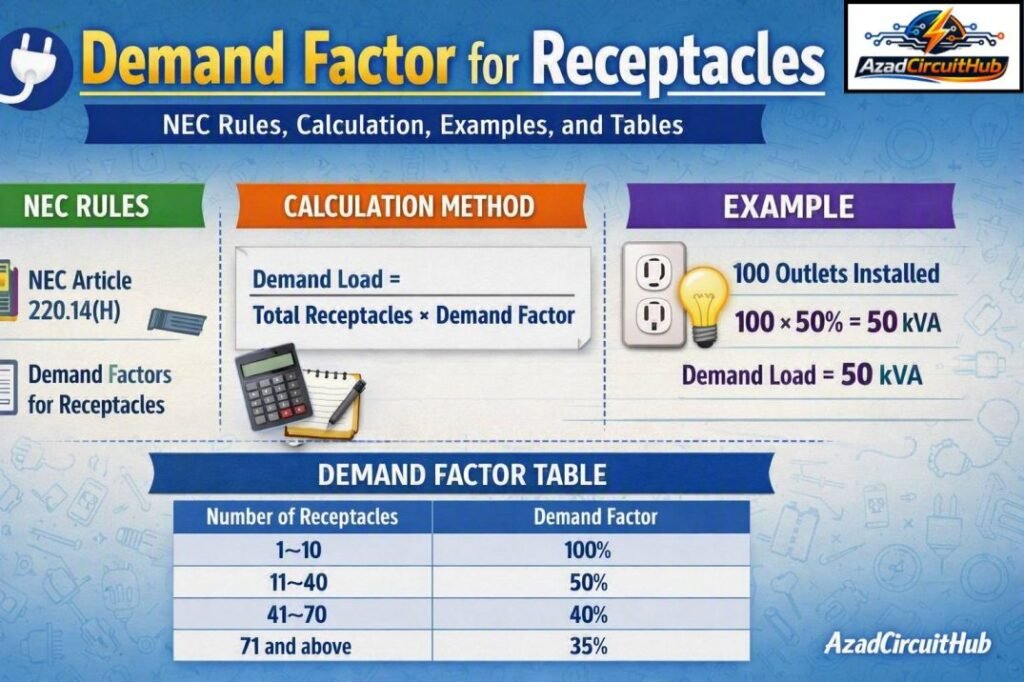
Table of Contents
Table of Contents
What Is the Demand Factor for Receptacles?
The demand factor for receptacles represents the portion of the connected receptacle load that is expected to be used at one time. It helps prevent an electrical system from being unnecessarily oversized when the full connected load is unlikely to occur simultaneously.
For example, a commercial office may contain dozens of convenience outlets for computers, chargers, printers, and small appliances. Although the receptacles have a significant connected load when calculated individually, it is unlikely that every outlet will operate at maximum capacity simultaneously.
This is where NEC demand provisions become useful. However, the demand allowance is not a general permission to reduce every receptacle load. The applicable occupancy, equipment, and NEC section must be considered before applying a reduction.
NEC Receptacle Load Calculation
For many non-dwelling installations, NEC 220.14(I) provides the basic receptacle load calculation. The load is generally based on 180 VA per receptacle outlet or strap, subject to the specific wording and application of the Code.
A simple formula is:
Receptacle connected load = Number of receptacle straps × 180 VA
For example, if a commercial space has 40 receptacle straps:
40 × 180 VA = 7,200 VA
Because the calculated load is below 10 kVA, the NEC 220.44 demand calculation does not reduce this amount.
| Receptacle straps | VA per strap | Connected load |
|---|---|---|
| 10 | 180 VA | 1,800 VA |
| 20 | 180 VA | 3,600 VA |
| 40 | 180 VA | 7,200 VA |
| 50 | 180 VA | 9,000 VA |
| 60 | 180 VA | 10,800 VA |
| 100 | 180 VA | 18,000 VA |
Always verify how the outlet is configured. A multi-receptacle device does not automatically mean that every individual contact point should be counted as a separate 180 VA strap.
NEC Table for Receptacle Demand
The key rule for many commercial receptacle load calculations is found in NEC 220.44. The demand calculation is commonly summarized as follows:
| Calculated receptacle load | Demand factor |
|---|---|
| First 10 kVA | 100% |
| Remainder above 10 kVA | 50% |
This means the first 10,000 VA remains fully included in the calculated load. Only the portion above 10 kVA receives the 50% demand allowance.
For example, consider a calculated receptacle load of 18 kVA:
- First 10 kVA × 100% = 10 kVA
- Remaining 8 kVA × 50% = 4 kVA
- Calculated demand = 14 kVA
Therefore, the calculated demand is 14 kVA rather than the full 18 kVA connected receptacle load.
Demand Factor for Receptacles Example
Consider a small commercial office with 80 receptacle straps.
First calculate the connected load:
80 × 180 VA = 14,400 VA
Convert this to kVA:
14,400 VA ÷ 1,000 = 14.4 kVA
Apply the NEC 220.44 calculation:
| Calculation step | Load | Demand | Result |
|---|---|---|---|
| First portion | 10.0 kVA | 100% | 10.0 kVA |
| Remaining portion | 4.4 kVA | 50% | 2.2 kVA |
| Total | 14.4 kVA | — | 12.2 kVA |
The resulting calculated receptacle demand is 12.2 kVA.
This approach can have a meaningful effect on feeder and service load calculations in larger commercial spaces.
When Can You Apply the Receptacle Demand Factor?
The NEC provision is primarily associated with non-dwelling receptacle loads. It should not be treated as a universal reduction for every outlet in an electrical installation.
The designer should first identify whether the receptacles are:
- General-purpose convenience outlets
- Dedicated equipment outlets
- Kitchen or food-service receptacles
- Motor-related equipment
- Heating or cooling equipment
- Special-purpose outlets
- Dwelling-unit receptacles
Dedicated loads may need to be calculated under other NEC requirements. Equipment with a known nameplate rating should generally be evaluated using the applicable equipment load rules rather than simply applying a general receptacle allowance.
This distinction is especially important in offices, retail buildings, workshops, restaurants, schools, and industrial facilities.
Dwelling Receptacles and Commercial Receptacles
One common source of confusion is applying the commercial receptacle demand calculation to dwelling units.
NEC 220.52(A) provides specific provisions for dwelling-unit receptacle loads. The dwelling calculation uses an allowance of 1,500 VA for each required two-wire circuit covered by that section or each portion of such a circuit, depending on the installation.
| Installation | Primary NEC reference | General approach |
|---|---|---|
| Dwelling-unit receptacles | 220.52(A) | Specific dwelling-unit calculation |
| Non-dwelling receptacles | 220.44 | 100% first 10 kVA, 50% remainder |
| Individual receptacle load | 220.14(I) | 180 VA per strap, where applicable |
| Branch-circuit requirements | Article 210 | Circuit and outlet rules |
Because dwelling units have their own load-calculation provisions, the designer should not automatically transfer the commercial calculation method to a residential project.
If you regularly work with electrical load calculations, a dedicated demand factor and diversity factor guide can make repetitive calculations much faster and help compare connected and calculated loads.
Demand Factor vs. Diversity Factor
The terms demand factor and diversity factor are related, but they are not interchangeable.
Demand factor is generally the ratio of maximum demand to connected load:
Demand Factor = Maximum Demand ÷ Connected Load
Diversity factor is generally expressed as:
Diversity Factor = Sum of Individual Maximum Demands ÷ Maximum Demand of the Entire System
A demand factor is normally equal to or less than 1.0. A diversity factor can be greater than 1.0.
| Factor | Basic formula | Typical purpose |
|---|---|---|
| Demand factor | Maximum demand ÷ connected load | Reduces connected load to expected maximum demand |
| Diversity factor | Sum of individual maximum demands ÷ system maximum demand | Accounts for non-simultaneous peak loads |
| Load factor | Average load ÷ maximum demand | Measures how consistently a system is loaded |
Understanding these differences is useful when moving from branch-circuit calculations to feeder, service, and distribution-system design.
Related NEC Standards and References
The receptacle calculation should be reviewed alongside other NEC requirements rather than treated as a standalone rule.
Important references include:
- NEC 210.21 — Requirements for receptacles, cord-and-plug-connected equipment, and branch-circuit ratings.
- NEC 210.23 — Permissible loads for branch circuits.
- NEC 220.14(I) — Load calculation provisions for receptacle outlets.
- NEC 220.44 — Demand factors for receptacle loads in non-dwelling occupancies.
- NEC 220.52(A) — Dwelling-unit small-appliance and laundry receptacle load provisions.
- NEC Article 100 — Definitions relevant to load calculations and electrical terminology.
The exact NEC edition adopted by the local authority having jurisdiction should always be checked. Local amendments may also change how a requirement is enforced.
Common Mistakes in Receptacle Load Calculations
Several mistakes appear frequently during electrical load calculations.
Applying 50% to the entire load
The 50% allowance applies to the portion above the first 10 kVA under NEC 220.44. It does not mean that the entire receptacle load is automatically reduced to 50%.
Using the rule for dwelling units
Residential receptacle calculations have separate NEC provisions. Always identify the occupancy before selecting the calculation method.
Ignoring dedicated equipment
A receptacle serving a dedicated appliance or piece of equipment may require a different load calculation based on the equipment rating and applicable NEC requirements.
Confusing outlets with straps
The terminology used in NEC load calculations matters. Do not assume that every individual opening on a receptacle device is automatically an independent 180 VA load.
Choosing the breaker from the calculated load alone
A calculated load does not replace branch-circuit requirements. Conductor ampacity, overcurrent protection, receptacle ratings, continuous loads, equipment ratings, and other NEC rules must also be evaluated.
For larger projects, using a demand factor and diversity factor guide can help organize the calculation before final feeder or service sizing.
Quick Calculation Reference
The following table provides a quick reference for common non-dwelling receptacle calculations.
| Connected receptacle load | First 10 kVA | Excess load | Calculated demand |
|---|---|---|---|
| 5 kVA | 5 kVA × 100% | — | 5 kVA |
| 10 kVA | 10 kVA × 100% | — | 10 kVA |
| 12 kVA | 10 kVA × 100% | 2 kVA × 50% | 11 kVA |
| 15 kVA | 10 kVA × 100% | 5 kVA × 50% | 12.5 kVA |
| 20 kVA | 10 kVA × 100% | 10 kVA × 50% | 15 kVA |
| 30 kVA | 10 kVA × 100% | 20 kVA × 50% | 20 kVA |
These values are useful for preliminary calculations, but the actual installation must be evaluated against the complete NEC requirements applicable to the project.
Frequently Asked Questions
What is the NEC demand factor for receptacles?
For qualifying non-dwelling receptacle loads, NEC 220.44 commonly uses 100% of the first 10 kVA and 50% of the remaining load. The rule must be applied to the receptacle load calculated under the applicable NEC provisions.
How many VA should be used per receptacle?
NEC 220.14(I) generally establishes 180 VA per receptacle outlet or strap for the applicable load calculation. The exact application should be checked against the wording of the adopted NEC edition.
Does the 50% receptacle demand factor apply to homes?
Not as a general rule. Dwelling-unit receptacles are covered by specific provisions, including NEC 220.52(A). Residential load calculations should therefore use the dwelling-unit rules that apply to the installation.
What is the difference between demand and diversity factors?
A demand factor compares maximum demand with connected load. A diversity factor compares the combined individual maximum demands with the maximum demand of the entire system. Both concepts address load usage, but they are used differently in electrical design.
Can I use the receptacle demand factor for dedicated equipment?
Not automatically. Dedicated equipment may have its own load calculation requirements based on its nameplate rating, type of equipment, continuous operation, and applicable NEC provisions. The general receptacle allowance should not be used simply to reduce a known equipment load.
Final Takeaway
The demand factor for receptacles can significantly reduce the calculated load for qualifying non-dwelling installations, particularly when a building contains a large number of general-purpose receptacles. The key NEC 220.44 calculation uses 100% of the first 10 kVA and 50% of the remainder.
Start with the correct receptacle load under NEC 220.14(I), identify the occupancy, separate dedicated equipment where required, and then apply the appropriate demand provisions. This produces a more accurate basis for feeder and service calculations without arbitrarily reducing the electrical load.
Always verify the adopted NEC edition, local amendments, equipment requirements, and AHJ interpretation before using the calculation for final design or installation.
Get new guides in your feed. Follow Electrical Insights on LinkedIn for new electrical standards guides, calculators and design tips from Azad Circuit Hub.
#DemandFactorForReceptacles, #ElectricalLoadCalculation, #NEC, #NEC210, #ReceptacleLoad, #DemandFactor, #ElectricalEngineering, #ElectricalDesign, #NECCode, #LoadCalculation
